Afar
Afar, also known as ’Afar af, Qafar af, or عَفَر أَف, is an Afroasiatic language belonging to the Cushitic branch, primarily spoken by the Afar people, native to parts of Djibouti, Eritrea and Ethiopia. It is an official language in Ethiopia; and a national language in Djibouti and Eritrea. Afar is officially written in the Latin script and has over 2.6 million speakers.
Translate in Afar ↗The Afar language is spoken as a mother tongue by the Afar people in Djibouti, Eritrea, and the Afar Region of Ethiopia. According to Ethnologue, there are 2,600,000 total Afar speakers. Of these, 1,280,000 were recorded in the 2007 Ethiopian census, with 906,000 monolinguals registered in the 1994 census. In Djibouti, Afar is a recognized national language. It is also one of the broadcasting languages of the Radio Television of Djibouti public network. In Eritrea, Afar is recognized as one of nine national languages which formally enjoy equal status although Tigrinya and Arabic are by far of greatest significance in official usage. There are daily broadcasts on the national radio and a translated version of the Eritrean constitution. In education, however, Afar speakers prefer Arabic – which many of them speak as a second language – as the language of instruction. In the Afar Region of Ethiopia, Afar is also recognized as an official working language. Since 2020, Afar is one of the five official working languages of Ethiopia.
Sub-Saharan Africa
Present-day use
In Djibouti, Afar is a recognized national language. It is also one of the broadcasting languages of the Radio Television of Djibouti public network. In Eritrea, Afar is recognized as one of nine national languages which formally enjoy equal status although Tigrinya and Arabic are by far of greatest significance in official usage. There are daily broadcasts on the national radio and a translated version of the Eritrean constitution. In education, however, Afar speakers prefer Arabic – which many of them speak as a second language – as the language of instruction. In the Afar Region of Ethiopia, Afar is also recognized as an official working language. Since 2020, Afar is one of the five official working languages of Ethiopia.
Origins
The captured article does not contain a separate origins section. See the historical account and linked source.
Development
The captured article does not contain a distinct historical account. No chronology has been invented.
Writing
In Ethiopia, Afar used to be written with the Ge'ez script (Ethiopic script). Since around 1849, the Latin script has been used in other areas to transcribe the language. Additionally, Afar is also transcribed using the Arabic script. In the early 1970s, two Afar intellectuals and nationalists, Dimis and Redo, formalized the Afar alphabet. Known as Qafar Feera, the orthography is based on the Latin script. Officials from the Institut des Langues de Djibouti, the Eritrean Ministry of Education, and the Ethiopian Afar Language Studies and Enrichment Center have since worked with Afar linguists, authors and community representatives to select a standard orthography for Afar from among the various existing writing systems used to transcribe the language.
Beyond the typeface.
Signs, manuscripts, published pages and contextual photographs, with their place, period, source and reuse terms. Captions identify historical spellings, regional examples, community references and character imagery.
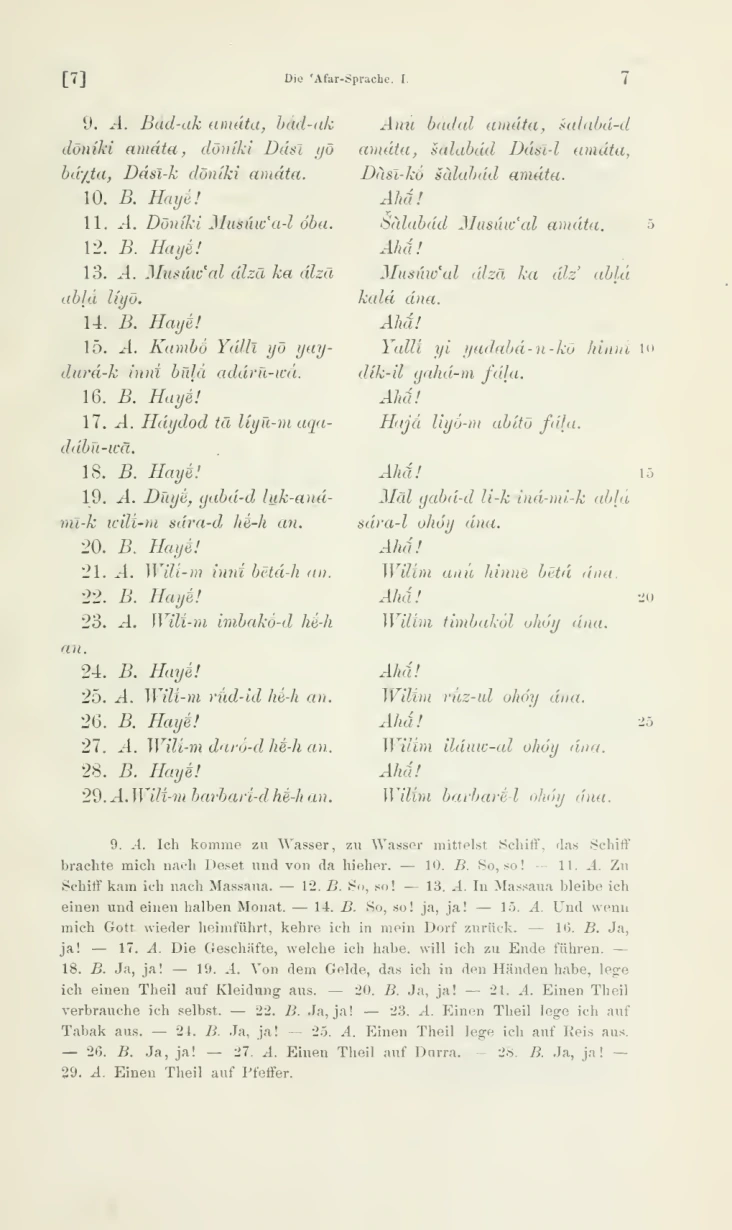
Afar dialogue in the left column of Reinisch’s 1885 Die Afar-Sprache, printed page 7. The right column is Saho, and the footnotes are German. The introduction identifies Bilal-Nugus as the source of the Afar dictation and Abdallah Dasamoyta as its Saho translator. Historical scholarly transcription, not modern standard spelling.
Saved in Babelbook · resized display copy. Select the image to open it independently of its source.
Leo Reinisch (1832–1919); Afar narrator Bilal-Nugus; Saho translation by Abdallah Dasamoyta · Source ↗Public domain ↗View the local visual field note
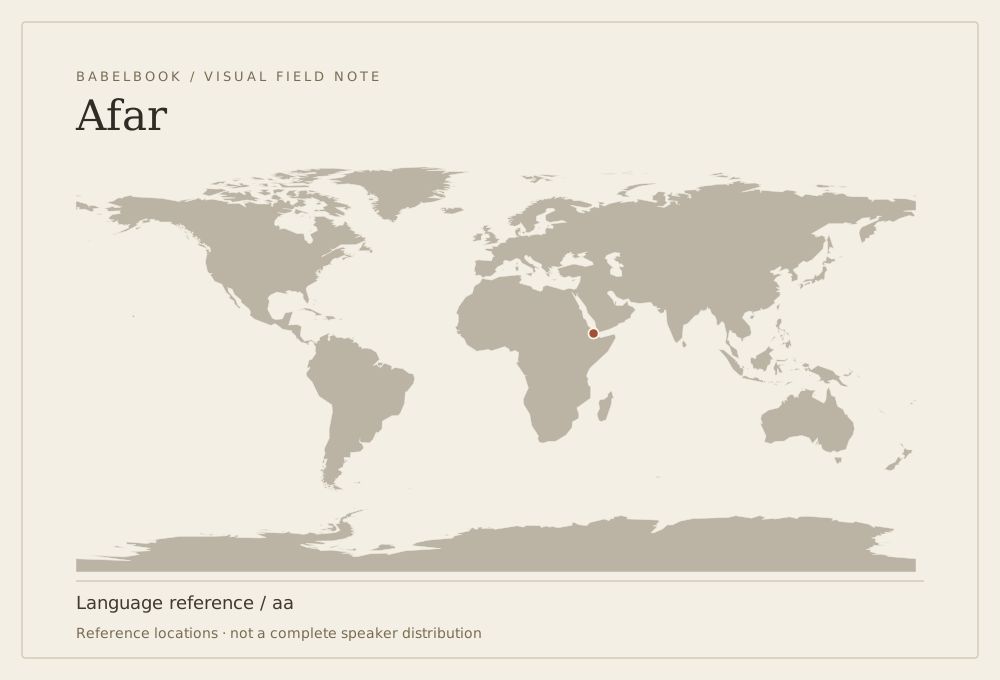
Representative reference points from Glottolog. Historical entries show reference locations, not current speakers. 1 point.
Reference & context ↗Babelbook · original editorial illustration · CC BY 4.0 · Glottolog locations; public-domain Natural Earth land
Source excerpts, selected, shortened and where noted editorially corrected from Afar language by Wikipedia contributors. Retrieved 2026-10-05. CC BY-SA 4.0. These excerpts are not an independently verified scholarly history; missing accounts are identified above.
Read further in the source
Geographic distribution
The Afar language is spoken as a mother tongue by the Afar people in Djibouti, Eritrea, and the Afar Region of Ethiopia.
According to Ethnologue, there are 2,600,000 total Afar speakers. Of these, 1,280,000 were recorded in the 2007 Ethiopian census, with 906,000 monolinguals registered in the 1994 census.
Official status
In Djibouti, Afar is a recognized national language. It is also one of the broadcasting languages of the Radio Television of Djibouti public network. In Eritrea, Afar is recognized as one of nine national languages which formally enjoy equal status although Tigrinya and Arabic are by far of greatest significance in official usage. There are daily broadcasts on the national radio and a translated version of the Eritrean constitution. In education, however, Afar speakers prefer Arabic – which many of them speak as a second language – as the language of instruction. In the Afar Region of Ethiopia, Afar is also recognized as an official working language. Since 2020, Afar is one of the five official working languages of Ethiopia.
Writing system
In Ethiopia, Afar used to be written with the Ge'ez script (Ethiopic script). Since around 1849, the Latin script has been used in other areas to transcribe the language. Additionally, Afar is also transcribed using the Arabic script. In the early 1970s, two Afar intellectuals and nationalists, Dimis and Redo, formalized the Afar alphabet. Known as Qafar Feera, the orthography is based on the Latin script. Officials from the Institut des Langues de Djibouti, the Eritrean Ministry of Education, and the Ethiopian Afar Language Studies and Enrichment Center have since worked with Afar linguists, authors and community representatives to select a standard orthography for Afar from among the various existing writing systems used to transcribe the language.