Abkhazian
Abkhaz, also known as Abkhazian, is a Northwest Caucasian language most closely related to Abaza. It is spoken mostly by the Abkhaz people. It is one of the official languages of Abkhazia, where around 190,000 people speak it. Furthermore, it is spoken by thousands of members of the Abkhazian diaspora in Turkey, Georgia's autonomous republic of Adjara, Syria, Jordan, and several Western countries. 27 October is the day of the Abkhazian language in Georgia.
Translate in Abkhazian ↗There is not an agreed number of speakers of Abkhaz, and there are widely different numbers. It is agreed that today most of the Abkhaz people do not live in Abkhazia. In the census conducted by the Republic of Abkhazia in 2011, Abkhazians comprised 50.8% of the population, around 122,175 people; of these 92,838 spoke it natively. Only two of the original dialects are still spoken in Abkhazia. The Bzyp dialect is still spoken in its homeland northwest of Sukhumi, stretching from the Bzyp River to the western environs of Sukhumi and the Psyrtskha valley, whereas the Abzhywa dialect is spoken south-east of Sukhumi. The rest of the Abkhaz speaking population inhabits other neighbouring areas. The exact number of Abkhazians and Abkhaz speakers in Turkey is not clear. The Turkish census denotes 13,951, but the figures are dubious, since the numbers of Abkhazians that came from the beginning of the 19th century to the middle of the 20th have been documented at around 30 thousand. Ethnologue gives 150,000 Abkhazians living in Turkey, of these 50,000 still speak the language. The head of the Abkhaz federation says there are in between 500 and 700 thousand Abkhazians in Turkey. In general, Abkhaz seems to have been lost by most of the descendants, and bilingualism being low except in some specific areas, although there seems to be an effort for the new generation to learn the language with public schools being able to teach Abkhaz and together with 7,836 second language speakers.
Europe
Present-day use
Both Georgian and Abkhaz law enshrines an official status of the Abkhaz language in Abkhazia. The 1992 law of Georgia, reiterated in the 1995 constitution, grants Abkhaz the status of second official language in the territory of Abkhazia — along with Georgian. In November 2007, the de facto authorities of Abkhazia adopted a new law "on the state language of the Republic of Abkhazia" that mandates Abkhaz as the language of official communication. According to the law, all meetings held by the president, parliament, and government must be conducted in Abkhaz (instead of Russian, which is currently a de facto administrative language) from 2010, and all state officials will be obliged to use Abkhaz as their language of everyday business from 2015. Some, however, have considered the implementation of this law unrealistic and concerns have been made that it will drive people away from Abkhazia and hurt the independent press due to a significant share of non-Abkhaz speakers among ethnic minorities as well as Abkhaz themselves, and a shortage of teachers of Abkhaz. The law is an attempt to amend a situation where up to a third of the ethnic Abkhaz population are no longer capable of speaking their ethnic language, and even more are unable to read or write it; instead, Russian is the language most commonly used in public life at present.
Origins
The retained history excerpts concern written records; they do not establish when spoken Abkhaz originated. See Historical development for the chronology of writing.
Development
The earliest indisputable extant written records of the Abkhaz language are in the Arabic script, recorded by the Turkish traveller Evliya Çelebi in the 17th century. Abkhaz has been used as a literary language for only about 100 years. It was suggested that certain inscriptions on Ancient Greek pottery which had been considered nonsense are in fact written in Abkhaz-Adydge languages. The methodology of the research was criticised and the results called improbable. In 1918, Tbilisi State University became the first institution of higher education to teach Abkhazian language. The founders of the university began to take care of the development and scientific study of the Abkhazian language. At the meeting of the Council of Professors held at Tbilisi State University in 1918, Ivane Javakhishvili noted the scientific importance of studying Caucasian languages. In 1918, by the decision of the Council of Professors, Petre Charaia was invited to teach the Abkhazian language, and from 1925, this mission was continued by Dimitri Gulia and Simon Janashia.
Writing
Abkhaz has used the Cyrillic script since 1862. The first alphabet was a 37-character Cyrillic alphabet invented by Baron Peter von Uslar. In 1909 a 55-letter Cyrillic alphabet was used. A 75-letter Latin script devised by a Russian/Georgian linguist Nikolai Marr lasted for 2 years 1926–1928 (during the Latinization campaign). The Georgian script was adopted and used between 1938 and 1954, after that the initial Cyrillic alphabet, designed in 1892 by Dmitry Gulia together with Konstantin Machavariani and modified in 1909 by Aleksey Chochua, was restored to use. Cyrillic script: Latin script: [darbanzaːlakʼ awaɥɨ tʂəʊpʼ jɨχɨ dakʷʰitʰnɨ ǁ awaː zəgʲ zinləɪ pʼatʼwɨləɪ əɪqʼarəʊpʼ ǁ wərtʰ jɨrɨməʊpʼ aχʂɨɥiː alamɨsiː ǀ dara daragʲ ajəʃəɪ ajəʃəɪ rəɪpʰʂ əɪzɨqʼazarəʊpʼ ǁ]
Beyond the typeface.
Signs, manuscripts, published pages and contextual photographs, with their place, period, source and reuse terms. Captions identify historical spellings, regional examples, community references and character imagery.
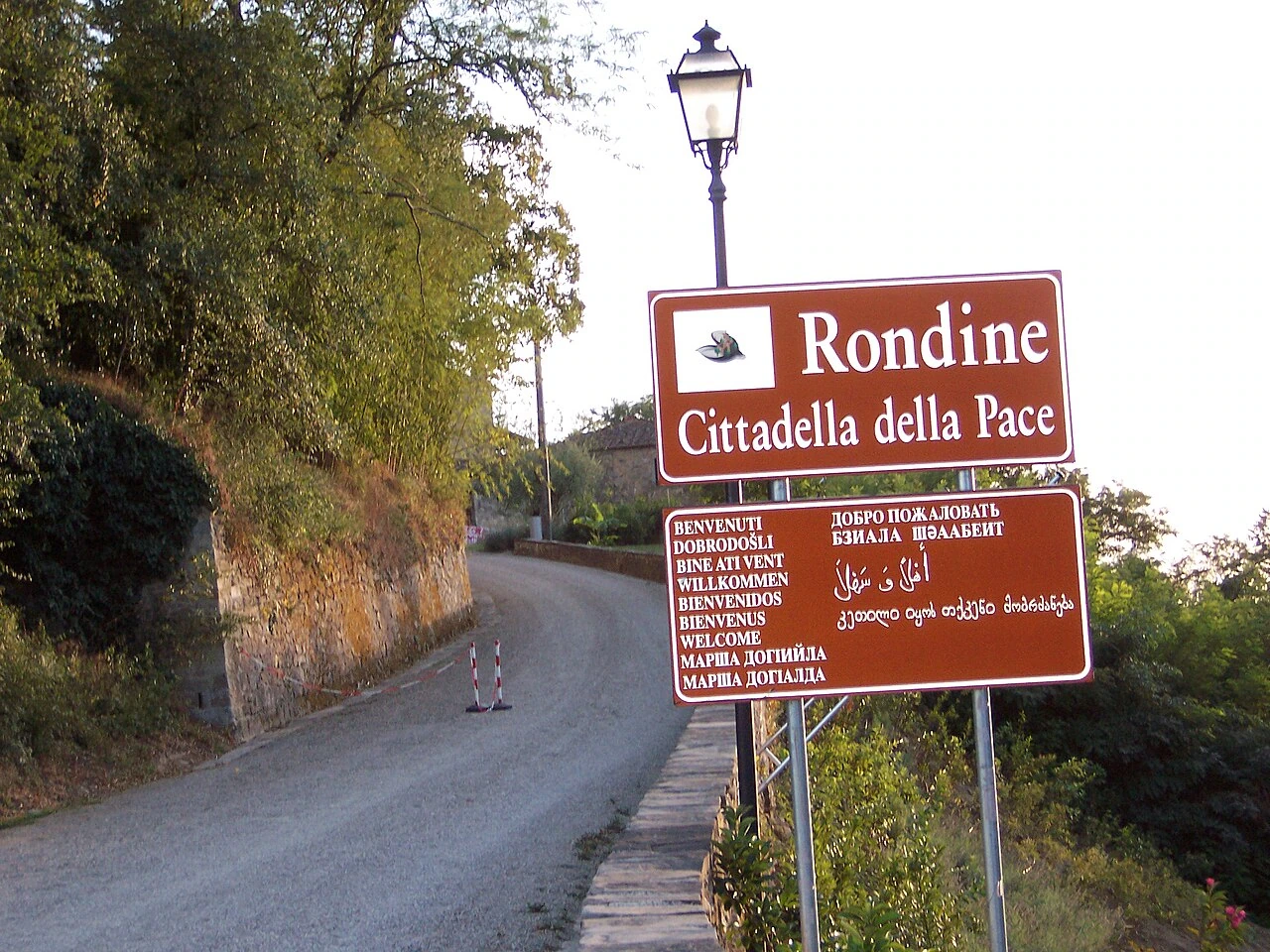
Multilingual welcome sign at Rondine, Arezzo. Commons explicitly identifies and transcribes the Abkhaz greeting visible in this photograph. The description separately notes that Ossetian was added after this photograph, so this image does not support an Ossetian assignment.
Saved in Babelbook · resized display copy. Select the image to open it independently of its source.
Pil56 · Source ↗CC BY-SA 3.0 ↗View the local visual field note
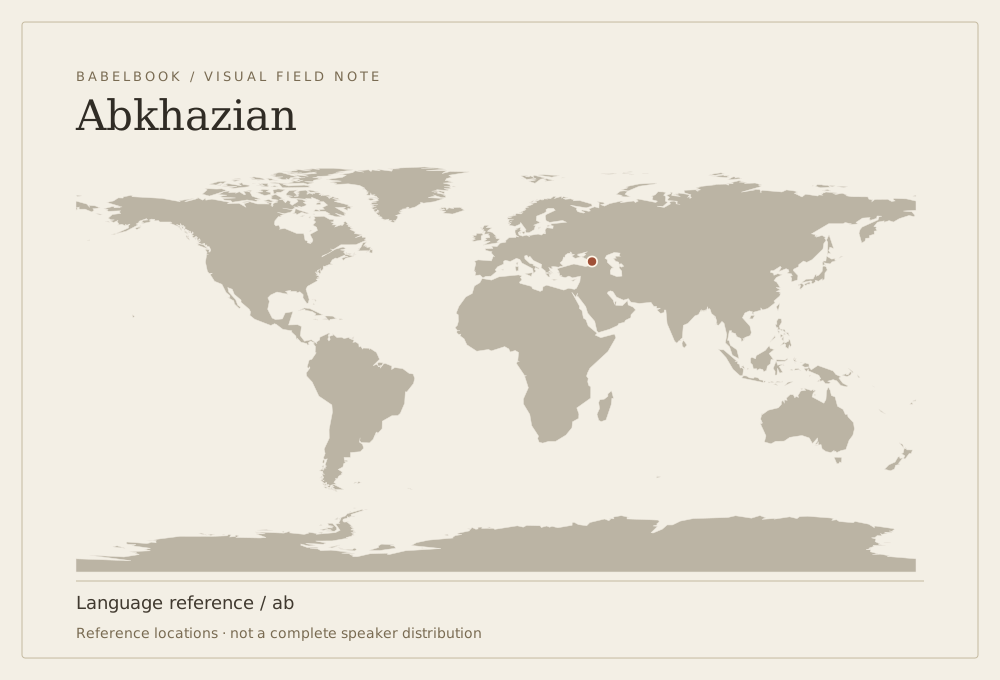
Representative reference points from Glottolog. Historical entries show reference locations, not current speakers. 1 point.
Reference & context ↗Babelbook · original editorial illustration · CC BY 4.0 · Glottolog locations; public-domain Natural Earth land
Source excerpts, selected, shortened and where noted editorially corrected from Abkhaz language by Wikipedia contributors. Retrieved 2026-10-05. CC BY-SA 4.0. These excerpts are not an independently verified scholarly history; missing accounts are identified above.
Read further in the source
Geographical distribution
There is not an agreed number of speakers of Abkhaz, and there are widely different numbers. It is agreed that today most of the Abkhaz people do not live in Abkhazia. In the census conducted by the Republic of Abkhazia in 2011, Abkhazians comprised 50.8% of the population, around 122,175 people; of these 92,838 spoke it natively. Only two of the original dialects are still spoken in Abkhazia. The Bzyp dialect is still spoken in its homeland northwest of Sukhumi, stretching from the Bzyp River to the western environs of Sukhumi and the Psyrtskha valley, whereas the Abzhywa dialect is spoken south-east of Sukhumi. The rest of the Abkhaz speaking population inhabits other neighbouring areas. The exact number of Abkhazians and Abkhaz speakers in Turkey is not clear. The Turkish census denotes 13,951, but the figures are dubious, since the numbers of Abkhazians that came from the beginning of the 19th century to the middle of the 20th have been documented at around 30 thousand. Ethnologue gives 150,000 Abkhazians living in Turkey, of these 50,000 still speak the language. The head of the Abkhaz federation says there are in between 500 and 700 thousand Abkhazians in Turkey. In general, Abkhaz seems to have been lost by most of the descendants, and bilingualism being low except in some specific areas, although there seems to be an effort for the new generation to learn the language with public schools being able to teach Abkhaz and together with 7,836 second language speakers. Abkhazian villages are concentrated around the cities of Adapazarı, Düzce, Sinop, Hendek and Samsun in the northern part, and in the west around cities such as Bilecik, Inegöl and Eskişehir; they are mainly found in the provinces of Sakarya and Bolu in the western part, and near the Çoruh river in the north-east. Historically the dialects of Sadz, Ahchypsy and Tsabal were located in Abkhazia; Sadz being spoken from the Bzyp river to the Matsesta River, and further to the north-west bordering the Sochypsta River. Today they are exclusively spoken in the northwestern part of Turkey, specially in the Sakarya province, it being spoken in 14 villages. The other major place where Abkhaz is spoken is in Karachay-Cherkessia, where the Northern dialects are spoken, although there they are considered as a separate language and form the literary Abaza language. They are spoken by 37,831 people in Russia, mostly in the south of Stavropol Krai in the area around Kislovodsk, and in the upper Kuma river area. Abkhaz is also spoken as a minority language around the world. There is a considerable number of Abkhaz speakers in Adjara in southern Georgia, with the diaspora concentrating itself around the capital Batumi, with about 982 people considering Abkhaz their first language. In the Russian census of 2010, 6,786 speakers of Abkhaz were reported in Russia. In Ukraine there are around 1,458 according to the 2001 census, but of these only 317 speak Abkhazian. There were also communities in Syria, Jordan and Iraq with around 5,000 Abkhazians, although this number could reach 10,000 according to the Abkhazia's Foreign Ministry. The biggest western diaspora is in Germany, with around 5,000 speakers, but other communities are found in countries such as the United States, United Kingdom, Austria, France, Belgium and so on.
History
The earliest indisputable extant written records of the Abkhaz language are in the Arabic script, recorded by the Turkish traveller Evliya Çelebi in the 17th century. Abkhaz has been used as a literary language for only about 100 years. It was suggested that certain inscriptions on Ancient Greek pottery which had been considered nonsense are in fact written in Abkhaz-Adydge languages. The methodology of the research was criticised and the results called improbable. In 1918, Tbilisi State University became the first institution of higher education to teach Abkhazian language. The founders of the university began to take care of the development and scientific study of the Abkhazian language. At the meeting of the Council of Professors held at Tbilisi State University in 1918, Ivane Javakhishvili noted the scientific importance of studying Caucasian languages. In 1918, by the decision of the Council of Professors, Petre Charaia was invited to teach the Abkhazian language, and from 1925, this mission was continued by Dimitri Gulia and Simon Janashia.
Status
Both Georgian and Abkhaz law enshrines an official status of the Abkhaz language in Abkhazia. The 1992 law of Georgia, reiterated in the 1995 constitution, grants Abkhaz the status of second official language in the territory of Abkhazia — along with Georgian. In November 2007, the de facto authorities of Abkhazia adopted a new law "on the state language of the Republic of Abkhazia" that mandates Abkhaz as the language of official communication. According to the law, all meetings held by the president, parliament, and government must be conducted in Abkhaz (instead of Russian, which is currently a de facto administrative language) from 2010, and all state officials will be obliged to use Abkhaz as their language of everyday business from 2015. Some, however, have considered the implementation of this law unrealistic and concerns have been made that it will drive people away from Abkhazia and hurt the independent press due to a significant share of non-Abkhaz speakers among ethnic minorities as well as Abkhaz themselves, and a shortage of teachers of Abkhaz. The law is an attempt to amend a situation where up to a third of the ethnic Abkhaz population are no longer capable of speaking their ethnic language, and even more are unable to read or write it; instead, Russian is the language most commonly used in public life at present.
Writing system
Abkhaz has used the Cyrillic script since 1862. The first alphabet was a 37-character Cyrillic alphabet invented by Baron Peter von Uslar. In 1909 a 55-letter Cyrillic alphabet was used. A 75-letter Latin script devised by a Russian/Georgian linguist Nikolai Marr lasted for 2 years 1926–1928 (during the Latinization campaign). The Georgian script was adopted and used between 1938 and 1954, after that the initial Cyrillic alphabet, designed in 1892 by Dmitry Gulia together with Konstantin Machavariani and modified in 1909 by Aleksey Chochua, was restored to use. Cyrillic script:
Latin script:
Original version
Дарбанзаалак ауаҩы дшоуп ихы дақәиҭны. Ауаа зегь зинлеи патулеи еиҟароуп. Урҭ ирымоуп ахшыҩи аламыси, дара дарагь аешьеи аешьеи реиԥш еизыҟазароуп.