Avestan
Avestan ( ə-VESS-tən) is the liturgical language of Zoroastrianism. It belongs to the Iranian branch of the Indo-European language family and was originally spoken during the Avestan period (c. 1500 – c. 400 BCE) by the Iranians living in eastern Greater Iran as evidenced from names in Avestan geography. After Avestan became extinct, its religious texts were transmitted orally, then collected and put into writing during the Sasanian period (c. 400 – c. 500 CE). The extant material falls into two groups: Old Avestan (c. 1500 – c. 900 BCE) and Younger Avestan (c. 900 – c. 400 BCE). The immediate ancestor of Old Avestan was the Proto-Iranian language, a sister language to the Proto-Indo-Aryan language, with both having developed from the earlier Proto-Indo-Iranian language. As such, Old Avestan is quite close in both grammar and lexicon to Vedic Sanskrit, the oldest preserved Indo-Aryan language.
Translate in Avestan ↗There are no historical sources that connect Avestan or its native speakers with any specific region. In addition, the Old Avestan texts do not mention any place names that can be identified. On the other hand, the Younger Avestan texts contain a substantial number of geographical references that are known from later sources and therefore allow to delineate the geographical horizon that was known and important to the speakers of Younger Avestan. It is nowadays widely accepted that these place names are situated in the eastern parts of Greater Iran corresponding to the entirety of present-day Afghanistan and Tajikistan as well as parts of Turkmenistan, Uzbekistan, and Pakistan. Avestan is therefore assumed to have been spoken somewhere within this large region, although its precise location cannot be further specified. Due to this geographical uncertainty, as well as the lack of any dateable historical events within the texts themselves, linking any given archeological culture with the speakers of Avestan has remained difficult. Among possible candidates, the Yaz culture has been named as likely. This is due to the fact that it is connected with the southward spread of steppe-derived Iranic groups, the presence of farming practices consistent with the Young Avestan society and the lack of burial sites, indicating the Zoroastrian practice of open air excarnation.
Global / other
Present-day use
The captured source does not contain a separate current-use account.
Origins
The captured article does not contain a separate origins section. See the historical account and linked source.
Development
The captured article does not contain a distinct historical account. No chronology has been invented.
Writing
Avestan (catalog classification; see the source for context).
Beyond the typeface.
Signs, manuscripts, published pages and contextual photographs, with their place, period, source and reuse terms. Captions identify historical spellings, regional examples, community references and character imagery.
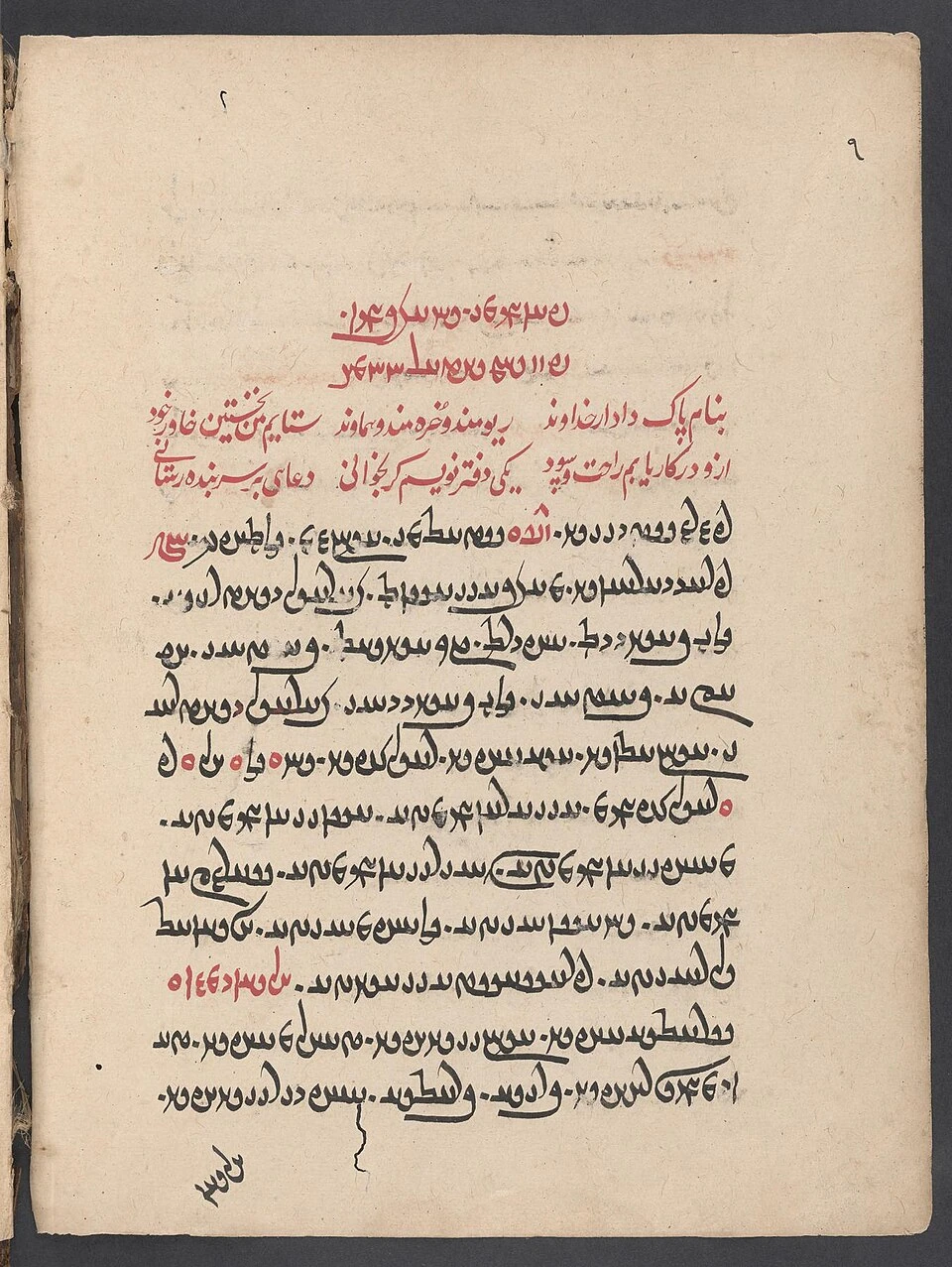
Page of the Vendidad Sade manuscript, Columbia University MS Or 320, copied in 1762. Commons metadata identifies the manuscript as Avestan. The Commons filename and description differ in folio designation, so no recto/verso claim is made.
Saved in Babelbook · resized display copy. Select the image to open it independently of its source.
Herbed Darab Framroz Minochehr; digitization Columbia University · Source ↗CC0 1.0 ↗View the local visual field note
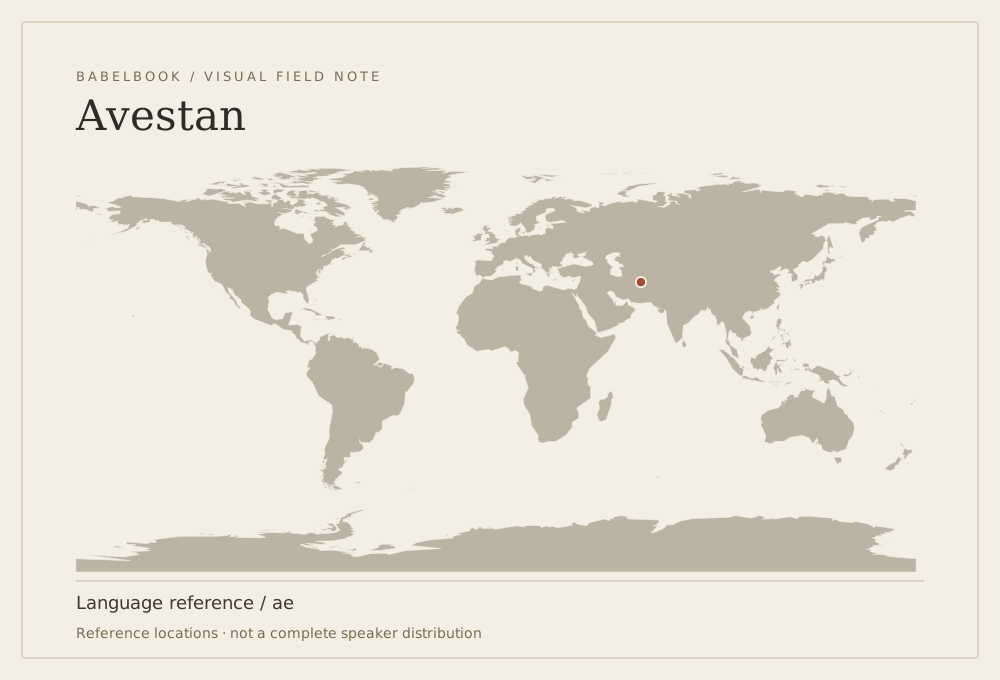
Representative reference points from Glottolog. Historical entries show reference locations, not current speakers. 1 point.
Reference & context ↗Babelbook · original editorial illustration · CC BY 4.0 · Glottolog locations; public-domain Natural Earth land
Source excerpts, selected, shortened and where noted editorially corrected from Avestan by Wikipedia contributors. Retrieved 2026-10-05. CC BY-SA 4.0. These excerpts are not an independently verified scholarly history; missing accounts are identified above.
Read further in the source
Geographical distribution
There are no historical sources that connect Avestan or its native speakers with any specific region. In addition, the Old Avestan texts do not mention any place names that can be identified. On the other hand, the Younger Avestan texts contain a substantial number of geographical references that are known from later sources and therefore allow to delineate the geographical horizon that was known and important to the speakers of Younger Avestan. It is nowadays widely accepted that these place names are situated in the eastern parts of Greater Iran corresponding to the entirety of present-day Afghanistan and Tajikistan as well as parts of Turkmenistan, Uzbekistan, and Pakistan. Avestan is therefore assumed to have been spoken somewhere within this large region, although its precise location cannot be further specified. Due to this geographical uncertainty, as well as the lack of any dateable historical events within the texts themselves, linking any given archeological culture with the speakers of Avestan has remained difficult. Among possible candidates, the Yaz culture has been named as likely. This is due to the fact that it is connected with the southward spread of steppe-derived Iranic groups, the presence of farming practices consistent with the Young Avestan society and the lack of burial sites, indicating the Zoroastrian practice of open air excarnation.