Afrikaans
Afrikaans is a West Germanic language spoken in South Africa, Namibia, and to a lesser extent Botswana, Zambia, Zimbabwe, and also Argentina, where a group in Sarmiento speaks a Patagonian dialect. It emerged during the late 19th century as a fusion of Dutch dialects (mainly Hollandic and Zeelandic) spoken by the Dutch settlers in South Africa since the 17th century and the Dutch-based creole languages spoken by the Khoisan, Nguni and Coloured peoples. Afrikaans is the third most spoken home language in South Africa, out of the country's 12 official languages. In 1996 it was spoken by 14.5% of the population, an estimated 5.9 million people. By 2022 that had fallen to 10.6% (6.3 million people), with Afrikaans gaining roughly 480,000 speakers overall. Although Afrikaans has adopted words from other languages, including German, Malay, and Khoisan languages, an estimated 90 to 95% of its vocabulary is of Dutch origin. Differences between Afrikaans and Dutch often lie in the more analytic morphology and grammar of Afrikaans, and different spellings. There is a large degree of mutual intelligibility between the two languages, especially in written form.
Translate in Afrikaans ↗Besides South-Africa, Afrikaans is also widely spoken in Namibia. Before independence, Afrikaans had equal status with German as an official language. Since independence in 1990, Afrikaans has had constitutional recognition as a national, but not official, language. There is a much smaller number of Afrikaans speakers among Zimbabwe's white minority, as most have left the country since 1980. Afrikaans was also a medium of instruction for schools in Bophuthatswana, an Apartheid-era Bantustan. Eldoret, Kenya, was founded by Afrikaners. There are also around 30,000 South Africans in the Netherlands, of which the majority are of Afrikaans-speaking Afrikaner and Coloured South-African descent. A much smaller and unknown number of Afrikaans speakers also reside in the Dutch Caribbean. Contrary to popular belief, the majority of Afrikaans speakers today are not Afrikaners or Boers, but Coloureds. In 1976, secondary-school pupils in Soweto began a rebellion in response to the government's decision that Afrikaans be used as the language of instruction for half the subjects taught in non-White schools (with English continuing for the other half). Although English is the mother tongue of only 8.2% of the population, it is the language most widely understood, and the second language of a majority of South Africans. Afrikaans is more widely spoken than English in the Northern and Western Cape provinces, several hundred kilometres from Soweto. The Black community's opposition to Afrikaans and preference for continuing English instruction was underlined when the government rescinded the policy one month after the uprising: 96% of Black schools chose English (over Afrikaans or native languages) as the language of instruction. Afrikaans-medium schools were also accused of using language policy to deter Black African parents.
Global / other
Present-day use
Besides South-Africa, Afrikaans is also widely spoken in Namibia. Before independence, Afrikaans had equal status with German as an official language. Since independence in 1990, Afrikaans has had constitutional recognition as a national, but not official, language. There is a much smaller number of Afrikaans speakers among Zimbabwe's white minority, as most have left the country since 1980. Afrikaans was also a medium of instruction for schools in Bophuthatswana, an Apartheid-era Bantustan. Eldoret, Kenya, was founded by Afrikaners. There are also around 30,000 South Africans in the Netherlands, of which the majority are of Afrikaans-speaking Afrikaner and Coloured South-African descent. A much smaller and unknown number of Afrikaans speakers also reside in the Dutch Caribbean. Contrary to popular belief, the majority of Afrikaans speakers today are not Afrikaners or Boers, but Coloureds. In 1976, secondary-school pupils in Soweto began a rebellion in response to the government's decision that Afrikaans be used as the language of instruction for half the subjects taught in non-White schools (with English continuing for the other half). Although English is the mother tongue of only 8.2% of the population, it is the language most widely understood, and the second language of a majority of South Africans. Afrikaans is more widely spoken than English in the Northern and Western Cape provinces, several hundred kilometres from Soweto. The Black community's opposition to Afrikaans and preference for continuing English instruction was underlined when the government rescinded the policy one month after the uprising: 96% of Black schools chose English (over Afrikaans or native languages) as the language of instruction. Afrikaans-medium schools were also accused of using language policy to deter Black African parents.
Origins
The language's name comes directly from the Dutch word Afrikaansch (now spelled Afrikaans) meaning 'African'. It was previously called 'Cape Dutch' (Kaap-Hollands or Kaap-Nederlands), a term also used to refer to the early Cape settlers collectively, or the derogatory 'kitchen Dutch' (kombuistaal) from its use by slaves of colonial settlers "in the kitchen". For a long time, the so-called Eastern Border Hypothesis of the South African linguist Prof. Dr. Christo van Rensburg (1938–2018) was regarded as the scientific consensus explaining the development and standardization of Afrikaans. According to this hypothesis, the Dutch dialect spoken on the eastern frontier of the Cape Colony was to be seen as a direct and natural development of the Dutch dialects (particularly Hollandic and Zeelandic varieties) spoken by the Trekboers, while the two other major dialects, Kaaps and Orange River Afrikaans, were considered to have undergone substantial creolization. This was attributed to the fact that, in these regions, a significant proportion of speakers had acquired Dutch not as their first language but as a second language. According to Van Rensburg, Eastern Border Afrikaans developed around 1775 into a stable and comparatively homogeneous Dutch dialect form, which became increasingly standardized and written down during the 19th century; particularly in the period after 1806–1820, when European Dutch began being replaced by English as the official and administrative language. More recent research, however, has concluded that the development of Afrikaans was considerably more complex than this and Afrikaans appears to have developed considerably more gradually and diversely than originally assumed.
Development
Most of the first settlers whose descendants today are the Afrikaners were from the United Provinces (now Netherlands), with up to one-sixth of the community of French Huguenot origin, and a seventh from Germany. African and Asian workers, Cape Coloured children of European settlers and Khoikhoi women, and slaves contributed to the development of Afrikaans. The slave population comprised people from East Africa, West Africa, Mughal India, Madagascar, and the Dutch East Indies (modern Indonesia). Many were also indigenous Khoisan people, who were valued as interpreters, domestic servants, and labourers. Many free and enslaved women married or cohabited with male Dutch settlers. M. F. Valkhoff argued that 75% of children born to female slaves in the Dutch Cape Colony between 1652 and 1672 had a Dutch father. Sarah Grey Thomason and Terrence Kaufman argue that Afrikaans' development as a separate language was "heavily conditioned by nonwhites who learned Dutch imperfectly as a second language." Beginning in about 1815, Afrikaans started to replace Malay as the language of instruction in Muslim schools in South Africa, written in Arabic Afrikaans. These are the earliest known works written in Afrikaans, at a time when Standard Dutch was the main written language. Later, Afrikaans, now written with the Latin script, started to appear in newspapers and political and religious works in around 1850 (alongside the already established Dutch). In 1875 a group of Afrikaans-speakers from the Cape formed the Genootskap vir Regte Afrikaaners ('Society for Real Afrikaners'), and published a number of books in Afrikaans, including grammars, dictionaries, religious materials, and histories. Until the early 20th century Afrikaans was considered a Dutch dialect, alongside Standard Dutch, which it eventually replaced as an official language. Before the Boer wars, "and indeed for some time afterwards, Afrikaans was regarded as inappropriate for educated discourse.
Writing
The Afrikaans writing system is based on Dutch, using the 26 letters of the ISO basic Latin alphabet, plus 16 additional vowel sounds represented by adding diacritics. The hyphen (e.g. in a compound like see-eend 'sea duck'), apostrophe (e.g. ma's 'mothers'), and a whitespace character (e.g. in multi-word units like Dooie See 'Dead Sea') is part of the orthography of words, while the indefinite article ʼn is a ligature. All the alphabet letters, including those with diacritics, have capital letters as allographs; the ʼn does not have a capital letter allograph. This means that Afrikaans has 88 graphemes with allographs in total. In Afrikaans, many consonants are dropped from the earlier Dutch spelling. For example, slechts ('only') in Dutch becomes slegs in Afrikaans. Also, Afrikaans and some Dutch dialects make no distinction between /s/ and /z/, having merged the latter into the former; while the word for "south" is written zuid in Dutch, it is spelled suid in Afrikaans (as well as dialectal Dutch writings) to represent this merger. Similarly, the Dutch digraph ij, normally pronounced as /ɛi/, corresponds to Afrikaans y, except where it replaces the Dutch suffix –lijk which is pronounced as /lək/, as in waarschijnlijk > waarskynlik. Another difference is the indefinite article, 'n in Afrikaans and een in Dutch. "A book" is 'n boek in Afrikaans, whereas it is either een boek or 'n boek in Dutch. This 'n is usually pronounced as just a weak vowel, [ə], just like English "a". The diminutive suffix in Afrikaans is -tjie, -djie or -ie, whereas in Dutch it is -tje or dje, hence a "bit" is ʼn bietjie in Afrikaans and beetje in Dutch. The letters c, q, x, and z occur almost exclusively in borrowings from French, English, Greek and Latin. This is usually because words that had c and ch in the original Dutch are spelled with k and g, respectively, in Afrikaans. Similarly original qu and x are most often spelt kw and ks, respectively.
Beyond the typeface.
Signs, manuscripts, published pages and contextual photographs, with their place, period, source and reuse terms. Captions identify historical spellings, regional examples, community references and character imagery.
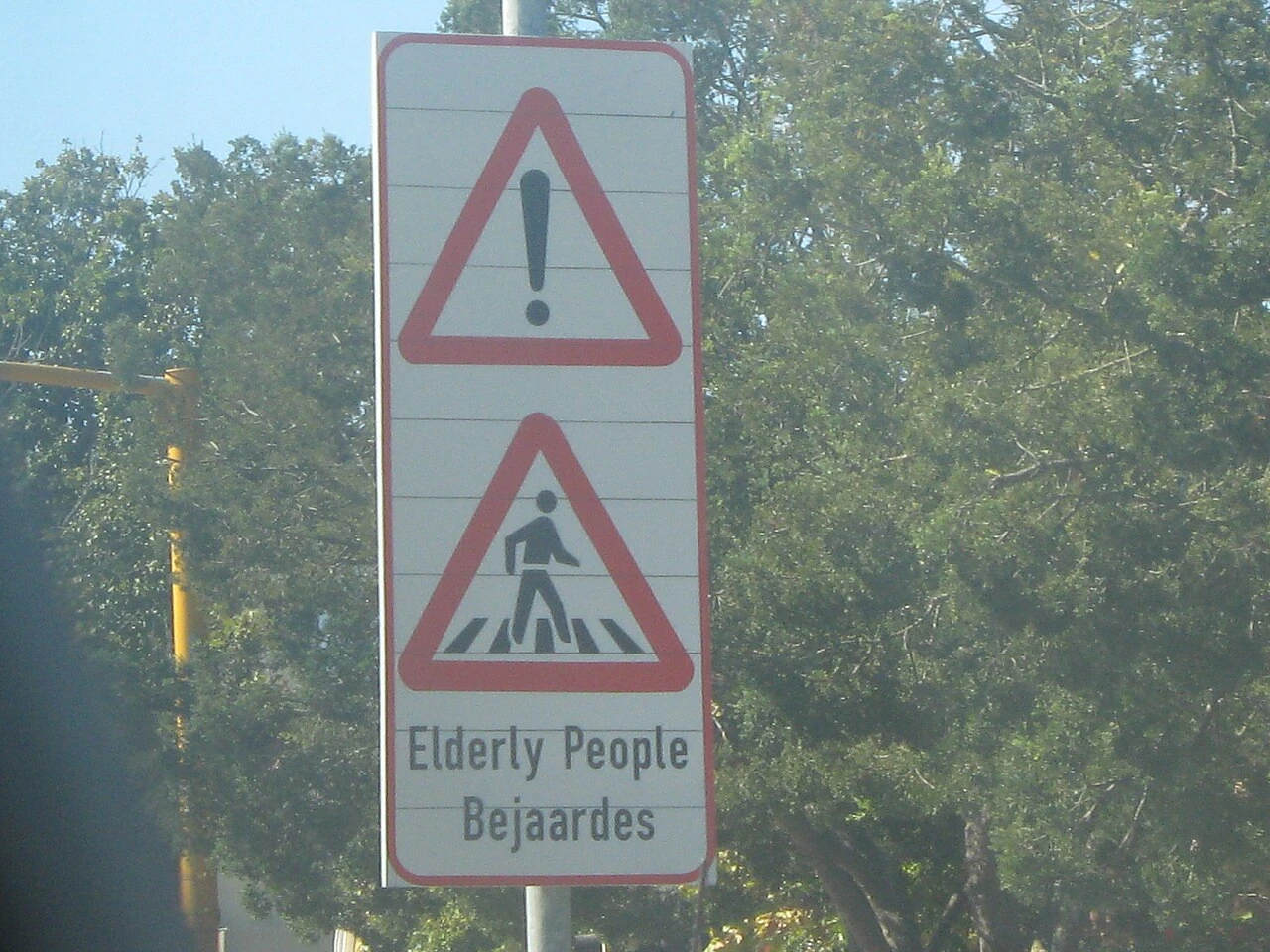
Afrikaans and English road warning for elderly people, photographed in April 2011. Language identification follows Commons descriptions or categories; not independently transcribed.
Saved in Babelbook · resized display copy. Select the image to open it independently of its source.
Bezuidenhout · Source ↗CC BY-SA 3.0 ↗View the local visual field note
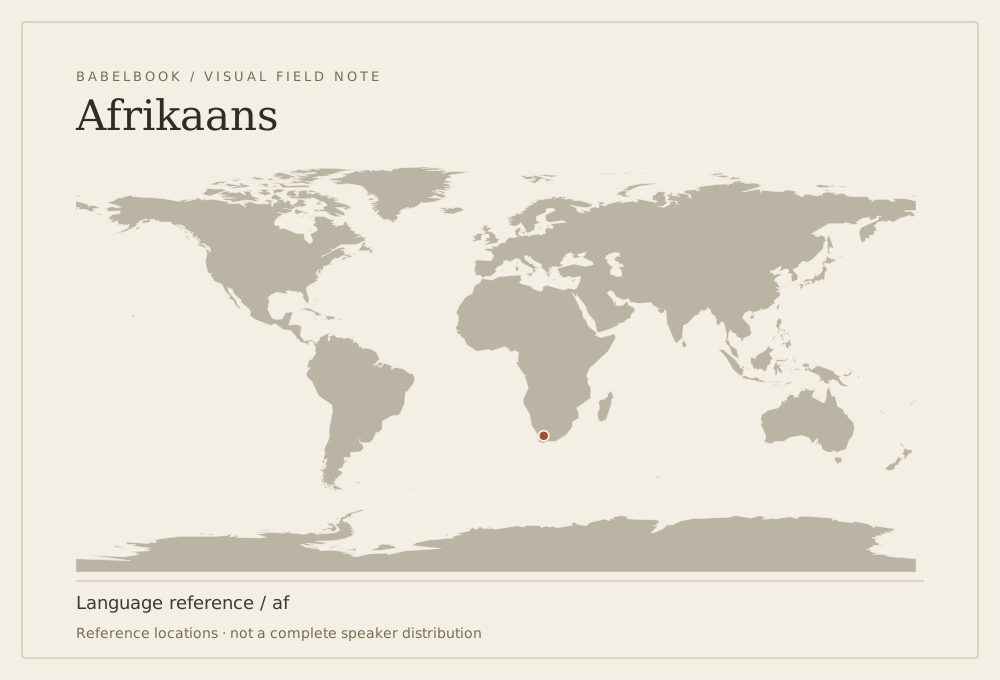
Representative reference points from Glottolog. Historical entries show reference locations, not current speakers. 1 point.
Reference & context ↗Babelbook · original editorial illustration · CC BY 4.0 · Glottolog locations; public-domain Natural Earth land
Source excerpts, selected, shortened and where noted editorially corrected from Afrikaans by Wikipedia contributors. Retrieved 2026-10-05. CC BY-SA 4.0. These excerpts are not an independently verified scholarly history; missing accounts are identified above.
Read further in the source
Origin
For a long time, the so-called Eastern Border Hypothesis of the South African linguist Prof. Dr. Christo van Rensburg (1938–2018) was regarded as the scientific consensus explaining the development and standardization of Afrikaans. According to this hypothesis, the Dutch dialect spoken on the eastern frontier of the Cape Colony was to be seen as a direct and natural development of the Dutch dialects (particularly Hollandic and Zeelandic varieties) spoken by the Trekboers, while the two other major dialects, Kaaps and Orange River Afrikaans, were considered to have undergone substantial creolization. This was attributed to the fact that, in these regions, a significant proportion of speakers had acquired Dutch not as their first language but as a second language. According to Van Rensburg, Eastern Border Afrikaans developed around 1775 into a stable and comparatively homogeneous Dutch dialect form, which became increasingly standardized and written down during the 19th century; particularly in the period after 1806–1820, when European Dutch began being replaced by English as the official and administrative language. More recent research, however, has concluded that the development of Afrikaans was considerably more complex than this and Afrikaans appears to have developed considerably more gradually and diversely than originally assumed. Instead of a single more or less unified dialect developing into a standardized language over the course of the 19th century, South Africa was characterized by a highly diverse linguistic landscape until the early twentieth century, with language communities ranging from some in which Dutch was used in schools and at home, differring little, if at all, from contemporary Dutch in Europe, to communities (often consisting of black, mixed or non-Dutch European immigrants) for whom Dutch was a second or even third language. These speech communities were interconnected through highly complex patterns of linguistic and social interaction, with the choice and use of a particular varieties depending on language proficiency and sociolinguistic factors such as social class, ethnicity, and race. In the late eighteenth century, a written tradition emerged that made conspicuous use of features associated with these highly diverse South African dialects and sociolects. The earliest deliberate imitation of colloquial speech, dating from 1795, is found in the anonymous poem Gedicht Lied ter eere van de Swellendamsche en diverse andere helden bij de bloedige actie aan Muizenberg (“Song in honor of the heroes of Swellendam and various other heroes at the bloody Battle of Muizenberg”), which mocks the inhabitants of Swellendam. During the following century, this developed into a distinctive writing tradition, in which Dutch texts increasingly incorporated stereotypical features of the various non-standard varieties spoken in South Africa. This use of local vernacular, much of which was considered rustic, colonial or uncouth by the Dutch and Cape Dutch of the time period, became increasingly deliberate and became closely associated with broader processes of social identity formation, in which the Boers increasingly asserted a distinct identity from both the British and the Dutch-speaking urban population of Cape Town. In the late 19th and early 20th centuries, the codification and institutionalization of Afrikaans accelerated considerably. In 1875, the Genootskap van Regte Afrikaners was founded with the explicit aim of establishing spoken Afrikaans as a written language. Dutch spelling reforms promoted and proposed in 1891 by the Dutch linguist Roeland Kollewijn, with its emphasis on phonetic spelling, were generally regarded in the Netherlands and Belgium as being “too modernistic” or even “demeaning.” In South Africa, by contrast, Kollewijn’s Vereenvoudigde Nederlandse spelling (“Simplified Dutch Spelling”) was seen as bridging the increasing gap between the written and spoken language and adopted in 1905 as the official orthography of the Dutch language in South Africa and subsequently served as the basis for modern Afrikaans orthography.
Standardisation
The earliest Afrikaans texts were some doggerel verses from 1795 and a dialogue transcribed by a Dutch traveller in 1825. Afrikaans used the Latin alphabet around this time, although the Cape Muslim community used the Arabic script. In 1861, L. H. Meurant published his Zamenspraak tusschen Klaas Waarzegger en Jan Twyfelaar (Conversation between Nicholas Truthsayer and John Doubter), which is considered the first book published in Afrikaans. The first grammar book was published in 1876; a bilingual dictionary was published in 1902. The main modern Afrikaans dictionary in use is the Verklarende Handwoordeboek van die Afrikaanse Taal (HAT). A new authoritative dictionary, Woordeboek van die Afrikaanse Taal (WAT), was under development As of 2018. The official orthography of Afrikaans is the Afrikaanse Woordelys en Spelreëls, compiled by Die Taalkommissie.
Sociolinguistics
Besides South-Africa, Afrikaans is also widely spoken in Namibia. Before independence, Afrikaans had equal status with German as an official language. Since independence in 1990, Afrikaans has had constitutional recognition as a national, but not official, language. There is a much smaller number of Afrikaans speakers among Zimbabwe's white minority, as most have left the country since 1980. Afrikaans was also a medium of instruction for schools in Bophuthatswana, an Apartheid-era Bantustan. Eldoret, Kenya, was founded by Afrikaners. There are also around 30,000 South Africans in the Netherlands, of which the majority are of Afrikaans-speaking Afrikaner and Coloured South-African descent. A much smaller and unknown number of Afrikaans speakers also reside in the Dutch Caribbean. Contrary to popular belief, the majority of Afrikaans speakers today are not Afrikaners or Boers, but Coloureds. In 1976, secondary-school pupils in Soweto began a rebellion in response to the government's decision that Afrikaans be used as the language of instruction for half the subjects taught in non-White schools (with English continuing for the other half). Although English is the mother tongue of only 8.2% of the population, it is the language most widely understood, and the second language of a majority of South Africans. Afrikaans is more widely spoken than English in the Northern and Western Cape provinces, several hundred kilometres from Soweto. The Black community's opposition to Afrikaans and preference for continuing English instruction was underlined when the government rescinded the policy one month after the uprising: 96% of Black schools chose English (over Afrikaans or native languages) as the language of instruction. Afrikaans-medium schools were also accused of using language policy to deter Black African parents. Some of these parents, in part supported by provincial departments of education, initiated litigation which enabled enrolment with English as language of instruction. By 2006 there were 300 single-medium Afrikaans schools, compared to 2,500 in 1994, after most converted to dual-medium education. Due to Afrikaans being viewed as the "language of the white oppressor" by some, pressure has been increased to remove Afrikaans as a teaching language in South African universities, resulting in bloody student protests in 2015. Under South Africa's Constitution of 1996, Afrikaans remains an official language, and has equal status to English and ten other languages. The new policy means that the use of Afrikaans is now often reduced in favour of English, or to accommodate the other official languages. In 1996, for example, the South African Broadcasting Corporation reduced the amount of television airtime in Afrikaans, while South African Airways dropped its Afrikaans name Suid-Afrikaanse Lugdiens from its livery. Similarly, South Africa's diplomatic missions overseas now display the name of the country only in English and their host country's language, and not in Afrikaans. Meanwhile, the constitution of the Western Cape, which went into effect in 1998, declares Afrikaans to be an official language of the province alongside English and Xhosa. The Afrikaans-language general-interest family magazine Huisgenoot has the largest readership of any magazine in the country. When the British design magazine Wallpaper described Afrikaans as "one of the world's ugliest languages" in its September 2005 article about the monument, South African billionaire Johann Rupert (chairman of the Richemont Group), responded by withdrawing advertising for brands such as Cartier, Van Cleef & Arpels, Montblanc and Alfred Dunhill from the magazine. The author of the article, Bronwyn Davies, was an English-speaking South African.
Current status
Afrikaans is an official language of the Republic of South Africa and a recognised national language of the Republic of Namibia. Post-apartheid South Africa has seen a loss of preferential treatment by the government for Afrikaans, in terms of education, social events, media (TV and radio), and general status throughout the country, given that it now shares its place as official language with ten other languages. Nevertheless, Afrikaans remains more prevalent in the media – radio, newspapers and television – than any of the other official languages except English. More than 300 book titles in Afrikaans are published annually. South African census figures suggest a decreasing number of first language Afrikaans speakers in South Africa from 13.5% in 2011 to 10.6% in 2022. The South African Institute of Race Relations (SAIRR) projects that a growing majority of Afrikaans speakers will be Coloured. Afrikaans speakers experience higher employment rates than other South African language groups, though as of 2012 half a million were unemployed. Despite the challenges of demotion and emigration that it faces in South Africa, the Afrikaans vernacular remains competitive, being popular in DSTV pay channels and several internet sites, while generating high newspaper and music CD sales. A resurgence in Afrikaans popular music since the late 1990s has invigorated the language, especially among a younger generation of South Africans. A recent trend is the increased availability of pre-school educational CDs and DVDs. Such media also prove popular with the extensive Afrikaans-speaking emigrant communities who seek to retain language proficiency in a household context. Afrikaans-language cinema showed signs of new vigour in the early 21st century. The 2007 film Ouma se slim kind, the first full-length Afrikaans movie since Paljas in 1998, is seen as the dawn of a new era in Afrikaans cinema. Several short films have been created and more feature-length movies, such as Poena Is Koning and Bakgat (both in 2008) have been produced, besides the 2011 Afrikaans-language film Skoonheid, which was the first Afrikaans film to screen at the Cannes Film Festival. The film Platteland was also released in 2011. The Afrikaans film industry started gaining international recognition via the likes of big Afrikaans Hollywood film stars, like Charlize Theron (Monster) and Sharlto Copley (District 9) promoting their mother tongue. SABC 3 announced early in 2009 that it would increase Afrikaans programming due to the "growing Afrikaans-language market and [their] need for working capital as Afrikaans advertising is the only advertising that sells in the current South African television market". In April 2009, SABC3 started screening several Afrikaans-language programmes. There is a groundswell movement within Afrikaans to be inclusive, and to promote itself along with the indigenous official languages. In Namibia, the percentage of Afrikaans speakers declined from 11.4% (2001 Census) to 10.4% (2011 Census). The major concentrations are in Hardap (41.0%), ǁKaras (36.1%), Erongo (20.5%), Khomas (18.5%), Omaheke (10.0%), Otjozondjupa (9.4%), Kunene (4.2%), and Oshikoto (2.3%). Some native speakers of Bantu languages and English also speak Afrikaans as a second language. It is widely taught in South African schools, with about 10.3 million second-language students. Afrikaans is offered at many universities outside South Africa, including in the Netherlands, Belgium, Germany, Poland, Russia and the United States.
Dialects
Following early dialectal studies of Afrikaans, it was theorised that three main historical dialects probably existed after the Great Trek in the 1830s. These dialects are the Northern Cape, Western Cape, and Eastern Cape dialects. Northern Cape dialect may have resulted from contact between Dutch settlers and the Khoekhoe people between the Great Karoo and the Kunene, and Eastern Cape dialect between the Dutch and the Xhosa. Remnants of these dialects still remain in present-day Afrikaans, although the standardising effect of Standard Afrikaans has contributed to a great levelling of differences in modern times. Oranjerivier-Afrikaans (Orange River Afrikaans) is a major variety, including the Oranjerivier Afrikaans spoken by whites and Griqua Afrikaans spoken by Griqua as well as Namakwalands. There is also a prison cant, known as Sabela, which is based on Afrikaans, yet heavily influenced by Zulu. This language is used as a secret language in prison and is taught to initiates.
Orthography
The Afrikaans writing system is based on Dutch, using the 26 letters of the ISO basic Latin alphabet, plus 16 additional vowel sounds represented by adding diacritics. The hyphen (e.g. in a compound like see-eend 'sea duck'), apostrophe (e.g. ma's 'mothers'), and a whitespace character (e.g. in multi-word units like Dooie See 'Dead Sea') is part of the orthography of words, while the indefinite article ʼn is a ligature. All the alphabet letters, including those with diacritics, have capital letters as allographs; the ʼn does not have a capital letter allograph. This means that Afrikaans has 88 graphemes with allographs in total.
In Afrikaans, many consonants are dropped from the earlier Dutch spelling. For example, slechts ('only') in Dutch becomes slegs in Afrikaans. Also, Afrikaans and some Dutch dialects make no distinction between /s/ and /z/, having merged the latter into the former; while the word for "south" is written zuid in Dutch, it is spelled suid in Afrikaans (as well as dialectal Dutch writings) to represent this merger. Similarly, the Dutch digraph ij, normally pronounced as /ɛi/, corresponds to Afrikaans y, except where it replaces the Dutch suffix –lijk which is pronounced as /lək/, as in waarschijnlijk > waarskynlik. Another difference is the indefinite article, 'n in Afrikaans and een in Dutch. "A book" is 'n boek in Afrikaans, whereas it is either een boek or 'n boek in Dutch. This 'n is usually pronounced as just a weak vowel, [ə], just like English "a". The diminutive suffix in Afrikaans is -tjie, -djie or -ie, whereas in Dutch it is -tje or dje, hence a "bit" is ʼn bietjie in Afrikaans and beetje in Dutch. The letters c, q, x, and z occur almost exclusively in borrowings from French, English, Greek and Latin. This is usually because words that had c and ch in the original Dutch are spelled with k and g, respectively, in Afrikaans. Similarly original qu and x are most often spelt kw and ks, respectively. For example, ekwatoriaal instead of equatoriaal, and ekskuus instead of excuus. The vowels with diacritics in non-loanword Afrikaans are: á, ä, é, è, ê, ë, í, î, ï, ó, ô, ö, ú, û, ü, ý. Diacritics are ignored when alphabetising, but it is important to include them even if they are difficult to type. For example, geëet ("ate") instead of the 3 e's alongside each other: *geeet, which can never occur in Afrikaans, or sê, which translates to "say", whereas se is a possessive form. The primary function of the acute accent (á, é, í, ó, ú, ý) is to indicate an emphasised syllable. For example, sál ("will" (verb)), néé ('no'), móét ("must"), hý ("he"), gewéét ("knew"). The acute is only placed on an i if that is the only vowel in an emphasised word: wil ('want' (verb)) becomes wíl, but lui ('lazy') becomes lúi. Only a few non-loan words are spelled with acutes, e.g. dié ('this'), ná ('after'), óf ... óf ('either ... or'), nóg ... nóg ('neither ... nor'), etc. Only four non-loan words are spelled with the grave accent: nè ('yes?', 'right?', 'eh?'), dè ('here, take this!' or '[this is] yours!'), hè ('huh?', 'what?', 'eh?'), and appèl ('(formal) appeal' (noun)).