Akan
Twi-Fante, commonly referred to by its speakers as either Twi (pronounced ) or Fante () and academically and institutionally known by the broader term Akan (pronounced ), is a widely spoken language of Ghana and the main native language of the Akan people. Spoken over much of the southern half of Ghana, about 44% of Ghanaians are native speakers, and about 80% of Ghana's population speak Akan as a first or second language. The Bono dialect is also widely spoken in Ghana and across the border in Ivory Coast. Three dialects of Twi-Fante were developed as literary standards with distinct orthographies: Asante Twi, Akuapem Twi, and Fante. Despite being mutually intelligible, they were inaccessible in written form to speakers of the other standards until the Akan Orthography Committee (AOC)'s development of a common Twi-Fante orthography in 1978, based mainly on Akuapem dialect. As the first Akan variety to be used for Bible translation, Akuapem Twi had become the prestige dialect. With the Atlantic slave trade, Akan languages, principally Twi/Fante, were introduced to the Caribbean and South America, notably in Suriname and Jamaica, where they heavily influenced the language of the Ndyuka and the Jamaican Maroons, also known as the Coromantee. The cultures of the descendants of escaped slaves in the interior of Suriname and the Maroons in Jamaica still retain Akan influences, including the Akan naming practice of naming children after the day of the week on which they are born, e.g. Akwasi/Kwasi for a boy or Akosua for a girl born on a Sunday, etc.
Translate in Akan ↗Twi-Fante, commonly referred to by its speakers as either Twi (pronounced ) or Fante () and academically and institutionally known by the broader term Akan (pronounced ), is a widely spoken language of Ghana and the main native language of the Akan people. Spoken over much of the southern half of Ghana, about 44% of Ghanaians are native speakers, and about 80% of Ghana's population speak Akan as a first or second language. The Bono dialect is also widely spoken in Ghana and across the border in Ivory Coast. Three dialects of Twi-Fante were developed as literary standards with distinct orthographies: Asante Twi, Akuapem Twi, and Fante. Despite being mutually intelligible, they were inaccessible in written form to speakers of the other standards until the Akan Orthography Committee (AOC)'s development of a common Twi-Fante orthography in 1978, based mainly on Akuapem dialect. As the first Akan variety to be used for Bible translation, Akuapem Twi had become the prestige dialect. With the Atlantic slave trade, Akan languages, principally Twi/Fante, were introduced to the Caribbean and South America, notably in Suriname and Jamaica, where they heavily influenced the language of the Ndyuka and the Jamaican Maroons, also known as the Coromantee. The cultures of the descendants of escaped slaves in the interior of Suriname and the Maroons in Jamaica still retain Akan influences, including the Akan naming practice of naming children after the day of the week on which they are born, e.g. Akwasi/Kwasi for a boy or Akosua for a girl born on a Sunday, etc. In Jamaica and Suriname, the Ananse spider stories are still well-known.
Sub-Saharan Africa
Present-day use
The captured source does not contain a separate current-use account.
Origins
The captured article does not contain a separate origins section. See the historical account and linked source.
Development
The largest Akan migration was to Ghana in successive waves between the 11th and 18th centuries. Smaller numbers migrated to the eastern part of Côte d'Ivoire and parts of Togo. Within Ghana, the Akan expanded from the north to occupy the southern forest and coastal areas during the 13th century. The Akans have a strong oral history tradition of their past and are also known in for symbolic artifacts of wood, metal and terracotta. Their cultural ideas are expressed in stories and proverbs as well as in designs such as symbols used in carvings and on clothes. The rich Akan culture and history in Ghana are areas of research for many disciplines, such as folklore, literary studies, linguistics, anthropology, and history.
Writing
The letters C, J, Q, V, X and Z are also used, but only in loanwords.
Beyond the typeface.
Signs, manuscripts, published pages and contextual photographs, with their place, period, source and reuse terms. Captions identify historical spellings, regional examples, community references and character imagery.
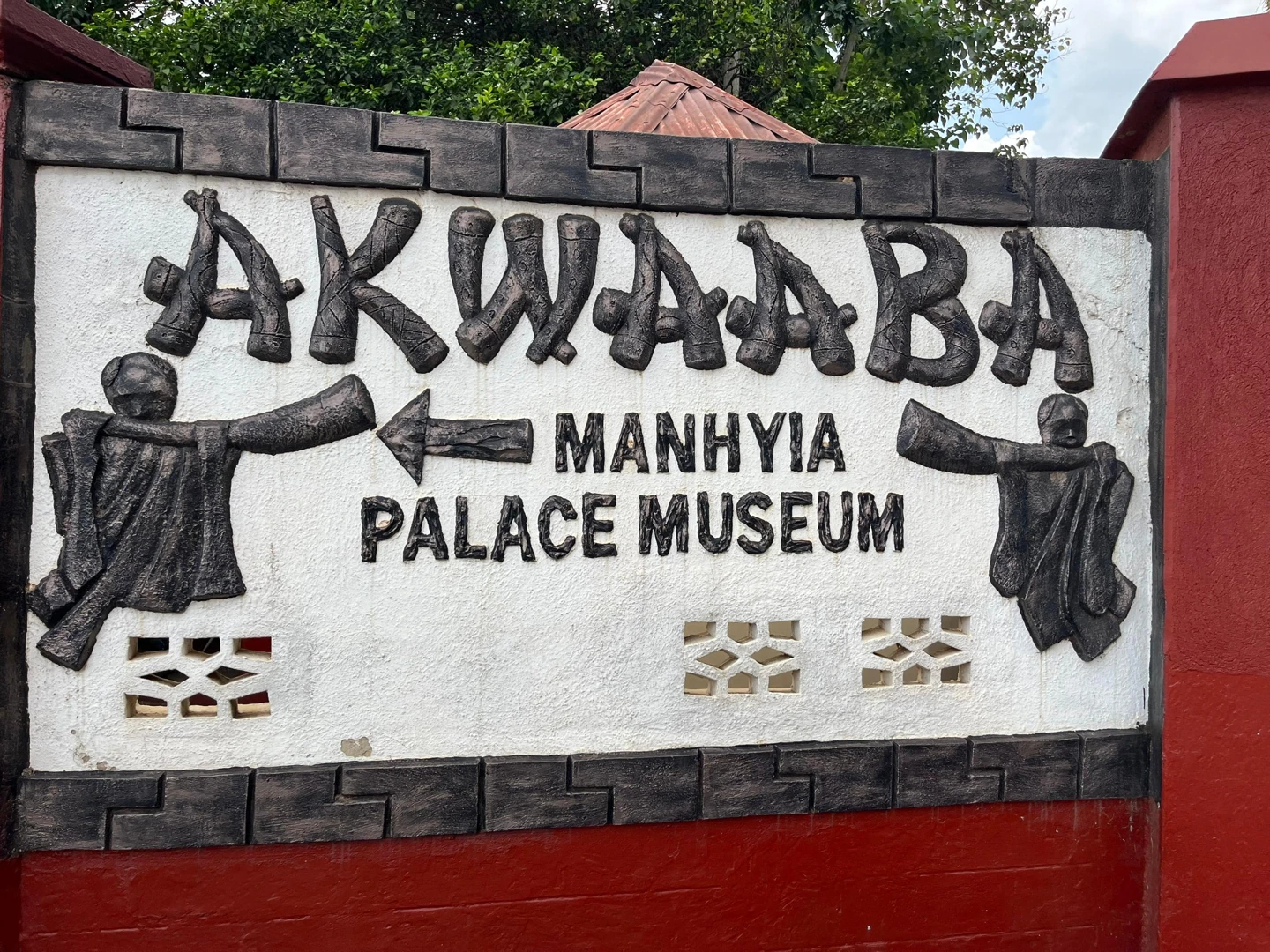
Welcome sign at Manhyia Palace Museum, Ghana, photographed on 21 June 2025. The photographer explicitly records the visible word AKWAABA. Ghana’s National Commission on Culture identifies that word as Twi; Ohio University identifies it as Akan and explains the relationship of Twi to Akan. This is one shared Twi example within the broader Akan grouping, not a separate Fante specimen.
Saved in Babelbook · resized display copy. Select the image to open it independently of its source.
Emmanuel Anin · Source ↗CC BY 4.0 ↗View the local visual field note
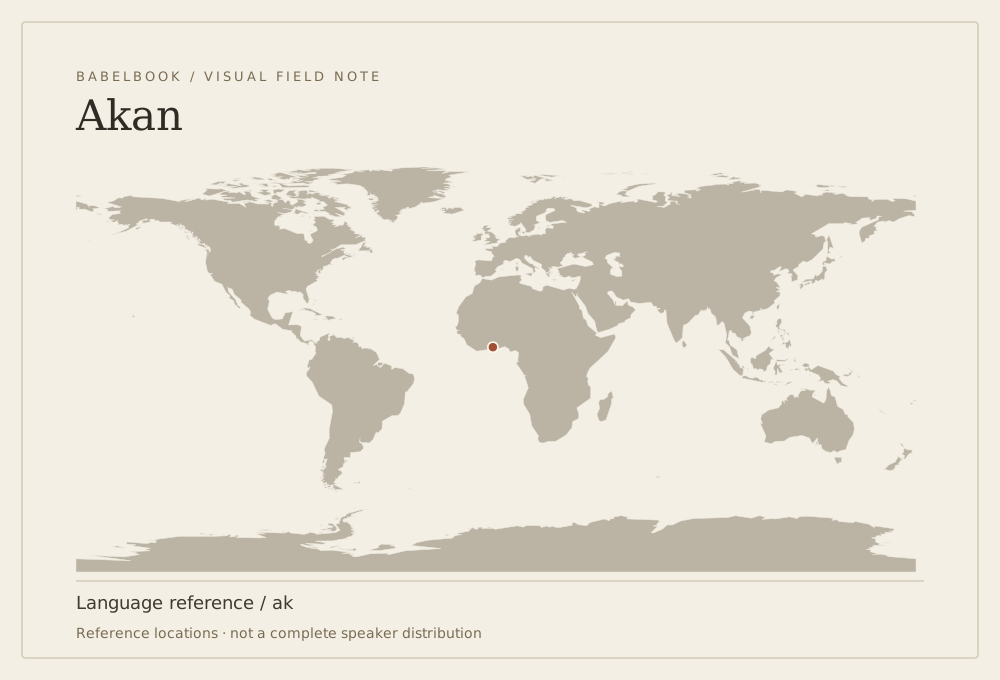
Representative reference points from Glottolog. Historical entries show reference locations, not current speakers. 1 point.
Reference & context ↗Babelbook · original editorial illustration · CC BY 4.0 · Glottolog locations; public-domain Natural Earth land
Source excerpts, selected, shortened and where noted editorially corrected from Twi-Fante language by Wikipedia contributors. Retrieved 2026-10-05. CC BY-SA 4.0. These excerpts are not an independently verified scholarly history; missing accounts are identified above.
Read further in the source
History
The largest Akan migration was to Ghana in successive waves between the 11th and 18th centuries. Smaller numbers migrated to the eastern part of Côte d'Ivoire and parts of Togo. Within Ghana, the Akan expanded from the north to occupy the southern forest and coastal areas during the 13th century. The Akans have a strong oral history tradition of their past and are also known in for symbolic artifacts of wood, metal and terracotta. Their cultural ideas are expressed in stories and proverbs as well as in designs such as symbols used in carvings and on clothes. The rich Akan culture and history in Ghana are areas of research for many disciplines, such as folklore, literary studies, linguistics, anthropology, and history.
Dialects
Twi-Fante is a dialect continuum that is closely related to the Bia languages and the other Akan languages that are spoken by the Akan people. The relationships of the major Twi-Fante dialects are as follows:
Brong and Wasa have limited mutual intelligibility with each other, and so are separate languages by that standard. Neighboring Brong and Asante are mutually intelligible, though geographically more distant Brong and Fante are less so. Indeed, 'a Fante-speaker will be right in looking on Bron [Bono] as a different language.'
Orthography
The letters C, J, Q, V, X and Z are also used, but only in loanwords.