Akkadian
Akkadian ( ə-KAY-dee-ən; Akkadian: 𒀝𒅗𒁺𒌑(𒌝), romanized: Akkadû(m)) is an East Semitic language that is attested in ancient Mesopotamia (Akkad, Assyria, Isin, Larsa, Babylonia) from the mid-third millennium BC until its gradual replacement in common use by Old Aramaic among Mesopotamians by the 8th century BC. Akkadian, which is the earliest documented Semitic language, is named after the city of Akkad, a major centre of Mesopotamian civilization during the Akkadian Empire (c. 2334–2154 BC). It was written using the cuneiform script, originally used for Sumerian, but also used to write multiple languages in the region including Eblaite, Hurrian, Elamite, Old Persian and Hittite. The influence of Sumerian on Akkadian went beyond just the cuneiform script; owing to their close proximity, a lengthy span of contact and the prestige held by the former, Sumerian significantly influenced Akkadian phonology, vocabulary and syntax. This mutual influence of Akkadian and Sumerian has also led scholars to describe the languages as a sprachbund. Akkadian proper names are first attested in Sumerian texts in the mid-3rd millennium BC, and inscriptions ostensibly written in Sumerian but whose character order reveals that they were intended to be read in East Semitic (presumably early Akkadian) date back to as early as c. 2600 BC. From about the 24th century BC, texts fully written in Akkadian begin to appear. By the 20th century BC, two variant forms of the same language were in use in Assyria and Babylonia, known as Assyrian and Babylonian respectively.
Translate in Akkadian ↗Akkadian ( ə-KAY-dee-ən; Akkadian: 𒀝𒅗𒁺𒌑(𒌝), romanized: Akkadû(m)) is an East Semitic language that is attested in ancient Mesopotamia (Akkad, Assyria, Isin, Larsa, Babylonia) from the mid-third millennium BC until its gradual replacement in common use by Old Aramaic among Mesopotamians by the 8th century BC. Akkadian, which is the earliest documented Semitic language, is named after the city of Akkad, a major centre of Mesopotamian civilization during the Akkadian Empire (c. 2334–2154 BC). It was written using the cuneiform script, originally used for Sumerian, but also used to write multiple languages in the region including Eblaite, Hurrian, Elamite, Old Persian and Hittite. The influence of Sumerian on Akkadian went beyond just the cuneiform script; owing to their close proximity, a lengthy span of contact and the prestige held by the former, Sumerian significantly influenced Akkadian phonology, vocabulary and syntax. This mutual influence of Akkadian and Sumerian has also led scholars to describe the languages as a sprachbund. Akkadian proper names are first attested in Sumerian texts in the mid-3rd millennium BC, and inscriptions ostensibly written in Sumerian but whose character order reveals that they were intended to be read in East Semitic (presumably early Akkadian) date back to as early as c. 2600 BC. From about the 24th century BC, texts fully written in Akkadian begin to appear. By the 20th century BC, two variant forms of the same language were in use in Assyria and Babylonia, known as Assyrian and Babylonian respectively. The bulk of preserved material is from this later period, corresponding to the Near Eastern Iron Age.
Middle East & North Africa
Present-day use
The captured source does not contain a separate current-use account.
Origins
The captured article does not contain a separate origins section. See the historical account and linked source.
Development
Akkadian is divided into several varieties based on geography and historical period: Old Akkadian, 2500–1950 BC Old Babylonian and Old Assyrian, 1950–1530 BC Middle Babylonian and Middle Assyrian, 1530–1000 BC Neo-Babylonian and Neo-Assyrian, 1000–600 BC Late Babylonian, 600 BC – 100 AD One of the earliest known Akkadian inscriptions was found on a bowl at Ur, addressed to the very early pre-Sargonic king Meskiagnunna of Ur (c. 2485–2450 BC) by his queen Gan-saman, who is thought to have been from Akkad. The Akkadian Empire, established by Sargon of Akkad, introduced the Akkadian language (the "language of Akkad") as a written language, adapting Sumerian cuneiform orthography for the purpose. During the Middle Bronze Age (Old Assyrian and Old Babylonian period), the language virtually displaced Sumerian, which is assumed to have been extinct as a living language by the 18th century BC. Old Akkadian, which was used until the end of the 3rd millennium BC, differed from both Babylonian and Assyrian, and was displaced by these dialects. By the 21st century BC Babylonian and Assyrian, which were to become the primary dialects, were easily distinguishable. Old Babylonian, along with the closely related dialect Mariotic, is clearly more innovative than the Old Assyrian dialect and the more distantly related Eblaite language. For this reason, forms like lu-prus ('I will decide') were first encountered in Old Babylonian instead of the older la-prus. While generally more archaic, Assyrian developed certain innovations as well, such as the "Assyrian vowel harmony". Eblaite was even more so, retaining a productive dual and a relative pronoun declined in case, number and gender. Both of these had already disappeared in Old Akkadian.
Writing
Old Akkadian is preserved on clay tablets dating back to c. 2500 BC. It was written using cuneiform, a script adopted from the Sumerians using wedge-shaped symbols pressed in wet clay. As employed by Akkadian scribes, the adapted cuneiform script could represent either (a) Sumerian logograms (i.e., picture-based characters representing entire words), (b) Sumerian syllables, (c) Akkadian syllables, or (d) phonetic complements. In Akkadian the script practically became a fully fledged syllabic script, and the original logographic nature of cuneiform became secondary, though logograms for frequent words such as 'god' and 'temple' continued to be used. For this reason, the sign AN can on the one hand be a logogram for the word ilum ('god') and on the other signify the god Anu or even the syllable -an-. Additionally, this sign was used as a determinative for divine names. Another peculiarity of Akkadian cuneiform is that many signs do not have a well defined phonetic value. Certain signs, such as AḪ, do not distinguish between the different vowel qualities. Nor is there any coordination in the other direction; the syllable -ša-, for example, is rendered by the sign ŠA, but also by the sign NĪĜ. Both of these are often used for the same syllable in the same text. Cuneiform was in many ways unsuited to Akkadian: among its flaws was its inability to represent important phonemes in Semitic, including a glottal stop, pharyngeals, and emphatic consonants. In addition, cuneiform was a syllabary writing system—i.e., a consonant plus vowel comprised one writing unit—frequently inappropriate for a Semitic language made up of triconsonantal roots (i.e., three consonants plus any vowels). Gelb, I. J. (1961). Old Akkadian writing and grammar. Materials for the Assyrian dictionary, no. 2. Chicago: University of Chicago Press. ISBN 0-226-62304-1 Hasselbach, Rebecca. Sargonic Akkadian: A Historical and Comparative Study of the Syllabic Texts. Wiesbaden: Harrassowitz Verlag 2005.
Beyond the typeface.
Signs, manuscripts, published pages and contextual photographs, with their place, period, source and reuse terms. Captions identify historical spellings, regional examples, community references and character imagery.
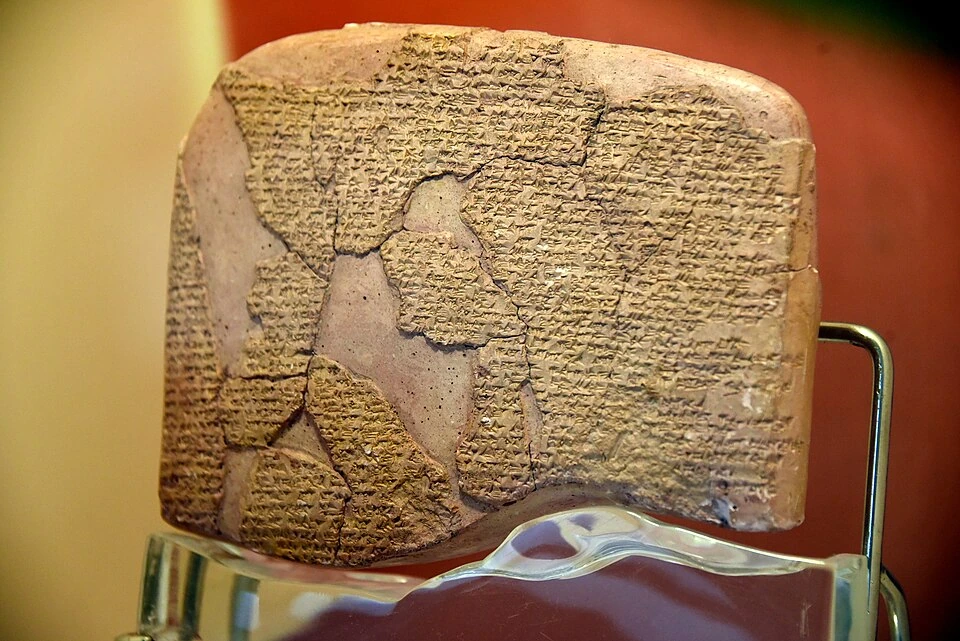
Akkadian treaty tablet fragment from Boğazköy, displayed at the Museum of the Ancient Orient, Istanbul. Commons explicitly identifies the language as Akkadian; it is not Hittite merely because the treaty concerns Hittite rulers. Not independently transcribed.
Saved in Babelbook · resized display copy. Select the image to open it independently of its source.
Osama Shukir Muhammed Amin FRCP(Glasg) · Source ↗CC BY-SA 4.0 ↗View the local visual field note
Representative reference points from Glottolog. Historical entries show reference locations, not current speakers. 1 point.
Reference & context ↗Babelbook · original editorial illustration · CC BY 4.0 · Glottolog locations; public-domain Natural Earth land
Source excerpts, selected, shortened and where noted editorially corrected from Akkadian language by Wikipedia contributors. Retrieved 2026-10-05. CC BY-SA 4.0. These excerpts are not an independently verified scholarly history; missing accounts are identified above.
Read further in the source
Writing
Old Akkadian is preserved on clay tablets dating back to c. 2500 BC. It was written using cuneiform, a script adopted from the Sumerians using wedge-shaped symbols pressed in wet clay. As employed by Akkadian scribes, the adapted cuneiform script could represent either (a) Sumerian logograms (i.e., picture-based characters representing entire words), (b) Sumerian syllables, (c) Akkadian syllables, or (d) phonetic complements. In Akkadian the script practically became a fully fledged syllabic script, and the original logographic nature of cuneiform became secondary, though logograms for frequent words such as 'god' and 'temple' continued to be used. For this reason, the sign AN can on the one hand be a logogram for the word ilum ('god') and on the other signify the god Anu or even the syllable -an-. Additionally, this sign was used as a determinative for divine names. Another peculiarity of Akkadian cuneiform is that many signs do not have a well defined phonetic value. Certain signs, such as AḪ, do not distinguish between the different vowel qualities. Nor is there any coordination in the other direction; the syllable -ša-, for example, is rendered by the sign ŠA, but also by the sign NĪĜ. Both of these are often used for the same syllable in the same text. Cuneiform was in many ways unsuited to Akkadian: among its flaws was its inability to represent important phonemes in Semitic, including a glottal stop, pharyngeals, and emphatic consonants. In addition, cuneiform was a syllabary writing system—i.e., a consonant plus vowel comprised one writing unit—frequently inappropriate for a Semitic language made up of triconsonantal roots (i.e., three consonants plus any vowels).
Dialects
The following table summarises the dialects of Akkadian identified with certainty so far.
Some researchers (such as W. Sommerfeld 2003) believe that the Old Akkadian variant used in the older texts is not an ancestor of the later Assyrian and Babylonian dialects, but rather a separate dialect that was replaced by these two dialects and which died out early. Eblaite, formerly thought of as yet another Akkadian dialect, is now generally considered a separate East Semitic language.