Amharic
Amharic is an Ethio-Semitic language, which is a subgrouping within the Semitic branch of the Afroasiatic languages. It is spoken as a first language by the Habesha Amhara people, and also serves as a lingua franca for all other metropolitan populations in Ethiopia. The language serves as the official working language of the Ethiopian federal government, and is also the official or working language of several of Ethiopia's federal regions. In 2020 in Ethiopia, it had over 33.7 million mother-tongue speakers of which 31 million are ethnically Amhara, and more than 25.1 million second language speakers in 2019, making the total number of speakers over 58.8 million. Amharic is the largest, most widely spoken language in Ethiopia, and the most spoken mother-tongue in Ethiopia. Amharic is also the second most widely spoken Semitic language in the world (after Arabic). Amharic is written left-to-right using an extended Geʽez script, known as Ethiopic script or fidäl (ፊደል), meaning 'script, alphabet, letter, character'. The segmental writing system in which consonant-vowel sequences are written as units is called an abugida (አቡጊዳ). There is no universally agreed-upon Romanization of Amharic into Latin script. The Amharic examples in the sections below use one system that is common among linguists specializing in Ethiopian Semitic languages.
Translate in Amharic ↗The 2007 census reported that Amharic was spoken by 21.6 million native speakers in Ethiopia. More recent sources state the number of first-language speakers in 2018 as nearly 32 million, with another 25 million second-language speakers in Ethiopia. Additionally, 3 million emigrants outside of Ethiopia speak the language.
Sub-Saharan Africa
Present-day use
The captured source does not contain a separate current-use account.
Origins
The captured article does not contain a separate origins section. See the historical account and linked source.
Development
Amharic has been the official working language of Ethiopia, language of the courts, the language of trade and everyday communications and of the military since the late 12th century. The Amhara nobles supported the Zagwe prince Lalibela in his power struggle against his brothers which led him to make Amharic Lisane Negus (tongue of the king) as well as fill the Amhara nobles in the top positions of his kingdom. The appellation of 'language of the king' (Ge'ez: ልሳነ ነጋሢ, Lǝssanä nägaśi; Amharic: የነጋሢ ቋንቋ, Yä-nägaśi qʷanqʷa) and its use in the royal court are otherwise traced to the Amhara Emperor Yekuno Amlak. Until 2020 Amharic was the sole official language of Ethiopia. Early Afro-Asiatic populations speaking proto-Semitic, proto-Cushitic and proto-Omotic languages would have diverged by the fourth or fifth millennium BC. Shortly afterwards, the proto-Cushitic and proto-Omotic groups would have settled in the Ethiopian highlands, with the proto-Semitic speakers crossing the Sinai Peninsula into Asia. A later return movement of peoples from South Arabia would have introduced the Semitic languages to Ethiopia. Based on archaeological evidence, the presence of Semitic speakers in the territory date to some time before 500 BC. Linguistic analysis suggests the presence of Semitic languages in Ethiopia as early as 2000 BC. Levine indicates that by the end of that millennium, the core inhabitants of Greater Ethiopia would have consisted of dark-skinned agropastoralists speaking Afro-Asiatic languages of the Semitic, Cushitic and Omotic branches. Other scholars such as Messay Kebede and Daniel E. Alemu argue that migration across the Red Sea was defined by reciprocal exchange, if it even occurred at all, and that Ethio-Semitic-speaking ethnic groups should not be characterized as foreign invaders. Amharic is a South Ethio-Semitic language, along with Gurage, Argobba, Harari, and others.
Writing
The Amharic script is an abugida, and the graphemes of the Amharic writing system are called fidäl. It is derived from a modification of the Geʽez script. Each character represents a consonant+vowel sequence, but the basic shape of each character is determined by the consonant, which is modified for the vowel. Some consonant phonemes are written by more than one series of characters: /ʔ/, /s/, /tsʼ/, and /h/ (the last one has four distinct letter forms). This is because these fidäl originally represented distinct sounds, but phonological changes merged them. The citation form for each series is the consonant+ä form, i.e. the first column of the fidäl. There are 34 basic characters, each of which has seven forms depending on which vowel is to be pronounced in the syllable. There are also 49 "wa" letters, which form compound sounds involving "w." All together, the alphabet has some 280 letters. The Amharic script is included in Unicode, and glyphs are included in fonts available with major operating systems.
Beyond the typeface.
Signs, manuscripts, published pages and contextual photographs, with their place, period, source and reuse terms. Captions identify historical spellings, regional examples, community references and character imagery.
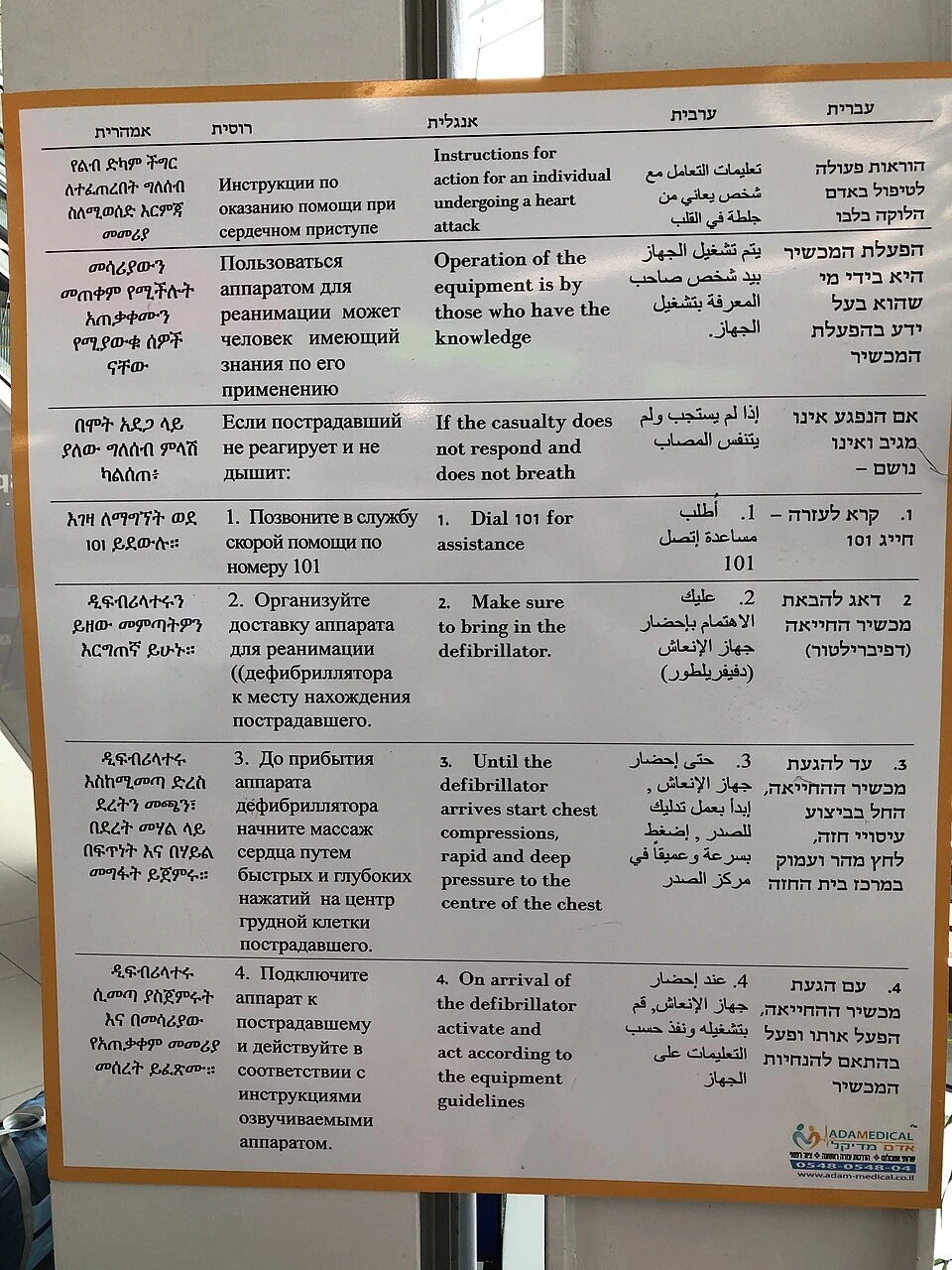
Multilingual notice at Ramon Airport, photographed in 2020, containing Amharic alongside Russian, English, Arabic and Hebrew. Label it as multilingual. Displayed at reduced size; no additional crop.
Saved in Babelbook · resized display copy. Select the image to open it independently of its source.
Craig Talbert · Source ↗CC BY 2.0 ↗View the local visual field note
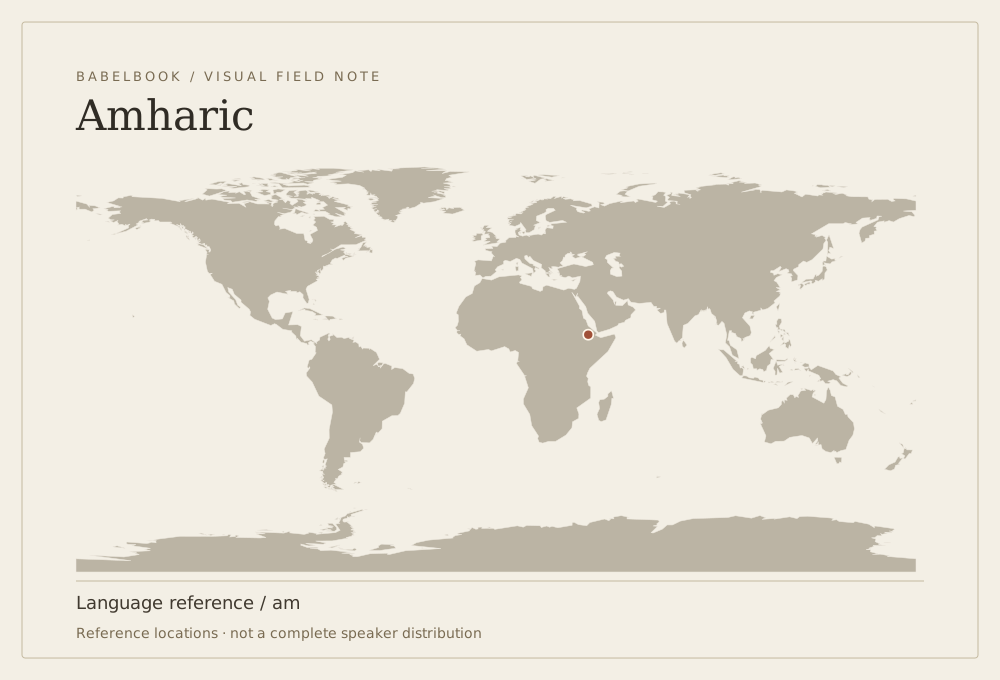
Representative reference points from Glottolog. Historical entries show reference locations, not current speakers. 1 point.
Reference & context ↗Babelbook · original editorial illustration · CC BY 4.0 · Glottolog locations; public-domain Natural Earth land
Source excerpts, selected, shortened and where noted editorially corrected from Amharic by Wikipedia contributors. Retrieved 2026-10-05. CC BY-SA 4.0. These excerpts are not an independently verified scholarly history; missing accounts are identified above.
Read further in the source
Dialects
Not much has been published about Amharic dialect differences. All dialects are mutually intelligible, but certain minor variations are noted.
History
Amharic has been the official working language of Ethiopia, language of the courts, the language of trade and everyday communications and of the military since the late 12th century. The Amhara nobles supported the Zagwe prince Lalibela in his power struggle against his brothers which led him to make Amharic Lisane Negus (tongue of the king) as well as fill the Amhara nobles in the top positions of his kingdom. The appellation of 'language of the king' (Ge'ez: ልሳነ ነጋሢ, Lǝssanä nägaśi; Amharic: የነጋሢ ቋንቋ, Yä-nägaśi qʷanqʷa) and its use in the royal court are otherwise traced to the Amhara Emperor Yekuno Amlak. Until 2020 Amharic was the sole official language of Ethiopia.
Writing system
The Amharic script is an abugida, and the graphemes of the Amharic writing system are called fidäl. It is derived from a modification of the Geʽez script. Each character represents a consonant+vowel sequence, but the basic shape of each character is determined by the consonant, which is modified for the vowel. Some consonant phonemes are written by more than one series of characters: /ʔ/, /s/, /tsʼ/, and /h/ (the last one has four distinct letter forms). This is because these fidäl originally represented distinct sounds, but phonological changes merged them. The citation form for each series is the consonant+ä form, i.e. the first column of the fidäl. There are 34 basic characters, each of which has seven forms depending on which vowel is to be pronounced in the syllable. There are also 49 "wa" letters, which form compound sounds involving "w." All together, the alphabet has some 280 letters. The Amharic script is included in Unicode, and glyphs are included in fonts available with major operating systems.