Aragonese
Aragonese ( ARR-ə-gə-NEEZ; aragonés [aɾaɣoˈnes] in Aragonese) is a Romance language spoken in several dialects by about 12,000 people as of 2011, in the Pyrenees valleys of Aragon, Spain, primarily in the comarcas of Somontano de Barbastro, Jacetania, Alto Gállego, Sobrarbe, and Ribagorza/Ribagorça. It is the only modern language which survived from medieval Navarro-Aragonese in a form distinct from Spanish. Historically, people referred to the language as fabla ('talk' or 'speech'). Native Aragonese people usually refer to it by the names of its local dialects such as cheso (from Valle de Hecho) or patués (from the Benasque Valley).
Translate in Aragonese ↗Aragonese ( ARR-ə-gə-NEEZ; aragonés [aɾaɣoˈnes] in Aragonese) is a Romance language spoken in several dialects by about 12,000 people as of 2011, in the Pyrenees valleys of Aragon, Spain, primarily in the comarcas of Somontano de Barbastro, Jacetania, Alto Gállego, Sobrarbe, and Ribagorza/Ribagorça. It is the only modern language which survived from medieval Navarro-Aragonese in a form distinct from Spanish. Historically, people referred to the language as fabla ('talk' or 'speech'). Native Aragonese people usually refer to it by the names of its local dialects such as cheso (from Valle de Hecho) or patués (from the Benasque Valley).
Europe
Present-day use
Aragonese is the native language of the Aragonese mountain ranges of the Pyrenees, in the comarcas of Somontano, Jacetania, Sobrarbe, and Ribagorza. Cities and towns in which Aragonese is spoken are Huesca, Graus, Monzón, Barbastro, Bielsa, Chistén, Fonz, Echo, Estadilla, Benasque, Campo, Sabiñánigo, Jaca, Plan, Ansó, Ayerbe, Broto, and El Grado. It is spoken as a second language by inhabitants of Zaragoza, Huesca, Ejea de los Caballeros, or Teruel. According to recent polls, there are about 25,500 speakers (2011) including speakers living outside the native area. In 2017, the Dirección General de Política Lingüística de Aragón estimated there were 10,000 to 12,000 active speakers of Aragonese. In 2009, the Languages Act of Aragon (Law 10/2009) recognized the "native language, original and historic" of Aragon. The language received several linguistic rights, including its use in public administration. Some of the legislation was repealed by a new law in 2013 (Law 3/2013).. See Languages Acts of Aragon for more information. Since 1500, Spanish has been the cultural language of Aragon; many Aragonese wrote in Spanish, and during the 17th century the Argensola brothers went to Castile to teach Spanish. Aragonese became a popular village language. During the 17th century, popular literature in the language began to appear. In a 1650 Huesca literary contest, Aragonese poems were submitted by Matías Pradas, Isabel de Rodas and "Fileno, montañés". The 1997 Aragonese law of languages stipulated that Aragonese (and Catalan) speakers had a right to the teaching of and in their own language. Following this, Aragonese lessons started in schools in the 1997–1998 academic year. It was originally taught as an extra-curricular, non-evaluable voluntary subject in four schools.
Origins
The captured article does not contain a separate origins section. See the historical account and linked source.
Development
Aragonese, which developed in portions of the Ebro basin, can be traced back to the High Middle Ages. It spread throughout the Pyrenees to areas where languages similar to modern Basque might have been previously spoken. The Kingdom of Aragon (formed by the counties of Aragon, Sobrarbe and Ribagorza) expanded southward from the mountains, pushing the Moors farther south in the Reconquista and spreading the Aragonese language. The union of the Catalan counties and the Kingdom of Aragon which formed the 12th-century Crown of Aragon did not merge the languages of the two territories; Catalan continued to be spoken in the east and Navarro-Aragonese in the west, with the boundaries blurred by dialectal continuity. The Aragonese Reconquista in the south ended with the cession of Murcia by James I of Aragon to the Kingdom of Castile as dowry for an Aragonese princess. The best-known proponent of the Aragonese language was Johan Ferrandez d'Heredia, the Grand Master of the Knights Hospitaller in Rhodes at the end of the 14th century. He wrote an extensive catalog of works in Aragonese and translated several works from Greek into Aragonese (the first in medieval Europe). The spread of Castilian (Spanish), the Castilian origin of the Trastámara dynasty, and the similarity between Castilian (Spanish) and Aragonese facilitated the recession of the latter. A turning point was the 15th-century coronation of the Castilian Ferdinand I of Aragon, also known as Ferdinand of Antequera. In the early 18th century, after the defeat of the allies of Aragon in the War of the Spanish Succession, Philip V ordered the prohibition of the Aragonese language in schools and the establishment of Castilian (Spanish) as the only official language in Aragon. This was ordered in the Aragonese Nueva Planta decrees of 1707. In recent times, Aragonese was mostly regarded as a group of rural dialects of Spanish.
Writing
Before 2023, Aragonese had three orthographic standards: The grafía de Uesca, codified in 1987 by the Consello d'a Fabla Aragonesa (CFA) at a convention in Huesca, is used by most Aragonese writers. It has a more uniform system of assigning letters to phonemes, with less regard for etymology; words traditionally written with ⟨v⟩ and ⟨b⟩ are uniformly written with ⟨b⟩ in the Uesca system. Similarly, ⟨ch⟩, ⟨j⟩, and ⟨g⟩ before ⟨e⟩ and ⟨i⟩ are all written ⟨ch⟩. It uses letters associated with Spanish, such as ⟨ñ⟩. The grafia SLA, devised in 2004 by the Sociedat de Lingüistica Aragonesa (SLA), is used by some Aragonese writers. It uses etymological forms which are closer to Catalan, Occitan, and medieval Aragonese sources; trying to come closer to the original Aragonese and the other Occitano-Romance languages. In the SLA system ⟨v⟩, ⟨b⟩, ⟨ch⟩, ⟨j⟩, and ⟨g⟩ before ⟨e⟩ and ⟨i⟩ are distinct, and the digraph ⟨ny⟩ replaces ⟨ñ⟩. In 2010, the Academia de l'Aragonés (founded in 2006) established an orthographic standard to modernize medieval orthography and to make it more etymological. During the 16th century, Aragonese Moriscos wrote aljamiado texts (Romance texts in Arabic script), possibly because of their inability to write in Arabic. The language in these texts has a mixture of Aragonese and Castilian traits, and they are among the last known written examples of the Aragonese formerly spoken in central and southern Aragon. In 2023, a new orthographic standard has been published by the Academia Aragonesa de la Lengua. This version is close to the Academia de l'Aragonés orthography, but with the following differences: /kw/ is always spelled ⟨cu⟩, e. g. cuan, cuestión (exception is made for some loanwords: quad, quadrívium, quark, quásar, quáter, quórum); /ɲ/ is spelled ⟨ny⟩ or ⟨ñ⟩ by personal preference; final ⟨z⟩ is not written as ⟨tz⟩. The marginal phoneme /x/ (only in loanwords, e. g.
Beyond the typeface.
Signs, manuscripts, published pages and contextual photographs, with their place, period, source and reuse terms. Captions identify historical spellings, regional examples, community references and character imagery.
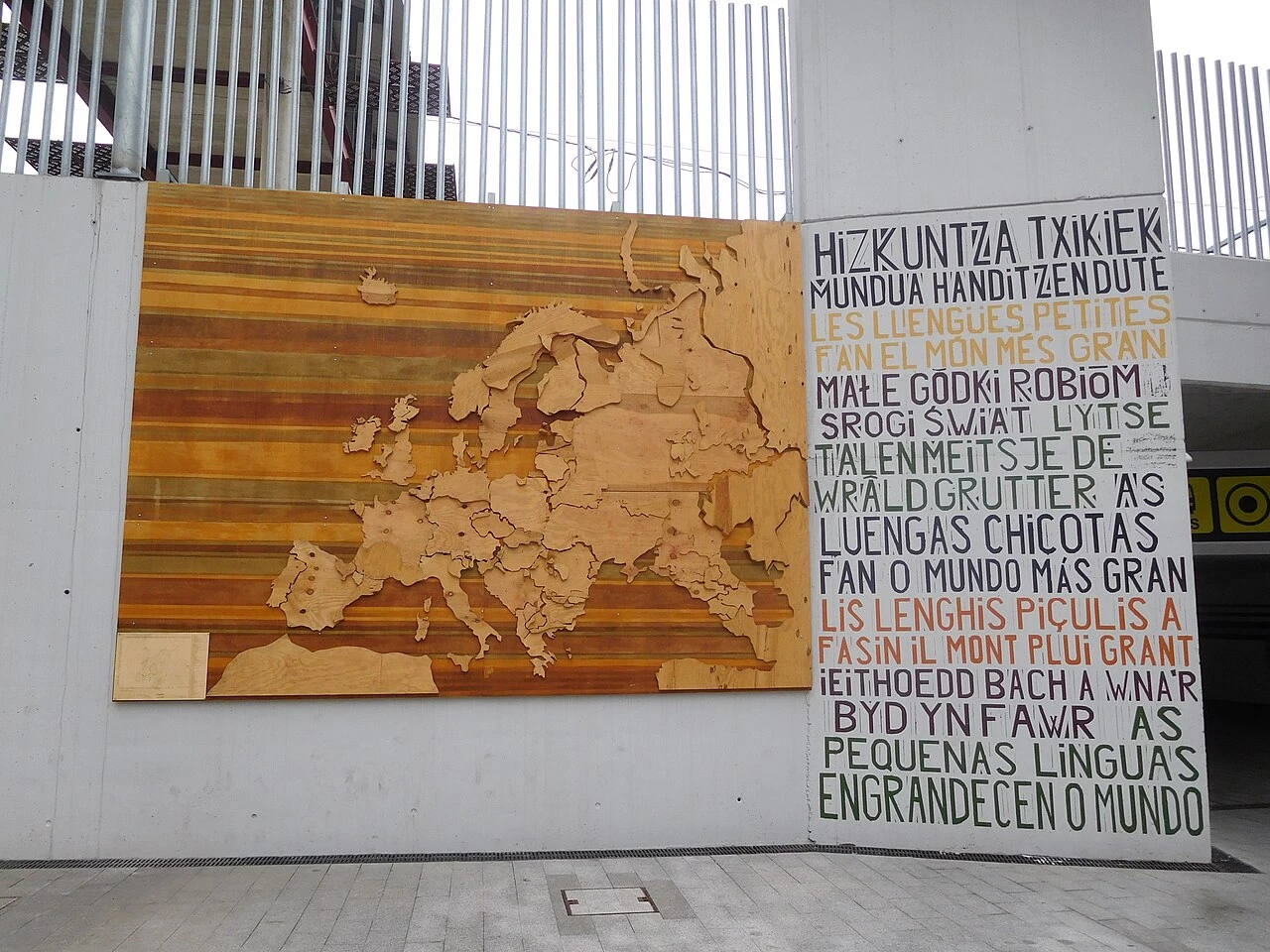
Multilingual mural in San Sebastián, photographed in 2016. Commons explicitly lists Aragonese among its languages. The same photograph also contains other languages.
Saved in Babelbook · resized display copy. Select the image to open it independently of its source.
Vasconium · Source ↗CC BY-SA 4.0 ↗View the local visual field note
Representative reference points from Glottolog. Historical entries show reference locations, not current speakers. 1 point.
Reference & context ↗Babelbook · original editorial illustration · CC BY 4.0 · Glottolog locations; public-domain Natural Earth land
Source excerpts, selected, shortened and where noted editorially corrected from Aragonese language by Wikipedia contributors. Retrieved 2026-10-05. CC BY-SA 4.0. These excerpts are not an independently verified scholarly history; missing accounts are identified above.
Read further in the source
History
Aragonese, which developed in portions of the Ebro basin, can be traced back to the High Middle Ages. It spread throughout the Pyrenees to areas where languages similar to modern Basque might have been previously spoken. The Kingdom of Aragon (formed by the counties of Aragon, Sobrarbe and Ribagorza) expanded southward from the mountains, pushing the Moors farther south in the Reconquista and spreading the Aragonese language. The union of the Catalan counties and the Kingdom of Aragon which formed the 12th-century Crown of Aragon did not merge the languages of the two territories; Catalan continued to be spoken in the east and Navarro-Aragonese in the west, with the boundaries blurred by dialectal continuity. The Aragonese Reconquista in the south ended with the cession of Murcia by James I of Aragon to the Kingdom of Castile as dowry for an Aragonese princess. The best-known proponent of the Aragonese language was Johan Ferrandez d'Heredia, the Grand Master of the Knights Hospitaller in Rhodes at the end of the 14th century. He wrote an extensive catalog of works in Aragonese and translated several works from Greek into Aragonese (the first in medieval Europe). The spread of Castilian (Spanish), the Castilian origin of the Trastámara dynasty, and the similarity between Castilian (Spanish) and Aragonese facilitated the recession of the latter. A turning point was the 15th-century coronation of the Castilian Ferdinand I of Aragon, also known as Ferdinand of Antequera. In the early 18th century, after the defeat of the allies of Aragon in the War of the Spanish Succession, Philip V ordered the prohibition of the Aragonese language in schools and the establishment of Castilian (Spanish) as the only official language in Aragon. This was ordered in the Aragonese Nueva Planta decrees of 1707. In recent times, Aragonese was mostly regarded as a group of rural dialects of Spanish. Compulsory education undermined its already weak position; for example, pupils were punished for using it. However, the 1978 Spanish transition to democracy heralded literary works and studies of the language.
Dialects
Western dialect: Ansó, Valle de Hecho, Chasa, Berdún, Chaca Central dialect: Panticosa, Biescas, Torla, Broto, Bielsa, Yebra de Basa, Aínsa-Sobrarbe Eastern dialect: Benás, Plan, Bisagorri, Campo, Perarrúa, Graus, Estadilla Southern dialect: Agüero, Ayerbe, Rasal, Bolea, Lierta, Uesca, Almudévar, Nozito, Labata, Alguezra, Angüés, Pertusa, Balbastro, Nabal
Orthography
Before 2023, Aragonese had three orthographic standards:
The grafía de Uesca, codified in 1987 by the Consello d'a Fabla Aragonesa (CFA) at a convention in Huesca, is used by most Aragonese writers. It has a more uniform system of assigning letters to phonemes, with less regard for etymology; words traditionally written with ⟨v⟩ and ⟨b⟩ are uniformly written with ⟨b⟩ in the Uesca system. Similarly, ⟨ch⟩, ⟨j⟩, and ⟨g⟩ before ⟨e⟩ and ⟨i⟩ are all written ⟨ch⟩. It uses letters associated with Spanish, such as ⟨ñ⟩. The grafia SLA, devised in 2004 by the Sociedat de Lingüistica Aragonesa (SLA), is used by some Aragonese writers. It uses etymological forms which are closer to Catalan, Occitan, and medieval Aragonese sources; trying to come closer to the original Aragonese and the other Occitano-Romance languages. In the SLA system ⟨v⟩, ⟨b⟩, ⟨ch⟩, ⟨j⟩, and ⟨g⟩ before ⟨e⟩ and ⟨i⟩ are distinct, and the digraph ⟨ny⟩ replaces ⟨ñ⟩. In 2010, the Academia de l'Aragonés (founded in 2006) established an orthographic standard to modernize medieval orthography and to make it more etymological. During the 16th century, Aragonese Moriscos wrote aljamiado texts (Romance texts in Arabic script), possibly because of their inability to write in Arabic. The language in these texts has a mixture of Aragonese and Castilian traits, and they are among the last known written examples of the Aragonese formerly spoken in central and southern Aragon.
In 2023, a new orthographic standard has been published by the Academia Aragonesa de la Lengua. This version is close to the Academia de l'Aragonés orthography, but with the following differences: /kw/ is always spelled ⟨cu⟩, e. g. cuan, cuestión (exception is made for some loanwords: quad, quadrívium, quark, quásar, quáter, quórum); /ɲ/ is spelled ⟨ny⟩ or ⟨ñ⟩ by personal preference; final ⟨z⟩ is not written as ⟨tz⟩. The marginal phoneme /x/ (only in loanwords, e. g. jabugo) is spelled j in the Uesca, Academia de l'Aragonés and Academia Aragonesa de la Lengua standards (not mentioned in the SLA standard). Additionally, the Academia de l'Aragonés and Academia Aragonesa de la Lengua orthographies allow the letter j in some loanwords internationally known with it (e. g. jazz, jacuzzi, which normally have /tʃ/ in the Aragonese pronunciation) and also mention the letters k and w, also used only in loanwords (w may represent /b/ or /w/).