Old English
Old English (Englisċ or Ænglisċ, pronounced [ˈeŋɡliʃ] or [ˈæŋɡliʃ]), Early English or Anglo-Saxon, is the earliest attested form of the English language, spoken in England and southern and eastern Scotland in the Early Middle Ages. It developed from the languages brought to Great Britain by Anglo-Saxon settlers in the mid-5th century, and the first Old English literature dates from the mid-7th century. After the Norman Conquest of 1066, English was replaced as the language of the upper classes for several centuries by Anglo-Norman, a type of French. 1066 is therefore regarded as marking the end of the Old English era, since during the subsequent period the English language was heavily influenced by Anglo-Norman and Old Norse, developing into what is now known as Middle English. Old English developed from a set of Anglo-Frisian or Ingvaeonic dialects originally spoken by Germanic tribes traditionally known as the Angles, Saxons and Jutes. As the Germanic settlers became dominant in England, their language replaced the languages of Roman Britain: Common Brittonic, a Celtic language; and Latin, brought to Britain by the Roman conquest. Old English had four main dialects, associated with particular Anglo-Saxon kingdoms: Kentish, Mercian, Northumbrian, and West Saxon. It was West Saxon that formed the basis for the literary standard of the later Old English period, although the dominant forms of Middle and Modern English would develop mainly from Mercian, and Scots from Northumbrian.
Translate in Old English ↗Old English (Englisċ or Ænglisċ, pronounced [ˈeŋɡliʃ] or [ˈæŋɡliʃ]), Early English or Anglo-Saxon, is the earliest attested form of the English language, spoken in England and southern and eastern Scotland in the Early Middle Ages. It developed from the languages brought to Great Britain by Anglo-Saxon settlers in the mid-5th century, and the first Old English literature dates from the mid-7th century. After the Norman Conquest of 1066, English was replaced as the language of the upper classes for several centuries by Anglo-Norman, a type of French. 1066 is therefore regarded as marking the end of the Old English era, since during the subsequent period the English language was heavily influenced by Anglo-Norman and Old Norse, developing into what is now known as Middle English. Old English developed from a set of Anglo-Frisian or Ingvaeonic dialects originally spoken by Germanic tribes traditionally known as the Angles, Saxons and Jutes. As the Germanic settlers became dominant in England, their language replaced the languages of Roman Britain: Common Brittonic, a Celtic language; and Latin, brought to Britain by the Roman conquest. Old English had four main dialects, associated with particular Anglo-Saxon kingdoms: Kentish, Mercian, Northumbrian, and West Saxon. It was West Saxon that formed the basis for the literary standard of the later Old English period, although the dominant forms of Middle and Modern English would develop mainly from Mercian, and Scots from Northumbrian. The speech of eastern and northern parts of England was subject to strong Old Norse influence due to Scandinavian rule and settlement beginning in the 9th century. Old English is one of the West Germanic languages, with its closest relatives being Old Frisian and Old Saxon.
Europe
Present-day use
In modern scholarship, the following dictionaries remain current: Cameron, Angus, et al. (ed.) (1983–). Dictionary of Old English. Toronto: Published for the Dictionary of Old English Project, Centre for Medieval Studies, University of Toronto by the Pontifical Institute of Medieval Studies. Initially issued on microfiche and subsequently as a CD-ROM, the dictionary is now primarily published online at https://www.doe.utoronto.ca. This generally supersedes previous dictionaries where available. As of September 2018, the dictionary covered A-I. Bosworth, Joseph and T. Northcote Toller. (1898). An Anglo-Saxon Dictionary. Oxford: Clarendon. The main research dictionary for Old English, unless superseded by the Dictionary of Old English. Various digitisations are available open-access, including at http://bosworth.ff.cuni.cz/. Due to errors and omissions in the 1898 publication, this needs to be read in conjunction with: T. Northcote Toller. (1921). An Anglo-Saxon Dictionary: Supplement. Oxford: Clarendon. Alistair Campbell (1972). An Anglo-Saxon Dictionary: Enlarged addenda and corrigenda. Oxford: Clarendon. Clark Hall, J. R. (1969). A Concise Anglo-Saxon Dictionary. 4th rev. edn by Herbet D. Meritt. Cambridge University Press. Occasionally more accurate than Bosworth-Toller, and widely used as a reading dictionary. Various digitisations are available, including here. Roberts, Jane and Christian Kay, with Lynne Grundy, A Thesaurus of Old English in Two Volumes, Costerus New Series, 131–32, 2nd rev. impression, 2 vols (Amsterdam: Rodopi, 2000), also available online.
Origins
Englisċ, from which the word English is derived, means 'pertaining to the Angles'. The Angles were one of the Germanic tribes who settled in many parts of Britain in the 5th century. By the 9th century, all speakers of Old English, including those who claimed Saxon or Jutish ancestry, could be referred to as Englisċ. This name probably either derives from Proto-Germanic *anguz, which referred to narrowness, constriction or anxiety, perhaps referring to shallow waters near the coast, or else it may derive from a related word *angô which could refer to curve or hook shapes including fishing hooks. Concerning the second option, it has been hypothesised that the Angles acquired their name either because they lived on a curved promontory of land shaped like a fishhook, or else because they were fishermen (anglers). The earliest history of Old English lexicography lies in the Anglo-Saxon period itself, when English-speaking scholars created English glosses on Latin texts. At first, these were often marginal or interlinear glosses; however, they soon came to be gathered into word-lists such as the Épinal-Erfurt, Leiden and Corpus Glossaries. Over time, these word-lists were consolidated and alphabetised to create extensive Latin–Old English glossaries with some of the character of dictionaries, such as the Cleopatra Glossaries, the Harley Glossary and the Brussels Glossary. In some cases, the material in these glossaries continued to be circulated and updated in Middle English glossaries, such as the Durham Plant-Name Glossary and the Laud Herbal Glossary. Old English lexicography was revived in the early modern period, drawing heavily on Anglo-Saxons' own glossaries. The major publication at this time was William Somner's Dictionarium Saxonico-Latino-Anglicum. The next substantial Old English dictionary was Joseph Bosworth's Anglo-Saxon Dictionary of 1838.
Development
Old English was not static, and its usage covered a period of 700 years, from the Anglo-Saxon settlement of Britain in the 5th century to the late 11th century, some time after the Norman Conquest. While indicating that the establishment of dates is an arbitrary process, Albert Baugh dates Old English from 450 to 1150, a period of full inflections, a synthetic language. Perhaps around 85% of Old English words are no longer in use, but those that survived are the basic elements of Modern English vocabulary. Old English is a West Germanic language, and developed out of North Sea Germanic dialects from the 5th century. It came to be spoken over most of the territory of the Anglo-Saxon kingdoms which became the Kingdom of England. This included most of present-day England, as well as part of what is now southeastern Scotland, which for several centuries belonged to the kingdom of Northumbria. Other parts of the island continued to use Celtic languages (Gaelic – and perhaps some Pictish – in most of Scotland, Medieval Cornish all over Cornwall and in adjacent parts of Devon, Cumbric perhaps to the 12th century in parts of Cumbria, and Welsh in Wales and possibly also on the English side of the Anglo-Welsh border); except in the areas of Scandinavian settlements, where Old Norse was spoken and Danish law applied. Old English literacy developed after the Christianisation of Anglo-Saxon England in the late 7th century. The oldest surviving work of Old English literature is Cædmon's Hymn, which was composed between 658 and 680 but not written down until the early 8th century. There is a limited corpus of runic inscriptions from the 5th to 7th centuries, but the oldest coherent runic texts (notably the inscriptions on the Franks Casket) date to the early 8th century.
Writing
Old English was first written in runes, using the futhorc – a rune set derived from the Germanic 24-character elder futhark, extended by five more runes used to represent Anglo-Saxon vowel sounds and sometimes by several more additional characters. From around the 8th century, the runic system came to be supplanted by a (minuscule) half-uncial script of the Latin alphabet introduced by Irish Christian missionaries. This was replaced by Insular script, a cursive and pointed version of the half-uncial script. This was used until the end of the 12th century when continental Carolingian minuscule (also known as Caroline) replaced the insular. The Latin alphabet of the time still lacked the letters ⟨j⟩ and ⟨w⟩, and there was no ⟨v⟩ as distinct from ⟨u⟩; moreover native Old English spellings did not use ⟨k⟩, ⟨q⟩ or ⟨z⟩. The remaining 20 Latin letters were supplemented by 4 more: ⟨æ⟩ (æsc, modern ash) and ⟨ð⟩ (ðæt, now called eth or edh), which were modified Latin letters, and thorn ⟨þ⟩ and wynn ⟨ƿ⟩, which are borrowings from the futhorc. A few letter pairs were used as digraphs, representing a single sound. Also used was the Tironian note ⟨⁊⟩ (a character similar to the digit ⟨7⟩) for the conjunction and. A common scribal abbreviation was a thorn with a stroke ⟨ꝥ⟩, which was used for the pronoun þæt (that). Macrons over vowels were originally used not to mark long vowels (as in modern editions), but to indicate stress, or as abbreviations for a following ⟨m⟩ or ⟨n⟩. Modern editions of Old English manuscripts generally introduce some additional conventions. The modern forms of Latin letters are used, including ⟨g⟩ instead of insular G, ⟨s⟩ instead of insular S and long S, and others which may differ considerably from the insular script, notably ⟨e⟩, ⟨f⟩ and ⟨r⟩. Macrons are used to indicate long vowels, where usually no distinction was made between long and short vowels in the originals.
Beyond the typeface.
Signs, manuscripts, published pages and contextual photographs, with their place, period, source and reuse terms. Captions identify historical spellings, regional examples, community references and character imagery.
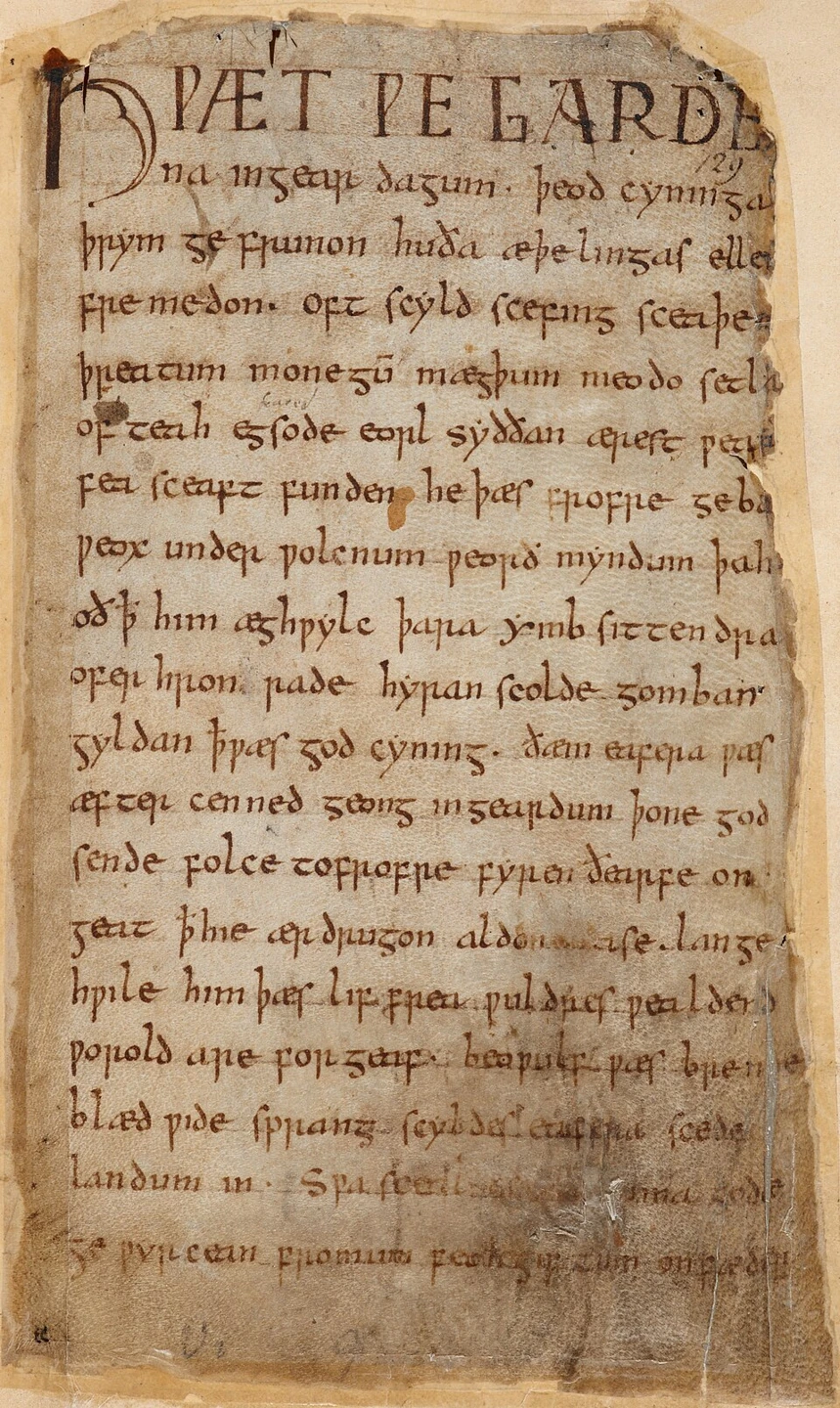
Opening folio of Beowulf, Cotton MS Vitellius A XV, f. 132r. Commons identifies the language as primarily West Saxon Old English and dates the manuscript to approximately 975–1025. Not independently transcribed.
Saved in Babelbook · resized display copy. Select the image to open it independently of its source.
Anonymous Anglo-Saxon poet; digital reproduction supplied by the British Library · Source ↗Public domain (PD-Art) ↗View the local visual field note
Representative reference points from Glottolog. Historical entries show reference locations, not current speakers. 1 point.
Reference & context ↗Babelbook · original editorial illustration · CC BY 4.0 · Glottolog locations; public-domain Natural Earth land
Source excerpts, selected, shortened and where noted editorially corrected from Old English by Wikipedia contributors. Retrieved 2026-10-05. CC BY-SA 4.0. These excerpts are not an independently verified scholarly history; missing accounts are identified above.
Read further in the source
History
Old English was not static, and its usage covered a period of 700 years, from the Anglo-Saxon settlement of Britain in the 5th century to the late 11th century, some time after the Norman Conquest. While indicating that the establishment of dates is an arbitrary process, Albert Baugh dates Old English from 450 to 1150, a period of full inflections, a synthetic language. Perhaps around 85% of Old English words are no longer in use, but those that survived are the basic elements of Modern English vocabulary. Old English is a West Germanic language, and developed out of North Sea Germanic dialects from the 5th century. It came to be spoken over most of the territory of the Anglo-Saxon kingdoms which became the Kingdom of England. This included most of present-day England, as well as part of what is now southeastern Scotland, which for several centuries belonged to the kingdom of Northumbria. Other parts of the island continued to use Celtic languages (Gaelic – and perhaps some Pictish – in most of Scotland, Medieval Cornish all over Cornwall and in adjacent parts of Devon, Cumbric perhaps to the 12th century in parts of Cumbria, and Welsh in Wales and possibly also on the English side of the Anglo-Welsh border); except in the areas of Scandinavian settlements, where Old Norse was spoken and Danish law applied. Old English literacy developed after the Christianisation of Anglo-Saxon England in the late 7th century. The oldest surviving work of Old English literature is Cædmon's Hymn, which was composed between 658 and 680 but not written down until the early 8th century. There is a limited corpus of runic inscriptions from the 5th to 7th centuries, but the oldest coherent runic texts (notably the inscriptions on the Franks Casket) date to the early 8th century. The Old English Latin alphabet was introduced in the 7th century.
With the unification of several of the Anglo-Saxon kingdoms (outside the Danelaw) by Alfred the Great in the later 9th century, the language of government and literature became standardised around the West Saxon dialect (Early West Saxon). Alfred advocated education in English alongside Latin, and had many works translated into the English language; some of them, such as Pope Gregory I's treatise Pastoral Care, appear to have been translated by Alfred himself. In Old English, typical of the development of literature, poetry arose before prose, but Alfred chiefly inspired the growth of prose. A later literary standard, dating from the late 10th century, arose under the influence of Bishop Æthelwold of Winchester and was followed by such writers as the prolific Ælfric of Eynsham ("the Grammarian"). This form of the language is known as the "Winchester standard", or more commonly as Late West Saxon. It is considered to represent the classical form of Old English. It retained its position of prestige until the Norman Conquest, after which English ceased for a time to be of importance as a literary language. The history of Old English can be subdivided into:
Prehistoric Old English (c. 450–650) — For this period, Old English is mostly a reconstructed language, as no literary witnesses survive, with the exception of limited epigraphic evidence. This language (or closely related group of dialects spoken by the Angles, Saxons, and Jutes, and pre-dating documented Old English or Anglo-Saxon) has also been called Primitive Old English. Early Old English (c. 650–900) — The period of the oldest manuscript traditions, with authors such as Cædmon, Bede, Cynewulf, and Aldhelm. Late Old English (c. 900–1150) — The final stage of the language leading up to the Norman conquest of England and the subsequent transition to Early Middle English. The Old English period is followed by Middle English (1150–1500), Early Modern English (1500–1650), and finally Modern English (after 1650); and in Scotland by Early Scots (before 1450), Middle Scots (c. 1450–1700), and Modern Scots (after 1700).
Dialects
Just as Modern English is not monolithic, Old English varied according to place. Despite the diversity of language among the Germanic-speaking migrants who established Old English in England and southeastern Scotland, it is possible to reconstruct proto-Old English as a fairly unitary language. For the most part the differences between the attested regional dialects of Old English developed within England and southeastern Scotland, rather than on the mainland of Europe. Although dating from the 10th century, Old English writing from all regions tended to conform to a written standard based on Late West Saxon, in speech Old English continued to exhibit much local and regional variation, which remained in Middle English and to some extent Modern English dialects. The four main dialectal forms of Old English were Mercian, Northumbrian, Kentish, and West Saxon. Mercian and Northumbrian are together referred to as Anglian. In terms of geography the Northumbrian region lay north of the Humber River; the Mercian lay north of the Thames and south of the Humber River; West Saxon lay south and southwest of the Thames; and the Kentish region lay southeast of the Thames in a small corner of England. The Kentish region, settled by the Jutes from Jutland, has the scantest literary remains. The term West Saxon actually is represented by two different dialects: Early West Saxon and Late West Saxon. Hogg has suggested that these dialects would be more appropriately named Alfredian Saxon and Æthelwoldian Saxon, respectively, so that the naive reader would not assume that they are chronologically related. Each of these four dialects was associated with an independent kingdom on the island. Of these, Northumbria south of the Tyne and most of Mercia were overrun by the Vikings during the 9th century. The portion of Mercia that was successfully defended and all of Kent were then integrated into Wessex under Alfred the Great. From that time on, the West Saxon dialect (then in the form now known as Early West Saxon) became standardised as the language of government and as the basis for the many works of literature and religious materials produced or translated from Latin in that period. The later literary standard known as Late West Saxon (see § History), although centred in the same region of the country, appears not to have been directly descended from Alfred's Early West Saxon. For example, the former diphthong /iy/ tended to become monophthongised to /i/ in EWS, but to /y/ in LWS. Due to the centralisation of power and the destruction wrought by Viking invasions, there is relatively little written record of the non-West Saxon dialects after Alfred's unification. Some Mercian texts continued to be written, however, and the influence of Mercian is apparent in some of the translations produced under Alfred's programme, many of which were produced by Mercian scholars. Other dialects certainly continued to be spoken, as is evidenced by the continued variation between their successors in Middle and Modern English. In fact, what would become the standard forms of Middle English and of Modern English are descended from Mercian rather than West Saxon, while Scots developed from the Northumbrian dialect. It was once claimed that, owing to its position at the heart of the Kingdom of Wessex, the relics of Anglo-Saxon accent, idiom and vocabulary were best preserved in the dialect of Somerset.
Orthography
Old English was first written in runes, using the futhorc – a rune set derived from the Germanic 24-character elder futhark, extended by five more runes used to represent Anglo-Saxon vowel sounds and sometimes by several more additional characters. From around the 8th century, the runic system came to be supplanted by a (minuscule) half-uncial script of the Latin alphabet introduced by Irish Christian missionaries. This was replaced by Insular script, a cursive and pointed version of the half-uncial script. This was used until the end of the 12th century when continental Carolingian minuscule (also known as Caroline) replaced the insular. The Latin alphabet of the time still lacked the letters ⟨j⟩ and ⟨w⟩, and there was no ⟨v⟩ as distinct from ⟨u⟩; moreover native Old English spellings did not use ⟨k⟩, ⟨q⟩ or ⟨z⟩. The remaining 20 Latin letters were supplemented by 4 more: ⟨æ⟩ (æsc, modern ash) and ⟨ð⟩ (ðæt, now called eth or edh), which were modified Latin letters, and thorn ⟨þ⟩ and wynn ⟨ƿ⟩, which are borrowings from the futhorc. A few letter pairs were used as digraphs, representing a single sound. Also used was the Tironian note ⟨⁊⟩ (a character similar to the digit ⟨7⟩) for the conjunction and. A common scribal abbreviation was a thorn with a stroke ⟨ꝥ⟩, which was used for the pronoun þæt (that). Macrons over vowels were originally used not to mark long vowels (as in modern editions), but to indicate stress, or as abbreviations for a following ⟨m⟩ or ⟨n⟩. Modern editions of Old English manuscripts generally introduce some additional conventions. The modern forms of Latin letters are used, including ⟨g⟩ instead of insular G, ⟨s⟩ instead of insular S and long S, and others which may differ considerably from the insular script, notably ⟨e⟩, ⟨f⟩ and ⟨r⟩. Macrons are used to indicate long vowels, where usually no distinction was made between long and short vowels in the originals. (In some older editions an acute accent mark was used for consistency with Old Norse conventions.) Additionally, modern editions often distinguish between velar and palatal ⟨c⟩ and ⟨g⟩ by placing dots above the palatals: ⟨ċ⟩, ⟨ġ⟩. The letter wynn ⟨ƿ⟩ is usually replaced with ⟨w⟩, but ⟨æ⟩, ⟨ð⟩ and ⟨þ⟩ are normally retained – except when ⟨ð⟩ is replaced by ⟨þ⟩. In contrast with modern English orthography, Old English spelling was reasonably regular, with a mostly predictable correspondence between letters and phonemes. There were not usually any silent letters – in the word cniht, for example, both the ⟨c⟩ and ⟨h⟩ were pronounced (/knixt ~ kniçt/) unlike the ⟨k⟩ and ⟨gh⟩ in the modern knight (/naɪt/). One exception was the occasional insertion of a silent ⟨e⟩ between a palatal consonant and an immediately following back vowel. While most of the sound changes that produced palatal consonants had occurred only before front vowels (and sometimes before /j/), later sound changes often deleted the responsible front vowel or /j/, resulting in a palatal consonant occurring in a "forbidden" position, i.e. before a back vowel. Additionally, certain cases of /j/ were inherited directly from Proto-Germanic rather than occurring due to palatalisation of /ɣ/, and so could freely occur before back vowels. To avoid ambiguity, scribes occasionally inserted the silent ⟨e⟩ to mark the "forbidden" palatal – for example, the verb smēaġan (/ˈsmæ͜ːɑ.jɑn/), which retains an inherited /j/, was sometimes written as ⟨smeagean⟩.
Doubled consonants are geminated; the geminate fricatives ⟨ff⟩, ⟨ss⟩ and ⟨ðð⟩/⟨þþ⟩/⟨ðþ⟩/⟨þð⟩ are always voiceless [ff], [ss], [θθ].
Early history
The earliest history of Old English lexicography lies in the Anglo-Saxon period itself, when English-speaking scholars created English glosses on Latin texts. At first, these were often marginal or interlinear glosses; however, they soon came to be gathered into word-lists such as the Épinal-Erfurt, Leiden and Corpus Glossaries. Over time, these word-lists were consolidated and alphabetised to create extensive Latin–Old English glossaries with some of the character of dictionaries, such as the Cleopatra Glossaries, the Harley Glossary and the Brussels Glossary. In some cases, the material in these glossaries continued to be circulated and updated in Middle English glossaries, such as the Durham Plant-Name Glossary and the Laud Herbal Glossary. Old English lexicography was revived in the early modern period, drawing heavily on Anglo-Saxons' own glossaries. The major publication at this time was William Somner's Dictionarium Saxonico-Latino-Anglicum. The next substantial Old English dictionary was Joseph Bosworth's Anglo-Saxon Dictionary of 1838.