Arabic
Arabic is a Central Semitic language of the Afroasiatic language family spoken primarily in the Arab world. The International Organization for Standardization (ISO) assigns language codes to 32 varieties of Arabic, including its standard form of Literary Arabic, known as Modern Standard Arabic, which is derived from Classical Arabic. This distinction is primarily made by Western linguists; Arabic speakers themselves generally do not distinguish between Modern Standard Arabic and Classical Arabic, but rather refer to both as al-ʿarabiyyatu l-fuṣḥā (اَلْعَرَبِيَّةُ ٱلْفُصْحَىٰ "the eloquent Arabic") or simply al-fuṣḥā (اَلْفُصْحَىٰ). Arabic is the third–most widespread official language after English and French, one of six official languages of the United Nations, and the liturgical language of Islam. Arabic is widely taught in schools and universities around the world and is used to varying degrees in workplaces, governments and the media. Arabic is spoken by as many as 380 million speakers, both native and non-native, in the Arab world, making it the fifth–most spoken language in the world and the fourth–most used language on the Internet in terms of users. It also serves as the liturgical language of around two billion Muslims. In 2011, Bloomberg Businessweek ranked Arabic the fourth–most useful language for business, after English, Mandarin Chinese, and French.
Translate in Arabic ↗With the sole exception of medieval linguist Abu Hayyan al-Gharnati – who, while a scholar of the Arabic language, was not ethnically Arab – medieval scholars of the Arabic language made no efforts at studying comparative linguistics, considering all other languages inferior. In modern times, the educated upper classes in the Arab world have taken a nearly opposite view. Yasir Suleiman wrote in 2011 that "studying and knowing English or French in most of the Middle East and North Africa have become a badge of sophistication and modernity and ... feigning, or asserting, weakness or lack of facility in Arabic is sometimes paraded as a sign of status, class, and perversely, even education through a mélange of code-switching practices."
Middle East & North Africa
Present-day use
Arabic usually refers to Standard Arabic, which Western linguists divide into Classical Arabic and Modern Standard Arabic. It could also refer to any of a variety of regional vernacular Arabic dialects, which are not necessarily mutually intelligible.Classical Arabic is the language found in the Quran, used from the period of Pre-Islamic Arabia to that of the Abbasid Caliphate. Classical Arabic is prescriptive, according to the syntactic and grammatical norms laid down by classical grammarians (such as Sibawayh) and the vocabulary defined in classical dictionaries (such as the Lisān al-ʻArab). Modern Standard Arabic (MSA) largely follows the grammatical standards of Classical Arabic and uses much of the same vocabulary. However, it has discarded some grammatical constructions and vocabulary that no longer have any counterpart in the spoken varieties and has adopted certain new constructions and vocabulary from the spoken varieties. Much of the new vocabulary is used to denote concepts that have arisen in the industrial and post-industrial era, especially in modern times. Due to its grounding in Classical Arabic, Modern Standard Arabic is removed over a millennium from everyday speech, which is construed as a multitude of dialects of this language. These dialects and Modern Standard Arabic are described by some scholars as not mutually comprehensible. The former are usually acquired in families, while the latter is taught in formal education settings.
Origins
The captured article does not contain a separate origins section. See the historical account and linked source.
Development
Ibn Jinni of Mosul, a pioneer in phonology, wrote prolifically in the 10th century on Arabic morphology and phonology in works such as Kitāb Al-Munṣif, Kitāb Al-Muḥtasab, and Kitāb Al-Khaṣāʾiṣ . Ibn Mada' of Cordoba (1116–1196) realized the overhaul of Arabic grammar first proposed by Al-Jahiz 200 years prior. The Maghrebi lexicographer Ibn Manzur compiled Lisān al-ʿArab (لسان العرب, "Tongue of Arabs"), a major reference dictionary of Arabic, in 1290.
Writing
The Arabic alphabet derives from the Aramaic through Nabatean, to which it bears a loose resemblance like that of Coptic or Cyrillic scripts to Greek script. Traditionally, there were several differences between the Western (North African) and Middle Eastern versions of the alphabet—in particular, the faʼ had a dot underneath and qaf a single dot above in the Maghreb, and the order of the letters was slightly different (at least when they were used as numerals). However, the old Maghrebi variant has been abandoned except for calligraphic purposes in the Maghreb itself, and remains in use mainly in the Quranic schools (zaouias) of West Africa. Arabic, like all other Semitic languages (except for the Latin-written Maltese, and the languages with the Ge'ez script), is written from right to left. There are several styles of scripts such as thuluth, muhaqqaq, tawqi, rayhan, and notably naskh, which is used in print and by computers, and ruqʻah, which is commonly used for correspondence. Originally Arabic was made up of only rasm without diacritical marks Later diacritical points (which in Arabic are referred to as nuqaṯ) were added (which allowed readers to distinguish between letters such as b, t, th, n and y). Finally signs known as Tashkil were used for short vowels known as harakat and other uses such as final postnasalized or long vowels. Notes: Modern Standard Arabic (Literary Arabic) ⟨ج⟩ can be pronounced /d͡ʒ/, /ʒ/, /ɟ/, or /g/ depending on the speaker's regional dialect. The Hamza ⟨ء⟩ can be considered a letter and plays an important role in Arabic spelling but it is not considered part of the alphabet, it has different written forms depending on its position in the word, check Hamza.
Beyond the typeface.
Signs, manuscripts, published pages and contextual photographs, with their place, period, source and reuse terms. Captions identify historical spellings, regional examples, community references and character imagery.
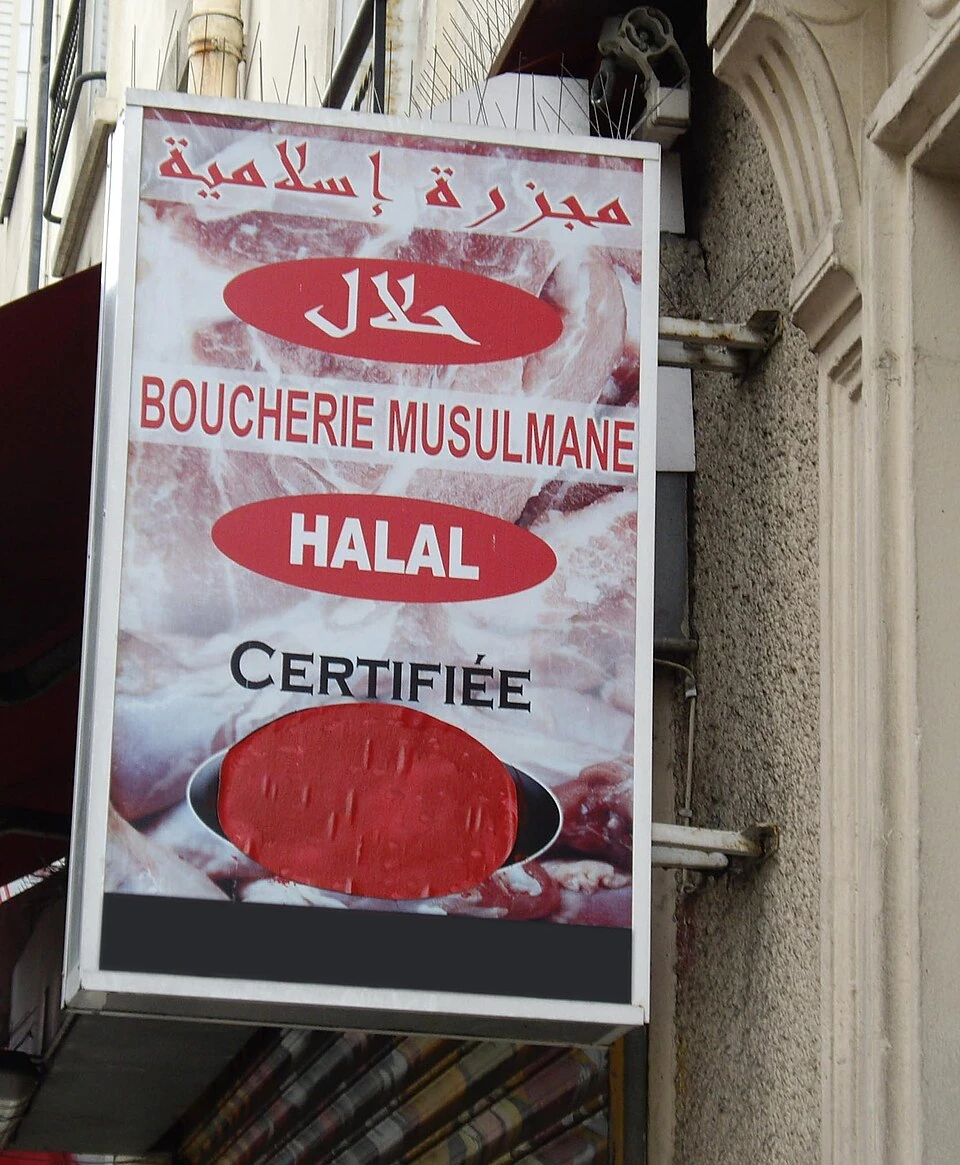
Arabic alongside French on Rue de Patay, photographed in 2010. The source derivative removes a telephone number. Displayed at reduced size; no additional crop.
Saved in Babelbook · resized display copy. Select the image to open it independently of its source.
Wikimedia Commons / Mu; edited by Econobre · Source ↗CC BY-SA 3.0 ↗View the local visual field note
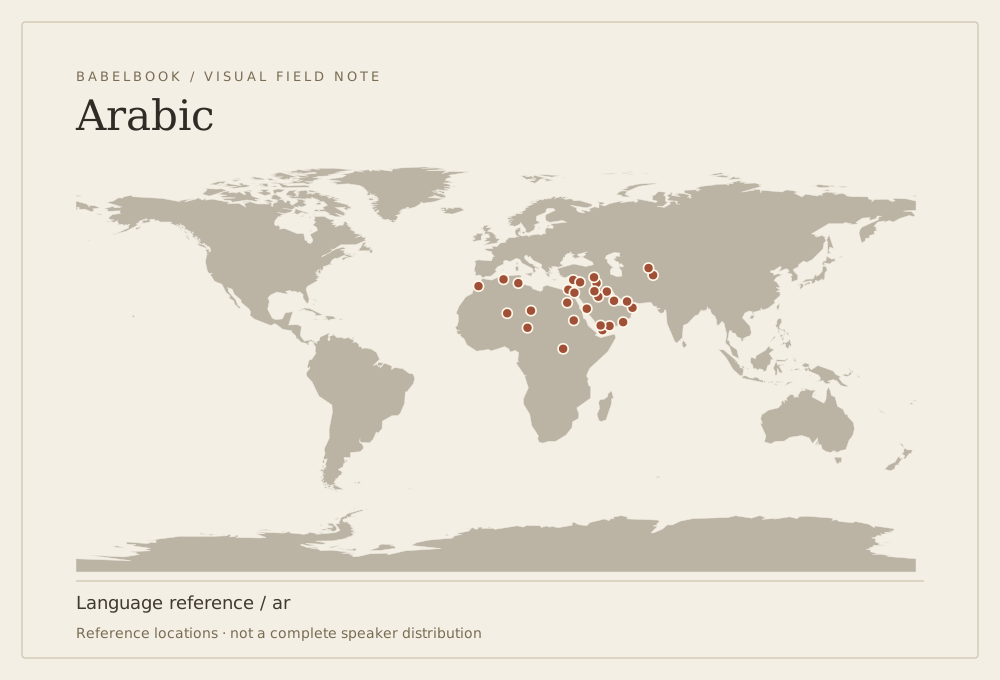
Representative reference points from Glottolog. Historical entries show reference locations, not current speakers. 28 points.
Reference & context ↗Babelbook · original editorial illustration · CC BY 4.0 · Glottolog locations; public-domain Natural Earth land
Source excerpts, selected, shortened and where noted editorially corrected from Arabic by Wikipedia contributors. Retrieved 2026-10-05. CC BY-SA 4.0. These excerpts are not an independently verified scholarly history; missing accounts are identified above.
Read further in the source
Standardization
Abu al-Aswad al-Du'ali (c. 603–689) is credited with standardizing Arabic grammar, or an-naḥw (النَّحو "the way"), and pioneering a system of diacritics to differentiate consonants (نقط الإعجام nuqaṭu‿l-i'jām "pointing for non-Arabs") and indicate vocalization (التشكيل at-tashkīl). Al-Khalil ibn Ahmad al-Farahidi (718–786) compiled the first Arabic dictionary, Kitāb al-'Ayn (كتاب العين "The Book of the Letter ع"), and is credited with establishing the rules of Arabic prosody. Al-Jahiz (776–868) proposed to Al-Akhfash al-Akbar an overhaul of the grammar of Arabic, but it would not come to pass for two centuries. The standardization of Arabic reached completion around the end of the 8th century. The first comprehensive description of the ʿarabiyya "Arabic", Sībawayhi's al-Kitāb, is based first of all upon a corpus of poetic texts, in addition to Qur'an usage and Bedouin informants whom he considered to be reliable speakers of the ʿarabiyya.
Classical, Modern Standard and spoken Arabic
Arabic usually refers to Standard Arabic, which Western linguists divide into Classical Arabic and Modern Standard Arabic. It could also refer to any of a variety of regional vernacular Arabic dialects, which are not necessarily mutually intelligible.Classical Arabic is the language found in the Quran, used from the period of Pre-Islamic Arabia to that of the Abbasid Caliphate. Classical Arabic is prescriptive, according to the syntactic and grammatical norms laid down by classical grammarians (such as Sibawayh) and the vocabulary defined in classical dictionaries (such as the Lisān al-ʻArab). Modern Standard Arabic (MSA) largely follows the grammatical standards of Classical Arabic and uses much of the same vocabulary. However, it has discarded some grammatical constructions and vocabulary that no longer have any counterpart in the spoken varieties and has adopted certain new constructions and vocabulary from the spoken varieties. Much of the new vocabulary is used to denote concepts that have arisen in the industrial and post-industrial era, especially in modern times. Due to its grounding in Classical Arabic, Modern Standard Arabic is removed over a millennium from everyday speech, which is construed as a multitude of dialects of this language. These dialects and Modern Standard Arabic are described by some scholars as not mutually comprehensible. The former are usually acquired in families, while the latter is taught in formal education settings. However, there have been studies reporting some degree of comprehension of stories told in the standard variety among preschool-aged children. The relation between Modern Standard Arabic and these dialects is sometimes compared to that of Classical Latin and Vulgar Latin vernaculars (which became Romance languages) in medieval and early modern Europe. MSA is the variety used in most current, printed Arabic publications, spoken by some of the Arabic media across North Africa and the Middle East, and understood by most educated Arabic speakers. "Literary Arabic" and "Standard Arabic" (فُصْحَى fuṣḥá) are less strictly defined terms that may refer to Modern Standard Arabic or Classical Arabic. Some of the differences between Classical Arabic (CA) and Modern Standard Arabic (MSA) are as follows:
Certain grammatical constructions of CA that have no counterpart in any modern vernacular dialect (e.g., the energetic mood) are almost never used in Modern Standard Arabic. Case distinctions are very rare in Arabic vernaculars. As a result, MSA is generally composed without case distinctions in mind, and the proper cases are added after the fact, when necessary. Because most case endings are noted using final short vowels, which are normally left unwritten in the Arabic script, it is unnecessary to determine the proper case of most words. The practical result of this is that MSA, like English and Standard Chinese, is written in a strongly determined word order and alternative orders that were used in CA for emphasis are rare. In addition, because of the lack of case marking in the spoken varieties, most speakers cannot consistently use the correct endings in extemporaneous speech. As a result, spoken MSA tends to drop or regularize the endings except when reading from a prepared text. The numeral system in CA is complex and heavily tied in with the case system. This system is never used in MSA, even in the most formal of circumstances; instead, a greatly simplified system is used, approximating the system of the conservative spoken varieties.
MSA uses much Classical vocabulary (e.g., dhahaba 'to go') that is not present in the spoken varieties, but deletes Classical words that sound obsolete in MSA. In addition, MSA has borrowed or coined many terms for concepts that did not exist in Quranic times, and MSA continues to evolve. Some words have been borrowed from other languages—notice that transliteration mainly indicates spelling and not real pronunciation (e.g., فِلْم film 'film' or ديمقراطية dīmuqrāṭiyyah 'democracy'). The current preference is to avoid direct borrowings, preferring to either use loan translations (e.g., فرع farʻ 'branch', also used for the branch of a company or organization; جناح janāḥ 'wing', is also used for the wing of an airplane, building, air force, etc.), or to coin new words using forms within existing roots (استماتة istimātah 'apoptosis', using the root موت m/w/t 'death' put into the Xth form, or جامعة jāmiʻah 'university', based on جمع jamaʻa 'to gather, unite'; جمهورية jumhūriyyah 'republic', based on جمهور jumhūr 'multitude'). An earlier tendency was to redefine an older word although this has fallen into disuse (e.g., هاتف hātif 'telephone' < 'invisible caller (in Sufism)'; جريدة jarīdah 'newspaper' < 'palm-leaf stalk').
Colloquial or dialectal Arabic refers to the many national or regional varieties which constitute the everyday spoken language. Colloquial Arabic has many regional variants; geographically distant varieties usually differ enough to be mutually unintelligible, and some linguists consider them distinct languages. However, research indicates a high degree of mutual intelligibility between closely related Arabic variants for native speakers listening to words, sentences, and texts; and between more distantly related dialects in interactional situations.The varieties are typically unwritten. They are often used in informal spoken media, such as soap operas and talk shows, as well as occasionally in certain forms of written media such as poetry and printed advertising. Hassaniya Arabic, Maltese, and Cypriot Arabic are only varieties of modern Arabic to have acquired official recognition. Hassaniya is official in Mali and recognized as a minority language in Morocco, while the Senegalese government adopted the Latin script to write it. Maltese is official in (predominantly Catholic) Malta and written with the Latin script. Linguists agree that it is a variety of spoken Arabic, descended from Siculo-Arabic, though it has experienced extensive changes as a result of sustained and intensive contact with Italo-Romance varieties, and more recently also with English. Due to "a mix of social, cultural, historical, political, and indeed linguistic factors", many Maltese people today consider their language Semitic but not a type of Arabic. Cypriot Arabic is recognized as a minority language in Cyprus.
Status in the Arab world in relation to other languages
With the sole exception of medieval linguist Abu Hayyan al-Gharnati – who, while a scholar of the Arabic language, was not ethnically Arab – medieval scholars of the Arabic language made no efforts at studying comparative linguistics, considering all other languages inferior. In modern times, the educated upper classes in the Arab world have taken a nearly opposite view. Yasir Suleiman wrote in 2011 that "studying and knowing English or French in most of the Middle East and North Africa have become a badge of sophistication and modernity and ... feigning, or asserting, weakness or lack of facility in Arabic is sometimes paraded as a sign of status, class, and perversely, even education through a mélange of code-switching practices."
Dialect groups
Egyptian Arabic, spoken by 67 million people in Egypt. It is one of the most understood varieties of Arabic, due in large part to the widespread distribution of Egyptian films and television shows throughout the Arabic-speaking world. Levantine Arabic, spoken by about 44 million people in Lebanon, Syria, Jordan, Palestine, Israel, and Turkey. Lebanese Arabic is a variety of Levantine Arabic spoken primarily in Lebanon. Jordanian Arabic is a continuum of mutually intelligible varieties of Levantine Arabic spoken by the population of the Kingdom of Jordan. Palestinian Arabic is a name of several dialects of the subgroup of Levantine Arabic spoken by the Palestinians in Palestine, by Arab citizens of Israel and in most Palestinian populations around the world. Samaritan Arabic, spoken by only several hundred in the Nablus region. Cypriot Maronite Arabic, spoken in Cyprus by around 9,800 people (2013 UNSD). Maghrebi Arabic, also called "Darija", spoken by about 70 million people in Morocco, Algeria, Tunisia and Libya. It also forms the basis of Maltese via the extinct Sicilian Arabic dialect. Maghrebi Arabic is very hard to understand for Arabic speakers from the Mashriq or Mesopotamia, the most comprehensible being Libyan Arabic and the most difficult Moroccan Arabic. The others such as Algerian Arabic can be considered in between the two in terms of difficulty. Libyan Arabic, spoken in Libya and neighboring countries. Tunisian Arabic, spoken in Tunisia and north-eastern Algeria. Algerian Arabic, spoken in Algeria. Judeo-Algerian Arabic was spoken by Jews in Algeria until 1962, now it is spoken by a few elderly Algerian Jews in France and Israel. Moroccan Arabic, spoken in Morocco. Hassaniya Arabic (3 million speakers), spoken in Mauritania, Western Sahara, some parts of the Azawad in northern Mali, southern Morocco, and south-western Algeria. Andalusian Arabic, spoken in Spain until the 16th century. Siculo-Arabic (Sicilian Arabic), was spoken in Sicily and Malta between the end of the 9th century and the end of the 12th century and eventually evolved into the Maltese language. Maltese, spoken on the island of Malta, is the only fully separate standardized language to have originated from an Arabic dialect, the extinct Siculo-Arabic dialect, with independent literary norms. Maltese has evolved independently of Modern Standard Arabic and its varieties into a standardized language over the past 800 years in a gradual process of Latinisation. Maltese is therefore considered an exceptional descendant of Arabic that has no diglossic relationship with Standard Arabic or Classical Arabic. Maltese is different from Arabic and other Semitic languages since its morphology has been deeply influenced by Romance languages, Italian and Sicilian. It is the only Semitic language written in the Latin script. In terms of basic everyday language, speakers of Maltese are reported to be able to understand less than a third of what is said to them in Tunisian Arabic, which is related to Siculo-Arabic, whereas speakers of Tunisian are able to understand about 40% of what is said to them in Maltese. This asymmetric intelligibility is considerably lower than the mutual intelligibility found between Maghrebi Arabic dialects. Maltese has its own dialects, with urban varieties of Maltese being closer to Standard Maltese than rural varieties. Mesopotamian Arabic, spoken by about 41.2 million people in Iraq (where it is called "Aamiyah"), eastern Syria and southwestern Iran (Khuzestan) and in the southeastern of Turkey (in the eastern Mediterranean, Southeastern Anatolia Region). North Mesopotamian Arabic is a spoken north of the Hamrin Mountains in Iraq, in western Iran, northern Syria, and in southeastern Turkey (in the eastern Mediterranean Region, Southeastern Anatolia Region, and southern Eastern Anatolia region). Judeo-Mesopotamian Arabic, also known as Iraqi Judeo Arabic and Yahudic, is a variety of Arabic spoken by Iraqi Jews of Mosul. Baghdad Arabic is the Arabic dialect spoken in Baghdad, and the surrounding cities and it is a subvariety of Mesopotamian Arabic. Baghdad Jewish Arabic is the dialect spoken by the Iraqi Jews of Baghdad. South Mesopotamian Arabic (Basrawi dialect) is the dialect spoken in southern Iraq, such as Basra, Dhi Qar, and Najaf. Khuzestani Arabic, spoken in the Iranian province of Khuzestan. This is a mix of Southern Mesopotamian Arabic and Gulf Arabic. Khorasani Arabic, spoken in the Iranian province of Khorasan. Kuwaiti Arabic is a Gulf Arabic dialect spoken in Kuwait. Sudanese Arabic, spoken by 17 million people in Sudan and some parts of southern Egypt. Sudanese Arabic is quite distinct from the dialect of its neighbor to the north; rather, the Sudanese have a dialect similar to the Hejazi dialect. Juba Arabic, spoken in South Sudan and southern far Sudan. Gulf Arabic, spoken by around four million people, predominantly in Kuwait, Bahrain, some parts of Oman, eastern Saudi Arabia coastal areas and some parts of UAE and Qatar. Also spoken in Iran's Bushehr and Hormozgan provinces. Although Gulf Arabic is spoken in Qatar, most Qatari citizens speak Najdi Arabic (Bedawi). Omani Arabic, distinct from the Gulf Arabic of Eastern Arabia and Bahrain, spoken in Central Oman. With its oil wealth and mobility it has spread to various areas of the former Sultanate of Muscat, especially Zanzibar and the Swahili Coast. Hadhrami Arabic, spoken by around 8 million people, predominantly in Hadhramaut, and in parts of the Arabian Peninsula, South and Southeast Asia, and East Africa by Hadhrami descendants. Indonesian Arabic, spoken in Arab ethnic enclaves in Indonesia, especially along the north coast of Java. It has about 60,000 speakers according to a rough estimate in 2010. Yemeni Arabic, spoken in Yemen, and southern Saudi Arabia by 15 million people. Similar to Gulf Arabic. Najdi Arabic, spoken by around 10 million people, mainly spoken in Najd, central and northern Saudi Arabia. Most Qatari citizens speak Najdi Arabic (Bedawi). Hejazi Arabic (6 million speakers), spoken in Hejaz, western Saudi Arabia. Saharan Arabic spoken in some parts of Algeria, Niger and Mali. Baharna Arabic (800,000 speakers), spoken by Bahrani Shias in Bahrain and Qatif, the dialect exhibits many big differences from Gulf Arabic. It is also spoken to a lesser extent in Oman. Judeo-Arabic dialects – these are the dialects spoken by the Jews that had lived or continue to live in the Arab World. As Jewish migration to Israel took hold, the language did not thrive and is now considered endangered. So-called Qəltu Arabic. Chadian Arabic, spoken in Chad, Sudan, some parts of South Sudan, Central African Republic, Niger, Nigeria, and Cameroon. Central Asian Arabic, spoken in Uzbekistan, Tajikistan, and Afghanistan by around 8,000 people. Tajiki Arabic is highly endangered. Shirvani Arabic, spoken in Azerbaijan and Dagestan until the 1930s, now extinct.
Writing system
The Arabic alphabet derives from the Aramaic through Nabatean, to which it bears a loose resemblance like that of Coptic or Cyrillic scripts to Greek script. Traditionally, there were several differences between the Western (North African) and Middle Eastern versions of the alphabet—in particular, the faʼ had a dot underneath and qaf a single dot above in the Maghreb, and the order of the letters was slightly different (at least when they were used as numerals). However, the old Maghrebi variant has been abandoned except for calligraphic purposes in the Maghreb itself, and remains in use mainly in the Quranic schools (zaouias) of West Africa. Arabic, like all other Semitic languages (except for the Latin-written Maltese, and the languages with the Ge'ez script), is written from right to left. There are several styles of scripts such as thuluth, muhaqqaq, tawqi, rayhan, and notably naskh, which is used in print and by computers, and ruqʻah, which is commonly used for correspondence. Originally Arabic was made up of only rasm without diacritical marks Later diacritical points (which in Arabic are referred to as nuqaṯ) were added (which allowed readers to distinguish between letters such as b, t, th, n and y). Finally signs known as Tashkil were used for short vowels known as harakat and other uses such as final postnasalized or long vowels.
Notes:
Modern Standard Arabic (Literary Arabic) ⟨ج⟩ can be pronounced /d͡ʒ/, /ʒ/, /ɟ/, or /g/ depending on the speaker's regional dialect. The Hamza ⟨ء⟩ can be considered a letter and plays an important role in Arabic spelling but it is not considered part of the alphabet, it has different written forms depending on its position in the word, check Hamza.