Imperial Aramaic
Imperial Aramaic is a linguistic term, coined by modern scholars in order to designate a specific historical variety of Aramaic. The term is polysemic, with two distinctive meanings, wider (sociolinguistic) and narrower (dialectological). Since most surviving examples of the language have been found in Egypt, the language is also referred to as Egyptian Aramaic. Some scholars use the term as a designation for a distinctive, socially prominent phase in the history of Aramaic language, that lasted from the middle of the 8th century BCE to the end of the 4th century BCE and was marked by the use of Aramaic as a language of public life and administration in the late Neo-Assyrian Empire and its successor states, the Neo-Babylonian Empire and the Achaemenid Empire, also adding to that some later (Post-Imperial) uses that persisted throughout the early Hellenistic period. Other scholars use the term Imperial Aramaic in a narrower sense, reduced only to the Achaemenid period, basing that reduction on several strictly linguistic distinctions between the previous (Neo-Assyrian and Neo-Babylonian) phase and later (more prominent) Achaemenid phase. Since all of those phases can be semantically labelled as "imperial", some scholars opt for the use of more specific and unambiguous terms, like Neo-Assyrian Aramaic and Neo-Babylonian Aramaic (for the older phases), and Achaemenid Aramaic (for the later phase), thus avoiding the use of the polysemic "imperial" label, and its primarily sociolinguistic implications.
Translate in Imperial Aramaic ↗Imperial Aramaic is a linguistic term, coined by modern scholars in order to designate a specific historical variety of Aramaic. The term is polysemic, with two distinctive meanings, wider (sociolinguistic) and narrower (dialectological). Since most surviving examples of the language have been found in Egypt, the language is also referred to as Egyptian Aramaic. Some scholars use the term as a designation for a distinctive, socially prominent phase in the history of Aramaic language, that lasted from the middle of the 8th century BCE to the end of the 4th century BCE and was marked by the use of Aramaic as a language of public life and administration in the late Neo-Assyrian Empire and its successor states, the Neo-Babylonian Empire and the Achaemenid Empire, also adding to that some later (Post-Imperial) uses that persisted throughout the early Hellenistic period. Other scholars use the term Imperial Aramaic in a narrower sense, reduced only to the Achaemenid period, basing that reduction on several strictly linguistic distinctions between the previous (Neo-Assyrian and Neo-Babylonian) phase and later (more prominent) Achaemenid phase. Since all of those phases can be semantically labelled as "imperial", some scholars opt for the use of more specific and unambiguous terms, like Neo-Assyrian Aramaic and Neo-Babylonian Aramaic (for the older phases), and Achaemenid Aramaic (for the later phase), thus avoiding the use of the polysemic "imperial" label, and its primarily sociolinguistic implications. Similar issues have arisen in relation to the uses of some alternative terms, like Official Aramaic or Standard Aramaic, that were also criticized as unspecific.
Middle East & North Africa
Present-day use
The captured source does not contain a separate current-use account.
Origins
The captured article does not contain a separate origins section. See the historical account and linked source.
Development
The native speakers of Aramaic, the Arameans, settled in great numbers in Babylonia and Upper Mesopotamia during the ages of the Neo-Assyrian and Neo-Babylonian Empires. The massive influx of settlers led to the adoption of Aramaic as the lingua franca of the Neo-Assyrian Empire. After the Achaemenid conquest of Mesopotamia in 539 BC, the Achaemenids continued the use of Aramaic as the language of the region, further extending its prevalence by making it the imperial standard (thus "Imperial" Aramaic) so it may be the "vehicle for written communication between the different regions of the vast empire with its different peoples and languages." The adoption of a single official language for the various regions of the empire has been cited as a reason for the at the time unprecedented success of the Achaemenids in maintaining the expanse of their empire for a period of centuries.
Writing
The Pahlavi scripts used in the Arsacid and Sassanian Empire as well as in post-Sassanid Zoroastrian writings were derived from the Imperial Aramaic script due to its traditional use by Achaemenid scribes. Apart from the shape of the letters, these scripts contained numerous so-called Aramaeograms, i.e. spellings that had originally expressed Aramaic words phonetically, but had come to be used conventionally as logograms to denote Iranian words.
Beyond the typeface.
Signs, manuscripts, published pages and contextual photographs, with their place, period, source and reuse terms. Captions identify historical spellings, regional examples, community references and character imagery.

Marriage document dated 3 July 449 BCE, Brooklyn Museum 47.218.89. The file identifies Aramaic and belongs to the Elephantine papyri collection, whose Commons metadata explicitly identifies Imperial Aramaic. The museum states no known copyright restrictions; this is not a Creative Commons license.
Saved in Babelbook · resized display copy. Select the image to open it independently of its source.
Unknown ancient scribe; image contributed by Brooklyn Museum · Source ↗No known copyright restrictions (Brooklyn Museum) ↗View the local visual field note
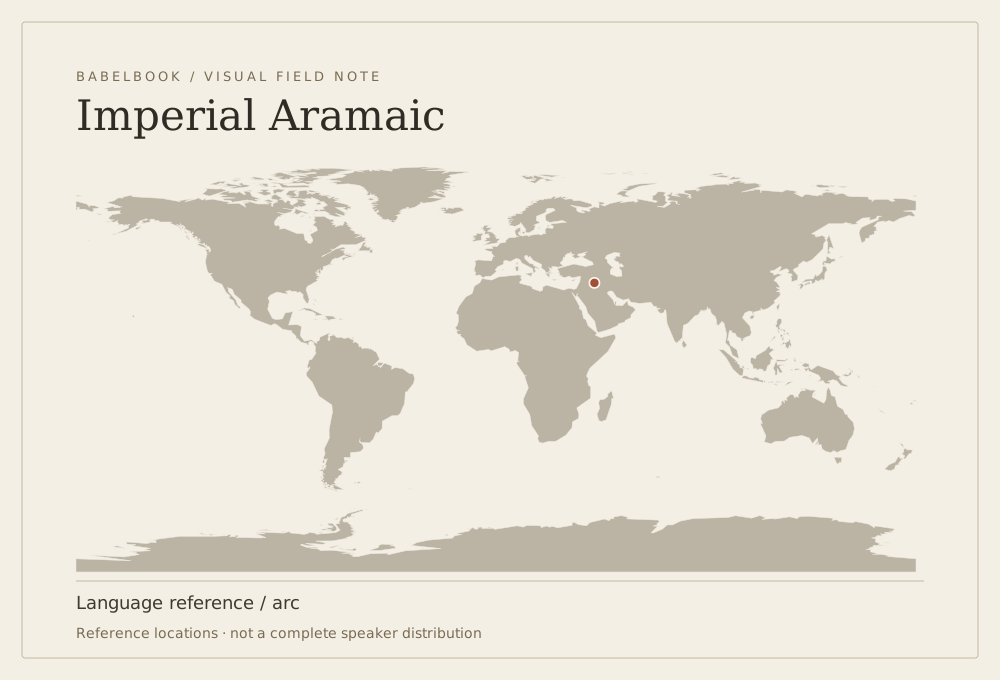
Representative reference points from Glottolog. Historical entries show reference locations, not current speakers. 1 point.
Reference & context ↗Babelbook · original editorial illustration · CC BY 4.0 · Glottolog locations; public-domain Natural Earth land
Source excerpts, selected, shortened and where noted editorially corrected from Imperial Aramaic by Wikipedia contributors. Retrieved 2026-10-05. CC BY-SA 4.0. These excerpts are not an independently verified scholarly history; missing accounts are identified above.
Read further in the source
History
The native speakers of Aramaic, the Arameans, settled in great numbers in Babylonia and Upper Mesopotamia during the ages of the Neo-Assyrian and Neo-Babylonian Empires. The massive influx of settlers led to the adoption of Aramaic as the lingua franca of the Neo-Assyrian Empire. After the Achaemenid conquest of Mesopotamia in 539 BC, the Achaemenids continued the use of Aramaic as the language of the region, further extending its prevalence by making it the imperial standard (thus "Imperial" Aramaic) so it may be the "vehicle for written communication between the different regions of the vast empire with its different peoples and languages." The adoption of a single official language for the various regions of the empire has been cited as a reason for the at the time unprecedented success of the Achaemenids in maintaining the expanse of their empire for a period of centuries.