Assamese
Assamese, also known by its endonyms Asamiya or Oxomiya (অসমীয়া Ôxômiya [ɔxɔmija] ), is an Indo-Aryan language spoken mainly in the north-eastern Indian state of Assam, where it is an official language. It has long served as a lingua franca in parts of Northeast India. It has over 15 million native speakers and 8.3 million second language speakers according to Ethnologue, although this claim is widely disputed by academics, based on census figures. Assamese was designated as a classical Indian language by the Government of India on 3 October 2024 on account of its antiquity and literary traditions. Nefamese, an Assamese-based pidgin in Arunachal Pradesh, was used as a lingua franca before being replaced by Hindi; and Nagamese, an Assamese-based Creole language, continues to be widely used in Nagaland. The Kamtapuri language of Rangpur Division of Bangladesh and the Cooch Behar and Jalpaiguri districts of India is linguistically closest to Assamese and they both are descended from the Kamarupi Prakrit. In the past, it was the court language of the Ahom kingdom from the 17th century. After the differentiation of Maithili and Odia, Assamese was in its formative stages in the 12th century CE from the middle Indo-Aryan Magadhi Prakrit. Its sister languages include Angika, Bengali, Bishnupriya Manipuri, Chakma, Chittagonian, Hajong, Rajbangsi, Surjapuri, Maithili, Rohingya and Sylheti.
Translate in Assamese ↗Assamese is native to Assam and surrounding regions of Northeast India. It is majorly spoken in the state of Assam. Other major areas where the language is extensively used include Arunachal Pradesh’s Namsai, Lohit and Changlang districts; Meghalaya’s west Garo Hills; Nagaland’s Dimapur, Kohima, Mokokchung, Wokha and Zunheboto; West Bengal’s Jalpaiguri and Cooch Behar districts. There is a significant Assamese-speaking diaspora worldwide. Assamese is the official language of Assam, and one of the 22 official languages recognised by the Republic of India. The Assam Secretariat functions in Assamese.
South Asia
Present-day use
The modern period of Assamese begins with printing—the publication of the Assamese Bible in 1813 from the Serampore Mission Press. But after the British East India Company (EIC) removed the Burmese in 1826 and took complete administrative control of Assam in 1836, it filled administrative positions with people from Bengal, and introduced Bengali language in its offices, schools and courts. The EIC had earlier promoted the development of Bengali to replace Persian, the language of administration in Mughal India, and maintained that Assamese was a dialect of Bengali. Amidst this loss of status, the American Baptist Mission (ABM) established a press in Sibsagar in 1846 leading to publications of an Assamese periodical (Orunodoi), the first Assamese grammar by Nathan Brown (1846), and the first Assamese-English dictionary by Miles Bronson (1863). The ABM argued strongly with the EIC officials in an intense debate in the 1850s to reinstate Assamese. Among the local personalities, Anandaram Dhekial Phukan drew up an extensive catalogue of medieval Assamese literature (among other works) and pioneered the effort among the natives to reinstate Assamese in Assam. Though this effort was not immediately successful the administration eventually declared Assamese the official vernacular in 1873 on the eve of Assam becoming a Chief Commissioner's Province in 1874. Assamese is the official language of Assam, and one of the 22 official languages recognised by the Republic of India. The Assam Secretariat functions in Assamese.
Origins
The captured article does not contain a separate origins section. See the historical account and linked source.
Development
Assamese originated in Old Indo-Aryan dialects, though the exact nature of its origin and growth is not clear yet. It is generally believed that Assamese and the Kamatapuri lects derive from the Kamarupi Prakrit, an eastern variety of the Magadhi Prakrit, though an admixture with the Sauraseni Prakrit is also hypothesised by one author. The Indo-Aryan, which appeared in the 4th–5th century in Assam, was probably spoken in the new settlements of Kamarupa—in urban centres and along the Brahmaputra River—surrounded by Tibeto-Burman and Austroasiatic communities. Kakati's (1941) assertion that Assamese has an Austroasiatic substrate is generally assumed—which suggests that when the Indo-Aryan centres formed in the 4th–5th centuries CE, there were substantial Austroasiatic speakers that later accepted the Indo-Aryan vernacular. Based on the 7th-century Chinese traveller Xuanzang's observations, Chatterji (1926) suggests that the Indo-Aryan vernacular differentiated itself in Kamarupa before it did in Bengal, and that these differences could be attributed to non-Indo-Aryan speakers adopting the language. The newly differentiated vernacular, from which Assamese eventually emerged, is evident in the Prakritisms present in the Sanskrit of the Kamarupa inscriptions.
Writing
Modern Assamese uses the Assamese alphabet which was based on the Bengali standard introduced by the missionaries. The traditional Assamese script which was used before the 20th century had significant differences from the Bengali script and as a result of the replacement, the traditional Assamese script is largely illegible to the people trained in the current Bengali-based Assamese alphabet. The traditional Assamese script came in three varieties: Bamuniya, Garhgaya, and Kaitheli/Lakhari, which developed from the Kamarupi script. It is closely related to the Mithilakshar script of the Maithili language, as well as the Bengali alphabet. There is a strong literary tradition from early times. Examples can be seen in edicts, land grants and copper plates of medieval kings. Assam had its own manuscript writing system on the bark of the saanchi tree in which religious texts and chronicles were written, as opposed to the pan-Indian system of Palm leaf manuscript writing. The present-day spellings in Assamese are not necessarily phonetic. Hemkosh (হেমকোষ [ɦɛmkʊx]), the second Assamese dictionary, introduced spellings based on Sanskrit, which are now the standard. Assamese has also historically been written using the Arabic script by Assamese Muslims. One example is Tariqul Haq Fi Bayane Nurul Haq by Zulqad Ali (1796–1891) of Sivasagar, which is one of the oldest works in modern Assamese prose. In the early 1970s, it was agreed upon that the Roman script was to be the standard writing system for Nagamese Creole. In January 2020, the Assam government announced that Assamese would be a mandatory language for government job eligibility.
Beyond the typeface.
Signs, manuscripts, published pages and contextual photographs, with their place, period, source and reuse terms. Captions identify historical spellings, regional examples, community references and character imagery.
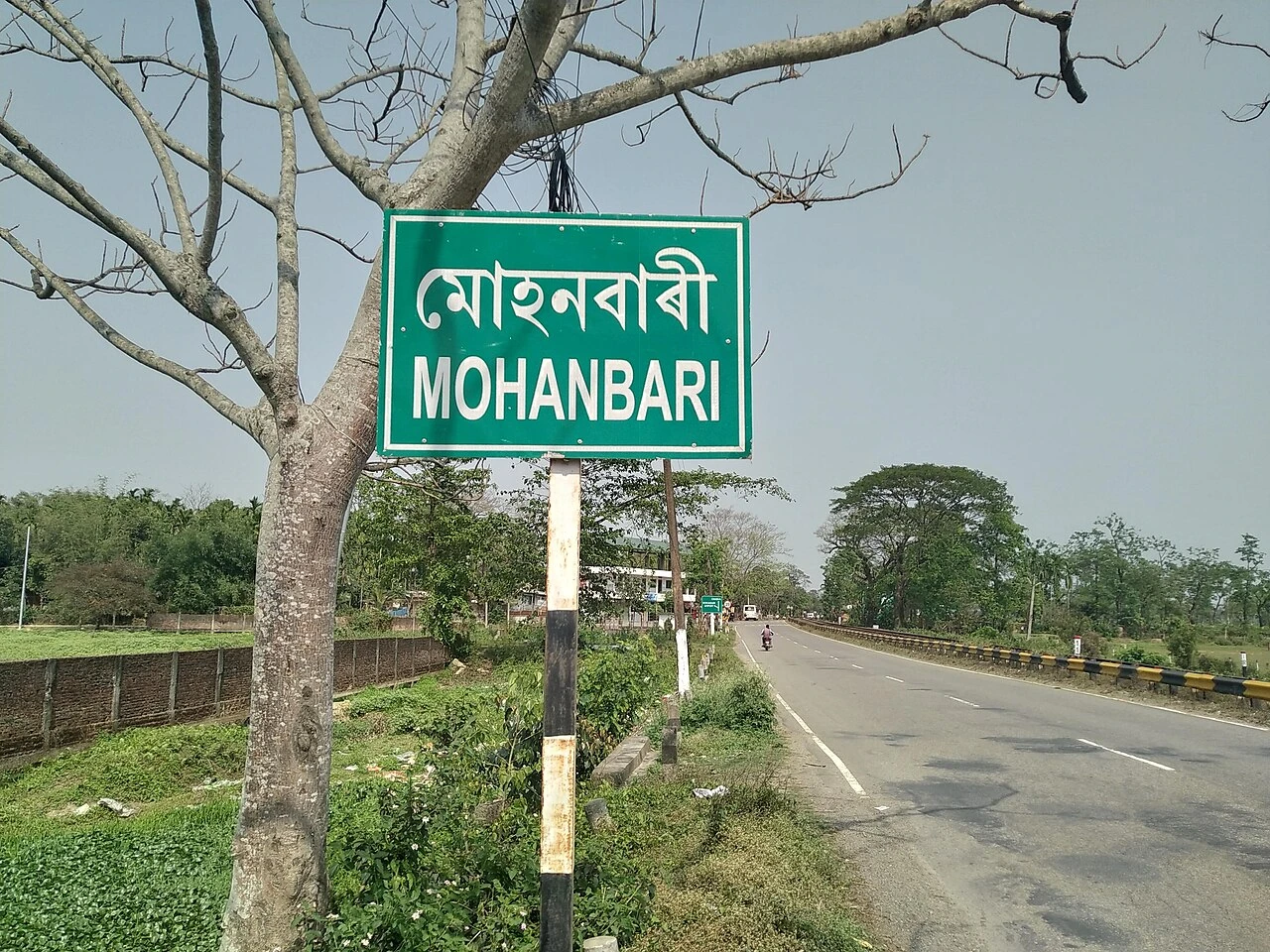
Assamese and English place-name lettering near Dibrugarh Airport, Assam.
Saved in Babelbook · resized display copy. Select the image to open it independently of its source.
SlowPhoton · Source ↗CC BY-SA 4.0 ↗View the local visual field note
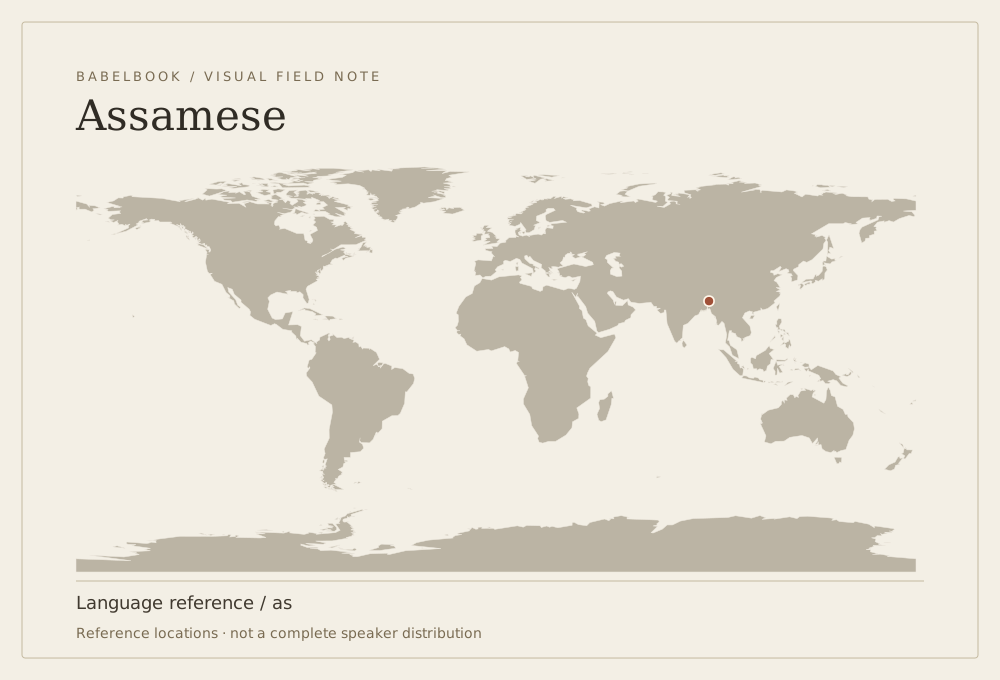
Representative reference points from Glottolog. Historical entries show reference locations, not current speakers. 1 point.
Reference & context ↗Babelbook · original editorial illustration · CC BY 4.0 · Glottolog locations; public-domain Natural Earth land
Source excerpts, selected, shortened and where noted editorially corrected from Assamese language by Wikipedia contributors. Retrieved 2026-10-05. CC BY-SA 4.0. These excerpts are not an independently verified scholarly history; missing accounts are identified above.
Read further in the source
History
Assamese originated in Old Indo-Aryan dialects, though the exact nature of its origin and growth is not clear yet. It is generally believed that Assamese and the Kamatapuri lects derive from the Kamarupi Prakrit, an eastern variety of the Magadhi Prakrit, though an admixture with the Sauraseni Prakrit is also hypothesised by one author. The Indo-Aryan, which appeared in the 4th–5th century in Assam, was probably spoken in the new settlements of Kamarupa—in urban centres and along the Brahmaputra River—surrounded by Tibeto-Burman and Austroasiatic communities. Kakati's (1941) assertion that Assamese has an Austroasiatic substrate is generally assumed—which suggests that when the Indo-Aryan centres formed in the 4th–5th centuries CE, there were substantial Austroasiatic speakers that later accepted the Indo-Aryan vernacular. Based on the 7th-century Chinese traveller Xuanzang's observations, Chatterji (1926) suggests that the Indo-Aryan vernacular differentiated itself in Kamarupa before it did in Bengal, and that these differences could be attributed to non-Indo-Aryan speakers adopting the language. The newly differentiated vernacular, from which Assamese eventually emerged, is evident in the Prakritisms present in the Sanskrit of the Kamarupa inscriptions.
Standardisation
In the extant medieval Assamese manuscripts the orthography was not uniform. The ABM had evolved a phonemic orthography based on a contracted set of characters. Working independently Hemchandra Barua provided an etymological orthography and his etymological dictionary, Hemkosh, was published posthumously. He also provided a Sanskritised approach to the language in his Asamiya Bhaxar Byakaran ("Grammar of the Assamese Language") (1859, 1873). Barua's approach was adopted by the Asamiya Bhasa Unnati Sadhini Sabha (1888, "Assamese Language Development Society") that emerged in Kolkata among Assamese students led by Lakshminath Bezbaroa. The Society published a periodical Jonaki and the period of its publication, Jonaki era, saw spirited negotiations on language standardisation. What emerged at the end of those negotiations was a standard close to the language of the Buranjis with the Sanskritised orthography of Hemchandra Barua. As the political and commercial centre moved to Guwahati in the mid-twentieth century, of which Dispur the capital of Assam is a suburb and which is situated at the border between the western and central dialect speaking regions, standard Assamese used in media and communications today is a neutral blend of the eastern variety without its distinctive features. This core is further embellished with Goalpariya and Kamrupi idioms and forms.
Geographical distribution
Assamese is native to Assam and surrounding regions of Northeast India. It is majorly spoken in the state of Assam. Other major areas where the language is extensively used include Arunachal Pradesh’s Namsai, Lohit and Changlang districts; Meghalaya’s west Garo Hills; Nagaland’s Dimapur, Kohima, Mokokchung, Wokha and Zunheboto; West Bengal’s Jalpaiguri and Cooch Behar districts. There is a significant Assamese-speaking diaspora worldwide.
Official status
Assamese is the official language of Assam, and one of the 22 official languages recognised by the Republic of India. The Assam Secretariat functions in Assamese.
Writing system
Modern Assamese uses the Assamese alphabet which was based on the Bengali standard introduced by the missionaries. The traditional Assamese script which was used before the 20th century had significant differences from the Bengali script and as a result of the replacement, the traditional Assamese script is largely illegible to the people trained in the current Bengali-based Assamese alphabet. The traditional Assamese script came in three varieties: Bamuniya, Garhgaya, and Kaitheli/Lakhari, which developed from the Kamarupi script. It is closely related to the Mithilakshar script of the Maithili language, as well as the Bengali alphabet. There is a strong literary tradition from early times. Examples can be seen in edicts, land grants and copper plates of medieval kings. Assam had its own manuscript writing system on the bark of the saanchi tree in which religious texts and chronicles were written, as opposed to the pan-Indian system of Palm leaf manuscript writing. The present-day spellings in Assamese are not necessarily phonetic. Hemkosh (হেমকোষ [ɦɛmkʊx]), the second Assamese dictionary, introduced spellings based on Sanskrit, which are now the standard. Assamese has also historically been written using the Arabic script by Assamese Muslims. One example is Tariqul Haq Fi Bayane Nurul Haq by Zulqad Ali (1796–1891) of Sivasagar, which is one of the oldest works in modern Assamese prose. In the early 1970s, it was agreed upon that the Roman script was to be the standard writing system for Nagamese Creole. In January 2020, the Assam government announced that Assamese would be a mandatory language for government job eligibility.
Regional dialects
The language has quite a few regional variations. Banikanta Kakati identified two broad dialects which he named (1) Eastern and (2) Western dialects, of which the eastern dialect is homogeneous, and prevalent to the east of Guwahati, and the western dialect is heterogeneous. However, recent linguistic studies have identified four dialect groups and one dialect isolate listed below from east to west to south:
Eastern group in and around the undivided Sivasagar district (Golaghat, Jorhat, Majuli, Charaideo and Sivasagar) and the former undivided Lakhimpur district (Dibrugarh, Tinsukia, Lakhimpur and Dhemaji. Standard Assamese is based on the Eastern group. Central group spoken in Nagaon, Sonitpur, Morigaon districts and adjoining areas Kamrupi group in the Kamrup region: (Barpetia, Nalbariya, Palasbaria) Goalpariya group in the Goalpara region: (Ghulliya, Jharuwa, Caruwa) Cachar dialect (Dehan) in Cachar district of Barak valley
Non-regional dialects
Assamese does not have many caste- or occupation-based dialects. In the nineteenth century, the Eastern dialect became the standard dialect because it witnessed more literary activity and it was more uniform from east of Guwahati to Sadiya, whereas the western dialects were more heterogeneous. Since the nineteenth century, the centre of literary activity (as well as of politics and commerce) has shifted to Guwahati; as a result, the standard dialect has evolved considerably away from the largely rural Eastern dialects and has become more urban and acquired western dialectal elements. Most literary activity takes place in this dialect, and is often called the likhito-bhaxa, though regional dialects are often used in novels and other creative works. In addition to the regional variants, sub-regional, community-based dialects are also prevalent, namely:
Standard dialect influenced by surrounding centres. Bhakatiya dialect highly polite, a sattra-based dialect with a different set of nominals, pronominals, and verbal forms, as well as a preference for euphemism; indirect and passive expressions. Some of these features are used in the standard dialect on very formal occasions. The fisherman community has a dialect that is used in the central and eastern region. The astrologer community of Darrang district has a dialect called thar that is coded and secretive. The ratikhowa and bhitarpanthiya secretive cult-based Vaisnava groups too have their own dialects. The Muslim community have their own dialectal preference, with their own kinship, custom, and religious terms, with those in east Assam having distinct phonetic features. The urban adolescent and youth communities (for example, Guwahati) have exotic, hybrid and local slangs. Ethnic speech communities that use Assamese as a second language, often use dialects that are influenced heavily by the pronunciation, intonation, stress, vocabulary and syntax of their respective first languages (Mising Eastern Assamese, Bodo Central Kamrupi, Rabha Eastern Goalpariya etc.). Two independent pidgins/creoles, associated with the Assamese language, are Nagamese (used by Naga groups) and Nefamese (used in Arunachal Pradesh).