Avaric
Avar (авар мацӀ, avar maⱬ [ʔaˈwar mat͡sʼː] or магӀарул мацӀ, maⱨarul maⱬ [maʕarul mat͡sʼː], 'language of the mountains'), also known as Avaric, is a Northeast Caucasian language of the Avar–Andic subgroup that is spoken by Avars, primarily in Dagestan. In 2010, there were approximately one million speakers in Dagestan and elsewhere in Russia.
Translate in Avaric ↗It is spoken mainly in the western and southern parts of the Russian Caucasus republic of Dagestan, and the Balaken, Zaqatala regions of north-western Azerbaijan. Some Avars live in other regions of Russia. There are also small communities of speakers living in the Russian republics of Chechnya and Kalmykia; in Georgia, Kazakhstan, Ukraine, Jordan, and the Marmara Sea and Maraş region of Turkey. It is spoken by about 1,200,000 people worldwide. UNESCO classifies Avar as vulnerable to extinction. It is one of six literary languages of Dagestan, where it is spoken not only by the Avar, but also serves as the language of communication between different ethnic and linguistic groups.
Global / other
Present-day use
It is one of six literary languages of Dagestan, where it is spoken not only by the Avar, but also serves as the language of communication between different ethnic and linguistic groups.
Origins
The captured article does not contain a separate origins section. See the historical account and linked source.
Development
The captured article does not contain a distinct historical account. No chronology has been invented.
Writing
There were some attempts to write the Avar language in the Georgian alphabet as early as the 14th century. The use of the Perso-Arabic script for representing Avar in marginal glosses began in the 15th century. The use of Arabic, which is known as ajam, is still known today. Peter von Uslar developed a Cyrillic-based alphabet, published in 1889, that also used some Georgian-based letters. Many of its letters have not been encoded in Unicode. The alphabet takes the following form: а, б, в, г, ӷ, д, е, ж, һ, , , і, ј, к, қ, , л, м, н, о, п, ԛ, , р, с, ҫ, т, ҭ, у, х, х̍, хᷱ, ц, , / ц̓, / ꚑ, ч, ч̍, чᷱ, / ч̓, ш, ղ, ղ̓, ղᷱ, As part of Soviet language re-education policies in 1928 the Ajam was replaced by a Latin alphabet, which in 1938 was in turn replaced by the current Cyrillic script. Essentially, it is the Russian alphabet plus one additional letter called palochka (stick, Ӏ), originally the digit 1 on a manual typewriter. The palochka is not included in common computer keyboard layouts, and is often replaced with a capital Latin letter i ( I ) or occasionally a small Latin letter L ( l ) rather than the digit 1.
Beyond the typeface.
Signs, manuscripts, published pages and contextual photographs, with their place, period, source and reuse terms. Captions identify historical spellings, regional examples, community references and character imagery.
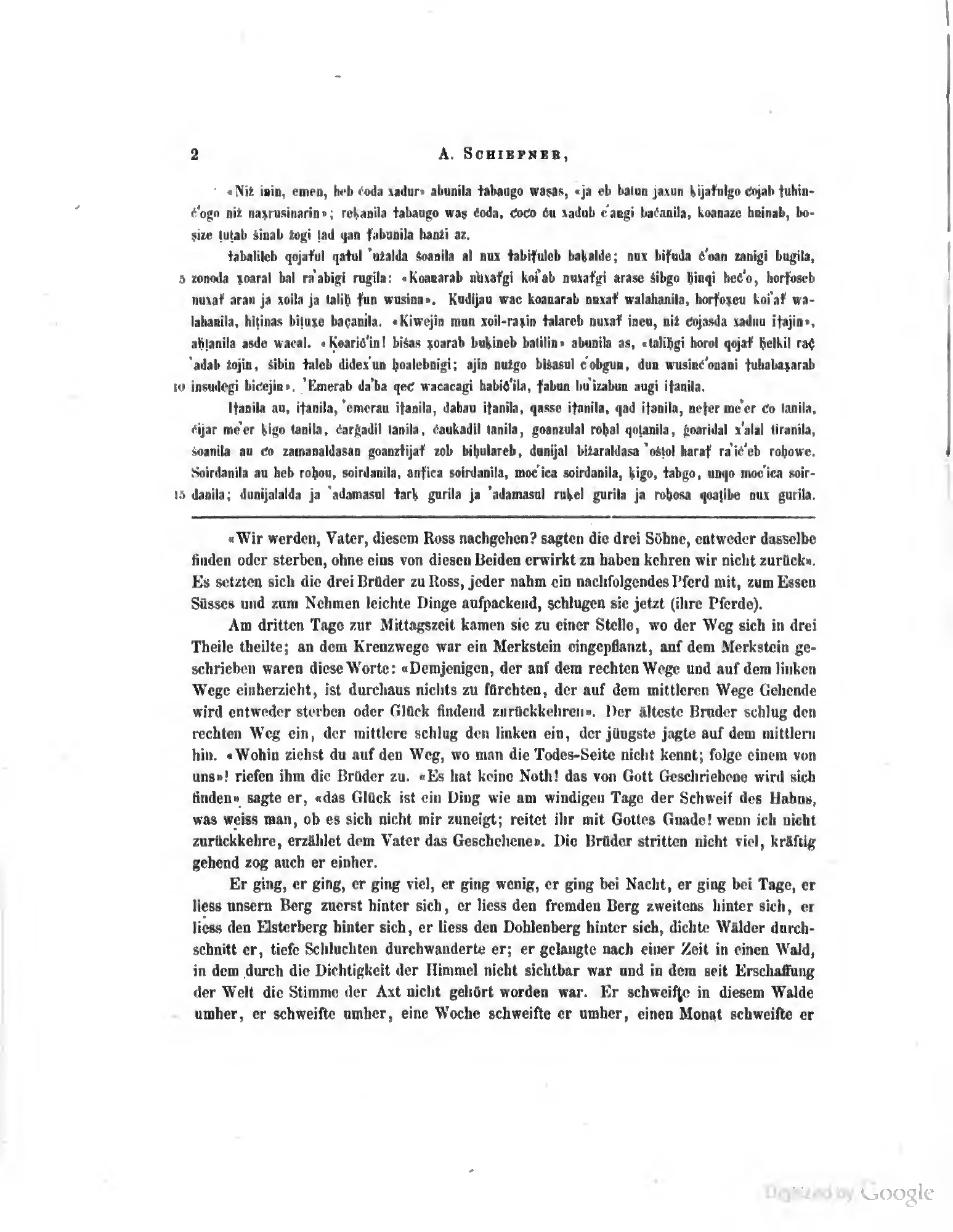
Authentic 1873 printed Avar prose in scholarly Latin transcription. The upper block continues the tale printed as Ratdal ču / Das Meerross; German translation occupies the lower block. This is actual language use in a historical text edition, not a modern-script example or an alphabet chart.
Saved in Babelbook · resized display copy. Select the image to open it independently of its source.
Anton Schiefner (editor, 1817–1879); digitized by Google from Harvard University copy · Source ↗Public domain ↗View the local visual field note
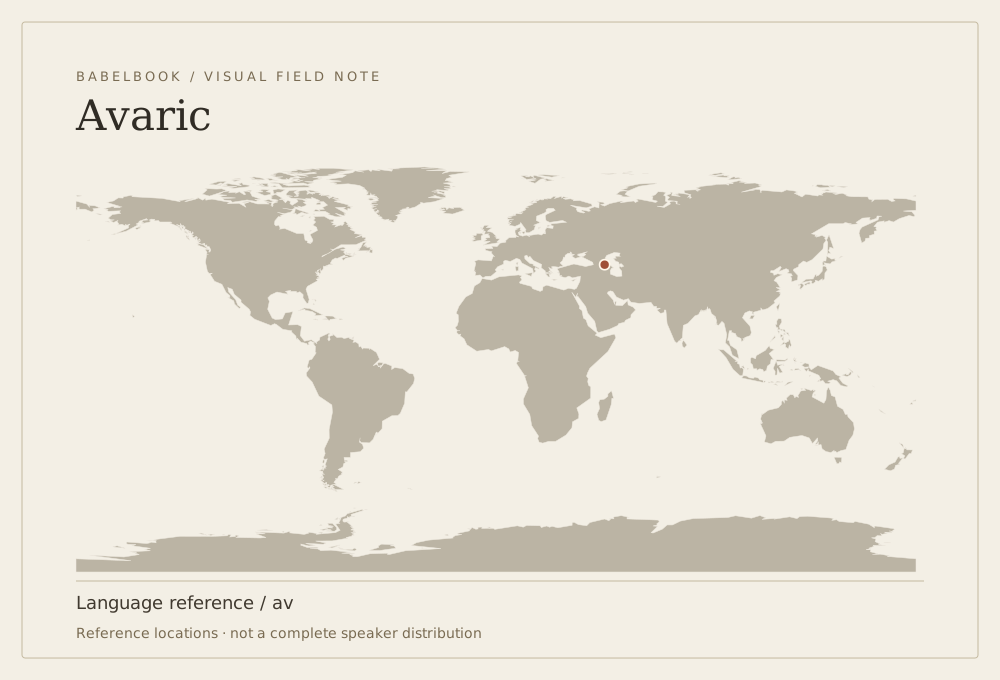
Representative reference points from Glottolog. Historical entries show reference locations, not current speakers. 1 point.
Reference & context ↗Babelbook · original editorial illustration · CC BY 4.0 · Glottolog locations; public-domain Natural Earth land
Source excerpts, selected, shortened and where noted editorially corrected from Avar language by Wikipedia contributors. Retrieved 2026-10-05. CC BY-SA 4.0. These excerpts are not an independently verified scholarly history; missing accounts are identified above.
Read further in the source
Geographic distribution
It is spoken mainly in the western and southern parts of the Russian Caucasus republic of Dagestan, and the Balaken, Zaqatala regions of north-western Azerbaijan. Some Avars live in other regions of Russia. There are also small communities of speakers living in the Russian republics of Chechnya and Kalmykia; in Georgia, Kazakhstan, Ukraine, Jordan, and the Marmara Sea and Maraş region of Turkey. It is spoken by about 1,200,000 people worldwide. UNESCO classifies Avar as vulnerable to extinction.
Status
It is one of six literary languages of Dagestan, where it is spoken not only by the Avar, but also serves as the language of communication between different ethnic and linguistic groups.
Dialects
Glottolog lists 14 dialects of Avar, some of which correspond to the villages where they are spoken. The dialects are listed in alphabetical order based on their name in Glottolog:
Ancux (Antsukh / Анцух) Andalal-Gxdatl Bacadin Batlux Hid Karax Kaxib Keleb Salatav Shulanin Untib Xunzax (Khunzakh / Xунзах) Zakataly Zaqatala
Writing systems
There were some attempts to write the Avar language in the Georgian alphabet as early as the 14th century. The use of the Perso-Arabic script for representing Avar in marginal glosses began in the 15th century. The use of Arabic, which is known as ajam, is still known today. Peter von Uslar developed a Cyrillic-based alphabet, published in 1889, that also used some Georgian-based letters. Many of its letters have not been encoded in Unicode. The alphabet takes the following form: а, б, в, г, ӷ, д, е, ж, һ, , , і, ј, к, қ, , л, м, н, о, п, ԛ, , р, с, ҫ, т, ҭ, у, х, х̍, хᷱ, ц, , / ц̓, / ꚑ, ч, ч̍, чᷱ, / ч̓, ш, ղ, ղ̓, ղᷱ, As part of Soviet language re-education policies in 1928 the Ajam was replaced by a Latin alphabet, which in 1938 was in turn replaced by the current Cyrillic script. Essentially, it is the Russian alphabet plus one additional letter called palochka (stick, Ӏ), originally the digit 1 on a manual typewriter. The palochka is not included in common computer keyboard layouts, and is often replaced with a capital Latin letter i ( I ) or occasionally a small Latin letter L ( l ) rather than the digit 1.