Aymara
Aymara (Aymara pronunciation: [ajˈmaɾa] ; also Aymar aru) is an Aymaran language spoken by the Aymara people of the Bolivian Andes. It is one of only a handful of Native American languages with over one million speakers. Aymara, along with Spanish and Quechua, is an official language in Bolivia and Peru. It is also spoken, to a much lesser extent, by some communities in northern Chile and northern Argentina, where it is a recognized minority language. Academic sources confirm that Aymara is spoken in Argentina, particularly in the provinces of Jujuy and Salta. Aymara is recognized as one of the indigenous language families within the country, often grouped alongside others such as Quechua, Mapuche, and Guaraní. The University of Arizona identifies the Kolla people, who speak Aymara, as having a significant presence in these provinces. The expansion of the Aymaran language family predates the expansion of the Quechuan language family across the southern Peruvian Andes. Some linguists have claimed that Aymara is related to its more widely spoken neighbor, Quechua. That claim, however, is disputed. Although there are indeed similarities, the majority position among linguists today is that the similarities are better explained as areal features arising from prolonged cohabitation, rather than natural genealogical changes that would stem from a common protolanguage. Aymara is an agglutinating and, to a certain extent, a polysynthetic language. It has a subject–object–verb word order. Aymara is normally written using the Latin alphabet.
Translate in Aymara ↗There are roughly two million Bolivian speakers, half a million Peruvian speakers, and perhaps a few thousand speakers in Chile. At the time of the Spanish conquest in the sixteenth century, Aymara was the dominant language over a much larger area than today, including most of highland Peru south of Cusco. Over the centuries, Aymara has gradually lost speakers both to Spanish and to Quechua; many Peruvian and Bolivian communities that were once Aymara-speaking now speak Quechua.
Central & South America
Present-day use
The captured source does not contain a separate current-use account.
Origins
The ethnonym "Aymara" may come from the name of a group in the southern part of what is now the Quechua speaking area of Apurímac. Regardless, the use of the word "Aymara" as a label for this people was standard practice as early as 1567, as evident from Garci Diez de San Miguel's report of his inspection of the province of Chucuito (1567, 14; cited in Lafaye 1964). In this document, he uses the term aymaraes to refer to the people. The language was then called Colla. It is believed that Colla was the name of an Aymara nation at the time of conquest, and later was the southernmost region of the Inca empire Collasuyu. However, Cerrón Palomino disputes this and asserts that Colla were Puquina speakers who ruled Tiwanaku in the first and third centuries (2008:246). This hypothesis suggests that the linguistically-diverse area ruled by the Puquina came to adopt Aymara languages in their southern region. In any case, the use of "Aymara" for the language may have first occurred in the works of Polo de Ondegardo, a lawyer, magistrate and tax collector in Potosí and Cusco. Do Ondegardo, who later helped Viceroy Toledo to create the system under which the indigenous population would be ruled for the next 200 years, wrote a report in 1559 entitled 'On the lineage of the Yncas and how they extended their conquests' in which he discusses land and taxation issues of the Aymara under the Inca Empire. More than a century passed before "Aymara" entered general use to mean the language spoken by the Aymara people (Briggs, 1976:14). In the meantime the Aymara language was called "the language of the Colla". The best account of the history of Aymara is that of Cerrón-Palomino, who shows that the ethnonym Aymara, which came from the glottonym, is likely derived from the Quechuaized toponym ayma-ra-y 'place of communal property'.
Development
The captured article does not contain a distinct historical account. No chronology has been invented.
Writing
Beginning with Spanish missionary efforts, there have been many attempts to create a writing system for Aymara. The colonial sources employed a variety of writing systems heavily influenced by Spanish, the most widespread one being that of Bertonio. Many of the early grammars employed unique alphabets as well as the one of Middendorf's Aymara-Sprache (1891). The first official alphabet to be adopted for Aymara was the Scientific Alphabet. It was approved by the III Congreso Indigenista Interamericano de la Paz in 1954, though its origins can be traced as far back as 1931. Rs. No 1593 (Deza Galindo 1989, 17). It was the first official record of an alphabet, but in 1914, Sisko Chukiwanka Ayulo and Julián Palacios Ríos had recorded what may be the first of many attempts to have one alphabet for both Quechua and Aymara, the Syentifiko Qheshwa-Aymara Alfabeto with 37 graphemes. Several other attempts followed, with varying degrees of success. Some orthographic attempts even expand further: the Alfabeto Funcional Trilingüe, made up of 40 letters (including the voiced stops necessary for Spanish) and created by the Academia de las Lenguas Aymara y Quechua in Puno in 1944 is the one used by the lexicographer Juan Francisco Deza Galindo in his Diccionario Aymara – Castellano / Castellano – Aymara. This alphabet has five vowels ⟨a, e, i, o, u⟩, aspiration is conveyed with an ⟨h⟩ next to the consonant, and ejectives with ⟨'⟩. The most unusual characteristic is the expression of the uvular /χ/ with ⟨jh⟩. The other uvular segment, /q/, is expressed by ⟨q⟩, but transcription rules mandate that the following vowel must be ⟨a, e, o⟩ (not ⟨i, u⟩), presumably to account for uvular lowering and to facilitate multilingual orthography. The alphabet created by the Comisión de Alfabetización y Literatura Aymara (CALA) was officially recognized in Bolivia in 1968 (co-existing with the 1954 Scientific Alphabet).
Beyond the typeface.
Signs, manuscripts, published pages and contextual photographs, with their place, period, source and reuse terms. Captions identify historical spellings, regional examples, community references and character imagery.
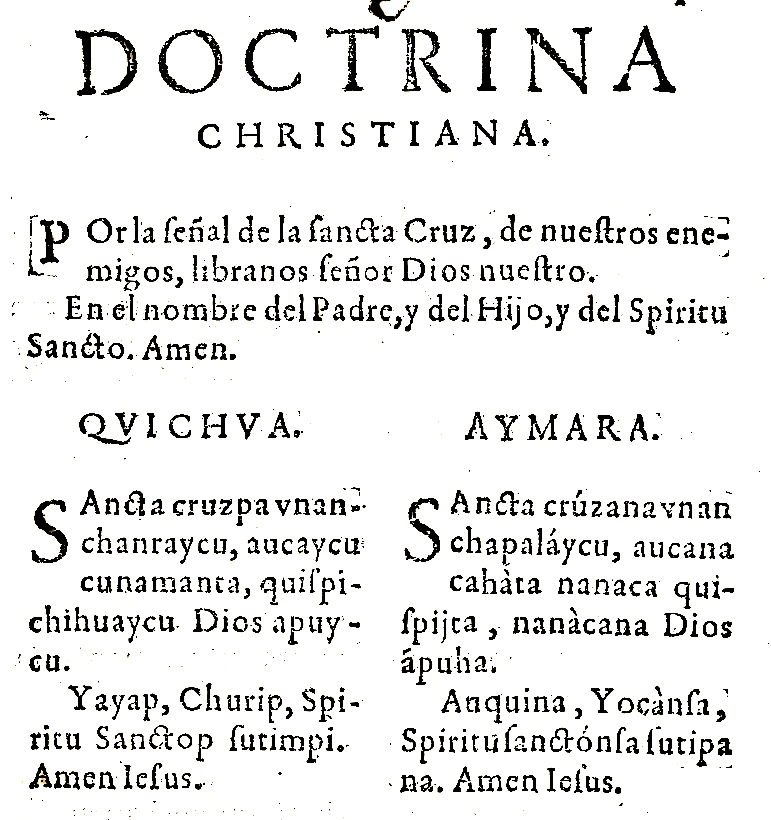
A scanned passage from the 1584 Lima edition, presenting the sign of the cross in Aymara and Classical Quechua.
Saved in Babelbook · resized display copy. Select the image to open it independently of its source.
José de Acosta (as credited by Commons) · Source ↗Public domain ↗View the local visual field note
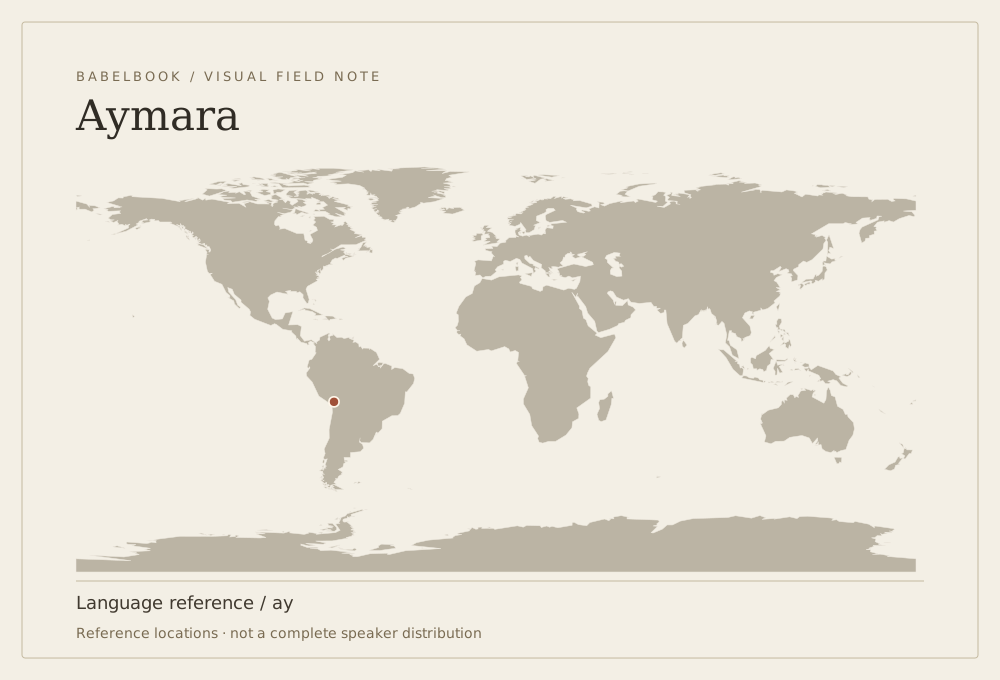
Representative reference points from Glottolog. Historical entries show reference locations, not current speakers. 1 point.
Reference & context ↗Babelbook · original editorial illustration · CC BY 4.0 · Glottolog locations; public-domain Natural Earth land
Source excerpts, selected, shortened and where noted editorially corrected from Aymara language by Wikipedia contributors. Retrieved 2026-10-05. CC BY-SA 4.0. These excerpts are not an independently verified scholarly history; missing accounts are identified above.
Read further in the source
Dialects
There is some degree of regional variation within Aymara, but all dialects are mutually intelligible. Most studies of the language focused on either the Aymara spoken on the southern Peruvian shore of Lake Titicaca or the Aymara spoken around La Paz. Lucy Therina Briggs classifies both regions as being part of the Northern Aymara dialect, which encompasses the department of La Paz in Bolivia and the department of Puno in Peru. The Southern Aymara dialect is spoken in the eastern half of the Tarapacá Region in northern Chile and in most of the Bolivian department of Oruro. It is also found in northern Potosi and southwest Cochabamba but is slowly being replaced by Quechua in those regions. Intermediate Aymara shares dialectical features with both Northern and Southern Aymara and is found in the eastern half of the Tacna and Moquegua departments in southern Peru and in the northeastern tip of Chile.
Geographical distribution
There are roughly two million Bolivian speakers, half a million Peruvian speakers, and perhaps a few thousand speakers in Chile. At the time of the Spanish conquest in the sixteenth century, Aymara was the dominant language over a much larger area than today, including most of highland Peru south of Cusco. Over the centuries, Aymara has gradually lost speakers both to Spanish and to Quechua; many Peruvian and Bolivian communities that were once Aymara-speaking now speak Quechua.
Orthography
Beginning with Spanish missionary efforts, there have been many attempts to create a writing system for Aymara. The colonial sources employed a variety of writing systems heavily influenced by Spanish, the most widespread one being that of Bertonio. Many of the early grammars employed unique alphabets as well as the one of Middendorf's Aymara-Sprache (1891). The first official alphabet to be adopted for Aymara was the Scientific Alphabet. It was approved by the III Congreso Indigenista Interamericano de la Paz in 1954, though its origins can be traced as far back as 1931. Rs. No 1593 (Deza Galindo 1989, 17). It was the first official record of an alphabet, but in 1914, Sisko Chukiwanka Ayulo and Julián Palacios Ríos had recorded what may be the first of many attempts to have one alphabet for both Quechua and Aymara, the Syentifiko Qheshwa-Aymara Alfabeto with 37 graphemes. Several other attempts followed, with varying degrees of success. Some orthographic attempts even expand further: the Alfabeto Funcional Trilingüe, made up of 40 letters (including the voiced stops necessary for Spanish) and created by the Academia de las Lenguas Aymara y Quechua in Puno in 1944 is the one used by the lexicographer Juan Francisco Deza Galindo in his Diccionario Aymara – Castellano / Castellano – Aymara. This alphabet has five vowels ⟨a, e, i, o, u⟩, aspiration is conveyed with an ⟨h⟩ next to the consonant, and ejectives with ⟨'⟩. The most unusual characteristic is the expression of the uvular /χ/ with ⟨jh⟩. The other uvular segment, /q/, is expressed by ⟨q⟩, but transcription rules mandate that the following vowel must be ⟨a, e, o⟩ (not ⟨i, u⟩), presumably to account for uvular lowering and to facilitate multilingual orthography. The alphabet created by the Comisión de Alfabetización y Literatura Aymara (CALA) was officially recognized in Bolivia in 1968 (co-existing with the 1954 Scientific Alphabet). Besides being the alphabet employed by Protestant missionaries, it is also the one used for the translation of the Book of Mormon. Also in 1968, de Dios Yapita created his take on the Aymara alphabet at the Instituto de Lenga y Cultura Aymara (ILCA). Nearly 15 years later, the Servicio Nacional de Alfabetización y Educación Popular (SENALEP) attempted to consolidate these alphabets to create a system which could be used to write both Aymara and Quechua, creating what was known as the Alfabeto Unificado. The alphabet, later sanctioned in Bolivia by Decree 20227 on 9 May 1984 and in Peru as la Resolución Ministerial Peruana 1218ED on 18 November 1985, consists of 3 vowels, 26 consonants and an umlaut to mark vowel length. The orthography was shown in the phonological table in the previous section, and is the same where angle brackets are not shown. In 2015 a full writing system was developed for Aymara using the Korean script Hangeul.