Azerbaijani
Azerbaijani or Azeri (also referred to as Azerbaijani Turkic or Azerbaijani Turkish) is a Turkic language from the Oghuz sub-branch. It is spoken primarily by the Azerbaijani people, who are native to the Azerbaijan region of Iran, as well as the Republic of Azerbaijan. The Iranian Azerbaijanis speak South Azerbaijani, while the ones in the Republic speak North Azerbaijani; but it is unclear whether these two varieties form one language, as the International Organization for Standardization (ISO) considers Northern and Southern Azerbaijani to be distinct languages. Azerbaijani is the only official language in the Republic of Azerbaijan and one of the 14 official languages of Dagestan (a federal subject of Russia), but it does not have official status in Iran, where the majority of Iranian Azerbaijani people live. Azerbaijani is also spoken to lesser varying degrees in Azerbaijani communities of Georgia and Turkey and by diaspora communities, primarily in Europe and North America. Although there is a high degree of mutual intelligibility between both forms of Azerbaijani, there are significant differences in phonology, lexicon, morphology, syntax, and sources of loanwords. The standardized form of North Azerbaijani (spoken in the Republic of Azerbaijan and Russia) is based on the Shirvani dialect, while South Azerbaijani uses a variety of regional dialects. Since the Republic of Azerbaijan's independence from the Soviet Union in 1991, Northern Azerbaijani has used the Latin script.
Translate in Azerbaijani ↗Azerbaijani or Azeri (also referred to as Azerbaijani Turkic or Azerbaijani Turkish) is a Turkic language from the Oghuz sub-branch. It is spoken primarily by the Azerbaijani people, who are native to the Azerbaijan region of Iran, as well as the Republic of Azerbaijan. The Iranian Azerbaijanis speak South Azerbaijani, while the ones in the Republic speak North Azerbaijani; but it is unclear whether these two varieties form one language, as the International Organization for Standardization (ISO) considers Northern and Southern Azerbaijani to be distinct languages. Azerbaijani is the only official language in the Republic of Azerbaijan and one of the 14 official languages of Dagestan (a federal subject of Russia), but it does not have official status in Iran, where the majority of Iranian Azerbaijani people live. Azerbaijani is also spoken to lesser varying degrees in Azerbaijani communities of Georgia and Turkey and by diaspora communities, primarily in Europe and North America. Although there is a high degree of mutual intelligibility between both forms of Azerbaijani, there are significant differences in phonology, lexicon, morphology, syntax, and sources of loanwords. The standardized form of North Azerbaijani (spoken in the Republic of Azerbaijan and Russia) is based on the Shirvani dialect, while South Azerbaijani uses a variety of regional dialects. Since the Republic of Azerbaijan's independence from the Soviet Union in 1991, Northern Azerbaijani has used the Latin script. On the other hand, South Azerbaijani has always used and continues to use the Perso-Arabic script. Azerbaijani is closely related to Turkmen, Turkish, Gagauz, and Qashqai, being mutually intelligible with each of these languages to varying degrees.
Central Asia
Present-day use
The captured source does not contain a separate current-use account.
Origins
Historically, the language was referred to by its native speakers as türk dili or türkcə, meaning either "Turkish" or "Turkic". In the early years following the establishment of the Azerbaijan Soviet Socialist Republic, the language was still referred to as "Turkic" in official documents. However, in the 1930s, its name was officially changed to "Azerbaijani". The language is often still referred to as Turki or Torki (Turkish or Turkic) in Iranian Azerbaijan. The term "Azeri", generally interchangeable with "Azerbaijani", is from Turkish Azeri. The 17th century Capuchin missionary Raphael du Mans used the expression "Turk Ajami" in relation to the Azerbaijani language. This term is used by many modern authors to designate the direct historical predecessor of the modern Azerbaijani language (see Middle Azerbaijani language). The term is derived from earlier designations, such as lingua turcica agemica, or Turc Agemi, which was used in a grammar book composed by the French writer Capuchin Raphaël du Mans (died 1696) in 1684. Local texts simply called the language türkī. During "the Isfahan phase of the Safavids", it was called ḳızılbaşī in contrast to rūmī (Ottoman) and çaġatā’ī (Chagatai), due to its close relation to dialects spoken by the Qizilbash. Azerbaijani or Azeri is the term that is used interchangeably for the language throughout the 19th and 20th centuries.
Development
Azerbaijani evolved from the Eastern branch of Oghuz Turkic ("Western Turkic") which spread to the Caucasus in Eastern Europe and northern Iran in West Asia during the medieval Turkic migrations. Persian and Arabic influenced the language, but Arabic words were mainly transmitted through the intermediary of literary Persian. Azerbaijani is, perhaps after Uzbek, the Turkic language upon which Persian and other Iranian languages have exerted the strongest impact—mainly in phonology, syntax, and vocabulary, less in morphology. During the period of the Qara Qoyunlu and Aq Qoyunlu states, Azerbaijani Turkic (in the sources of that period, "Turki") gradually began to emerge as a means of literary and poetic expression. During this period, writing in Turkic became fashionable in the court and among poets. The ruler of the Qara Qoyunlu, Jahanshah, was known by his pen name "Haqiqi", and the ruler of the Aq Qoyunlu, Sultan Yaqub, was known for writing poems in Turkic. The Sufi poet Qasim-i Anvar also used Turkic as a literary language and wrote poetry in this language. The Turkic language of Azerbaijan gradually supplanted the Iranian languages in what is now northwestern Iran, and a variety of languages of the Caucasus and Iranian languages spoken in the Caucasus, particularly Udi and Old Azeri. By the beginning of the 16th century, it had become the dominant language of the region. It was one of the spoken languages in the court of the Safavids and Qajars. The historical development of Azerbaijani can be divided into two major periods: early (c. 14th to 18th century) and modern (18th century to present). Early Azerbaijani differs from its descendant in that it contained a much larger number of Persian and Arabic loanwords, phrases and syntactic elements. Early writings in Azerbaijani also demonstrate linguistic interchangeability between Oghuz and Kypchak elements in many aspects (such as pronouns, case endings, participles, etc.).
Writing
Before 1929, Azerbaijani was written only in the Perso-Arabic alphabet, an impure abjad that does not represent all vowels (without diacritical marks). In Iran, the process of standardization of orthography started with the publication of Azerbaijani magazines and newspapers such as Varlıq (وارلیق 'Existence') from 1979. Azerbaijani-speaking scholars and literarians showed great interest in involvement in such ventures and in working towards the development of a standard writing system. These efforts culminated in language seminars being held in Tehran, chaired by the founder of Varlıq, Javad Heyat, in 2001 where a document outlining the standard orthography and writing conventions were published for the public. This standard of writing is today canonized by a Persian–Azeri Turkic dictionary in Iran titled Loghatnāme-ye Torki-ye Āzarbāyjāni. Between 1929 and 1938, a Latin alphabet was in use for North Azerbaijani, although it was different from the one used now. From 1938 to 1991, the Cyrillic script was used. Lastly, in 1991, the current Latin alphabet was introduced, although the transition to it has been rather slow. For instance, until an Aliyev decree on the matter in 2001, newspapers would routinely write headlines in the Latin script, leaving the stories in Cyrillic. The transition has also resulted in some misrendering of İ as Ì. In Dagestan, Azerbaijani is still written in Cyrillic script. The Azerbaijani Latin alphabet is based on the Turkish Latin alphabet. In turn, the Turkish Latin alphabet was based on a former Azerbaijani Latin alphabet because of their linguistic connections and mutual intelligibility. The letters Әə, Xx, and Qq are available only in Azerbaijani for sounds which do not exist as separate phonemes in Turkish. Northern Azerbaijani, unlike Turkish, respells foreign names to conform with Latin Azerbaijani spelling, e.g. Bush is spelled Buş and Schröder becomes Şröder.
Beyond the typeface.
Signs, manuscripts, published pages and contextual photographs, with their place, period, source and reuse terms. Captions identify historical spellings, regional examples, community references and character imagery.
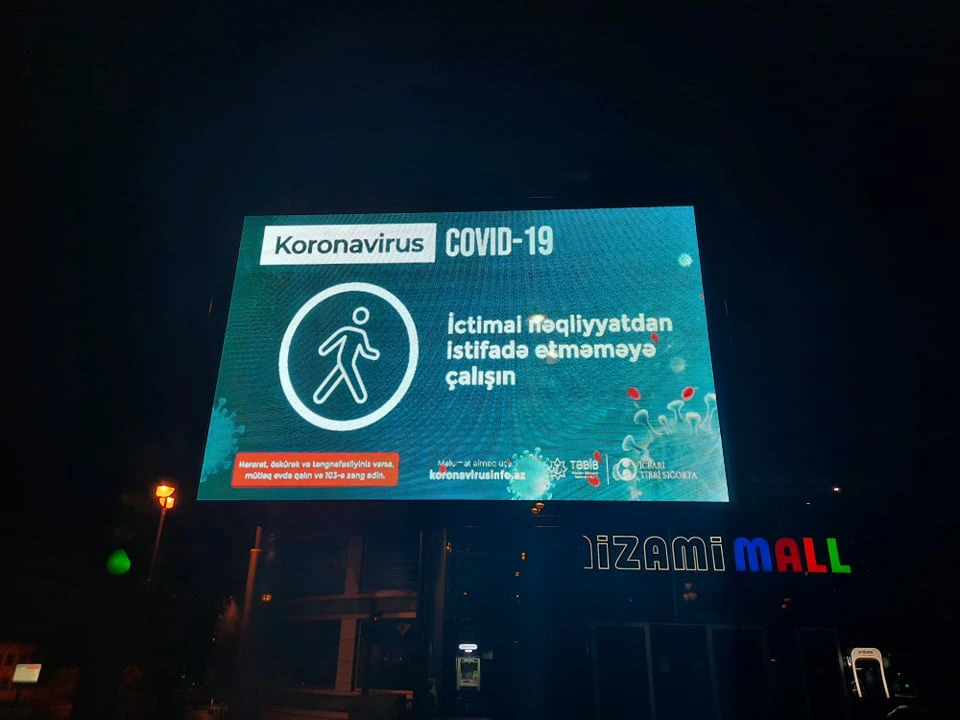
Azerbaijani public-health street notice in Baku, photographed in August 2020. Historical pandemic-era writing. Language identification follows Commons descriptions or categories; not independently transcribed.
Saved in Babelbook · resized display copy. Select the image to open it independently of its source.
State Agency for Compulsory Health Insurance of Republic of Azerbaijan; source: Aykhan Zayedzadeh · Source ↗Public domain — PD-AZ-exempt (Commons classification) ↗View the local visual field note
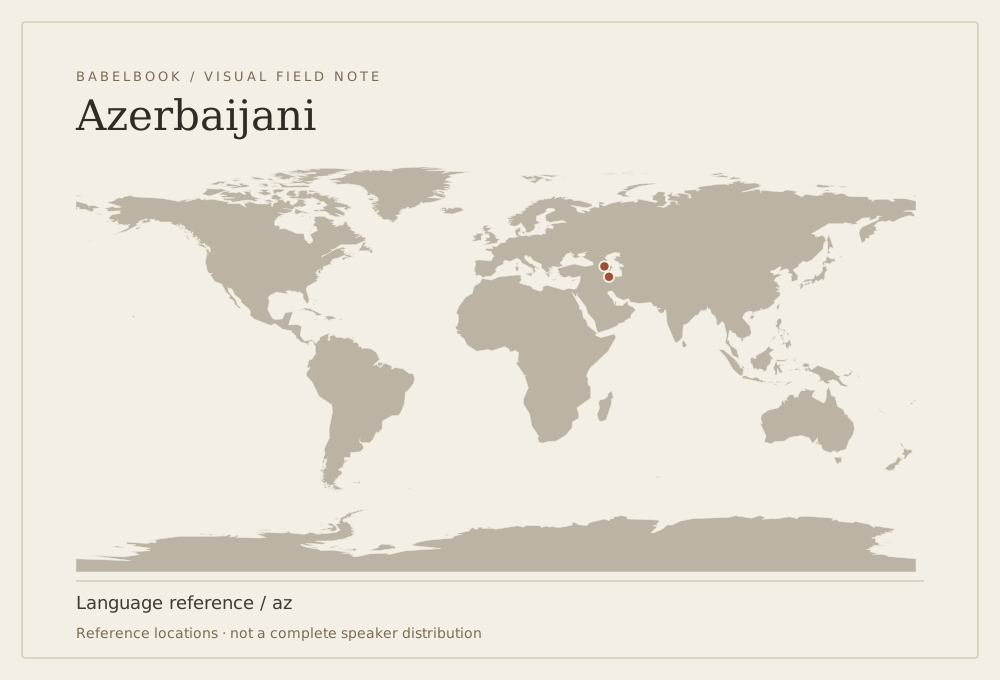
Representative reference points from Glottolog. Historical entries show reference locations, not current speakers. 2 points.
Reference & context ↗Babelbook · original editorial illustration · CC BY 4.0 · Glottolog locations; public-domain Natural Earth land
Source excerpts, selected, shortened and where noted editorially corrected from Azerbaijani language by Wikipedia contributors. Retrieved 2026-10-05. CC BY-SA 4.0. These excerpts are not an independently verified scholarly history; missing accounts are identified above.
Read further in the source
History and evolution
Azerbaijani evolved from the Eastern branch of Oghuz Turkic ("Western Turkic") which spread to the Caucasus in Eastern Europe and northern Iran in West Asia during the medieval Turkic migrations. Persian and Arabic influenced the language, but Arabic words were mainly transmitted through the intermediary of literary Persian. Azerbaijani is, perhaps after Uzbek, the Turkic language upon which Persian and other Iranian languages have exerted the strongest impact—mainly in phonology, syntax, and vocabulary, less in morphology. During the period of the Qara Qoyunlu and Aq Qoyunlu states, Azerbaijani Turkic (in the sources of that period, "Turki") gradually began to emerge as a means of literary and poetic expression. During this period, writing in Turkic became fashionable in the court and among poets. The ruler of the Qara Qoyunlu, Jahanshah, was known by his pen name "Haqiqi", and the ruler of the Aq Qoyunlu, Sultan Yaqub, was known for writing poems in Turkic. The Sufi poet Qasim-i Anvar also used Turkic as a literary language and wrote poetry in this language. The Turkic language of Azerbaijan gradually supplanted the Iranian languages in what is now northwestern Iran, and a variety of languages of the Caucasus and Iranian languages spoken in the Caucasus, particularly Udi and Old Azeri. By the beginning of the 16th century, it had become the dominant language of the region. It was one of the spoken languages in the court of the Safavids and Qajars. The historical development of Azerbaijani can be divided into two major periods: early (c. 14th to 18th century) and modern (18th century to present). Early Azerbaijani differs from its descendant in that it contained a much larger number of Persian and Arabic loanwords, phrases and syntactic elements. Early writings in Azerbaijani also demonstrate linguistic interchangeability between Oghuz and Kypchak elements in many aspects (such as pronouns, case endings, participles, etc.). As Azerbaijani gradually moved from being merely a language of epic and lyric poetry to being also a language of journalism and scientific research, its literary version has become more or less unified and simplified with the loss of many archaic Turkic elements, stilted Iranisms and Ottomanisms, and other words, expressions, and rules that failed to gain popularity among the Azerbaijani masses. The Russian annexation of Iran's territories in the Caucasus through the Russo-Iranian wars of 1804–1813 and 1826–1828 split the language community across two states. Afterwards, the Tsarist administration encouraged the spread of Azerbaijani in eastern Transcaucasia as a replacement for Persian spoken by the upper classes, and as a measure against Persian influence in the region. Between c. 1900 and 1930, there were several competing approaches to the unification of the national language in what is now the Azerbaijan Republic, popularized by scholars such as Hasan bey Zardabi and Mammad agha Shahtakhtinski. Despite major differences, they all aimed primarily at making it easy for semi-literate masses to read and understand literature. They all criticized the overuse of Persian, Arabic, and European elements in both colloquial and literary language and called for a simpler and more popular style. The Soviet Union promoted the development of the language but set it back considerably with two successive script changes – from the Persian to Latin and then to the Cyrillic script – while Iranian Azerbaijanis continued to use the Persian script as they always had. Despite the wide use of Azerbaijani in the Azerbaijan Soviet Socialist Republic, it became the official language of Azerbaijan only in 1956. After independence, the Republic of Azerbaijan decided to switch back to a modified Latin script.
Dialects
Azerbaijani is one of the Oghuz languages within the Turkic language family. Ethnologue lists North Azerbaijani (spoken mainly in the Republic of Azerbaijan and Russia) and South Azerbaijani (spoken in Iran, Iraq, and Syria) as two groups within the Azerbaijani macrolanguage with "significant differences in phonology, lexicon, morphology, syntax, and loanwords" between the two. The International Organization for Standardization (ISO) considers Northern and Southern Azerbaijani to be distinct languages. Linguists Mohammad Salehi and Aydin Neysani write that "there is a high degree of mutual intelligibility" between North and South Azerbaijani. Svante Cornell wrote in his 2001 book Small Nations and Great Powers that "it is certain that Russian and Iranian words (sic), respectively, have entered the vocabulary on either side of the Araxes river, but this has not occurred to an extent that it could pose difficulties for communication". There are numerous dialects, with 21 North Azerbaijani dialects and 11 South Azerbaijani dialects identified by Ethnologue. Three varieties have been accorded ISO 639-3 language codes: North Azerbaijani, South Azerbaijani and Qashqai. The Glottolog 4.1 database classifies North Azerbaijani, with 20 dialects, and South Azerbaijani, with 13 dialects, under the Modern Azeric family, a branch of Central Oghuz. In the northern dialects of the Azerbaijani language, linguists find traces of the influence of the Khazar language. According to Encyclopedia Iranica:
We may distinguish the following Azeri dialects: (1) eastern group: Derbent (Darband), Kuba, Shemakha (Šamāḵī), Baku, Salyani (Salyānī), and Lenkoran (Lankarān), (2) western group: Kazakh (not to be confounded with the Kipchak-Turkic language of the same name), the dialect of the Ayrïm (Āyrom) tribe (which, however, resembles Turkish), and the dialect spoken in the region of the Borchala river; (3) northern group: Zakataly, Nukha, and Kutkashen; (4) southern group: Yerevan (Īravān), Nakhichevan (Naḵjavān), and Ordubad (Ordūbād); (5) central group: Ganja (Kirovabad) and Shusha; (6) North Iraqi dialects; (7) Northwest Iranian dialects: Tabrīz, Reżāʾīya (Urmia), etc., extended east to about Qazvīn; (8) Southeast Caspian dialect (Galūgāh). Optionally, we may adjoin as Azeri (or "Azeroid") dialects: (9) East Anatolian, (10) Qašqāʾī, (11) Aynallū, (12) Sonqorī, (13) dialects south of Qom, (14) Kabul Afšārī.
Dialectal consonants
Works on Azerbaijani dialectology use the following notations for dialectal consonants:
Ⱪ ⱪ—[k] X' x'—[ç] Ŋ ŋ—[ŋ] Ц ц—[t͡s] Dz dz—[d͡z] Ž ž—[ð] W w—[w, ɥ] Examples:
[k]—ⱪış [kɯʃ] [ç]—üzüx' [ʔyˈzyç] [ŋ]—ataŋın [ʔɑt̪ɑŋˈɯn̪] [t͡s]—цay [t͡sɑj] [d͡z]—dzan [d͡zɑn̪] [ð]—əžəli [ʔæðæˈl̪ɪ] [w]—dowşan [d̪ɔːwˈʃɑn̪] [ɥ]—töwlə [t̪œːɥˈl̪æ]
Writing systems
Before 1929, Azerbaijani was written only in the Perso-Arabic alphabet, an impure abjad that does not represent all vowels (without diacritical marks). In Iran, the process of standardization of orthography started with the publication of Azerbaijani magazines and newspapers such as Varlıq (وارلیق 'Existence') from 1979. Azerbaijani-speaking scholars and literarians showed great interest in involvement in such ventures and in working towards the development of a standard writing system. These efforts culminated in language seminars being held in Tehran, chaired by the founder of Varlıq, Javad Heyat, in 2001 where a document outlining the standard orthography and writing conventions were published for the public. This standard of writing is today canonized by a Persian–Azeri Turkic dictionary in Iran titled Loghatnāme-ye Torki-ye Āzarbāyjāni. Between 1929 and 1938, a Latin alphabet was in use for North Azerbaijani, although it was different from the one used now. From 1938 to 1991, the Cyrillic script was used. Lastly, in 1991, the current Latin alphabet was introduced, although the transition to it has been rather slow. For instance, until an Aliyev decree on the matter in 2001, newspapers would routinely write headlines in the Latin script, leaving the stories in Cyrillic. The transition has also resulted in some misrendering of İ as Ì. In Dagestan, Azerbaijani is still written in Cyrillic script. The Azerbaijani Latin alphabet is based on the Turkish Latin alphabet. In turn, the Turkish Latin alphabet was based on a former Azerbaijani Latin alphabet because of their linguistic connections and mutual intelligibility. The letters Әə, Xx, and Qq are available only in Azerbaijani for sounds which do not exist as separate phonemes in Turkish.
Northern Azerbaijani, unlike Turkish, respells foreign names to conform with Latin Azerbaijani spelling, e.g. Bush is spelled Buş and Schröder becomes Şröder. Hyphenation across lines directly corresponds to spoken syllables, except for geminated consonants which are hyphenated as two separate consonants since morphonology considers them two separate consonants back-to-back but enunciated in the onset of the latter syllable as a single long consonant, as in other Turkic languages.