Bashkir
Bashkir (UK: bash-KEER, US: bahsh-KEER) or Bashkort (Bashkir: башҡорт теле, romanized: başqort tele, [bɑʂˈqʊ̞rt tɪ̞ˈlɪ̞] ) is a Turkic language belonging to the Kipchak branch. It is co-official with Russian in Bashkortostan. It is spoken by approximately 1.6 million native speakers in Russia, as well as in Ukraine, Belarus, Kazakhstan, Uzbekistan, Estonia, and other neighboring post-Soviet states, and among the Bashkir diaspora. It has three dialect groups: Southern, Eastern, and Northwestern.
Translate in Bashkir ↗Speakers of Bashkir mostly live in the republic of Bashkortostan (a republic within the Russian Federation). Many speakers also live in Tatarstan, Chelyabinsk, Orenburg, Tyumen, Sverdlovsk and Kurgan Oblasts, and other regions of Russia. Minor Bashkir groups also live in Kazakhstan and the United States.
Central Asia
Present-day use
The captured source does not contain a separate current-use account.
Origins
The captured article does not contain a separate origins section. See the historical account and linked source.
Development
The captured article does not contain a distinct historical account. No chronology has been invented.
Writing
After the adoption of Islam, which began in the 10th century and lasted for several centuries, the Bashkirs began to use Turki as a written language. Turki was written in a variant of the Arabic script. In 1923, a writing system based on the Arabic script was specifically created for the Bashkir language. At the same time, the Bashkir literary language was created, moving away from the older written Turkic influences. At first, it used a modified Arabic alphabet. In 1930 it was replaced with the Unified Turkic Latin Alphabet, which was in turn replaced with an adapted Cyrillic alphabet in 1939. The modern alphabet used by Bashkir is based on the Russian alphabet, with the addition of the following letters: Ә ә /æ/, Ө ө /ø/, Ү ү /ʏ/, Ғ ғ /ʁ/, Ҡ ҡ /q/, Ң ң /ŋ/, Ҙ ҙ /ð/, Ҫ ҫ /θ/, Һ һ /h/. Bashkir Latin alphabet based on the Common Turkic alphabet
Beyond the typeface.
Signs, manuscripts, published pages and contextual photographs, with their place, period, source and reuse terms. Captions identify historical spellings, regional examples, community references and character imagery.
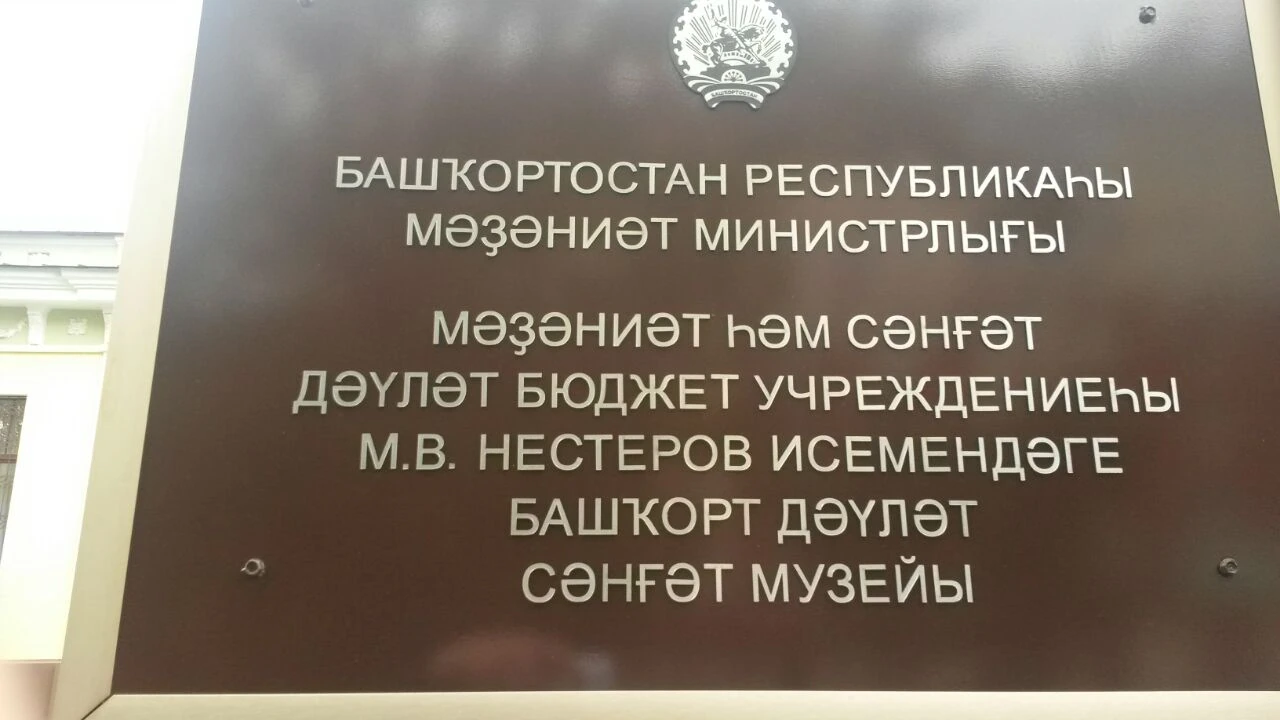
Museum signage catalogued by Commons as Bashkir-language writing.
Saved in Babelbook · resized display copy. Select the image to open it independently of its source.
Ayratayrat · Source ↗CC BY-SA 4.0 ↗View the local visual field note
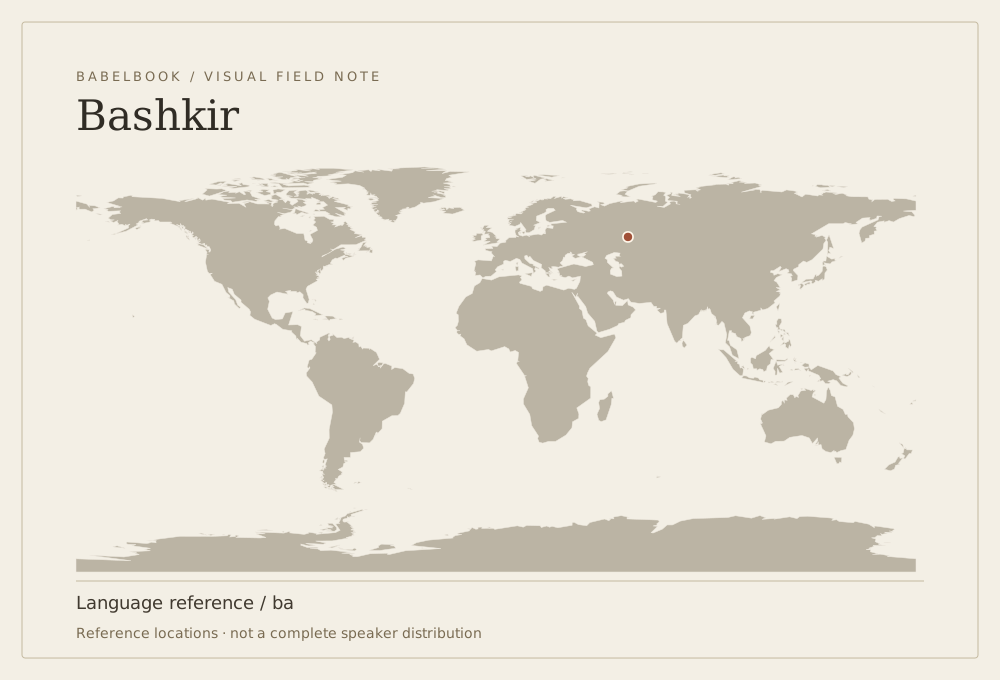
Representative reference points from Glottolog. Historical entries show reference locations, not current speakers. 1 point.
Reference & context ↗Babelbook · original editorial illustration · CC BY 4.0 · Glottolog locations; public-domain Natural Earth land
Source excerpts, selected, shortened and where noted editorially corrected from Bashkir language by Wikipedia contributors. Retrieved 2026-10-05. CC BY-SA 4.0. These excerpts are not an independently verified scholarly history; missing accounts are identified above.
Read further in the source
Speakers
Speakers of Bashkir mostly live in the republic of Bashkortostan (a republic within the Russian Federation). Many speakers also live in Tatarstan, Chelyabinsk, Orenburg, Tyumen, Sverdlovsk and Kurgan Oblasts, and other regions of Russia. Minor Bashkir groups also live in Kazakhstan and the United States.
Orthography
After the adoption of Islam, which began in the 10th century and lasted for several centuries, the Bashkirs began to use Turki as a written language. Turki was written in a variant of the Arabic script. In 1923, a writing system based on the Arabic script was specifically created for the Bashkir language. At the same time, the Bashkir literary language was created, moving away from the older written Turkic influences. At first, it used a modified Arabic alphabet. In 1930 it was replaced with the Unified Turkic Latin Alphabet, which was in turn replaced with an adapted Cyrillic alphabet in 1939. The modern alphabet used by Bashkir is based on the Russian alphabet, with the addition of the following letters: Ә ә /æ/, Ө ө /ø/, Ү ү /ʏ/, Ғ ғ /ʁ/, Ҡ ҡ /q/, Ң ң /ŋ/, Ҙ ҙ /ð/, Ҫ ҫ /θ/, Һ һ /h/.
Bashkir Latin alphabet based on the Common Turkic alphabet