Belarusian
Belarusian is an East Slavic language. It is one of the two official languages in Belarus, the other being Russian. It is also spoken in parts of Russia, Lithuania, Latvia, Poland (where it is the official language in 5 bilingual municipalities), Ukraine, and the United States by the Belarusian diaspora. Before Belarus gained independence in 1991, the language was known in English as Byelorussian or Belorussian, or alternatively as White Russian. Following independence, it became known as Belarusian, or alternatively as Belarusan. As one of the East Slavic languages, Belarusian shares many grammatical and lexical features with other members of the group. To some extent, Russian, Ukrainian, and Belarusian retain a degree of mutual intelligibility. Belarusian descends from a language generally referred to as Ruthenian (13th to 18th centuries), which had, in turn, descended from what is referred to as Old East Slavic (10th to 13th centuries). In the first Belarusian census in 1999, the Belarusian language was declared a "language spoken at home" by about 3,686,000 Belarusian citizens (36.7% of the population). About 6,984,000 (85.6%) of Belarusians declared it their "mother tongue". Other sources, such as Ethnologue, put the figure at approximately 3.5 million active speakers in Belarus. In Russia, the Belarusian language is declared as a "familiar language" by about 316,000 inhabitants, among them about 248,000 Belarusians, comprising about 30.7% of Belarusians living in Russia.
Translate in Belarusian ↗Under president Alexander Lukashenko, Belarusian speaking people in Belarus have complained about the discrimination against the Belarusian language in Belarus. Despite a formally equal status of Russian and Belarusian, Russian is primarily used by the Belarusian government, and cases of discrimination against the Belarusian language are not rare, even though the discrimination is not institutionalized. Authorities occasionally make minor concessions to demands for a widening of the usage of the Belarusian language. Organisations promoting the Belarusian language such as the Francišak Skaryna Belarusian Language Society were reported as being the object of attacks by Belarus-based Russian neo-Nazi groups in the 1990s and 2000s. The Frantsishak Skaryna Society has reported about the following categories of violations against the rights of Belarusian speakers in Belarus: The right to receive public and private services in the Belarusian language; The right to access legislation in the Belarusian language; The right to receive education in the Belarusian language; The right to an equitable presence of the Belarusian language in the media; The right to receive full oral and written information in the Belarusian language on the products and services proposed by commercial companies. Belarusian speakers are facing numerous obstacles when trying to arrange Belarusian language education for their children.
Europe
Present-day use
The captured source does not contain a separate current-use account.
Origins
The captured article does not contain a separate origins section. See the historical account and linked source.
Development
The modern Belarusian language was redeveloped on the base of the vernacular spoken remnants of the Ruthenian language, surviving in the ethnic Belarusian territories in the 19th century. The end of the 18th century (the times of the Divisions of Commonwealth) is the usual conventional borderline between the Ruthenian and Modern Belarusian stages of development. By the end of the 18th century, (Old) Belarusian was still common among the minor nobility in the eastern part, in the territory of present-day Belarus, of the Grand Duchy of Lithuania (hereafter Lithuania). Jan Czeczot in the 1840s had mentioned that even his generation's grandfathers preferred speaking (Old) Belarusian. According to A. N. Pypin, the Belarusian language was spoken in some areas among the minor nobility during the 19th century. In its vernacular form, it was the language of the smaller town dwellers and of the peasantry and it had been the language of oral folklore. Teaching in Belarusian was conducted mainly in schools run by the Basilian order. The development of Belarusian in the 19th century was strongly influenced by the political conflict in the territories of the former Lithuania, between the Russian Imperial authorities, trying to consolidate their rule over the "joined provinces", and the Polish and Polonized nobility, trying to bring back its pre-Partitions rule One of the important manifestations of this conflict was the struggle for ideological control over the educational system. The Polish and Russian languages were being introduced and re-introduced, while the general state of the people's education remained poor until the very end of the Russian Empire. In summary, the first two decades of the 19th century had seen the unprecedented prosperity of Polish culture and language in the former Lithuanian lands, and had prepared the era of such famous Polish writers as Adam Mickiewicz and Władysław Syrokomla.
Writing
Cyrillic (catalog classification; see the source for context).
Beyond the typeface.
Signs, manuscripts, published pages and contextual photographs, with their place, period, source and reuse terms. Captions identify historical spellings, regional examples, community references and character imagery.
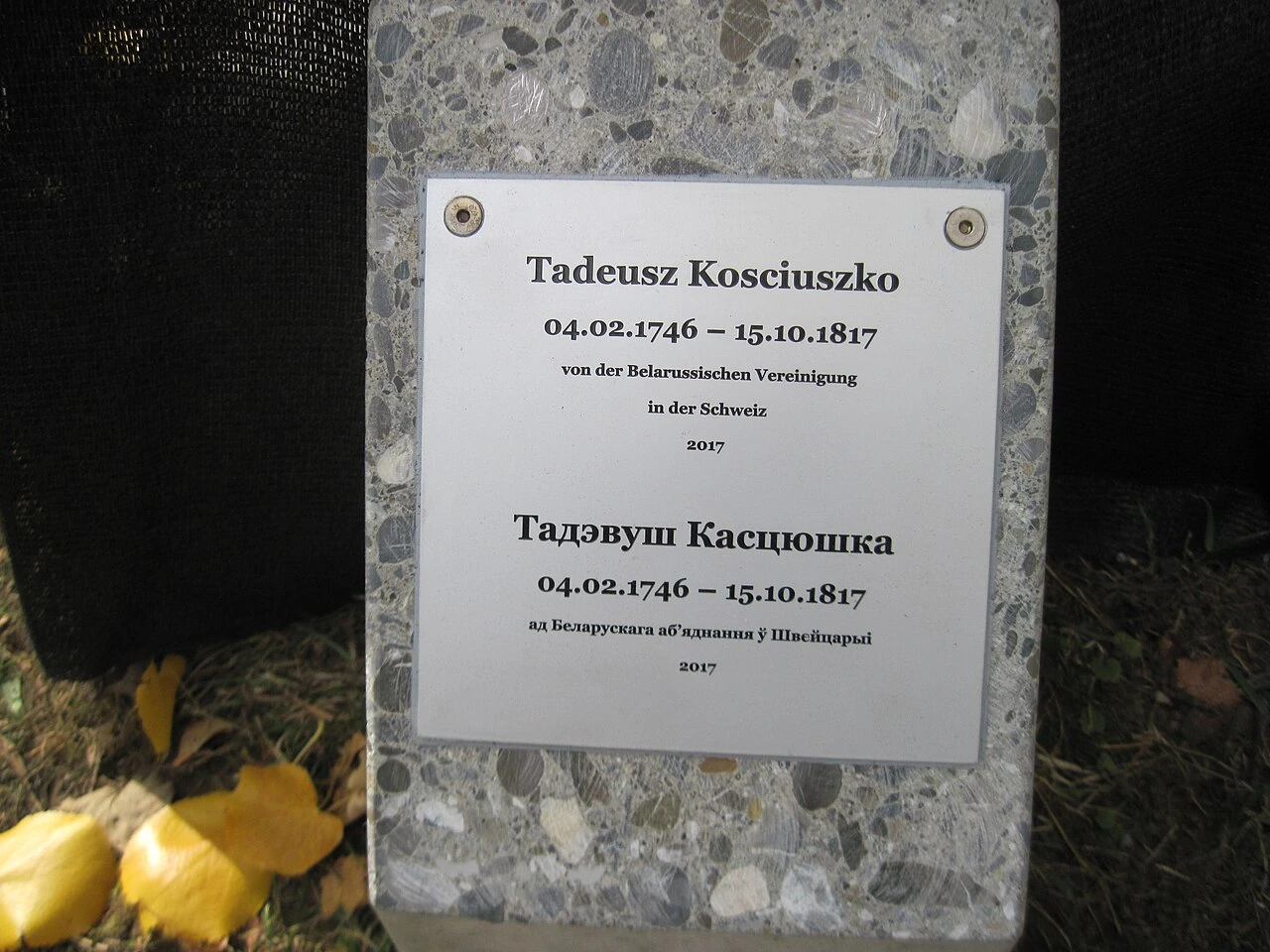
Belarusian and German on a plaque at the Tadeusz Kościuszko monument in Solothurn, photographed in 2017. Language identification follows Commons descriptions or categories; not independently transcribed.
Saved in Babelbook · resized display copy. Select the image to open it independently of its source.
Lesnas ättling · Source ↗CC BY-SA 4.0 ↗View the local visual field note
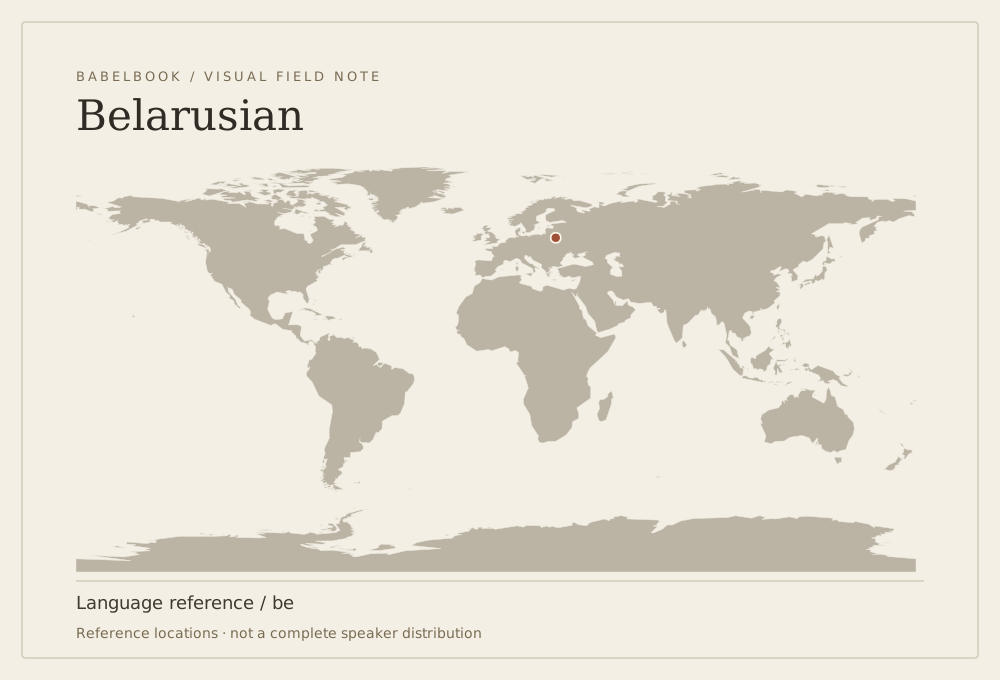
Representative reference points from Glottolog. Historical entries show reference locations, not current speakers. 1 point.
Reference & context ↗Babelbook · original editorial illustration · CC BY 4.0 · Glottolog locations; public-domain Natural Earth land
Source excerpts, selected, shortened and where noted editorially corrected from Belarusian language by Wikipedia contributors. Retrieved 2026-10-05. CC BY-SA 4.0. These excerpts are not an independently verified scholarly history; missing accounts are identified above.
Read further in the source
Dialects
Besides the standardized lect, there are two main dialects of the Belarusian language: the northeastern dialect and the southwestern dialect. In addition, there is a transitional "Middle Belarusian" dialect group and a separate "West Polesian" dialect group. The northeastern and southwestern dialects are separated by a hypothetical line (Ashmyany–Minsk–Babruysk–Gomel) with the area of the Middle Belarusian dialect group placed on and along this line. The northeastern dialect is characterised by the "soft sounding R" and "strong akanye"; and the southwestern dialect is characterised by the "hard sounding R" and "moderate akanye". The West Polesian dialect group is separated from the rest of the country by the conventional line Pruzhany–Ivatsevichy–Tsyelyakhany–Luninyets–Stolin.
History
The modern Belarusian language was redeveloped on the base of the vernacular spoken remnants of the Ruthenian language, surviving in the ethnic Belarusian territories in the 19th century. The end of the 18th century (the times of the Divisions of Commonwealth) is the usual conventional borderline between the Ruthenian and Modern Belarusian stages of development. By the end of the 18th century, (Old) Belarusian was still common among the minor nobility in the eastern part, in the territory of present-day Belarus, of the Grand Duchy of Lithuania (hereafter Lithuania). Jan Czeczot in the 1840s had mentioned that even his generation's grandfathers preferred speaking (Old) Belarusian. According to A. N. Pypin, the Belarusian language was spoken in some areas among the minor nobility during the 19th century. In its vernacular form, it was the language of the smaller town dwellers and of the peasantry and it had been the language of oral folklore. Teaching in Belarusian was conducted mainly in schools run by the Basilian order. The development of Belarusian in the 19th century was strongly influenced by the political conflict in the territories of the former Lithuania, between the Russian Imperial authorities, trying to consolidate their rule over the "joined provinces", and the Polish and Polonized nobility, trying to bring back its pre-Partitions rule
One of the important manifestations of this conflict was the struggle for ideological control over the educational system. The Polish and Russian languages were being introduced and re-introduced, while the general state of the people's education remained poor until the very end of the Russian Empire. In summary, the first two decades of the 19th century had seen the unprecedented prosperity of Polish culture and language in the former Lithuanian lands, and had prepared the era of such famous Polish writers as Adam Mickiewicz and Władysław Syrokomla. The era had seen the effective completion of the Polonization of the lowest level of the nobility, the further reduction of the area of use of contemporary Belarusian, and the effective folklorization of Belarusian culture. Nevertheless, at the beginning of the 19th century "there began a revival of national pride within the country … and a growth in interest [in Belarusian] from outside". Due both to the state of the people's education and to the strong positions of Polish and Polonized nobility, it was only after the 1880s–1890s that the educated Belarusian element, still shunned because of "peasant origin", began to appear in state offices. In 1846, ethnographer Pavel Shpilevskiy prepared a Belarusian grammar (using the Cyrillic alphabet) on the basis of the folk dialects of the Minsk region. However, the Russian Academy of Sciences refused to print his submission, on the basis that it had not been prepared in a sufficiently scientific manner. From the mid-1830s ethnographic works began to appear, and tentative attempts to study the language were instigated (e.g. Shpilevskiy's grammar). The Belarusian literary tradition began to re-form, based on the folk language, initiated by the works of Vintsent Dunin-Martsinkyevich.
At the beginning of the 1860s, both the Russian and Polish parties in Belarusian lands had begun to realise that the decisive role in the upcoming conflicts was shifting to the peasantry, overwhelmingly Belarusian. So a large amount of propaganda appeared, targeted at the peasantry and written in Belarusian; notably, the anti-Russian, anti-Tsarist, anti-Eastern Orthodox "Manifesto" and the first newspaper Mužyckaja prauda (lit. 'Peasants' Truth'; 1862–1863) by Konstanty Kalinowski, and anti-Polish, anti-Revolutionary, pro-Orthodox booklets and poems (1862). The advent of the all-Russian narodniks and Belarusian national movements during the late 1870s and early 1880s renewed interest in the Belarusian language and literary tradition. During these times, Belarusian writer Francišak Bahuševič made his appeal to Belarusians: "Do not forsake our language, lest you pass away". The First Belarusian Dictionary by Ivan Nasovič was published in 1870. In the editorial introduction to the dictionary, it is noted that:
The Belarusian local tongue, which dominates a vast area from the Nioman and the Narew to the Upper Volga and from the Western Dvina to the Prypiac and the Ipuc and which is spoken by inhabitants of the North-Western and certain adjacent provinces, or those lands that were in the past settled by the Kryvic tribe, has long attracted the attention of our philologists because of those precious remains of the ancient Ruthenian language that survived in that tongue.
In 1891, in the preface to the Belarusian Flute, Francišak Bahuševič wrote, "There have been many peoples, which first lost their language... and then they perished entirely. So do not abandon our Belarusian language, lest we perish!" According to the 1897 Russian Empire census, about 5.89 million people declared themselves speakers of Belarusian (then known as White Russian). The end of the 19th century, however, still showed that the urban language of Belarusian towns remained either Polish or Russian. The same census showed that towns with a population greater than 50,000 had fewer than a tenth Belarusian speakers. This state of affairs greatly contributed to a perception that Belarusian was a "rural" and "uneducated" language. However, the census was a major breakthrough for the first steps of the Belarusian national self-awareness and identity, since it clearly showed to the Imperial authorities and the still-strong Polish minority that the population and the language were neither Polish nor Russian.
Discrimination against Belarusian speakers
Under president Alexander Lukashenko, Belarusian speaking people in Belarus have complained about the discrimination against the Belarusian language in Belarus. Despite a formally equal status of Russian and Belarusian, Russian is primarily used by the Belarusian government, and cases of discrimination against the Belarusian language are not rare, even though the discrimination is not institutionalized. Authorities occasionally make minor concessions to demands for a widening of the usage of the Belarusian language. Organisations promoting the Belarusian language such as the Francišak Skaryna Belarusian Language Society were reported as being the object of attacks by Belarus-based Russian neo-Nazi groups in the 1990s and 2000s. The Frantsishak Skaryna Society has reported about the following categories of violations against the rights of Belarusian speakers in Belarus:
The right to receive public and private services in the Belarusian language; The right to access legislation in the Belarusian language; The right to receive education in the Belarusian language; The right to an equitable presence of the Belarusian language in the media; The right to receive full oral and written information in the Belarusian language on the products and services proposed by commercial companies. Belarusian speakers are facing numerous obstacles when trying to arrange Belarusian language education for their children. As of 2016 there are no Belarusian-language universities in the country. In its 2016 report on human rights in Belarus, the US State Department also stated that there was "discrimination against … those who sought to use the Belarusian language." "Because the government viewed many proponents of the Belarusian language as political opponents, authorities continued to harass and intimidate academic and cultural groups that sought to promote Belarusian and routinely rejected proposals to widen use of the language". In 2026, the United Nations Special Rapporteur on the situation of human rights in Belarus noted that "in practice the Belarusian language is subjected to systematic marginalization" and "that violations against Belarusian-language users have increased since August 2020, as authorities increasingly treat the use of Belarusian as a sign of political disloyalty and target both public figures and the general public". "Marginalization of the Belarusian language and discrimination against those who use it are systemic across State institutions, including in the public administration, courts, detention settings, education, media and official communication", according to UN Special Rapporteur. The UN Special Rapporteur notes that the combination of both discrimination tolerated or enabled by state authorities and lack of protection "creates an environment where the use of Belarusian is discouraged and may lead to negative consequences from government officials, administrative pressure or punitive measures against individuals who insist on exercising their linguistic rights".