Bulgarian
Bulgarian is an Eastern South Slavic language spoken in Southeast Europe, primarily in Bulgaria. It is the language of the Bulgarians. Along with the closely related Macedonian language (collectively forming Macedo-Bulgarian), it is a member of the Balkan sprachbund and South Slavic dialect continuum of the Indo-European language family. The two languages have several characteristics that set them apart from all other Slavic languages, including the elimination of case declension, the development of a suffixed definite article, and the lack of a verb infinitive. They retain and have further developed the Proto-Slavic verb system (albeit analytically). One such major development is the innovation of evidential verb forms to encode for the source of information: witnessed, inferred, or reported. It is the official language of Bulgaria, and since 2007 has been among the official languages of the European Union. It is also spoken by the Bulgarian communities in Ukraine, North Macedonia, Moldova, Serbia, Romania, Hungary, Albania, Greece and Turkey.
Translate in Bulgarian ↗Bulgarian is the official language of Bulgaria, where it is used in all spheres of public life. As of 2021, it is the first language of 77% of the country or 5,037,607 people. There is also a significant Bulgarian diaspora abroad. One of the main historically established communities are the Bessarabian Bulgarians, whose settlement in the Bessarabia region of nowadays Moldova and Ukraine dates mostly to the early 19th century. There were 134,000 Bulgarian speakers in Ukraine at the 2001 census, 41,800 in Moldova as of the 2014 census (of which 15,300 were habitual users of the language), and presumably a significant proportion of the 13,200 ethnic Bulgarians residing in neighbouring Transnistria in 2016. There are Bulgarian speakers in neighbouring countries as well. The regional dialects of Bulgarian and Macedonian form a dialect continuum, and there is no well-defined boundary where one language ends and the other begins. Within the limits of the Republic of North Macedonia a strong separate Macedonian identity has emerged since the Second World War, even though there still are a small number of citizens who identify their language as Bulgarian. Beyond the borders of North Macedonia, the situation is more fluid, and the pockets of speakers of the related regional dialects in Albania and in Greece variously identify their language as Macedonian or as Bulgarian. In Serbia, there were 7,939 speakers as per 2022 census, mainly concentrated in the so-called Western Outlands along the border with Bulgaria. Bulgarian is also spoken in Turkey: natively by Pomaks, and as a second language by many Bulgarian Turks who emigrated from Bulgaria, mostly during the "Big Excursion" of 1989. The language is also represented among the diaspora in Western Europe and North America, which has been steadily growing since the 1990s.
Europe
Present-day use
The captured source does not contain a separate current-use account.
Origins
The captured article does not contain a separate origins section. See the historical account and linked source.
Development
One can divide the development of the Bulgarian language into several periods. The Prehistoric period covers the time between the Slavic migration to the eastern Balkans (c. 6th century CE) and the mission of Saints Cyril and Methodius to Great Moravia in 860s. Old Church Slavonic (9th to 11th centuries) a literary norm of the early southern dialect of the Proto-Slavic language from which Bulgarian evolved, also referred to as Old Bulgarian. Saints Cyril and Methodius and their disciples used this norm when translating the Bible and other liturgical literature from Greek into Slavic. Middle Bulgarian (12th to 15th centuries) – a literary norm that evolved from the earlier Old Bulgarian, after major innovations occurred. A language of rich literary activity, it served as an official administration language of the Second Bulgarian Empire, Walachia, Moldavia (until the 19th century) and an important language in the Ottoman Empire. Sultan Selim I spoke and used it well. Modern Bulgarian dates from the 16th century onwards, undergoing general grammar and syntax changes in the 18th and 19th centuries. The present-day written Bulgarian language was standardized on the basis of the 19th-century Bulgarian vernacular. The historical development of the Bulgarian language can be described as a transition from a highly synthetic language (Old Bulgarian) to a fusional inflecting synthetic language with some analyticity (Modern Bulgarian) with Middle Bulgarian as a midpoint in this transition. Bulgarian was the first Slavic language attested in writing. As Slavic linguistic unity lasted into late antiquity, the oldest manuscripts initially referred to this language as ѧзꙑкъ словѣньскъ, "the Slavic language". In the Middle Bulgarian period this name was gradually replaced by the name ѧзꙑкъ блъгарьскъ, the "Bulgarian language".
Writing
Cyrillic (catalog classification; see the source for context).
Beyond the typeface.
Signs, manuscripts, published pages and contextual photographs, with their place, period, source and reuse terms. Captions identify historical spellings, regional examples, community references and character imagery.
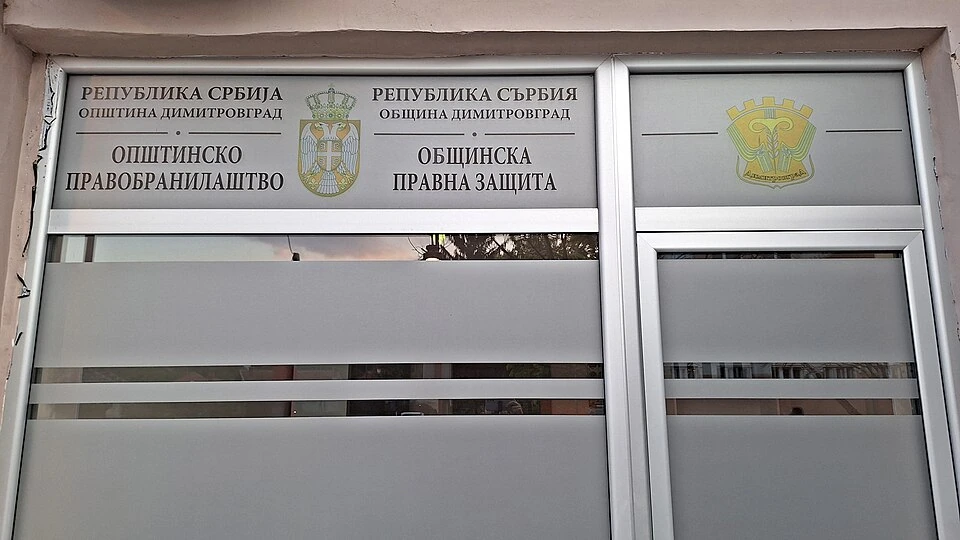
Serbian and Bulgarian sign on a municipal building in Dimitrovgrad. Language identification follows the source description; not independently transcribed.
Saved in Babelbook · resized display copy. Select the image to open it independently of its source.
Apokar · Source ↗CC BY-SA 4.0 ↗View the local visual field note
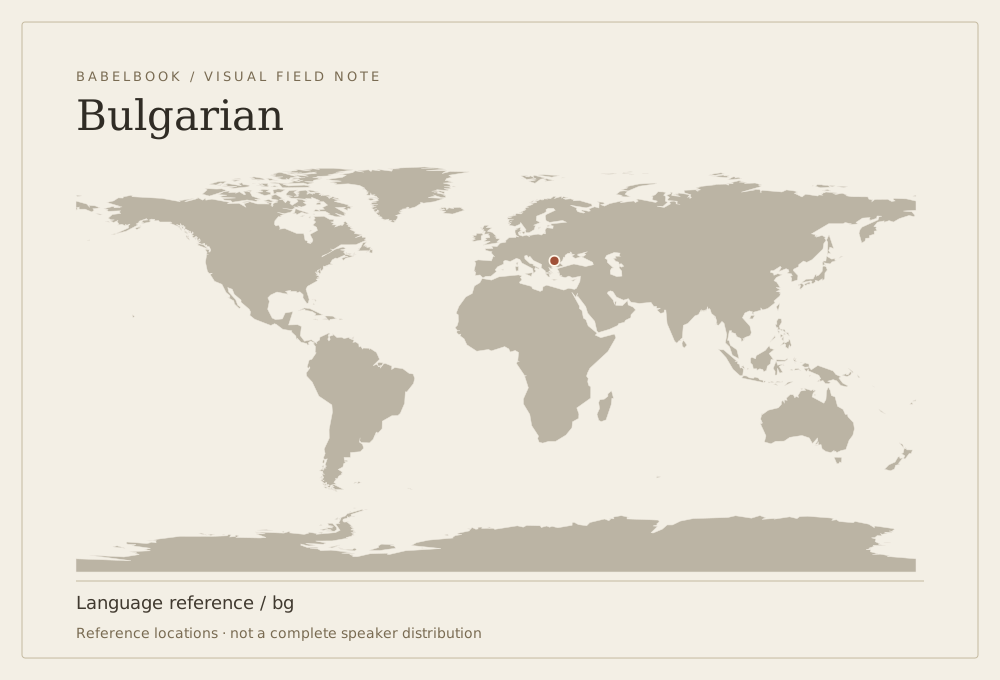
Representative reference points from Glottolog. Historical entries show reference locations, not current speakers. 1 point.
Reference & context ↗Babelbook · original editorial illustration · CC BY 4.0 · Glottolog locations; public-domain Natural Earth land
Source excerpts, selected, shortened and where noted editorially corrected from Bulgarian language by Wikipedia contributors. Retrieved 2026-10-05. CC BY-SA 4.0. These excerpts are not an independently verified scholarly history; missing accounts are identified above.
Read further in the source
History
One can divide the development of the Bulgarian language into several periods.
The Prehistoric period covers the time between the Slavic migration to the eastern Balkans (c. 6th century CE) and the mission of Saints Cyril and Methodius to Great Moravia in 860s. Old Church Slavonic (9th to 11th centuries) a literary norm of the early southern dialect of the Proto-Slavic language from which Bulgarian evolved, also referred to as Old Bulgarian. Saints Cyril and Methodius and their disciples used this norm when translating the Bible and other liturgical literature from Greek into Slavic. Middle Bulgarian (12th to 15th centuries) – a literary norm that evolved from the earlier Old Bulgarian, after major innovations occurred. A language of rich literary activity, it served as an official administration language of the Second Bulgarian Empire, Walachia, Moldavia (until the 19th century) and an important language in the Ottoman Empire. Sultan Selim I spoke and used it well. Modern Bulgarian dates from the 16th century onwards, undergoing general grammar and syntax changes in the 18th and 19th centuries. The present-day written Bulgarian language was standardized on the basis of the 19th-century Bulgarian vernacular. The historical development of the Bulgarian language can be described as a transition from a highly synthetic language (Old Bulgarian) to a fusional inflecting synthetic language with some analyticity (Modern Bulgarian) with Middle Bulgarian as a midpoint in this transition.
Bulgarian was the first Slavic language attested in writing. As Slavic linguistic unity lasted into late antiquity, the oldest manuscripts initially referred to this language as ѧзꙑкъ словѣньскъ, "the Slavic language". In the Middle Bulgarian period this name was gradually replaced by the name ѧзꙑкъ блъгарьскъ, the "Bulgarian language". In some cases, this name was used not only with regard to the contemporary Middle Bulgarian language of the copyist but also to the period of Old Bulgarian. A most notable example of anachronism is the Service of Saint Cyril from Skopje (Скопски миней), a 13th-century Middle Bulgarian manuscript from northern Macedonia according to which St. Cyril preached with "Bulgarian" books among the Moravian Slavs. The first mention of the language as the "Bulgarian language" instead of the "Slavonic language" comes in the work of the Greek clergy of the Archbishopric of Ohrid in the 11th century, for example in the Greek hagiography of Clement of Ohrid by Theophylact of Ohrid (late 11th century). During the Middle Bulgarian period, the language underwent dramatic changes, losing the Slavonic case system, but preserving the rich verb system (while the development was exactly the opposite in other Slavic languages) and developing a definite article. It was influenced by its non-Slavic neighbours in the Balkan language area (mostly grammatically) and later also by Turkish, which was the official language of the Ottoman Empire, in the form of the Ottoman Turkish language, mostly lexically. The damaskin texts mark the transition from Middle Bulgarian to New Bulgarian, which was standardized in the 19th century. As a national revival occurred toward the end of the period of Ottoman rule (mostly during the 19th century), a modern Bulgarian literary language gradually emerged that drew heavily on Church Slavonic/Old Bulgarian (and to some extent on literary Russian, which had preserved many lexical items from Church Slavonic) and later reduced the number of Turkish and other Balkan loans. Today one difference between Bulgarian dialects in the country and literary spoken Bulgarian is the significant presence of Old Bulgarian words and even word forms in the latter. Russian loans are distinguished from Old Bulgarian ones on the basis of the presence of specifically Russian phonetic changes, as in оборот (turnover, rev), непонятен (incomprehensible), ядро (nucleus) and others. Many other loans from French, English and the classical languages have subsequently entered the language as well. Modern Bulgarian was based essentially on the Eastern dialects of the language, but its pronunciation is in many respects a compromise between East and West Bulgarian (see especially the phonetic sections below). Following the efforts of some figures of the National awakening of Bulgaria (most notably Neofit Rilski and Ivan Bogorov), there had been many attempts to codify a standard Bulgarian language; however, there was much argument surrounding the choice of norms. Between 1835 and 1878 more than 25 proposals were put forward and "linguistic chaos" ensued. Eventually the eastern dialects prevailed, and in 1899 the Bulgarian Ministry of Education officially codified a standard Bulgarian language based on the Drinov-Ivanchev orthography.
Geographic distribution
Bulgarian is the official language of Bulgaria, where it is used in all spheres of public life. As of 2021, it is the first language of 77% of the country or 5,037,607 people. There is also a significant Bulgarian diaspora abroad. One of the main historically established communities are the Bessarabian Bulgarians, whose settlement in the Bessarabia region of nowadays Moldova and Ukraine dates mostly to the early 19th century. There were 134,000 Bulgarian speakers in Ukraine at the 2001 census, 41,800 in Moldova as of the 2014 census (of which 15,300 were habitual users of the language), and presumably a significant proportion of the 13,200 ethnic Bulgarians residing in neighbouring Transnistria in 2016. There are Bulgarian speakers in neighbouring countries as well. The regional dialects of Bulgarian and Macedonian form a dialect continuum, and there is no well-defined boundary where one language ends and the other begins. Within the limits of the Republic of North Macedonia a strong separate Macedonian identity has emerged since the Second World War, even though there still are a small number of citizens who identify their language as Bulgarian. Beyond the borders of North Macedonia, the situation is more fluid, and the pockets of speakers of the related regional dialects in Albania and in Greece variously identify their language as Macedonian or as Bulgarian. In Serbia, there were 7,939 speakers as per 2022 census, mainly concentrated in the so-called Western Outlands along the border with Bulgaria. Bulgarian is also spoken in Turkey: natively by Pomaks, and as a second language by many Bulgarian Turks who emigrated from Bulgaria, mostly during the "Big Excursion" of 1989. The language is also represented among the diaspora in Western Europe and North America, which has been steadily growing since the 1990s. Countries with significant numbers of speakers include Germany, Spain, Italy, the United Kingdom (38,500 speakers in England and Wales as of 2011), France, the United States, and Canada (19,100 in 2011). There were 14,678 Bulgarian speakers in Cyprus in 2021.
Dialects
In Bulgarian the different reflexes of the yat form the so-called Yat border (ятова граница), running approximately from Nikopol on the Danube to Solun (Thessaloniki) on the Aegean Sea. West of that isogloss, old yat is always realized as /ɛ/. East of it, the reflexes of yat prototypically alternate between /ja/ or /ʲa/ (in stressed syllables when not followed by a front vowel) and /ɛ/ (in all other cases). The division of the dialects of the Eastern South Slavic into western and eastern subgroup running along the yat border is the most important dividing isogloss there. The open articulation of yat (as /æ/ or ja) and the reflexes of Proto-Slavic *tj/*ktĭ/*gtĭ and *dj as ⟨щ⟩ (ʃt) and ⟨жд⟩ (ʒd) have traditionally been considered the two most distinctive phonetic features of Old Bulgarian. The language is mainly split into two broad dialect areas, based on the different reflexes of the Proto-Slavic yat vowel (Ѣ). This split, which occurred at some point during the Middle Ages, led to the development of Bulgaria's:
Western dialects (informally called твърд говор/tvurd govor – "hard speech") the former yat is pronounced "e" in all positions. e.g. млеко (mlekò) – milk, хлеб (hleb) – bread. Eastern dialects (informally called мек говор/mek govor – "soft speech") the former yat alternates between "ya" and "e": it is pronounced "ya" if it is under stress and the next syllable does not contain a front vowel (e or i) – e.g. мляко (mlyàko), хляб (hlyab), and "e" otherwise – e.g. млекар (mlekàr) – milkman, хлебар (hlebàr) – baker. This rule obtains in most Eastern dialects, although some have "ya", or a special "open e" sound, in all positions. The literary language norm, which is generally based on the Eastern dialects, also has the Eastern alternating reflex of yat. However, it has not incorporated the general Eastern umlaut of all synchronic or even historic "ya" sounds into "e" before front vowels – e.g. поляна (polyana) vs. полени (poleni) "meadow – meadows" or even жаба (zhaba) vs. жеби (zhebi) "frog – frogs", even though it co-occurs with the yat alternation in almost all Eastern dialects that have it (except a few dialects along the yat border, e.g. in the Pleven region). More examples of the yat umlaut in the literary language are:
mlyàko (milk) [n.] → mlekàr (milkman); mlèchen (milky), etc. syàdam (sit) [vb.] → sedàlka (seat); sedàlishte (seat, e.g. of government or institution, butt), etc. svyat (holy) [adj.] → svetètz (saint); svetìlishte (sanctuary), etc. (in this example, ya/e comes not from historical yat but from small yus (ѧ), which normally becomes e in Bulgarian, but the word was influenced by Russian and the yat umlaut) Until 1945, Bulgarian orthography did not reveal this alternation and used the original Old Slavic Cyrillic letter yat (Ѣ), which was commonly called двойно е (dvoyno e) at the time, to express the historical yat vowel or at least root vowels displaying the ya – e alternation. The letter was used in each occurrence of such a root, regardless of the actual pronunciation of the vowel: thus, both mlyako and mlekar were spelled with (Ѣ). Among other things, this was seen as a way to "reconcile" the Western and the Eastern dialects and maintain language unity at a time when much of Bulgaria's Western dialect area was controlled by Serbia and Greece, but there were still hopes and occasional attempts to recover it. With the 1945 orthographic reform, this letter was abolished and the present spelling was introduced, reflecting the alternation in pronunciation. This had implications for some grammatical constructions:
The third person plural pronoun and its derivatives. Before 1945 the pronoun "they" was spelled тѣ (tě), and its derivatives took this as the root. After the orthographic change, the pronoun and its derivatives were given an equal share of soft and hard spellings: "they" – те (te) → "them" – тях (tyah); "their(s)" – tehen (masc.); tyahna (fem.); tyahno (neut.); tehni (plur.) adjectives received the same treatment as тѣ: "whole" – tsyal → "the whole ...": tseliyat (masc.); tsyalata (fem.); tsyaloto (neut.); tselite (plur.) Sometimes, with the changes, words began to be spelled as other words with different meanings, e.g.:
свѣт (svět) – "world" became свят (svyat), spelt and pronounced the same as свят – "holy". тѣ (tě) – "they" became те (te). In spite of the literary norm regarding the yat vowel, many people living in Western Bulgaria, including the capital Sofia, will fail to observe its rules. While the norm requires the realizations vidyal vs. videli (he has seen; they have seen), some natives of Western Bulgaria will preserve their local dialect pronunciation with "e" for all instances of "yat" (e.g. videl, videli). Others, attempting to adhere to the norm, will actually use the "ya" sound even in cases where the standard language has "e" (e.g. vidyal, vidyali). The latter hypercorrection is called свръхякане (svrah-yakane ≈"over-ya-ing").