Bihari languages
Bihari languages are a group of the Indo-Aryan languages. The Bihari languages are mainly spoken in the Indian states of Bihar, Jharkhand, Uttar Pradesh, and West Bengal, and also in Nepal. The most widely spoken languages of the Bihari group are Bajjika, Angika, Bhojpuri, Magahi and Maithili. Despite the large number of speakers of these languages, only Maithili has been constitutionally recognised in India. Which gained constitutional status via the 92nd amendment to the Constitution of India, of 2003 (gaining assent in 2004). Maithili and Bhojpuri have constitutional recognition in Nepal. Bhojpuri-Awadhi mix is also official in Fiji as Fiji Hindi. There are demands for including Bhojpuri and Magahi/Khortha in the 8th schedule of Indian constitution. In Bihar, Hindi is the language used for educational and official matters. These languages were legally absorbed under the overarching label Hindi in the 1961 Census. Such state and national politics are creating conditions for language endangerments. After independence, Hindi was given the sole official status through the Bihar Official Language Act of 1950. Hindi was displaced as the sole official language of Bihar in 1981, when Urdu was accorded the status of the second official language.
Translate in Bihari languages ↗The number of speakers of Bihari languages is difficult to indicate because of unreliable sources. In the urban region most educated speakers of the language name Hindi as their language because this is what they use in formal contexts and believe it to be the appropriate response because of unawareness. The educated and the urban population of the region return Hindi as the generic name for their language. British linguist Grierson also mentioned that Bajjika, Angika and Surjapuri are also spoken in particular districts of Bihar. These languages are mostly spoken in rural areas.
South Asia
Present-day use
The captured source does not contain a separate current-use account.
Origins
The captured article does not contain a separate origins section. See the historical account and linked source.
Development
The captured article does not contain a distinct historical account. No chronology has been invented.
Writing
Latin or customary script (catalog classification; see the source for context).
Beyond the typeface.
Signs, manuscripts, published pages and contextual photographs, with their place, period, source and reuse terms. Captions identify historical spellings, regional examples, community references and character imagery.
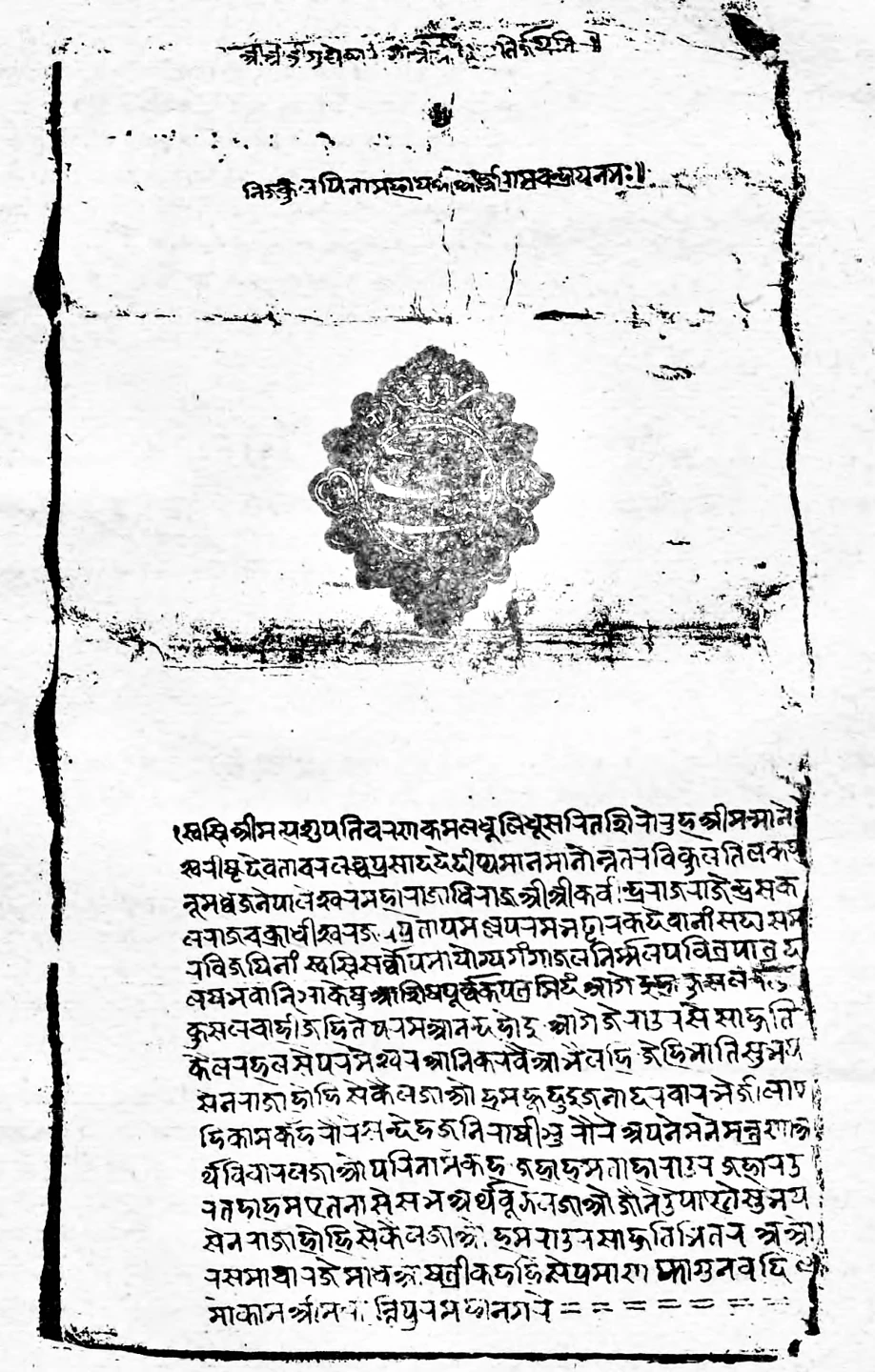
A historical letter attributed to King Pratap Malla and addressed to Dalakhamba Baniya, identified by Commons as Bhojpuri. This represents one member of the Bihari language group, not every language in that group. The reproduced page includes a transliteration. Language identification follows Commons, not independent transcription.
Saved in Babelbook · resized display copy. Select the image to open it independently of its source.
Unknown author · Source ↗Public domain ↗View the local visual field note
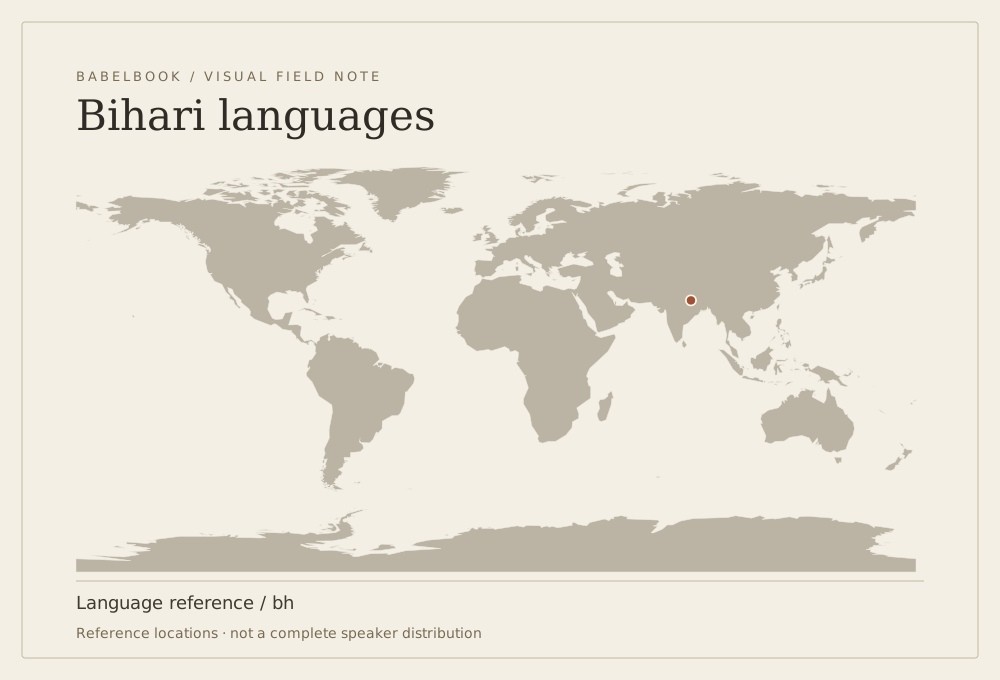
Representative reference points from Glottolog. Historical entries show reference locations, not current speakers. 1 point.
Reference & context ↗Babelbook · original editorial illustration · CC BY 4.0 · Glottolog locations; public-domain Natural Earth land
Source excerpts, selected, shortened and where noted editorially corrected from Bihari languages by Wikipedia contributors. Retrieved 2026-10-05. CC BY-SA 4.0. These excerpts are not an independently verified scholarly history; missing accounts are identified above.
Read further in the source
Speakers
The number of speakers of Bihari languages is difficult to indicate because of unreliable sources. In the urban region most educated speakers of the language name Hindi as their language because this is what they use in formal contexts and believe it to be the appropriate response because of unawareness. The educated and the urban population of the region return Hindi as the generic name for their language. British linguist Grierson also mentioned that Bajjika, Angika and Surjapuri are also spoken in particular districts of Bihar. These languages are mostly spoken in rural areas.