Bislama
Bislama (English: BISS-lə-mah; Bislama: [biˈslama]; also known by its earlier French name, bichelamar [biʃlamaʁ]) is an English-based creole language. It is the national language of Vanuatu, and one of the three official languages of the country, the other ones being English and French. Bislama is the first language of many of the "Urban ni-Vanuatu" (citizens who live in Port Vila and Luganville) and the second language of much of the rest of the country's residents. The lyrics of "Yumi, Yumi, Yumi", the country's national anthem, are composed in Bislama. More than 95% of Bislama words are of English origin, whilst the remainder comprises a few dozen words from French as well as some specific vocabulary inherited from various languages of Vanuatu—although these are essentially limited to flora and fauna terminology. While the influence of these vernacular languages is low on the vocabulary side, it is very high in the morphosyntax. As such, Bislama can be described simply as a language with an English vocabulary and an Oceanic grammar and phonology. Scholars highlight the role of Bislama in undermining the vitality of Vanuatu's indigenous languages.
Translate in Bislama ↗Bislama (English: BISS-lə-mah; Bislama: [biˈslama]; also known by its earlier French name, bichelamar [biʃlamaʁ]) is an English-based creole language. It is the national language of Vanuatu, and one of the three official languages of the country, the other ones being English and French. Bislama is the first language of many of the "Urban ni-Vanuatu" (citizens who live in Port Vila and Luganville) and the second language of much of the rest of the country's residents. The lyrics of "Yumi, Yumi, Yumi", the country's national anthem, are composed in Bislama. More than 95% of Bislama words are of English origin, whilst the remainder comprises a few dozen words from French as well as some specific vocabulary inherited from various languages of Vanuatu—although these are essentially limited to flora and fauna terminology. While the influence of these vernacular languages is low on the vocabulary side, it is very high in the morphosyntax. As such, Bislama can be described simply as a language with an English vocabulary and an Oceanic grammar and phonology. Scholars highlight the role of Bislama in undermining the vitality of Vanuatu's indigenous languages.
Oceania
Present-day use
The captured source does not contain a separate current-use account.
Origins
The captured article does not contain a separate origins section. See the historical account and linked source.
Development
During the period of "blackbirding" in the 1870s and 1880s, hundreds of thousands of Pacific islanders (many of them from the New Hebrides – now the Vanuatu archipelago) were taken as indentured labourers, often kidnapped, and forced to work on plantations, mainly in Queensland, Australia, and Fiji. With several languages being spoken in these plantations a localised pidgin was formed, combining English vocabulary with grammatical structures typical of languages in the region. This early plantation pidgin is the origin not only of Bislama, but also of Tok Pisin in Papua New Guinea, and Pijin of the Solomon Islands; though not of Torres Strait Creole in the north of Australia. This creole started spreading throughout the Vanuatu archipelago at the turn of the 20th century, as former blackbirds and their descendants began to return to their native islands. Knowledge of this creole would facilitate communication not only with European traders and settlers, but also between native populations, and because Vanuatu is the most language-dense country in the world (one count puts it at 113 languages for a population of 225,000), Bislama usefully serves as a lingua franca for communication between ni-Vanuatu, as well as with and between foreigners. Although it has been primarily a spoken-only language for most of its history, the first dictionary of Bislama was published in 1977. A new dictionary was published in 1995. This, along with its second edition in 2004, has helped to create a standardised and uniform spelling of written Bislama. Besides Bislama, most ni-Vanuatu also know their local language, the local language of their father and/or mother, as well as their spouse, oftentimes. The country's official languages of tuition in schools and educational institutions are English and French.
Writing
The Bislama Latin alphabet uses the letters A, B, D, E, F, G, H, I, J, K, L, M, N, O, P, R, S, T, U, V, W, Y and the digraphs AE, AO and NG. An older Latin orthography, used before 1995, had É (now written E), AI and AU (now AE and AO). For those vowels in hiatus, AÏ and AÜ were used (now written AI and AU). Labialized consonants (used in loanwords), now written with a tilde (M̃ and P̃) or a following W (MW and PW), were then spelled with a macron, following the conventions used for some vernacular Vanuatu languages: M̄ was used for /mʷ/ and P̄ for /pʷ/. On the island of Pentecost, the avoiuli script is sometimes used for Bislama. The shapes of the letters derive from sand-drawing. It has distinct letters for NG and NGG, but otherwise corresponds closely to the Latin alphabet above, though capitals are seldom used, punctuation differs, there are digits for higher numbers and logograms for commonly traded commodities such as pig tusks.
Beyond the typeface.
Signs, manuscripts, published pages and contextual photographs, with their place, period, source and reuse terms. Captions identify historical spellings, regional examples, community references and character imagery.
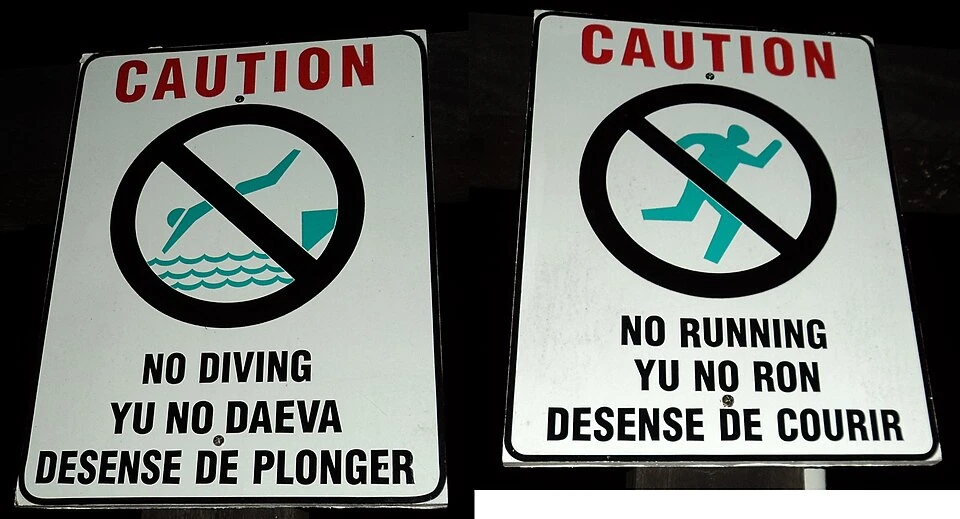
Public warning signs in Bislama, English and French, Vanuatu. Language identification follows Commons metadata; not independently transcribed.
Saved in Babelbook · resized display copy. Select the image to open it independently of its source.
Sgroey · Source ↗CC BY-SA 4.0 ↗View the local visual field note
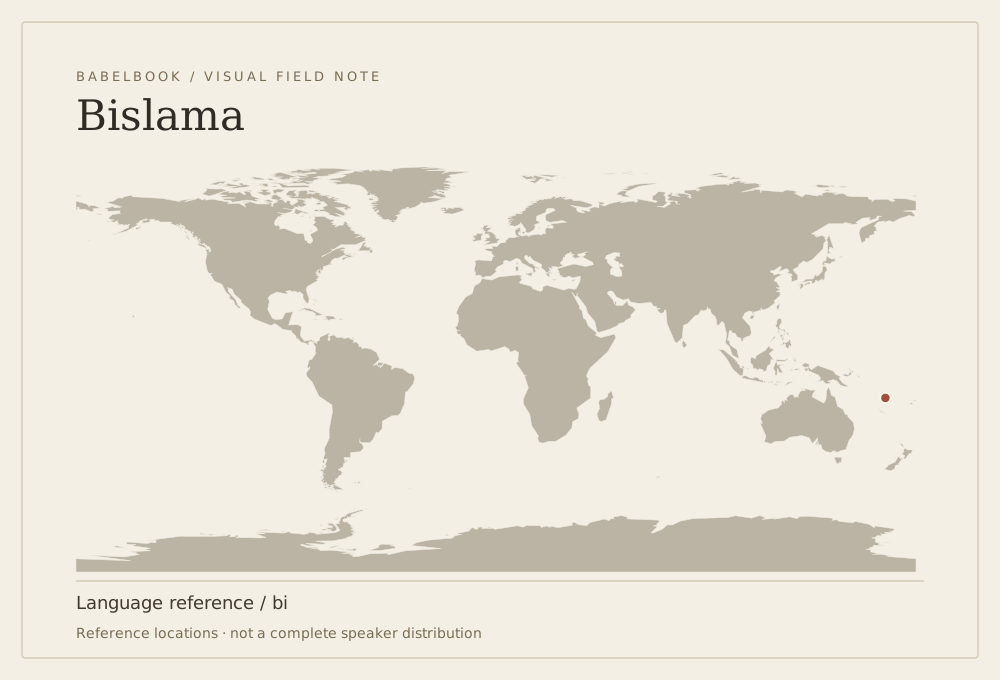
Representative reference points from Glottolog. Historical entries show reference locations, not current speakers. 1 point.
Reference & context ↗Babelbook · original editorial illustration · CC BY 4.0 · Glottolog locations; public-domain Natural Earth land
Source excerpts, selected, shortened and where noted editorially corrected from Bislama by Wikipedia contributors. Retrieved 2026-10-05. CC BY-SA 4.0. These excerpts are not an independently verified scholarly history; missing accounts are identified above.
Read further in the source
History
During the period of "blackbirding" in the 1870s and 1880s, hundreds of thousands of Pacific islanders (many of them from the New Hebrides – now the Vanuatu archipelago) were taken as indentured labourers, often kidnapped, and forced to work on plantations, mainly in Queensland, Australia, and Fiji. With several languages being spoken in these plantations a localised pidgin was formed, combining English vocabulary with grammatical structures typical of languages in the region. This early plantation pidgin is the origin not only of Bislama, but also of Tok Pisin in Papua New Guinea, and Pijin of the Solomon Islands; though not of Torres Strait Creole in the north of Australia. This creole started spreading throughout the Vanuatu archipelago at the turn of the 20th century, as former blackbirds and their descendants began to return to their native islands. Knowledge of this creole would facilitate communication not only with European traders and settlers, but also between native populations, and because Vanuatu is the most language-dense country in the world (one count puts it at 113 languages for a population of 225,000), Bislama usefully serves as a lingua franca for communication between ni-Vanuatu, as well as with and between foreigners. Although it has been primarily a spoken-only language for most of its history, the first dictionary of Bislama was published in 1977. A new dictionary was published in 1995. This, along with its second edition in 2004, has helped to create a standardised and uniform spelling of written Bislama. Besides Bislama, most ni-Vanuatu also know their local language, the local language of their father and/or mother, as well as their spouse, oftentimes. The country's official languages of tuition in schools and educational institutions are English and French.
Dialectal variations
Dialects exist, primarily due to differences in pronunciation in different places under the influence of the surrounding indigenous languages' phonologies. For example, the future tense marker can be pronounced bambae, mbae, nambae or bae. Preferences for using Bislama or indigenous vocabulary vary by location, although most individuals fill out Bislama with English, French or local vocabulary. In the capital city, computer or kompiuta is heard, although French-based ordinateur may be heard elsewhere.
Orthography
The Bislama Latin alphabet uses the letters A, B, D, E, F, G, H, I, J, K, L, M, N, O, P, R, S, T, U, V, W, Y and the digraphs AE, AO and NG. An older Latin orthography, used before 1995, had É (now written E), AI and AU (now AE and AO). For those vowels in hiatus, AÏ and AÜ were used (now written AI and AU). Labialized consonants (used in loanwords), now written with a tilde (M̃ and P̃) or a following W (MW and PW), were then spelled with a macron, following the conventions used for some vernacular Vanuatu languages: M̄ was used for /mʷ/ and P̄ for /pʷ/. On the island of Pentecost, the avoiuli script is sometimes used for Bislama. The shapes of the letters derive from sand-drawing. It has distinct letters for NG and NGG, but otherwise corresponds closely to the Latin alphabet above, though capitals are seldom used, punctuation differs, there are digits for higher numbers and logograms for commonly traded commodities such as pig tusks.