Bambara
Bambara, also known as Malian, Bamana (N'Ko script: ߓߡߊߣߊ߲) or Bamanankan (N'Ko script: ߓߡߊߣߊ߲ߞߊ߲; Arabic script: بَمَنَنكَن), is a lingua franca and national language of Mali spoken by perhaps 14 million people, natively by 4.2 million Bambara people and about 10 million second-language users. It is estimated that about 80 percent of the population of Mali speak Bambara as a first or second language. It has a subject–object–verb clause structure and two lexical tones.
Translate in Bambara ↗Bambara is spoken throughout Mali as a lingua franca. The language is most widely spoken in the areas east, south, and north of Bamako, where native speakers and/or those that identify as members of the Bambara ethnic group are most densely populated. These regions are also usually considered to be the historical geographical origin of Bambara people, particularly Ségou, after diverging from other Manding groups. Bambara was until 2023 one of several languages designated by Mali as a national language. In 2023, after a new constitution was approved by a majority of voters, Bambara became co-official, together with 12 other languages spoken in the country. French was removed as the official language and was kept only as a working language.
Sub-Saharan Africa
Present-day use
Bambara was until 2023 one of several languages designated by Mali as a national language. In 2023, after a new constitution was approved by a majority of voters, Bambara became co-official, together with 12 other languages spoken in the country. French was removed as the official language and was kept only as a working language.
Origins
The captured article does not contain a separate origins section. See the historical account and linked source.
Development
The captured article does not contain a distinct historical account. No chronology has been invented.
Writing
Since 1967, Bambara has mostly been written in the Latin script, using some additional phonetic characters from the Africa Alphabet. The vowels are a, e, ɛ (formerly è), i, o, ɔ (formerly ò), u; accents can be used to indicate tonality. The former digraph ny is now written ɲ when it designates a palatal nasal; the ny spelling is kept for the combination of a nasal vowel with a subsequent oral palatal glide. Following the 1966 Bamako spelling conventions, a velar nasal "ŋ" is written as "ŋ", although in early publications it was often transcribed as ng or nk. The N'Ko (N'Ko: ߒߞߏ) alphabet is a script devised by Solomana Kante in 1949 as a writing system for the Manding languages of West Africa; N'Ko means 'I say' in all Manding languages. Kante created N'Ko in response to what he felt were beliefs that Africans were a "cultureless people" since prior to this time there had been no indigenous African writing system for his language. N'ko first gained a strong user base around the Maninka-speaking area of Kante's hometown of Kankan, Guinea and disseminated from there into other Manding-speaking parts of West Africa. N'ko, and the Arabic script, also known as the Ajami script, are still in use for Bambara, although only the Latin-based orthography is officially recognized in Mali. Additionally, a script known as Masaba or Ma-sa-ba was developed for the language beginning in 1930 by Woyo Couloubayi (c. 1910-1982) of Assatiémala. Named for the first characters in Couloubayi's preferred collation order, Masaba is a syllabary which uses diacritics to indicate vowel qualities such as tone, length, and nasalization. Though not conclusively demonstrated to be related to other writing systems, Masaba appears to draw on traditional Bambara iconography and shares some similarities with the Vai syllabary of Liberia and with Arabic-derived secret alphabets used in Hodh (now Hodh El Gharbi and Hodh Ech Chargui Regions of Mauritania).
Beyond the typeface.
Signs, manuscripts, published pages and contextual photographs, with their place, period, source and reuse terms. Captions identify historical spellings, regional examples, community references and character imagery.
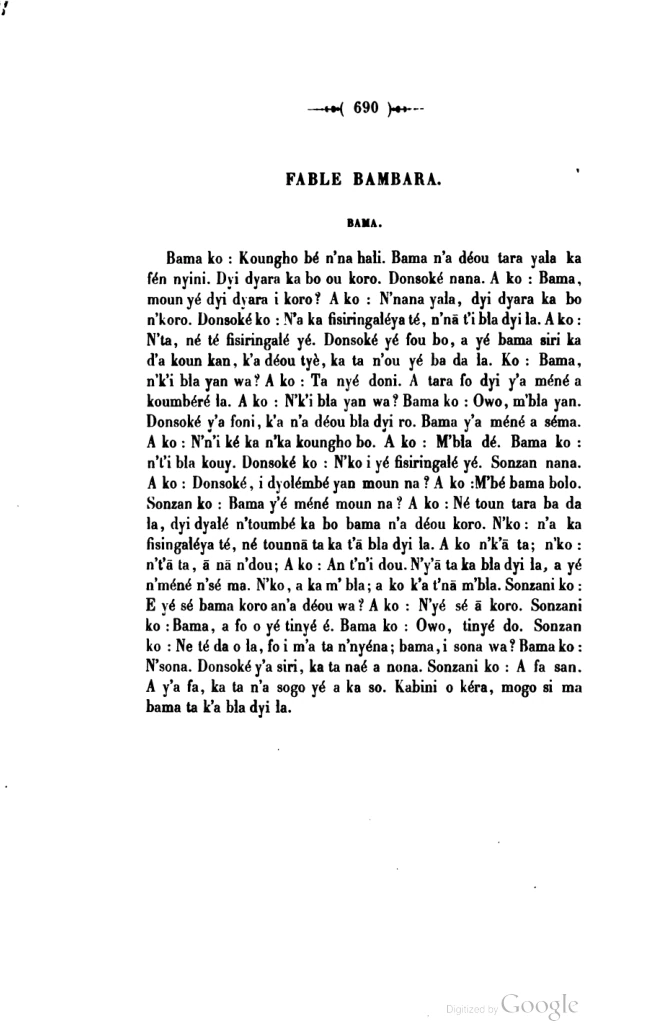
Bambara fable headed “Fable Bambara. Bama.” on printed page 690 of Bazin’s 1906 Bambara-French dictionary. This is a historical text in the compiler’s spelling, not a modern spelling standard.
Saved in Babelbook · resized display copy. Select the image to open it independently of its source.
Hippolyte Louis Bazin (1857–1910), compiler; Google scan · Source ↗Public domain ↗View the local visual field note
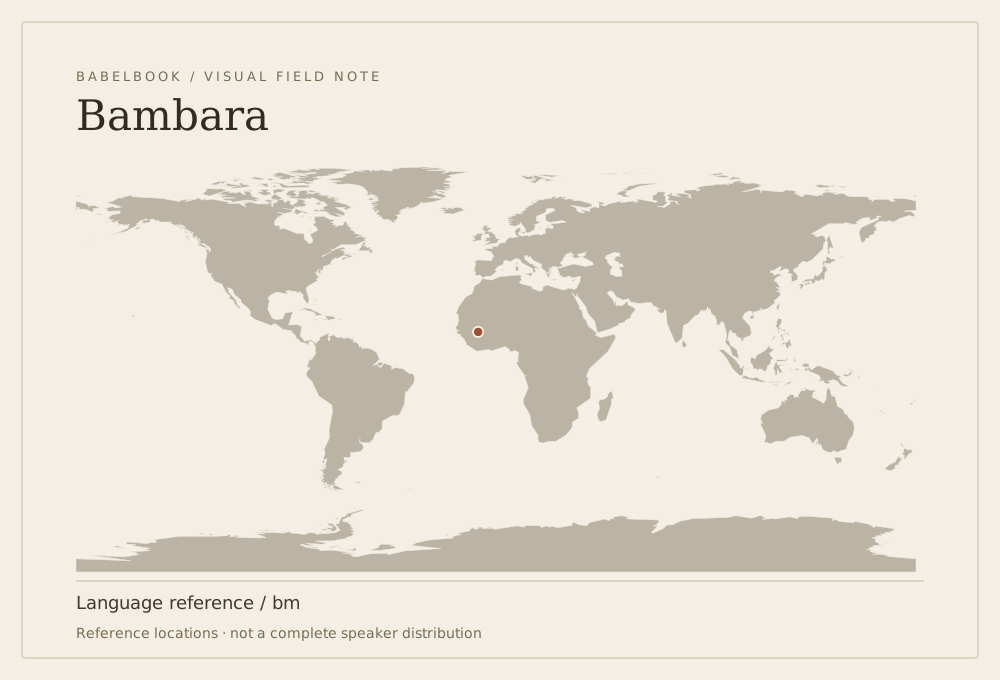
Representative reference points from Glottolog. Historical entries show reference locations, not current speakers. 1 point.
Reference & context ↗Babelbook · original editorial illustration · CC BY 4.0 · Glottolog locations; public-domain Natural Earth land
Source excerpts, selected, shortened and where noted editorially corrected from Bambara language by Wikipedia contributors. Retrieved 2026-10-05. CC BY-SA 4.0. These excerpts are not an independently verified scholarly history; missing accounts are identified above.
Read further in the source
Geographical distribution
Bambara is spoken throughout Mali as a lingua franca. The language is most widely spoken in the areas east, south, and north of Bamako, where native speakers and/or those that identify as members of the Bambara ethnic group are most densely populated. These regions are also usually considered to be the historical geographical origin of Bambara people, particularly Ségou, after diverging from other Manding groups.
Dialects
The main dialect is Standard Bamara, which has significant influence from Maninkakan. Bambara has many local dialects: Kaarta, Tambacounda (west); Beledugu, Bananba, Mesekele (north); Jitumu, Jamaladugu, Segu (center); Cakadugu, Keleyadugu, Jalakadougu, Kurulamini, Banimɔncɛ, Cɛmala, Cɛndugu, Baninkɔ, Shɛndugu, Ganadugu (south); Kala, Kuruma, Saro, dialects to the northeast of Mopti (especially Bɔrɛ); Zegedugu, Bɛndugu, Bakɔkan, Jɔnka (southeast).
Writing
Since 1967, Bambara has mostly been written in the Latin script, using some additional phonetic characters from the Africa Alphabet. The vowels are a, e, ɛ (formerly è), i, o, ɔ (formerly ò), u; accents can be used to indicate tonality. The former digraph ny is now written ɲ when it designates a palatal nasal; the ny spelling is kept for the combination of a nasal vowel with a subsequent oral palatal glide. Following the 1966 Bamako spelling conventions, a velar nasal "ŋ" is written as "ŋ", although in early publications it was often transcribed as ng or nk. The N'Ko (N'Ko: ߒߞߏ) alphabet is a script devised by Solomana Kante in 1949 as a writing system for the Manding languages of West Africa; N'Ko means 'I say' in all Manding languages. Kante created N'Ko in response to what he felt were beliefs that Africans were a "cultureless people" since prior to this time there had been no indigenous African writing system for his language. N'ko first gained a strong user base around the Maninka-speaking area of Kante's hometown of Kankan, Guinea and disseminated from there into other Manding-speaking parts of West Africa. N'ko, and the Arabic script, also known as the Ajami script, are still in use for Bambara, although only the Latin-based orthography is officially recognized in Mali. Additionally, a script known as Masaba or Ma-sa-ba was developed for the language beginning in 1930 by Woyo Couloubayi (c. 1910-1982) of Assatiémala. Named for the first characters in Couloubayi's preferred collation order, Masaba is a syllabary which uses diacritics to indicate vowel qualities such as tone, length, and nasalization. Though not conclusively demonstrated to be related to other writing systems, Masaba appears to draw on traditional Bambara iconography and shares some similarities with the Vai syllabary of Liberia and with Arabic-derived secret alphabets used in Hodh (now Hodh El Gharbi and Hodh Ech Chargui Regions of Mauritania). As of 1978, Masaba was in limited use in several communities in Nioro Cercle for accounting, personal correspondence, and the recording of Muslim prayers; the script's current status and prevalence is unknown.
Latin orthography
It uses seven vowels a, e, ɛ, i, o, ɔ and u, each of which can be nasalized, pharyngealized and murmured, giving a total number of 21 vowels (the letters approximate their IPA equivalents). Writing with the Latin alphabet began during the French colonization, and the first orthography was introduced in 1967. Literacy is limited, especially in rural areas. Although written literature is only slowly evolving (due to the predominance of French as the "language of the educated"), there exists a wealth of oral literature, which is often tales of kings and heroes. This oral literature is mainly passed on by the griots (Jeliw in Bambara) who are a mixture of storytellers, praise singers, and human history books who have studied the trade of singing and reciting for many years. Many of their songs are very old and are said to date back to the old empire of Mali.
Legal status
Bambara was until 2023 one of several languages designated by Mali as a national language. In 2023, after a new constitution was approved by a majority of voters, Bambara became co-official, together with 12 other languages spoken in the country. French was removed as the official language and was kept only as a working language.