Bengali
Bengali, also known by its endonym Bangla, is an Indo-Aryan language belonging to the Indo-Iranian branch of the Indo-European language family. It is primarily spoken by the Bengali people, native to the Bengal region (Bangladesh and India's West Bengal) as well as in Barak Valley in Assam and Tripura in South Asia. With over 242 million native speakers and another 43 million as second language speakers as of 2025, Bengali is the sixth most spoken native language and the seventh most spoken language by the total number of speakers in the world. Bengali is the official, national, and most widely spoken language of Bangladesh, with 98% of Bangladeshis using Bengali as their first language. It is the second-most widely spoken language in India. It is the official language of the Indian states of West Bengal, Tripura and the Barak Valley region of the state of Assam. It is also the second official language of the Indian state of Jharkhand since September 2011. It is the most widely spoken language in the Andaman and Nicobar Islands in the Bay of Bengal, and is spoken by significant populations in other states including Bihar, Arunachal Pradesh, Delhi, Chhattisgarh, Meghalaya, Mizoram, Nagaland, Odisha and Uttarakhand. Bengali is also spoken by the Bengali diasporas (Bangladeshi diaspora and Indian Bengalis) across Europe, North America, the Middle East and other regions. Bengali was accorded the status of a classical language by the Government of India on 3 October 2024.
Translate in Bengali ↗Besides the native region, it is also spoken by the Bengalis living in Tripura, southern Assam and the union territory of Andaman and Nicobar Islands. Bengali is also spoken in the neighbouring states of Odisha, Bihar, and Jharkhand, and sizeable minorities of Bengali speakers reside in Indian cities outside Bengal, including Delhi, Mumbai, Thane, Varanasi, and Vrindavan. There are also significant Bengali-speaking communities in the Middle East, the United States, Singapore, Malaysia, Australia, Canada, the United Kingdom, and Italy. The 3rd article of the Constitution of Bangladesh states Bengali to be the sole official language of Bangladesh. The Bengali Language Implementation Act, 1987, made it mandatory to use Bengali in all records and correspondences, laws, proceedings of court and other legal actions in all courts, government or semi-government offices, and autonomous institutions in Bangladesh. It is also the de facto national language of the country. In India, Bengali is one of the 22 official languages. It is the official language of the Indian states of West Bengal, Tripura and in Barak Valley of Assam. Bengali has been a second official language of the Indian state of Jharkhand since September 2011. In Pakistan, Bengali is a recognised secondary language in the city of Karachi mainly spoken by stranded Bengalis of Pakistan. The Department of Bengali in the University of Karachi (established by East Pakistani politicians before Independence of Bangladesh) also offers regular programs of studies at the Bachelors and at the Masters levels for Bengali Literature. The national anthems of both Bangladesh (Amar Sonar Bangla) and India (Jana Gana Mana) were written in Bengali by the Bengali Nobel laureate Rabindranath Tagore. Notuner Gaan known as "Chol Chol Chol" is Bangladesh's national march, written by The National Poet Kazi Nazrul Islam in Bengali in 1928. It was adopted as the national marching song by the Bangladeshi government in 1972.
South Asia
Present-day use
The standard literary form of Modern Bengali was developed during the 19th and early 20th centuries based on the west-central dialect spoken in Shantipur region of the Nadia district. Modern Bengali shows a high degree of diglossia, with the literary and standard form differing greatly from the colloquial speech of the regions that identify with the language. Modern Bengali vocabulary is based on words inherited from Magadhi Prakrit and Pali, along with tatsamas and reborrowings from Sanskrit and borrowings from Persian, Arabic, Austroasiatic languages and other languages with which it has historically been in contact. In the 19th and 20th centuries, there were two standard forms of written Bengali: চলিতভাষা Chôlitôbhasha, a colloquial form of Bengali using simplified inflections. সাধুভাষা Sadhubhasha, a formal and genteel form of Bengali. Sadhu Bangla is considered a high dialect of Modern Bengali in which all the Old Bengali characteristics are preserved. In 1948, the government of Pakistan tried to impose Urdu as the sole state language in Pakistan, giving rise to the Bengali language movement. This was a popular ethnolinguistic movement in the former East Bengal (today Bangladesh), which arose as a result of the strong linguistic consciousness of the Bengalis and their desire to promote and protect spoken and written Bengali's recognition as a state language of the then Dominion of Pakistan. On 21 February 1952, five students and political activists were killed during protests near the campus of the University of Dhaka; they were the first ever martyrs to die for their right to speak their mother tongue. In 1956, Bengali was made a state language of Pakistan.
Origins
The captured article does not contain a separate origins section. See the historical account and linked source.
Development
The captured article does not contain a distinct historical account. No chronology has been invented.
Writing
The Bengali-Assamese script is an abugida, a script with letters for consonants, with diacritics for vowels, and in which an inherent vowel (অ ô) is assumed for consonants if no vowel is marked. The Bengali alphabet is used throughout Bangladesh and eastern India (Assam, West Bengal, Tripura). The Bengali alphabet is believed to have evolved from a modified Brahmic script around 1000 CE (or 10th–11th century). It is a cursive script with eleven graphemes or signs denoting nine vowels and two diphthongs, and thirty-nine graphemes representing consonants and other modifiers. There are no distinct upper and lower case letter forms. The letters run from left to right and spaces are used to separate orthographic words. Bengali script has a distinctive horizontal line running along the tops of the graphemes that links them together called মাত্রা matra. Since the Bengali script is an abugida, its consonant graphemes usually do not represent phonetic segments, but carry an "inherent" vowel and thus are syllabic in nature. The inherent vowel is usually a back vowel, either [ɔ] as in মত [mɔt] "opinion" or [o], as in মন [mon] "mind", with variants like the more open [ɒ]. To emphatically represent a consonant sound without any inherent vowel attached to it, a special diacritic, called the hôsôntô (্), may be added below the basic consonant grapheme (as in ম্ [m]). This diacritic, however, is not common and is chiefly employed as a guide to pronunciation. The abugida nature of Bengali consonant graphemes is not consistent, however. Often, syllable-final consonant graphemes, though not marked by a hôsôntô, may carry no inherent vowel sound (as in the final ন in মন [mon] or the medial ম in গামলা [ɡamla]). A consonant sound followed by some vowel sound other than the inherent [ɔ] is orthographically realised by using a variety of vowel allographs above, below, before, after, or around the consonant sign, thus forming the ubiquitous consonant-vowel typographic ligatures.
Beyond the typeface.
Signs, manuscripts, published pages and contextual photographs, with their place, period, source and reuse terms. Captions identify historical spellings, regional examples, community references and character imagery.

Bengali station name on the trilingual Ghum railway station sign, 2018, alongside Hindi and English. Source-identified language; displayed without additional cropping.
Saved in Babelbook · resized display copy. Select the image to open it independently of its source.
Bernard Gagnon · Source ↗CC BY-SA 4.0 ↗View the local visual field note
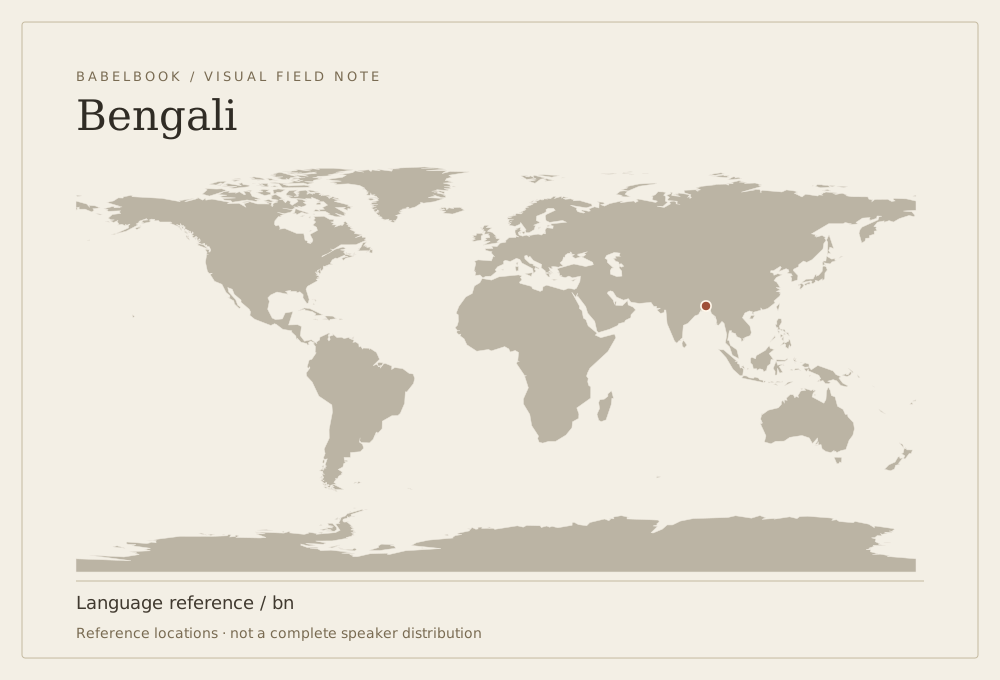
Representative reference points from Glottolog. Historical entries show reference locations, not current speakers. 1 point.
Reference & context ↗Babelbook · original editorial illustration · CC BY 4.0 · Glottolog locations; public-domain Natural Earth land
Source excerpts, selected, shortened and where noted editorially corrected from Bengali language by Wikipedia contributors. Retrieved 2026-10-05. CC BY-SA 4.0. These excerpts are not an independently verified scholarly history; missing accounts are identified above.
Read further in the source
Geographical distribution
Besides the native region, it is also spoken by the Bengalis living in Tripura, southern Assam and the union territory of Andaman and Nicobar Islands. Bengali is also spoken in the neighbouring states of Odisha, Bihar, and Jharkhand, and sizeable minorities of Bengali speakers reside in Indian cities outside Bengal, including Delhi, Mumbai, Thane, Varanasi, and Vrindavan. There are also significant Bengali-speaking communities in the Middle East, the United States, Singapore, Malaysia, Australia, Canada, the United Kingdom, and Italy.
Official status
The 3rd article of the Constitution of Bangladesh states Bengali to be the sole official language of Bangladesh. The Bengali Language Implementation Act, 1987, made it mandatory to use Bengali in all records and correspondences, laws, proceedings of court and other legal actions in all courts, government or semi-government offices, and autonomous institutions in Bangladesh. It is also the de facto national language of the country. In India, Bengali is one of the 22 official languages. It is the official language of the Indian states of West Bengal, Tripura and in Barak Valley of Assam. Bengali has been a second official language of the Indian state of Jharkhand since September 2011. In Pakistan, Bengali is a recognised secondary language in the city of Karachi mainly spoken by stranded Bengalis of Pakistan. The Department of Bengali in the University of Karachi (established by East Pakistani politicians before Independence of Bangladesh) also offers regular programs of studies at the Bachelors and at the Masters levels for Bengali Literature. The national anthems of both Bangladesh (Amar Sonar Bangla) and India (Jana Gana Mana) were written in Bengali by the Bengali Nobel laureate Rabindranath Tagore. Notuner Gaan known as "Chol Chol Chol" is Bangladesh's national march, written by The National Poet Kazi Nazrul Islam in Bengali in 1928. It was adopted as the national marching song by the Bangladeshi government in 1972. Additionally, the first two verses of Vande Mataram, a patriotic song written in Bengali by Bankim Chandra Chatterjee, was adopted as the "national song" of India in both the colonial period and later in 1950 in independent India. Furthermore, it is believed by many that the national anthem of Sri Lanka (Sri Lanka Matha) was inspired by a Bengali poem written by Rabindranath Tagore, while some even believe the anthem was originally written in Bengali and then translated into Sinhala. In 2009, elected representatives in both Bangladesh and West Bengal called for Bengali to be made an official language of the United Nations.
Dialects
Regional varieties in spoken Bengali constitute a dialect continuum. Linguist Suniti Kumar Chatterji grouped the dialects of Bengali language into four large clusters: Rarhi, Vangiya, Kamrupi and Varendri; but many alternative grouping schemes have also been proposed. The West-Central dialects (Rarhi or Nadia dialect) form the basis of modern standard colloquial Bengali. In the dialects prevalent in much of eastern and south-eastern Bangladesh (Barisal, Chittagong, Dhaka and Sylhet Divisions of Bangladesh), many of the stops and affricates heard in West Bengal and western Bangladesh are pronounced as fricatives. Western alveolo-palatal affricates চ [tʃɔ], ছ [tʃʰɔ~tʃɔ], জ [dʒɔ] correspond to eastern চ [tsɔ~sɔ], ছ [sɔ], জ [dzɔ~zɔ]. The potential influence of Tibeto-Burman languages on the phonology of Eastern Bengali is used to explain the lack of nasalised vowels and an alveolar articulation of what are categorised as the "cerebral" consonants (as opposed to the postalveolar articulation of western Bengal). Some varieties of Bengali, particularly Sylheti, Chittagonian and Chakma, have contrastive tone; differences in the pitch of the speaker's voice can distinguish words. Kharia Thar and Mal Paharia are closely related to Western Bengali dialects, but are typically classified as separate languages. Similarly, Hajong is considered a separate language, although it shares similarities to Northern Bengali dialects. During the standardisation of Modern Bengali in the 19th century and early 20th century, the cultural centre of Bengal was in Kolkata, a city founded by the British. What is accepted as the standard form today in both West Bengal and Bangladesh is based on the West-Central dialect of Nadia and Kushtia District. There are cases where speakers of Standard Bengali in West Bengal will use a different word from a speaker of Standard Bengali in Bangladesh, even though both words are of native Bengali descent. For example, the word for 'salt' is লবণ lôbôṇ in the east, which corresponds to নুন nun in the west.
Bengali exhibits diglossia, though some scholars have proposed triglossia or even n-glossia or heteroglossia between the written and spoken forms of the language. Two styles of writing have emerged, involving somewhat different vocabularies and syntax:
Sadhu bhasha (সাধু ভাষা "upright language") was the written language, with longer verb inflections and more of a Pali and Sanskrit-derived Tatsama vocabulary. Songs such as India's national anthem Jana Gana Mana (by Rabindranath Tagore) were composed in this style. Its use in modern writing however is uncommon, restricted to some official signs and documents as well as for achieving particular literary effects. Chôlito bhasha (চলিত ভাষা "running language"), known by linguists as Standard Colloquial Bengali, is a written Bengali style exhibiting a preponderance of colloquial idiom and shortened verb forms and is the standard for written Bengali now. This form came into vogue towards the turn of the 19th century, promoted by the writings of Peary Chand Mitra (Alaler Gharer Dulal, 1857), Pramatha Chaudhuri (Sabujpatra, 1914) and in the later writings of Rabindranath Tagore. It is modelled on the dialect spoken in the Shantipur and Shilaidaha region in Nadia and Kushtia Districts respectively. This form of Bengali is often referred to as the "Kushtia standard"(Bangladesh), "Nadia standard" (West Bengal), "West-Central dialect", "Shantipuri Bangla" or "Shilaidahi Bangla". Linguist Prabhat Ranjan Sarkar categorises the language as:
Madhya Rarhi dialect Kanthi (Contai) dialect Kolkata dialect Shantipuriya (Nadia) dialect Shershahabadia (Maldahiya/ Jangipuri) dialect Barendri dialect Rangapuriya dialect Sylheti dialect Dhakiya (Bikrampuri) dialect Jashore/Jessoriya dialect Barisal (Chandradwip) dialect Chattal (Chittagong) dialect While most writing is in Standard Colloquial Bengali (SCB), spoken dialects exhibit a greater variety. People in southeastern West Bengal, including Kolkata, speak in SCB. Other dialects, with minor variations from Standard Colloquial, are used in other parts of West Bengal and western Bangladesh, such as the Midnapore dialect, characterised by some unique words and constructions. However, a majority in Bangladesh speaks dialects notably different from SCB. Some dialects, particularly those of the Chittagong region, bear only a superficial resemblance to SCB. The dialect in the Chittagong region is least widely understood by the general body of Bengalis. The majority of Bengalis are able to communicate in more than one variety – often, speakers are fluent in Cholitobhasha (SCB) and one or more regional dialects.
Even in SCB, the vocabulary may differ according to the speaker's religion: Muslims are more likely to use words of Persian and Arabic origin, along with more words naturally derived from Sanskrit (tadbhava), whereas Hindus are more likely to use tatsama (words directly borrowed from Sanskrit).. For example:
Writing system
The Bengali-Assamese script is an abugida, a script with letters for consonants, with diacritics for vowels, and in which an inherent vowel (অ ô) is assumed for consonants if no vowel is marked. The Bengali alphabet is used throughout Bangladesh and eastern India (Assam, West Bengal, Tripura). The Bengali alphabet is believed to have evolved from a modified Brahmic script around 1000 CE (or 10th–11th century). It is a cursive script with eleven graphemes or signs denoting nine vowels and two diphthongs, and thirty-nine graphemes representing consonants and other modifiers. There are no distinct upper and lower case letter forms. The letters run from left to right and spaces are used to separate orthographic words. Bengali script has a distinctive horizontal line running along the tops of the graphemes that links them together called মাত্রা matra. Since the Bengali script is an abugida, its consonant graphemes usually do not represent phonetic segments, but carry an "inherent" vowel and thus are syllabic in nature. The inherent vowel is usually a back vowel, either [ɔ] as in মত [mɔt] "opinion" or [o], as in মন [mon] "mind", with variants like the more open [ɒ]. To emphatically represent a consonant sound without any inherent vowel attached to it, a special diacritic, called the hôsôntô (্), may be added below the basic consonant grapheme (as in ম্ [m]). This diacritic, however, is not common and is chiefly employed as a guide to pronunciation. The abugida nature of Bengali consonant graphemes is not consistent, however. Often, syllable-final consonant graphemes, though not marked by a hôsôntô, may carry no inherent vowel sound (as in the final ন in মন [mon] or the medial ম in গামলা [ɡamla]). A consonant sound followed by some vowel sound other than the inherent [ɔ] is orthographically realised by using a variety of vowel allographs above, below, before, after, or around the consonant sign, thus forming the ubiquitous consonant-vowel typographic ligatures. These allographs, called কার kar, are diacritical vowel forms and cannot stand on their own. For example, the graph মি [mi] represents the consonant [m] followed by the vowel [i], where [i] is represented as the diacritical allograph ি (called ই-কার i-kar) and is placed before the default consonant sign. Similarly, the graphs মা [ma], মী [mi], মু [mu], মূ [mu], মৃ [mri], মে [me~mɛ], মৈ [moj], মো [mo] and মৌ [mow] represent the same consonant ম combined with seven other vowels and two diphthongs. In these consonant-vowel ligatures, the so-called "inherent" vowel [ɔ] is first expunged from the consonant before adding the vowel, but this intermediate expulsion of the inherent vowel is not indicated in any visual manner on the basic consonant sign ম [mɔ]. The vowel graphemes in Bengali can take two forms: the independent form found in the basic inventory of the script and the dependent, abridged, allograph form (as discussed above). To represent a vowel in isolation from any preceding or following consonant, the independent form of the vowel is used. For example, in মই [moj] "ladder" and in ইলিশ [iliʃ] "Hilsa fish", the independent form of the vowel ই is used (cf. the dependent formি). A vowel at the beginning of a word is always realised using its independent form. In addition to the inherent-vowel-suppressing hôsôntô, three more diacritics are commonly used in Bengali. These are the superposed chôndrôbindu (ঁ), denoting a suprasegmental for nasalisation of vowels (as in চাঁদ [tʃãd] "moon"), the postposed ônusbar (ং) indicating the velar nasal [ŋ] (as in বাংলা [baŋla] "Bengali") and the postposed bisôrgô (ঃ) indicating the voiceless glottal fricative [h] (as in উঃ! [uh] "ouch!") or the gemination of the following consonant (as in দুঃখ [dukʰːɔ] "sorrow"). Like other Indic scripts, the Bengali script has Schwa deletion and does not always mark when the inherent vowel is deleted — typically at the end of words. The Bengali consonant clusters (যুক্তব্যঞ্জন juktôbênjôn) are usually realised as ligatures, where the consonant which comes first is put on top of or to the left of the one that immediately follows. In these ligatures, the shapes of the constituent consonant signs are often contracted and sometimes even distorted beyond recognition. As in, ক্ষ (ক+ষ) or হ্ম (হ+ম) In the Bengali writing system, there are nearly 285 such ligatures denoting consonant clusters. Although there exist a few visual formulas to construct some of these ligatures, many of them have to be learned by rote. Recently, in a bid to lessen this burden on young learners, efforts have been made by educational institutions in the two main Bengali-speaking regions (West Bengal and Bangladesh) to address the opaque nature of many consonant clusters, and as a result, modern Bengali textbooks are beginning to contain more and more "transparent" graphical forms of consonant clusters, in which the constituent consonants of a cluster are readily apparent from the graphical form. However, since this change is not as widespread and is not being followed as uniformly in the rest of the Bengali printed literature, today's Bengali-learning children will possibly have to learn to recognise both the new "transparent" and the old "opaque" forms, which ultimately amounts to an increase in learning burden. Bengali punctuation marks, apart from the downstroke । daṛi – the Bengali equivalent of a full stop – have been adopted from Western scripts and their usage is similar. Unlike in Western scripts (Latin, Cyrillic, etc.) where the letter forms stand on an invisible baseline, the Bengali letter-forms instead hang from a visible horizontal left-to-right headstroke called মাত্রা matra. The presence and absence of this matra can be important. For example, the letter ত tô and the numeral ৩ "3" are distinguishable only by the presence or absence of the matra, as is the case between the consonant cluster ত্র trô and the independent vowel এ e, also the letter হ hô and Bengali Ôbogroho ঽ (~ô) and letter ও o and consonant cluster ত্ত ttô. The letter-forms also employ the concepts of letter-width and letter-height (the vertical space between the visible matra and an invisible baseline). There is yet to be a uniform standard collating sequence (sorting order of graphemes to be used in dictionaries, indices, computer sorting programs, etc.) of Bengali graphemes. Experts in both Bangladesh and India are currently working towards a common solution for this problem.
Orthographic depth
The Bengali script in general has a comparatively shallow orthography when compared to the Latin script used for English and French, i.e., in many cases there is a one-to-one correspondence between the sounds (phonemes) and the letters (graphemes) of Bengali. But grapheme-phoneme inconsistencies do occur in many cases. In fact, Bengali-Assamese script has the deepest orthography among the Indian scripts. In general, the Bengali-Assamese script is fairly transparent for grapheme-to-phoneme conversion, i.e., it is easier to predict the pronunciation from spelling of the words, though there are many cases where pronunciation is different from what is written. But the script is fairly opaque for phoneme-to-grapheme conversion, i.e., it is often quite difficult to predict the spelling from the pronunciation of the words. In general, the script is fairly transparent for "tadbhav" words (native Bengali words). But it is quite opaque for "tatsam" words (words derived from Sanskrit), for both, phoneme-to-grapheme as well as grapheme-to-phoneme conversions. One kind of inconsistency is due to the presence of several letters in the script for the same sound. In spite of some modifications in the 19th century, the Bengali spelling system continues to be based on the one used for Sanskrit, and thus does not take into account some sound mergers that have occurred in the spoken language. For example, there are three letters (শ, ষ, and স) for the voiceless postalveolar fricative [ʃ], although the letter স retains the voiceless alveolar sibilant [s] sound when used in certain consonant conjuncts as in স্খলন [skʰɔlon] "fall", স্পন্দন [spɔndon] "beat", etc. The letter ষ also, sometimes, retains the voiceless retroflex sibilant [ʂ] sound when used in certain consonant conjuncts as in কষ্ট [kɔʂʈo] "suffering", গোষ্ঠী [ɡoʂʈʰi] "clan", etc. Similarly, there are two letters (জ and য) for the voiced postalveolar affricate [dʒ]. Moreover, what was once pronounced and written as a retroflex nasal ণ [ɳ] is now pronounced as an alveolar [n] when in conversation (the difference is heard when reading) (unless conjoined with another retroflex consonant such as ট, ঠ, ড and ঢ), although the spelling does not reflect this change. The near-open front unrounded vowel [æ] is orthographically realised by multiple means, as seen in the following examples: এত [æto] "so much", এ্যাকাডেমী [ækaɖemi] "academy", অ্যামিবা [æmiba] "amoeba", দেখা [dækʰa] "to see", ব্যস্ত [bæsto] "busy", ব্যাকরণ [bækorɔn] "grammar". Another kind of inconsistency is concerned with the incomplete coverage of phonological information in the script. The inherent vowel attached to every consonant can be either [ɔ] or [o] depending on vowel harmony (স্বরসঙ্গতি) with the preceding or following vowel or on the context, but this phonological information is not captured by the script, creating ambiguity for the reader. Furthermore, the inherent vowel is often not pronounced at the end of a syllable, as in কম [kɔm] "less", but this omission is not generally reflected in the script, making it difficult for the new reader. Many consonant clusters have different sounds than their constituent consonants. For example, the combination of the consonants ক্ [k] and ষ [ʂ] is graphically realised as ক্ষ and is pronounced [kkʰo] (as in রুক্ষ [rukkʰo] "coarse"), [kʰɔ] (as in ক্ষমতা [kʰɔmota] "capability") or even [kʰo] (as in ক্ষতি [kʰoti] "harm"), depending on the position of the cluster in a word. Another example is that there are around 7 or more graphemes to represent the sound [ʃ]. These are 'শ' as in শব্দ (śabda, pronounced as śôbdo "word"), 'ষ' as in ষড়যন্ত্র (ṣaṛayantra, pronounced as śoṛōjontrō "conspiracy"), 'স' as in সরকার (sarakāra, pronounced as śorkar "government"), 'শ্ব' as in শ্বশুর (written as śbaśura but pronounced with the ব b silent, i.e., as śōśur "father-in-law"), 'শ্ম' as in শ্মশান (written as śmaśāna but pronounced with the ম 'm' silent, i.e., as śośan "crematorium"), 'স্ব' as in স্বপ্ন (written as "sbapna" but pronounced with the ব 'b' silent, i.e., as śopnō "dream"), 'স্ম' as in স্মরণ (written as smaraṇa but pronounced with the ম 'm' silent, i.e., as śorōn "remembrance"), 'ষ্ম' as in গ্রীষ্ম (written as grīṣma but pronounced with the ম 'm' silent, i.e., as griśśō "summer") and so on. In most of the consonant clusters, only the first consonant is pronounced and rest of the consonants are silent. Examples are লক্ষ্মণ (written as lakṣmaṇa but pronounced as lokkhōn "Lakshman"), বিশ্বাস (written as biśbāsa but pronounced as biśśaś "belief"), বাধ্য (written as bādhya but pronounced as baddhō "obliged") and স্বাস্থ্য (written as sbāsthya but pronounced as śasthō "health"). Some consonant clusters have completely different pronunciation as compared to the constituent consonants. For example, 'হ্য' as in ঐতিহ্য (meaning "heritage") where hy is pronounced as jjh (written as aitihya but pronounced as ōitijjhō). The same হ্য is pronounced as 'hæ' as in হ্যাঁ (meaning "yes") (written as hyām̐ but pronounced as nasalised "hæ"). Another example of inconsistency in the script is that of words like, অন্য (written as anya but pronounced as ōnnō "other, different") and অন্ন (written as anna but pronounced as onnō "cooked rice, food"); in these words, the letter অ is combining with two different consonant clusters ন্য (nya) and ন্ন (nna), and while the same letter অ has two different pronunciations, ō and o, the two different consonant clusters have the same pronunciation. Thus, same letters and graphemes can often have different pronunciations depending on their position in a word and different graphemes and letters often have the same pronunciation. The main reason for these numerous inconsistencies is that there have been lots of sound mergers in Bengali, but the script has failed to account for the sound shifts and consonant mergers in the language. Bengali has lots of tatsam words (words directly derived from Sanskrit) and in all these words, the original spelling has been preserved but the pronunciations have changed due to consonant mergers and sound shifts. In fact, most of the tatsam words have many grapheme-to-phoneme inconsistencies while most of the tadbhav words (native Bengali words) have fairly consistent grapheme-to-phoneme correspondence. Another reason is that Vidyasagar's reformations in the 19th century flooded the Bengali language with lots of Sanskrit words. By the 19th century, the Bengali phonology had diverged a lot from Sanskrit phonology and had lost many of the consonant clusters used in Sanskrit. So when these Sanskrit words re-entered the Bengali vocabulary as tatsam words, their pronunciations were modified, but their spellings were retained. That is why most of the tatsam words are pronounced way different from what they are written or spelt. Almost all the cases of silent letters existing in Bengali are found in the tatsam words. The Bengali writing system, therefore, is often not a true guide for pronunciation.