Tibetan
The Tibetan language or Tibetic languages are a branch of the Tibeto-Burman languages in the Sino-Tibetan language family. Descending from Old Tibetan, there are 50 recognized Tibetic languages, which branch into more than 200 dialects, which can be grouped into eight dialect continua. These Tibetic languages are spoken in parts of China, Pakistan, Nepal, Bhutan, India and Myanmar. Classical Tibetan is the major literary language, particularly for its use in Tibetan Buddhist scriptures and literature. Tibetan languages are spoken by some 6 million people, not all of whom are Tibetan. With the worldwide spread of Tibetan Buddhism, the Tibetan language has also spread into the western world and can be found in many Buddhist publications and prayer materials, while western students also learn the language for the translation of Tibetan texts. Outside of Lhasa itself, Lhasa Tibetan is spoken by approximately 200,000 exiled Tibetans who have moved from Tibet to India, Nepal and other countries. Tibetan is also spoken by groups of ethnic minorities in Tibet who have lived in close proximity to Tibetans for centuries, but nevertheless retain their own languages and cultures. Although the Qiang peoples of Kham are classified by China as ethnic Tibetan, the Qiangic languages are not Tibetan, but rather form their own branch of the Tibeto-Burman language family. Classical Tibetan was not a tonal language, but many varieties such as Central and Khams Tibetan have developed tone registers. Amdo and Ladakhi-Balti are without tone.
Translate in Tibetan ↗The Tibetic-speaking area spans six countries: China (PRC), Nepal, Pakistan, India, Bhutan, and Myanmar. Tibetan is also spoken in diaspora communities in Europe, North America (e.g. Little Tibet, Toronto), Asia and Australia.
East Asia
Present-day use
The captured source does not contain a separate current-use account.
Origins
Marius Zemp (2018) hypothesizes that Tibetan originated as a pidgin with the West Himalayish language Zhangzhung as its superstratum, and Rgyalrongic as its substratum (both languages are part of the broader Sino-Tibetan family). However, there are many grammatical differences between the Rgyalrongic and Tibetic languages; Rgyalrongic tend to use prefixes such as *kə-, *tə-, etc., while Tibetic languages use suffixes such as -pa/-ba, -ma, -po/-bo, -mo, etc. Similarly, Tamangic also has a West Himalayish superstratum, but its substratum is derived from a different Sino-Tibetan branch. Only a few language clusters in the world are derived from a common language which is identical to or closely related to an old literary language. This small group includes the Tibetic languages, as descendants from Old Tibetan (7th–9th centuries), but also the Romance languages with Latin, the Arabic languages (or "dialects") with Classical Arabic, the Sinitic languages with Old Chinese, the modern Indic languages with Vedic Sanskrit.
Development
The captured article does not contain a distinct historical account. No chronology has been invented.
Writing
Most Tibetic languages are written in one of two Indic scripts. Standard Tibetan and most other Tibetic languages are written in the Tibetan script with a historically conservative orthography (see below) that helps unify the Tibetan-language area. Some other Tibetan languages (in India and Nepal) are written in the related Devanagari script, which is also used to write Hindi, Nepali and many other languages. However, some Ladakhi and Balti speakers write with the Urdu script; this occurs almost exclusively in Pakistan. The Tibetan script fell out of use in Pakistani Baltistan hundreds of years ago upon the region's adoption of Islam. However, increased concern among Balti people for the preservation of their language and traditions, especially in the face of strong Punjabi cultural influence throughout Pakistan, has fostered renewed interest in reviving the Tibetan script and using it alongside the Perso-Arabic script. Many shops in Baltistan's capital Skardu in Pakistan's "Northern Areas" region have begun supplementing signs written in the Perso-Arabic script with signs written in the Tibetan script. Baltis see this initiative not as separatist but rather as part of an attempt to preserve the cultural aspects of their region which has shared a close history with neighbours like Kashmiris and Punjabis since the arrival of Islam in the region many centuries ago.
Beyond the typeface.
Signs, manuscripts, published pages and contextual photographs, with their place, period, source and reuse terms. Captions identify historical spellings, regional examples, community references and character imagery.
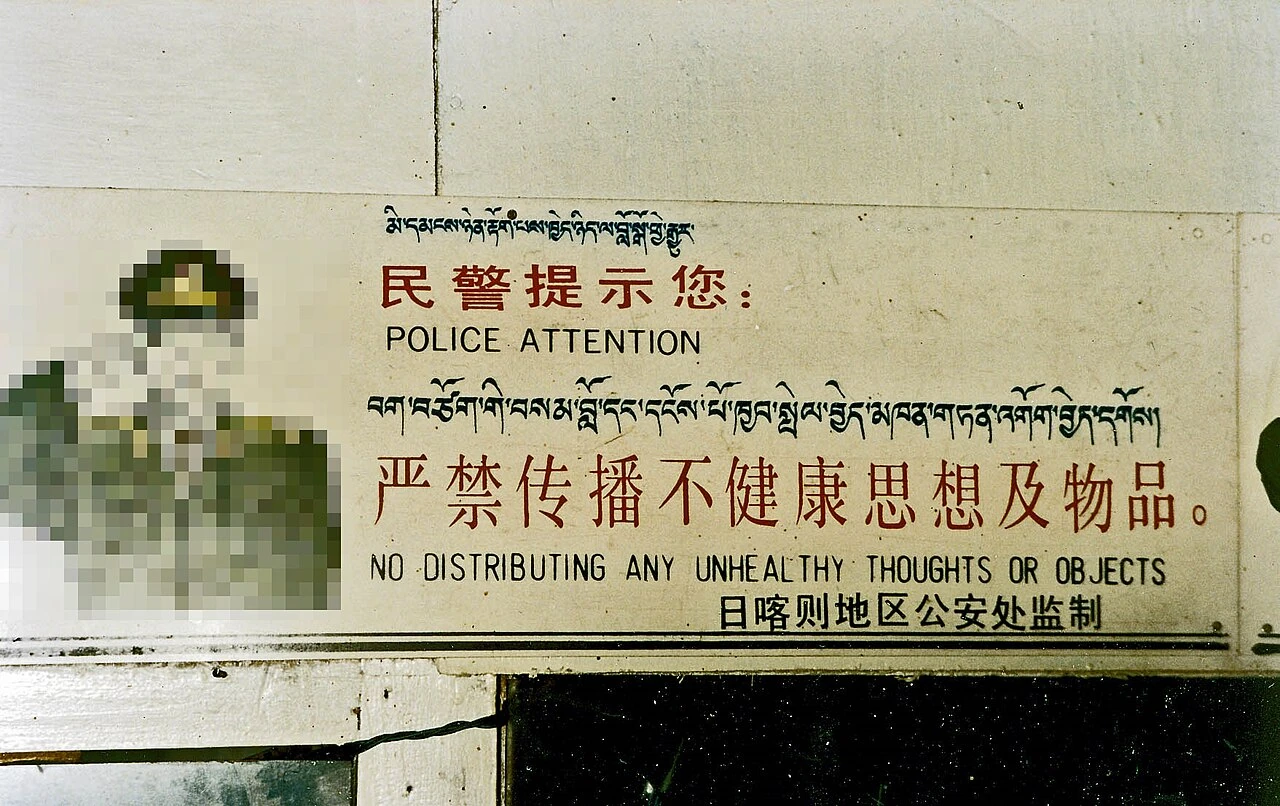
Tibetan police notice photographed in 1993, alongside Chinese and English. Modern Tibetan writing in use. Source-identified language; displayed without additional cropping.
Saved in Babelbook · resized display copy. Select the image to open it independently of its source.
John Hill · Source ↗CC BY-SA 3.0 ↗View the local visual field note
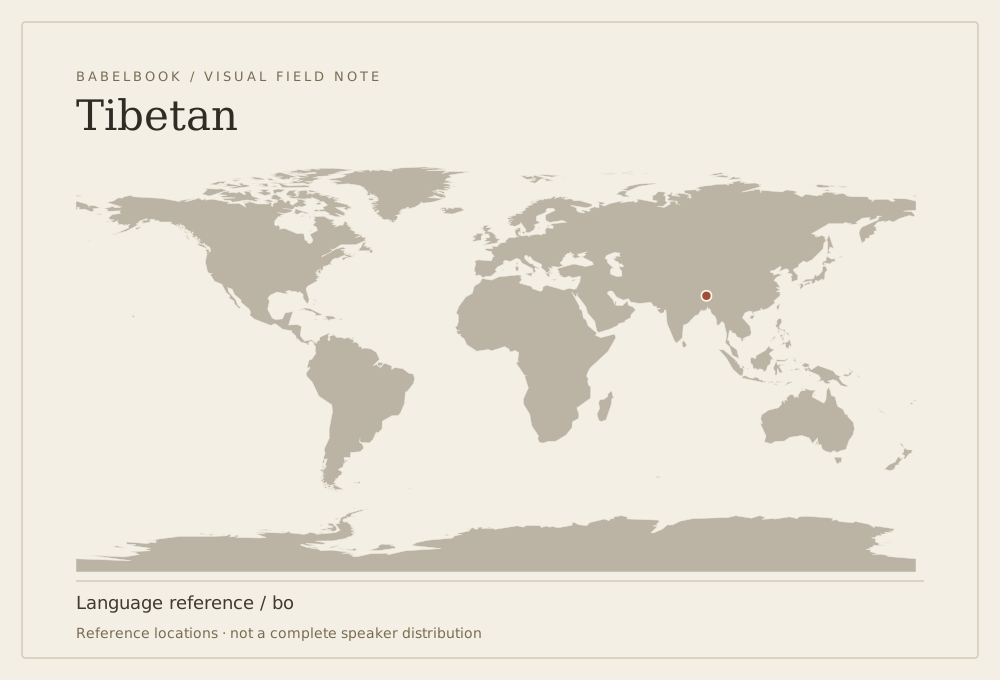
Representative reference points from Glottolog. Historical entries show reference locations, not current speakers. 1 point.
Reference & context ↗Babelbook · original editorial illustration · CC BY 4.0 · Glottolog locations; public-domain Natural Earth land
Wider Tibetic family background: this source covers multiple related languages, not only the Tibetan variety named in this catalog. Family-wide counts and developments should not be read as Tibetan-specific.
Source excerpts, selected, shortened and where noted editorially corrected from Tibetic languages by Wikipedia contributors. Retrieved 2026-10-05. CC BY-SA 4.0. These excerpts are not an independently verified scholarly history; missing accounts are identified above.
Read further in the source
Origins
Marius Zemp (2018) hypothesizes that Tibetan originated as a pidgin with the West Himalayish language Zhangzhung as its superstratum, and Rgyalrongic as its substratum (both languages are part of the broader Sino-Tibetan family). However, there are many grammatical differences between the Rgyalrongic and Tibetic languages; Rgyalrongic tend to use prefixes such as *kə-, *tə-, etc., while Tibetic languages use suffixes such as -pa/-ba, -ma, -po/-bo, -mo, etc. Similarly, Tamangic also has a West Himalayish superstratum, but its substratum is derived from a different Sino-Tibetan branch. Only a few language clusters in the world are derived from a common language which is identical to or closely related to an old literary language. This small group includes the Tibetic languages, as descendants from Old Tibetan (7th–9th centuries), but also the Romance languages with Latin, the Arabic languages (or "dialects") with Classical Arabic, the Sinitic languages with Old Chinese, the modern Indic languages with Vedic Sanskrit.
Geographical distribution
The Tibetic-speaking area spans six countries: China (PRC), Nepal, Pakistan, India, Bhutan, and Myanmar. Tibetan is also spoken in diaspora communities in Europe, North America (e.g. Little Tibet, Toronto), Asia and Australia.
Writing systems
Most Tibetic languages are written in one of two Indic scripts. Standard Tibetan and most other Tibetic languages are written in the Tibetan script with a historically conservative orthography (see below) that helps unify the Tibetan-language area. Some other Tibetan languages (in India and Nepal) are written in the related Devanagari script, which is also used to write Hindi, Nepali and many other languages. However, some Ladakhi and Balti speakers write with the Urdu script; this occurs almost exclusively in Pakistan. The Tibetan script fell out of use in Pakistani Baltistan hundreds of years ago upon the region's adoption of Islam. However, increased concern among Balti people for the preservation of their language and traditions, especially in the face of strong Punjabi cultural influence throughout Pakistan, has fostered renewed interest in reviving the Tibetan script and using it alongside the Perso-Arabic script. Many shops in Baltistan's capital Skardu in Pakistan's "Northern Areas" region have begun supplementing signs written in the Perso-Arabic script with signs written in the Tibetan script. Baltis see this initiative not as separatist but rather as part of an attempt to preserve the cultural aspects of their region which has shared a close history with neighbours like Kashmiris and Punjabis since the arrival of Islam in the region many centuries ago.