Breton
Breton is a Southwestern Brittonic language of the Celtic language group spoken in Brittany, part of modern-day France. It is the only Celtic language still in use on the European mainland. Breton is an Insular Celtic language that was brought from Great Britain to Brittany by migrating Britons during the Early Middle Ages, which makes Breton most closely related to Cornish, another Southwestern Brittonic language. Welsh and the extinct Cumbric, both Western Brittonic languages, are more distantly related, and the Goidelic languages (Irish, Manx, and Scottish Gaelic) have a slight connection due to their origins being from Insular Celtic. Having declined from more than one million speakers around 1950 to 107,000 in 2024, Breton is classified as "severely endangered" by the UNESCO Atlas of the World's Languages in Danger. The number of children attending bilingual classes rose 33% between 2006 and 2012 to 14,709.
Translate in Breton ↗Breton is spoken in Lower Brittany (Breton: Breizh-Izel), roughly to the west of a line linking Plouha (west of Saint-Brieuc) and La Roche-Bernard (east of Vannes). It comes from a Brittonic language community that once extended from Great Britain to Armorica (present-day Brittany) and had even established a toehold in Galicia (in present-day Spain). Old Breton is attested from the 9th century. It was the language of the upper classes until the 12th century after which it became the language of commoners in Lower Brittany. The nobility, followed by the bourgeoisie, adopted French. The written language of the Duchy of Brittany was Latin until it switched to French in the 15th century. There is a limited tradition of Breton literature. Some philosophical and scientific terms in Modern Breton come from Old Breton. The recognized stages of the Breton language are Old Breton – c. 800 to c. 1100, Middle Breton – c. 1100 to c. 1650, Modern Breton – c. 1650 to present. The French monarchy was not concerned with the minority languages of France, which were spoken by the lower classes, and required the use of French for government business as part of its policy of national unity. During the French Revolution, the government introduced policies favouring French over the regional languages, which it pejoratively referred to as patois. The revolutionaries assumed that reactionary and monarchist forces preferred regional languages to keep the peasant masses underinformed. In 1794, Bertrand Barère submitted his "report on the patois" to the Committee of Public Safety in which he said that "federalism and superstition speak Breton". Under the Third, Fourth and early Fifth Republics, the French government attempted to stamp out regional languages - including Breton — in state schools, in an effort to build a unified national culture.
Europe
Present-day use
Breton is spoken in Lower Brittany (Breton: Breizh-Izel), roughly to the west of a line linking Plouha (west of Saint-Brieuc) and La Roche-Bernard (east of Vannes). It comes from a Brittonic language community that once extended from Great Britain to Armorica (present-day Brittany) and had even established a toehold in Galicia (in present-day Spain). Old Breton is attested from the 9th century. It was the language of the upper classes until the 12th century after which it became the language of commoners in Lower Brittany. The nobility, followed by the bourgeoisie, adopted French. The written language of the Duchy of Brittany was Latin until it switched to French in the 15th century. There is a limited tradition of Breton literature. Some philosophical and scientific terms in Modern Breton come from Old Breton. The recognized stages of the Breton language are Old Breton – c. 800 to c. 1100, Middle Breton – c. 1100 to c. 1650, Modern Breton – c. 1650 to present. The French monarchy was not concerned with the minority languages of France, which were spoken by the lower classes, and required the use of French for government business as part of its policy of national unity. During the French Revolution, the government introduced policies favouring French over the regional languages, which it pejoratively referred to as patois. The revolutionaries assumed that reactionary and monarchist forces preferred regional languages to keep the peasant masses underinformed. In 1794, Bertrand Barère submitted his "report on the patois" to the Committee of Public Safety in which he said that "federalism and superstition speak Breton". Under the Third, Fourth and early Fifth Republics, the French government attempted to stamp out regional languages - including Breton — in state schools, in an effort to build a unified national culture.
Origins
The captured article does not contain a separate origins section. See the historical account and linked source.
Development
Breton is spoken in Lower Brittany (Breton: Breizh-Izel), roughly to the west of a line linking Plouha (west of Saint-Brieuc) and La Roche-Bernard (east of Vannes). It comes from a Brittonic language community that once extended from Great Britain to Armorica (present-day Brittany) and had even established a toehold in Galicia (in present-day Spain). Old Breton is attested from the 9th century. It was the language of the upper classes until the 12th century after which it became the language of commoners in Lower Brittany. The nobility, followed by the bourgeoisie, adopted French. The written language of the Duchy of Brittany was Latin until it switched to French in the 15th century. There is a limited tradition of Breton literature. Some philosophical and scientific terms in Modern Breton come from Old Breton. The recognized stages of the Breton language are Old Breton – c. 800 to c. 1100, Middle Breton – c. 1100 to c. 1650, Modern Breton – c. 1650 to present. The French monarchy was not concerned with the minority languages of France, which were spoken by the lower classes, and required the use of French for government business as part of its policy of national unity. During the French Revolution, the government introduced policies favouring French over the regional languages, which it pejoratively referred to as patois. The revolutionaries assumed that reactionary and monarchist forces preferred regional languages to keep the peasant masses underinformed. In 1794, Bertrand Barère submitted his "report on the patois" to the Committee of Public Safety in which he said that "federalism and superstition speak Breton". Under the Third, Fourth and early Fifth Republics, the French government attempted to stamp out regional languages - including Breton — in state schools, in an effort to build a unified national culture.
Writing
The first extant Breton texts, contained in the Leyden manuscript, were written at the end of the 8th century, 50 years prior to the Strasbourg Oaths, which are considered to be the earliest example of French. Like many medieval orthographies, Old and Middle Breton had an orthography that was at first not standardised, and the spelling of a particular word varied at the author's discretion. In 1499, however, the Catholicon, was published; as the first dictionary written for both French and Breton, it became a point of reference on how to transcribe the language. The orthography presented in the Catholicon was largely similar to that of French, in particular with respect to the representation of vowels, as well as the use of both the Latinate digraph ⟨qu⟩, which was a remnant of the sound change /kʷ/ > /k/ in Latin, and the Brittonic ⟨cou-⟩ or ⟨cu-⟩ to represent /k/ before front vowels. As phonetic and phonological differences between the dialects began to magnify, many regions, particularly the Vannes country, began to devise their own orthographies. Many of those orthographies were more closely related to the French model albeit with some modifications. Examples of modifications include the replacement of Old Breton -⟨z⟩ with -⟨h⟩ to denote word-final /x~h/ (an evolution of Old Breton /θ/ in the Vannes dialect) and the use of -⟨h⟩ to denote the initial mutation of /k/ (today, this mutation is written ⟨c'h⟩). In the 1830s, Jean-François Le Gonidec created a modern phonetic system for the language. During the early 20th century, a group of writers known as Emglev ar Skrivanerien elaborated and reformed Le Gonidec's system. They made it more suitable as a super-dialectal representation of the dialects of Cornouaille, Leon and Trégor (known as from Kernev, Leon and Treger in Breton). This KLT orthography was established in 1911.
Beyond the typeface.
Signs, manuscripts, published pages and contextual photographs, with their place, period, source and reuse terms. Captions identify historical spellings, regional examples, community references and character imagery.
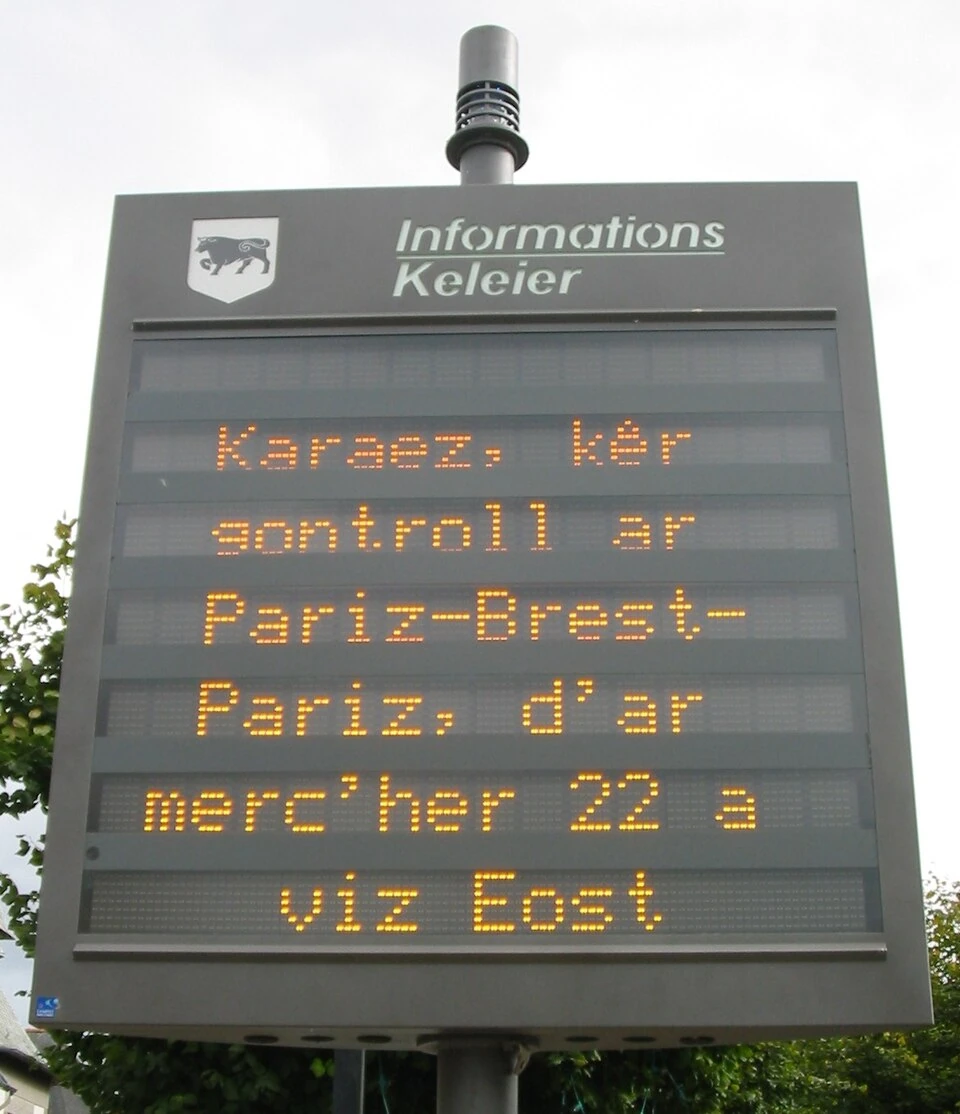
Municipal electronic sign displaying Breton information about the Paris–Brest–Paris cycling tour in Carhaix. Language identification follows Commons metadata; not independently transcribed.
Saved in Babelbook · resized display copy. Select the image to open it independently of its source.
Man vyi · Source ↗Public domain (author dedication) ↗View the local visual field note
Representative reference points from Glottolog. Historical entries show reference locations, not current speakers. 1 point.
Reference & context ↗Babelbook · original editorial illustration · CC BY 4.0 · Glottolog locations; public-domain Natural Earth land
Source excerpts, selected, shortened and where noted editorially corrected from Breton language by Wikipedia contributors. Retrieved 2026-10-05. CC BY-SA 4.0. These excerpts are not an independently verified scholarly history; missing accounts are identified above.
Read further in the source
History and status
Breton is spoken in Lower Brittany (Breton: Breizh-Izel), roughly to the west of a line linking Plouha (west of Saint-Brieuc) and La Roche-Bernard (east of Vannes). It comes from a Brittonic language community that once extended from Great Britain to Armorica (present-day Brittany) and had even established a toehold in Galicia (in present-day Spain). Old Breton is attested from the 9th century. It was the language of the upper classes until the 12th century after which it became the language of commoners in Lower Brittany. The nobility, followed by the bourgeoisie, adopted French. The written language of the Duchy of Brittany was Latin until it switched to French in the 15th century. There is a limited tradition of Breton literature. Some philosophical and scientific terms in Modern Breton come from Old Breton. The recognized stages of the Breton language are Old Breton – c. 800 to c. 1100, Middle Breton – c. 1100 to c. 1650, Modern Breton – c. 1650 to present. The French monarchy was not concerned with the minority languages of France, which were spoken by the lower classes, and required the use of French for government business as part of its policy of national unity. During the French Revolution, the government introduced policies favouring French over the regional languages, which it pejoratively referred to as patois. The revolutionaries assumed that reactionary and monarchist forces preferred regional languages to keep the peasant masses underinformed. In 1794, Bertrand Barère submitted his "report on the patois" to the Committee of Public Safety in which he said that "federalism and superstition speak Breton". Under the Third, Fourth and early Fifth Republics, the French government attempted to stamp out regional languages - including Breton — in state schools, in an effort to build a unified national culture. Teachers humiliated students for using their regional languages, and such practices prevailed until the late 1960s. In the early 21st century, the political centralization of France, the influence of the media and the increasing mobility of people have caused only about 200,000 people to be active speakers of Breton, a dramatic decline from more than 1 million in 1950. Most of today's speakers are more than 60 years old, and Breton is now classified as an endangered language. In the early 20th century, half of the population of Lower Brittany knew only Breton; the other half were bilingual. By 1950, there were only 100,000 monolingual Bretons, and the rapid decline has continued, with likely no monolingual speakers left today. A statistical survey in 1997 found around 300,000 speakers in Lower Brittany of whom about 190,000 were aged 60 or older. Few 15-to 19-year-olds spoke Breton. In 1993, parents were finally legally allowed to give their children Breton names.
Revival efforts
In 1925, Professor Roparz Hemon founded the Breton-language review Gwalarn. During its 19-year run, Gwalarn tried to raise the language to the level of a great international language. Its publication encouraged the creation of original literature in all genres, and proposed Breton translations of internationally recognized foreign works. In 1946, Al Liamm replaced Gwalarn. Other Breton-language periodicals have been published, which established a fairly large body of literature for a minority language. In 1977, Diwan schools were founded to teach Breton by immersion. Since their establishment, Diwan schools have provided fully-immersive primary school and partially-immersive secondary school instruction in Breton for thousands of students across Brittany. This has directly contributed to the growing numbers of school-age speakers of Breton. The Asterix comic series has been translated into Breton. According to the comic, the Gaulish village where Asterix lives is in the Armorica peninsula, which is now Brittany. Some other popular comics have also been translated into Breton, including The Adventures of Tintin, Spirou, Titeuf, Hägar the Horrible, Peanuts and Yakari. Some original media are created in Breton. The sitcom Ken Tuch is in Breton. Radio Kerne, broadcasting from Finistère, has exclusively Breton programming. Some movies (Lancelot du Lac, Shakespeare in Love, Marion du Faouet, Sezneg) and TV series (Columbo, Perry Mason) have also been translated and broadcast in Breton. Poets, singers, linguists, and writers who have written in Breton, including Yann-Ber Kalloc'h, Roparz Hemon, Añjela Duval, Xavier de Langlais, Pêr-Jakez Helias, Youenn Gwernig, Glenmor, Vefa de Saint-Pierre and Alan Stivell are now known internationally. Today, Breton is the only living Celtic language that is not recognized by a national government as an official or regional language. The first Breton dictionary, the Catholicon, was also the first French dictionary. Edited by Jehan Lagadec in 1464, it was a trilingual work containing Breton, French and Latin. Today bilingual dictionaries have been published for Breton and languages including English, Dutch, German, Spanish and Welsh. A monolingual dictionary, Geriadur Brezhoneg an Here was published in 1995. The first edition contained about 10,000 words, and the second edition of 2001 contains 20,000 words. In the early 21st century, the Ofis Publik ar Brezhoneg ("Public Office for the Breton language") began a campaign to encourage daily use of Breton in the region by both businesses and local communes. Efforts include installing bilingual signs and posters for regional events, as well as encouraging the use of the Spilhennig to let speakers identify each other. The office also started an Internationalization and localization policy asking Google, Firefox and SPIP to develop their interfaces in Breton. In 2004, the Breton Wikipedia launched, which counts over 91,000 articles as of September 2026. In March 2007, the Ofis ar Brezhoneg signed a tripartite agreement with Regional Council of Brittany and Microsoft for the consideration of the Breton language in Microsoft products. In October 2014, Facebook added Breton as one of its 121 languages after three years of talks between the Ofis and Facebook. France has twice chosen to enter the Eurovision Song Contest with songs in Breton; once in 1996 in Oslo with "Diwanit bugale" by Dan Ar Braz and the fifty piece band Héritage des Celtes, and most recently in 2022 in Turin with "Fulenn" by Alvan Morvan Rosius and vocal trio Ahez. These are two of five times France has chosen songs in one of its minority languages for the contest, the others being in 1992 (bilingual French and Antillean Creole), 1993 (bilingual French and Corsican), and 2011 (Corsican).
Geographic distribution and dialects
Breton is spoken mainly in Lower Brittany but also in a more dispersed way in Upper Brittany (where it is spoken alongside Gallo and French), and in areas around the world that have Breton emigrants. The four traditional dialects of Breton correspond to medieval bishoprics, rather than to linguistic divisions. They are leoneg (léonard, of the county of Léon), tregerieg (trégorrois, of Trégor), kerneveg (cornouaillais, of Cornouaille), and gwenedeg (vannetais, of Vannes). Gwerranneg (guérandais, of Guérande) was spoken up to the beginning of the 20th century in the region of Guérande and Batz-sur-Mer. There are no clear boundaries between the dialects because they form a dialect continuum and vary only slightly from one village to the next. Gwenedeg, however, requires a little study to be intelligible with most of the other dialects. Due to this difficulty in intelligibility, the Glottolog project split the Gwenedeg dialects into a separate language entry from the KLT Breton dialects in v5.2 under the name Vannetais.
Orthography
The first extant Breton texts, contained in the Leyden manuscript, were written at the end of the 8th century, 50 years prior to the Strasbourg Oaths, which are considered to be the earliest example of French. Like many medieval orthographies, Old and Middle Breton had an orthography that was at first not standardised, and the spelling of a particular word varied at the author's discretion. In 1499, however, the Catholicon, was published; as the first dictionary written for both French and Breton, it became a point of reference on how to transcribe the language. The orthography presented in the Catholicon was largely similar to that of French, in particular with respect to the representation of vowels, as well as the use of both the Latinate digraph ⟨qu⟩, which was a remnant of the sound change /kʷ/ > /k/ in Latin, and the Brittonic ⟨cou-⟩ or ⟨cu-⟩ to represent /k/ before front vowels. As phonetic and phonological differences between the dialects began to magnify, many regions, particularly the Vannes country, began to devise their own orthographies. Many of those orthographies were more closely related to the French model albeit with some modifications. Examples of modifications include the replacement of Old Breton -⟨z⟩ with -⟨h⟩ to denote word-final /x~h/ (an evolution of Old Breton /θ/ in the Vannes dialect) and the use of -⟨h⟩ to denote the initial mutation of /k/ (today, this mutation is written ⟨c'h⟩). In the 1830s, Jean-François Le Gonidec created a modern phonetic system for the language. During the early 20th century, a group of writers known as Emglev ar Skrivanerien elaborated and reformed Le Gonidec's system. They made it more suitable as a super-dialectal representation of the dialects of Cornouaille, Leon and Trégor (known as from Kernev, Leon and Treger in Breton). This KLT orthography was established in 1911. At the same time, writers of the more divergent Vannetais dialect developed a phonetic system, which was also based on that of Le Gonidec. Following proposals that had been made during the 1920s, the KLT and Vannetais orthographies were merged in 1941 to create an orthographic system to represent all four dialects. This Peurunvan ("wholly unified") orthography was significant for the inclusion of the digraph ⟨zh⟩, which represents a /h/ in Vannetais and corresponds to a /z/ in the KLT dialects. In 1955, François Falc'hun and the group Emgleo Breiz proposed a new orthography, which was designed to use a set of graphemes closer to the conventions of French. This Orthographe universitaire ("University Orthography", known in Breton as Skolveurieg) was given official recognition by the French authorities as the "official orthography of Breton in French education". It was opposed in the region and was used only by the magazine Brud Nevez and the publishing house Emgleo Breiz, which disappeared in 2015. In the 1970s, a new standard orthography was devised: the etrerannyezhel or interdialectale. This system is based on the derivation of the words. Today, most writers continue to use the Peurunvan orthography, and it is the version taught in most Breton-language schools.