Bosnian
Bosnian is the standard variety of the Serbo-Croatian language mainly used by Bosniaks. It is one of the three official languages of Bosnia and Herzegovina, a co-official language in Montenegro, and an officially recognized minority language in Croatia, Serbia, North Macedonia and Kosovo. Bosnian uses both the Latin and Cyrillic alphabets, with Latin in everyday use. It is notable among the varieties of Serbo-Croatian for a number of Arabic, Persian and Ottoman Turkish loanwords, largely due to the language's interaction with those cultures through Islamic ties. Bosnian is based on the most widespread dialect of Serbo-Croatian, Shtokavian, more specifically on Eastern Herzegovinian, which is also the basis of standard Croatian, Serbian and Montenegrin varieties. Therefore, the Declaration on the Common Language of Croats, Serbs, Bosniaks and Montenegrins was issued in 2017 in Sarajevo. Although the common name for the common language remains 'Serbo-Croatian', newer alternatives such as 'Bosnian-Croatian-Serbian' and 'Bosnian-Croatian-Montenegrin-Serbian' (commonly abbreviated 'BCMS') have been increasingly utilised since the 1990s, especially within diplomatic circles. Informally, the terms naš and naški ('ours / our language') are frequently used to avoid controversies over the naming of these languages.
Translate in Bosnian ↗Bosnian is the standard variety of the Serbo-Croatian language mainly used by Bosniaks. It is one of the three official languages of Bosnia and Herzegovina, a co-official language in Montenegro, and an officially recognized minority language in Croatia, Serbia, North Macedonia and Kosovo. Bosnian uses both the Latin and Cyrillic alphabets, with Latin in everyday use. It is notable among the varieties of Serbo-Croatian for a number of Arabic, Persian and Ottoman Turkish loanwords, largely due to the language's interaction with those cultures through Islamic ties. Bosnian is based on the most widespread dialect of Serbo-Croatian, Shtokavian, more specifically on Eastern Herzegovinian, which is also the basis of standard Croatian, Serbian and Montenegrin varieties. Therefore, the Declaration on the Common Language of Croats, Serbs, Bosniaks and Montenegrins was issued in 2017 in Sarajevo. Although the common name for the common language remains 'Serbo-Croatian', newer alternatives such as 'Bosnian-Croatian-Serbian' and 'Bosnian-Croatian-Montenegrin-Serbian' (commonly abbreviated 'BCMS') have been increasingly utilised since the 1990s, especially within diplomatic circles. Informally, the terms naš and naški ('ours / our language') are frequently used to avoid controversies over the naming of these languages.
Europe
Present-day use
The captured source does not contain a separate current-use account.
Origins
The captured article does not contain a separate origins section. See the historical account and linked source.
Development
The captured article does not contain a distinct historical account. No chronology has been invented.
Writing
Latin or customary script (catalog classification; see the source for context).
Beyond the typeface.
Signs, manuscripts, published pages and contextual photographs, with their place, period, source and reuse terms. Captions identify historical spellings, regional examples, community references and character imagery.
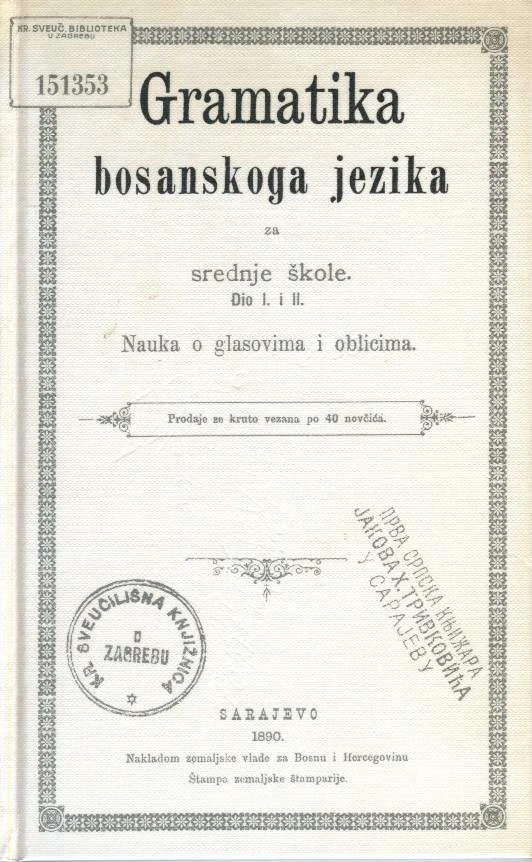
Scanned title page of Gramatika bosanskoga jezika za srednje škole, published in 1890. The publication itself identifies Bosnian; Commons supplies the author and public-domain status.
Saved in Babelbook · resized display copy. Select the image to open it independently of its source.
Frano Vuletić · Source ↗Public domain ↗View the local visual field note
Representative reference points from Glottolog. Historical entries show reference locations, not current speakers. 1 point.
Reference & context ↗Babelbook · original editorial illustration · CC BY 4.0 · Glottolog locations; public-domain Natural Earth land
Source excerpts, selected, shortened and where noted editorially corrected from Bosnian language by Wikipedia contributors. Retrieved 2026-10-05. CC BY-SA 4.0. These excerpts are not an independently verified scholarly history; missing accounts are identified above.
Read further in the source
Standardization
Although Bosnians are, at the level of vernacular idiom, linguistically more homogeneous than either Serbians or Croatians, unlike those nations they failed to codify a standard language in the 19th century, with at least two factors being decisive:
The Bosnian elite, as closely intertwined with Ottoman life, wrote predominantly in foreign (Arabic, Persian, Ottoman Turkish) languages. Vernacular literature written in Bosnian with the Arebica script was relatively thin and sparse. The Bosnians' national emancipation lagged behind that of the Serbs and Croats and because denominational rather than cultural or linguistic issues played the pivotal role, a Bosnian language project did not arouse much interest or support amongst the intelligentsia of the time. The modern Bosnian standard took shape in the 1990s and 2000s. Lexically, Islamic-Oriental loanwords are more frequent. Phonetically, the phoneme /x/ (spelled ⟨h⟩) is reinstated in many words as a distinct feature of vernacular Bosniak speech and language tradition. There are also some changes in grammar, morphology and orthography that reflect the Bosniak pre-World War I literary tradition, mainly that of the Bosniak renaissance at the beginning of the 20th century.