Catalan
Catalan (català) is a Western Romance language that is native to the eastern Iberian Peninsula. It shares official status with Spanish in three autonomous communities in eastern Spain – Catalonia; the Balearic Islands; and the Valencian Community, where it is called Valencian (valencià) – and is the sole official language of Andorra. Catalan also has semi-official status in Alghero, an Italian municipality in Sardinia, and is spoken in the Pyrénées-Orientales department of France and in two further areas in eastern Spain: the eastern strip of Aragon and the Carche area in the Region of Murcia. The Catalan-speaking regions are often called the Catalan Countries (Països Catalans). The language evolved from Vulgar Latin in the Middle Ages around the eastern Pyrenees. It became the language of the Principality of Catalonia and the kingdoms of Valencia and Mallorca, being present throughout the Mediterranean as the main language of the Crown of Aragon. It was replaced by Spanish as a language of government and literature in the 1700s, but 19th century Spain saw a Catalan literary revival, culminating in the early 1900s. During the Francoist dictatorship (1936–1975), the usage of Catalan was subject to repressive measures, before it entered a relatively successful process of re-normalization between the 1980s and the 2000s. However, during the 2010s, it experienced signs of decline in social use, diglossia and a resurgence in discrimination cases.
Translate in Catalan ↗The number of people known to be fluent in Catalan varies depending on the sources used. A 2004 study did not count the total number of speakers, but estimated a total of 9–9.5 million by matching the percentage of speakers to the population of each area where Catalan is spoken. The web site of the Generalitat de Catalunya estimated that as of 2004 there were 9,118,882 speakers of Catalan. These figures only reflect potential speakers; today it is the native language of only 35.6% of the Catalan population. According to Ethnologue, Catalan had 4.1 million native speakers and 5.1 million second-language speakers in 2021. According to a 2011 study the total number of Catalan speakers was over 9.8 million, with 5.9 million residing in Catalonia. More than half of them spoke Catalan as a second language, with native speakers being about 4.4 million of those (more than 2.8 in Catalonia). Very few Catalan monoglots exist; virtually all of the Catalan speakers in Spain are bilingual speakers of Catalan and Spanish, with 99.7% of Catalan speakers in Catalonia able to speak Spanish and 99.9% able to understand it. In Roussillon, only a minority of French Catalans speak Catalan nowadays, with French being the majority language for the inhabitants after a continued process of language shift. According to a 2019 survey by the Catalan government, 31.5% of the inhabitants of Catalonia predominantly spoke Catalan at home whereas 52.7% spoke Spanish, 2.8% both Catalan and Spanish and 10.8% other languages. Spanish was the most spoken language in Barcelona (according to the linguistic census held by the Government of Catalonia in 2013) and it is understood almost universally. According to 2013 census, Catalan was also very commonly spoken in the city of 1,501,262: it was understood by 95% of the population, while 72.3% over the age of two could speak it (1,137,816), 79% could read it (1,246.555), and 53% could write it (835,080).
Europe
Present-day use
Catalan sociolinguistics studies the situation of Catalan in the world and the different varieties that this language presents. It is a subdiscipline of Catalan philology and other affine studies and has as an objective to analyze the relation between the Catalan language, the speakers and the close reality (including the one of other languages in contact). Valencian is classified as a Western dialect, along with the North-Western varieties spoken in Western Catalonia (provinces of Lleida and the western half of Tarragona). Central Catalan has 90% to 95% inherent intelligibility for speakers of Valencian. Linguists, including Valencian scholars, deal with Catalan and Valencian as the same language. The official regulating body of the language of the Valencian Community, the Valencian Academy of Language (Acadèmia Valenciana de la Llengua, AVL) declares the linguistic unity between Valencian and Catalan varieties. The AVL, created by the Valencian parliament, is in charge of dictating the official rules governing the use of Valencian, and its standard is based on the Norms of Castelló (Normes de Castelló). Currently, everyone who writes in Valencian uses this standard, except the Royal Academy of Valencian Culture (Real Acadèmia de Cultura Valenciana, RACV), which uses an independent standard for Valencian known as the Norms of El Puig. Despite the position of the official organizations, an opinion poll carried out between 2001 and 2004 showed that the majority of the Valencian people consider Valencian different from Catalan. This position is promoted by people who do not use Valencian regularly. Furthermore, the data indicates that younger generations educated in Valencian are much less likely to hold these views.
Origins
The word Catalan is derived from the territorial name of Catalonia, itself of disputed etymology. The main theory suggests that Catalunya (Latin: Gathia Launia) derives from the name Gothia or Gauthia ('Land of the Goths'), since the origins of the Catalan counts, lords and people were found in the March of Gothia, whence Gothland > Gothlandia > Gothalania > Catalonia theoretically derived. In English, the term referring to a person first appears in the mid 14th century as Catelaner, followed in the 15th century as Catellain (from Middle French). It is attested a language name since at least 1652. The word Catalan can be pronounced in English as KAT-ə-lən, -lan or KAT-ə-LAN. The endonym is pronounced [kətəˈla] in the Eastern Catalan dialects, and [kataˈla] in the Western dialects. In the Valencian Community and Carche, the term valencià [valensiˈa] is frequently used instead. Thus, the name "Valencian", although often employed for referring to the varieties specific to the Valencian Community and Carche, is also used by Valencians as a name for the language as a whole, synonymous with "Catalan". Both uses of the term have their respective entries in the dictionaries by the Acadèmia Valenciana de la Llengua (AVL) and the Institut d'Estudis Catalans (IEC). (See also status of Valencian below).
Development
Catalan shares features with neighboring Romance languages (Occitan, Italian, Sardinian, French, Spanish). Marked contrast of the vowel pairs /ɛ/ ~ /e/ and /ɔ/ ~ /o/, as in other Western Romance languages, except Spanish and Sardinian. Lenition of voiced stops [b] → [β], [d] → [ð], [ɡ] → [ɣ] as in Galician and Spanish. Lack of diphthongization of Latin short ĕ, ŏ, as in Galician, Sardinian and Portuguese, and unlike French, Spanish and Italian. Abundance of diphthongs containing /w/, as in Galician and Portuguese. Abundance of /ʎ/ and /ɲ/ occurring at the end of words, as for instance moll ("wet") and any ("year"), unlike Spanish, Portuguese or Italian. In contrast with other Romance languages, Catalan has many monosyllabic words; and those ending in a wide variety of consonants and some consonant clusters. Also, Catalan has final obstruent devoicing, thus featuring many couplets like amic ('male friend') vs. amiga ('female friend').
Writing
Catalan uses the Latin script, with some added symbols and digraphs. The Catalan orthography is systematic and largely phonologically based. Standardization of Catalan was among the topics discussed during the First International Congress of the Catalan Language, held in Barcelona October 1906. Subsequently, the Philological Section of the Institut d'Estudis Catalans (IEC, founded in 1911) published the Normes ortogràfiques in 1913 under the direction of Antoni Maria Alcover and Pompeu Fabra. In 1932, Valencian writers and intellectuals gathered in Castelló de la Plana to make a formal adoption of the so-called Normes de Castelló, a set of guidelines following Pompeu Fabra's Catalan language norms.
Beyond the typeface.
Signs, manuscripts, published pages and contextual photographs, with their place, period, source and reuse terms. Captions identify historical spellings, regional examples, community references and character imagery.
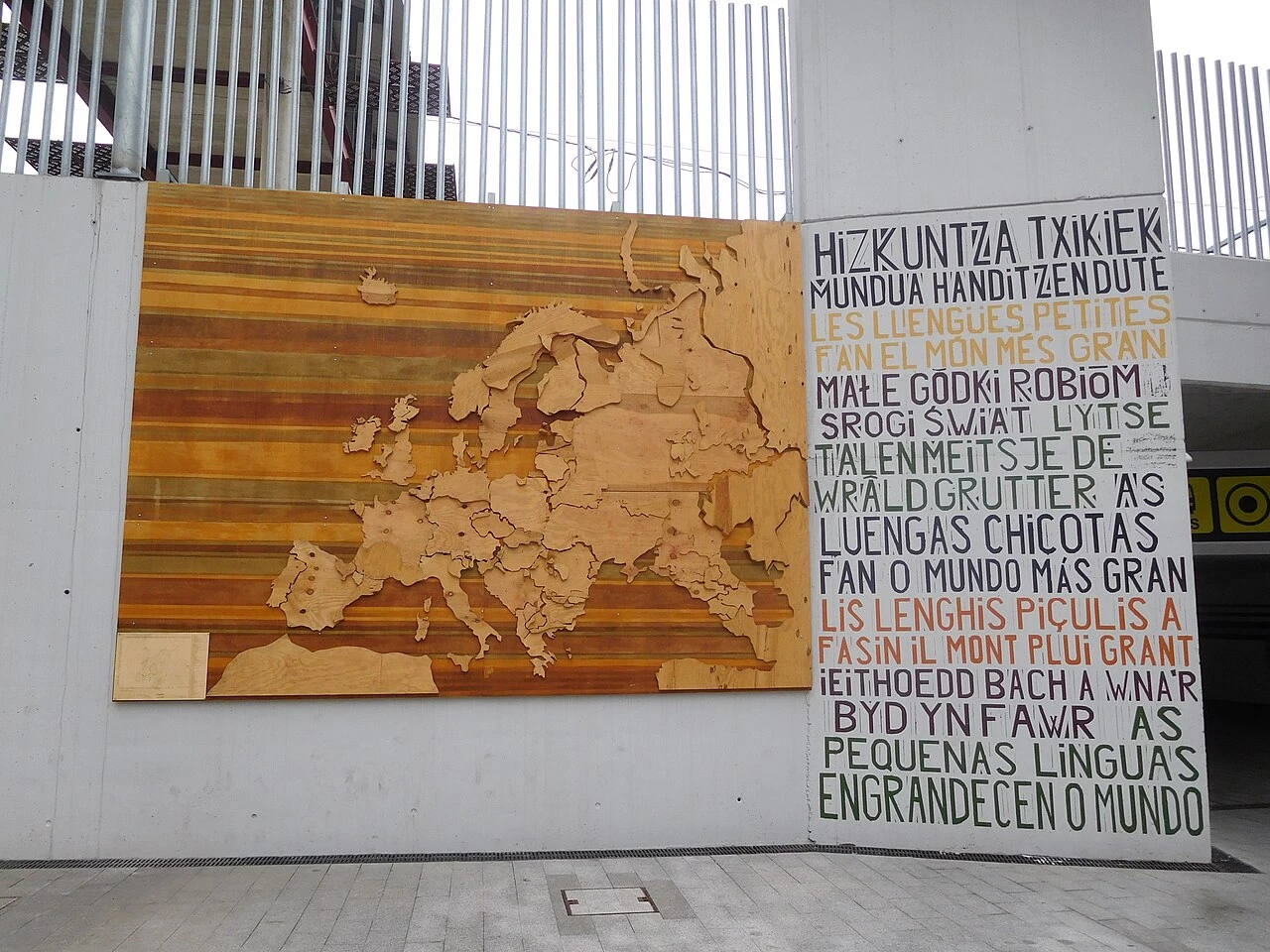
Multilingual street artwork celebrating smaller languages in San Sebastián, photographed in 2016. Includes Basque, Catalan and Galician among eight languages. Language identification follows Commons descriptions or categories; not independently transcribed.
Saved in Babelbook · resized display copy. Select the image to open it independently of its source.
Vasconium · Source ↗CC BY-SA 4.0 ↗View the local visual field note
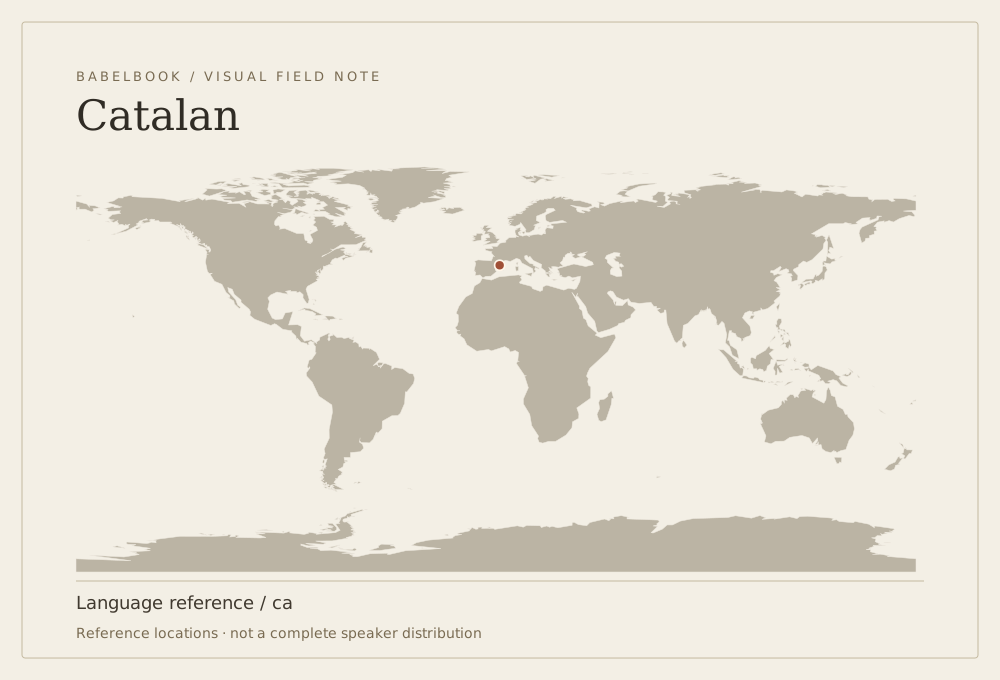
Representative reference points from Glottolog. Historical entries show reference locations, not current speakers. 1 point.
Reference & context ↗Babelbook · original editorial illustration · CC BY 4.0 · Glottolog locations; public-domain Natural Earth land
Source excerpts, selected, shortened and where noted editorially corrected from Catalan language by Wikipedia contributors. Retrieved 2026-10-05. CC BY-SA 4.0. These excerpts are not an independently verified scholarly history; missing accounts are identified above.
Read further in the source
Number of speakers
The number of people known to be fluent in Catalan varies depending on the sources used. A 2004 study did not count the total number of speakers, but estimated a total of 9–9.5 million by matching the percentage of speakers to the population of each area where Catalan is spoken. The web site of the Generalitat de Catalunya estimated that as of 2004 there were 9,118,882 speakers of Catalan. These figures only reflect potential speakers; today it is the native language of only 35.6% of the Catalan population. According to Ethnologue, Catalan had 4.1 million native speakers and 5.1 million second-language speakers in 2021.
According to a 2011 study the total number of Catalan speakers was over 9.8 million, with 5.9 million residing in Catalonia. More than half of them spoke Catalan as a second language, with native speakers being about 4.4 million of those (more than 2.8 in Catalonia). Very few Catalan monoglots exist; virtually all of the Catalan speakers in Spain are bilingual speakers of Catalan and Spanish, with 99.7% of Catalan speakers in Catalonia able to speak Spanish and 99.9% able to understand it. In Roussillon, only a minority of French Catalans speak Catalan nowadays, with French being the majority language for the inhabitants after a continued process of language shift. According to a 2019 survey by the Catalan government, 31.5% of the inhabitants of Catalonia predominantly spoke Catalan at home whereas 52.7% spoke Spanish, 2.8% both Catalan and Spanish and 10.8% other languages. Spanish was the most spoken language in Barcelona (according to the linguistic census held by the Government of Catalonia in 2013) and it is understood almost universally. According to 2013 census, Catalan was also very commonly spoken in the city of 1,501,262: it was understood by 95% of the population, while 72.3% over the age of two could speak it (1,137,816), 79% could read it (1,246.555), and 53% could write it (835,080). The share of Barcelona residents who could speak it (72.3%) was lower than that of the overall Catalan population, of whom 81.2% over the age of 15 spoke the language. Knowledge of Catalan has increased significantly in recent decades thanks to a language immersion educational system. An important social characteristic of the Catalan language is that all the areas where it is spoken are bilingual in practice: together with French in Roussillon, with Italian in Alghero, with Spanish and French in Andorra, and with Spanish in the rest of the territories.
1.^ The number of people who understand Catalan includes those who can speak it. 2.^ Figures relate to all self-declared capable speakers, not just native speakers.
Phonological evolution
Catalan shares features with neighboring Romance languages (Occitan, Italian, Sardinian, French, Spanish).
Marked contrast of the vowel pairs /ɛ/ ~ /e/ and /ɔ/ ~ /o/, as in other Western Romance languages, except Spanish and Sardinian. Lenition of voiced stops [b] → [β], [d] → [ð], [ɡ] → [ɣ] as in Galician and Spanish. Lack of diphthongization of Latin short ĕ, ŏ, as in Galician, Sardinian and Portuguese, and unlike French, Spanish and Italian. Abundance of diphthongs containing /w/, as in Galician and Portuguese. Abundance of /ʎ/ and /ɲ/ occurring at the end of words, as for instance moll ("wet") and any ("year"), unlike Spanish, Portuguese or Italian. In contrast with other Romance languages, Catalan has many monosyllabic words; and those ending in a wide variety of consonants and some consonant clusters. Also, Catalan has final obstruent devoicing, thus featuring many couplets like amic ('male friend') vs. amiga ('female friend').
Sociolinguistics
Catalan sociolinguistics studies the situation of Catalan in the world and the different varieties that this language presents. It is a subdiscipline of Catalan philology and other affine studies and has as an objective to analyze the relation between the Catalan language, the speakers and the close reality (including the one of other languages in contact).
Standards
Standard Catalan, virtually accepted by all speakers, is mostly based on Eastern Catalan, which is the most widely used dialect. Nevertheless, the standards of the Valencian Community and the Balearics admit alternative forms, mostly traditional ones, which are not current in eastern Catalonia. The most notable difference between both standards is some tonic ⟨e⟩ accentuation, for instance: francès, anglès (IEC) – francés, anglés (AVL). Nevertheless, AVL's standard keeps the grave accent ⟨è⟩, while pronouncing it as /e/ rather than /ɛ/, in some words such as: què ('what'), or València. Other divergences include the use of ⟨tl⟩ (AVL) in some words instead of ⟨tll⟩ like in ametla/ametlla ('almond'), espatla/espatlla ('back'), the use of elided demonstratives (este 'this', eixe 'that') in the same level as reinforced ones (aquest, aqueix) or the use of many verbal forms common in Valencian, and some of these common in the rest of Western Catalan too, such as subjunctive mood or inchoative conjugation in -ix- at the same level as -eix- or the priority use of -e morpheme in 1st person singular in present indicative (-ar verbs): jo compre instead of jo compro ('I buy'). In the Balearic Islands, IEC's standard is used but adapted for the Balearic dialect by the University of the Balearic Islands's philological section. In this way, for instance, IEC says it is correct writing cantam as much as cantem ('we sing'), but the university says that the priority form in the Balearic Islands must be cantam in all fields. Another feature of the Balearic standard is the non-ending in the 1st person singular present indicative: jo compr ('I buy'), jo tem ('I fear'), jo dorm ('I sleep'). In Alghero, the IEC has adapted its standard to the Algherese dialect. In this standard one can find, among other features: the definite article lo instead of el, special possessive pronouns and determinants la mia ('mine'), lo sou/la sua ('his/her'), lo tou/la tua ('yours'), and so on, the use of -v- /v/ in the imperfect tense in all conjugations: cantava, creixiva, llegiva; the use of many archaic words, usual words in Algherese: manco instead of menys ('less'), calqui u instead of algú ('someone'), qual/quala instead of quin/quina ('which'), and so on; and the adaptation of weak pronouns. In 1999, Catalan (Algherese dialect) was among the twelve minority languages officially recognized as Italy's "historical linguistic minorities" by the Italian State under Law No. 482/1999. In 2011, the Aragonese government passed a decree approving the statutes of a new language regulator of Catalan in La Franja (the so-called Catalan-speaking areas of Aragon) as originally provided for by Law 10/2009. The new entity, designated as Institut Aragonès del Català, shall allow a facultative education in Catalan and a standardization of the Catalan language in La Franja.
Status of Valencian
Valencian is classified as a Western dialect, along with the North-Western varieties spoken in Western Catalonia (provinces of Lleida and the western half of Tarragona). Central Catalan has 90% to 95% inherent intelligibility for speakers of Valencian. Linguists, including Valencian scholars, deal with Catalan and Valencian as the same language. The official regulating body of the language of the Valencian Community, the Valencian Academy of Language (Acadèmia Valenciana de la Llengua, AVL) declares the linguistic unity between Valencian and Catalan varieties.
The AVL, created by the Valencian parliament, is in charge of dictating the official rules governing the use of Valencian, and its standard is based on the Norms of Castelló (Normes de Castelló). Currently, everyone who writes in Valencian uses this standard, except the Royal Academy of Valencian Culture (Real Acadèmia de Cultura Valenciana, RACV), which uses an independent standard for Valencian known as the Norms of El Puig. Despite the position of the official organizations, an opinion poll carried out between 2001 and 2004 showed that the majority of the Valencian people consider Valencian different from Catalan. This position is promoted by people who do not use Valencian regularly. Furthermore, the data indicates that younger generations educated in Valencian are much less likely to hold these views. A minority of Valencian scholars active in fields other than linguistics defends the position of the Royal Academy of Valencian Culture (Real Acadèmia de Cultura Valenciana, RACV), which uses for Valencian a standard independent from Catalan. This clash of opinions has sparked much controversy. For example, during the drafting of the European Constitution in 2004, the Spanish government supplied the EU with translations of the text into Basque, Galician, Catalan, and Valencian, but the latter two were identical.
Writing system
Catalan uses the Latin script, with some added symbols and digraphs. The Catalan orthography is systematic and largely phonologically based. Standardization of Catalan was among the topics discussed during the First International Congress of the Catalan Language, held in Barcelona October 1906. Subsequently, the Philological Section of the Institut d'Estudis Catalans (IEC, founded in 1911) published the Normes ortogràfiques in 1913 under the direction of Antoni Maria Alcover and Pompeu Fabra. In 1932, Valencian writers and intellectuals gathered in Castelló de la Plana to make a formal adoption of the so-called Normes de Castelló, a set of guidelines following Pompeu Fabra's Catalan language norms.