Chechen
Chechen (Нохчийн, Noxçiyn, [ˈnɔxt͡ʃĩː]) is a Northeast Caucasian language, spoken primarily by the Chechen people, native to the Russian republic of Chechnya, as well as its neighbouring republics. With approximately 1.8 million speakers, it is also spoken by members of the Chechen diaspora throughout Russia and the rest of the world.
Translate in Chechen ↗According to the Russian Census of 2020, 1,490,000 people reported being able to speak Chechen in Russia. Chechen is an official language of Chechnya.
Global / other
Present-day use
Chechen is an official language of Chechnya.
Origins
The captured article does not contain a separate origins section. See the historical account and linked source.
Development
Before the Russian conquest, most writings in Chechnya consisted of Islamic texts and clan histories, written usually in Arabic but sometimes also in Chechen using Arabic script. The Chechen literary language was created after the October Revolution, and the Latin script began to be used instead of Arabic for Chechen writing in the mid-1920s. The Cyrillic script was adopted in 1938. Almost the entire library of Chechen medieval writing in Arabic and Georgian script about the land of Chechnya and its people was destroyed by Soviet authorities in 1944, leaving the modern Chechens and modern historians with a destroyed and no longer existent historical treasury of writings. The Chechen diaspora in Jordan, Turkey, and Syria is fluent but generally not literate in Chechen except for individuals who have made efforts to learn the writing system. The Cyrillic alphabet is not generally known in these countries, and thus for Jordan and Syria, they mostly use the Arabic alphabet, while in Turkey they use the Latin alphabet.
Writing
The current official script for Chechen language is Cyrillic. This script was created and adopted in 1938, replacing the Latin script prior to it. Up until 1992, only the Cyrillic script was used for Chechen. After the collapse of the Soviet Union and the de facto secession of the Chechen Republic of Ichkeria from Russia, a new Latin script was devised and was used parallel to Cyrillic until the dissolution of the separatist state. A new set of orthography rules for the Chechen language was prepared in 2020. In particular, it replaces the letters «я», «яь», «ю», and «юь» with «йа», «йаь», «йу», and «йуь», except for loanwords and proper names. Thus, the letters Юь юь and Яь яь have been excluded from the Chechen alphabet. The updated rules of Chechen orthography came into force on January 1, 2022. As a result, the modern Chechen alphabet has the following form: Lower-case palochka, ⟨ӏ⟩, is found in handwriting. Usually, palochka uppercase and lowercase forms consistent in print or upright, but only upper-case ⟨Ӏ⟩ is normally used in computers. The first, most widespread modern orthography for Chechen was the Arabic script, adopted in the 19th century. Chechen was not a traditionally written language, but due to the public's familiarity with the Arabic script – as the script of instruction in the region's Islamic and Quranic schools – the Arabic alphabet was first standardized and adopted for Chechen during the reign of Imam Shamil. Islam has been the dominant religion in Chechnya since the 16th century, and there were 200 religious schools as well as more than 3000 pupils in Chechnya and Ingushetia. Thus the Arabic script was well established among the speakers of Chechen. However, the Arabic alphabet would not be suitable for Chechen, and so modifications would be needed. The Arabic alphabet underwent various iterations, improvements and modifications for the Chechen language. Within Chechen society, these modifications were not without controversy.
Beyond the typeface.
Signs, manuscripts, published pages and contextual photographs, with their place, period, source and reuse terms. Captions identify historical spellings, regional examples, community references and character imagery.
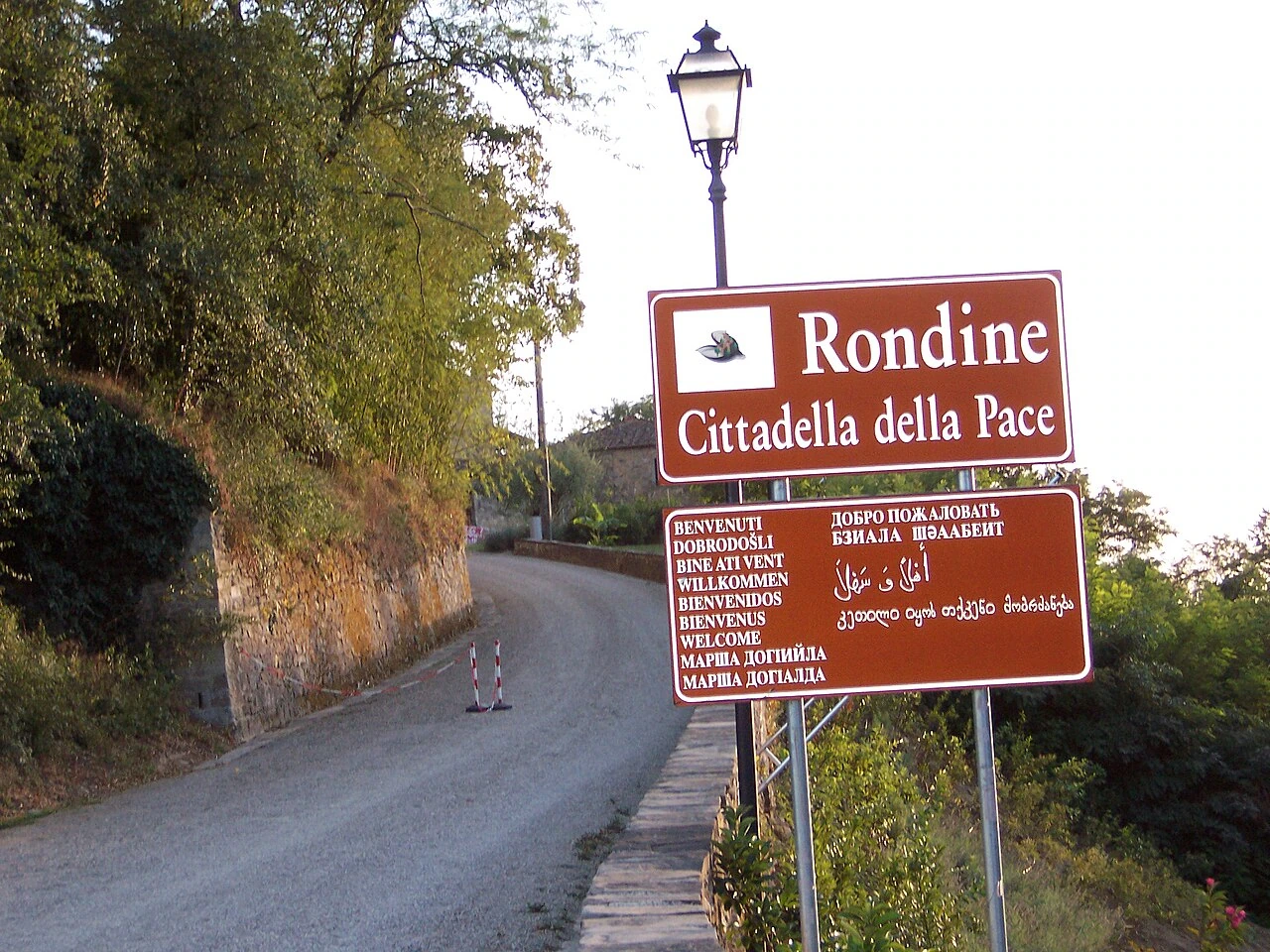
Multilingual welcome sign at Rondine, Arezzo. Commons explicitly identifies and transcribes the Chechen greeting visible in this photograph. The description separately notes that Ossetian was added after this photograph, so this image does not support an Ossetian assignment.
Saved in Babelbook · resized display copy. Select the image to open it independently of its source.
Pil56 · Source ↗CC BY-SA 3.0 ↗View the local visual field note
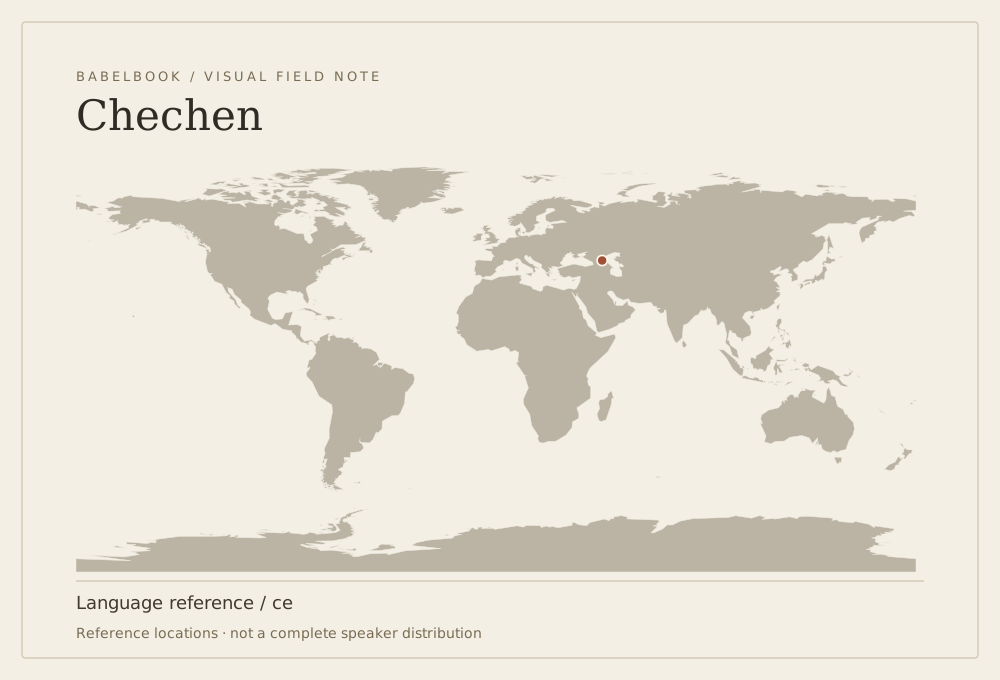
Representative reference points from Glottolog. Historical entries show reference locations, not current speakers. 1 point.
Reference & context ↗Babelbook · original editorial illustration · CC BY 4.0 · Glottolog locations; public-domain Natural Earth land
Source excerpts, selected, shortened and where noted editorially corrected from Chechen language by Wikipedia contributors. Retrieved 2026-10-05. CC BY-SA 4.0. These excerpts are not an independently verified scholarly history; missing accounts are identified above.
Read further in the source
History
Before the Russian conquest, most writings in Chechnya consisted of Islamic texts and clan histories, written usually in Arabic but sometimes also in Chechen using Arabic script. The Chechen literary language was created after the October Revolution, and the Latin script began to be used instead of Arabic for Chechen writing in the mid-1920s. The Cyrillic script was adopted in 1938. Almost the entire library of Chechen medieval writing in Arabic and Georgian script about the land of Chechnya and its people was destroyed by Soviet authorities in 1944, leaving the modern Chechens and modern historians with a destroyed and no longer existent historical treasury of writings. The Chechen diaspora in Jordan, Turkey, and Syria is fluent but generally not literate in Chechen except for individuals who have made efforts to learn the writing system. The Cyrillic alphabet is not generally known in these countries, and thus for Jordan and Syria, they mostly use the Arabic alphabet, while in Turkey they use the Latin alphabet.
Dialects
There are a number of Chechen dialects: Aukh, Chebarloish, Malkhish, Nokhchmakhkakhoish, Orstkhoish, Sharoish, Shuotoish, Terloish, Itum-Qalish and Himoish. Dialects of Chechen can be classified by their geographic position within the Chechen Republic. The dialects of the northern lowlands are often referred to as "Oharoy muott" (literally "lowlander's language") and the dialect of the southern mountain tribes is known as "Laamaroy muott" (lit. "mountainer's language"). Oharoy muott forms the basis for much of the standard and literary Chechen language, which can largely be traced to the regional dialects of Urus-Martan and contemporary Grozny. Laamaroy dialects include Chebarloish, Sharoish, Itum-Qalish, Kisti, and Himoish. Until recently, however, Himoy was undocumented and was considered a branch of Sharoish, as many dialects are also used as the basis of intertribal (teip) communication within a larger Chechen "tukkhum". Laamaroy dialects such as Sharoish, Himoish and Chebarloish are more conservative and retain many features from Proto-Chechen. For instance, many of these dialects lack a number of vowels found in the standard language which were a result of long-distance assimilation between vowel sounds. Additionally, the Himoy dialect preserves word-final, post-tonic vowels as a schwa [ə]. Literary Chechen is based on Plains Chechen, spoken around Grozny and Urus-Martan.
Geographic distribution
According to the Russian Census of 2020, 1,490,000 people reported being able to speak Chechen in Russia.