Chamorro
Chamorro is an Austronesian language spoken by about 58,000 people, numbering about 25,800 on Guam and about 32,200 in the Northern Mariana Islands and elsewhere. It is the historic native language of the Chamorro people, who are indigenous to the Mariana Islands, although it is less commonly spoken today than in the past. Chamorro has three distinct dialects: Guamanian, Rotanese, and that in the other Northern Mariana Islands (NMI).
Translate in Chamorro ↗The Chamorro language is threatened, with a precipitous drop in language fluency over the past century. It is estimated that 75% of the population of Guam was literate in the Chamorro language around the time the United States captured the island during the Spanish–American War (there are no similar language fluency estimates for other areas of the Mariana Islands during this time). A century later, the 2000 U.S. Census showed that fewer than 20% of Chamorros living in Guam speak their heritage language fluently, and the vast majority of those were over the age of 55. A number of forces have contributed to the steep, post-World War II decline of Chamorro language fluency. There is a long history of colonization of the Marianas, beginning with the Spanish colonization in 1668 and, eventually, the American acquisition of Guam in 1898 (whose hegemony continues to this day). This imposed power structures privileging the language of the region's colonizers. According to estimates, a large majority, as stated above (75%), maintained active knowledge of the Chamorro language even during the Spanish colonial era, but this was all to change with the advent of American imperialism and enforcement of the English language. In Guam, the language suffered additional suppression when the U.S. government banned the Chamorro language in schools and workplaces in 1922, destroying all Chamorro dictionaries. Similar policies were undertaken by the Japanese government when they controlled the region during World War II. After the war, when Guam was recaptured by the United States, American administrators of the island continued to impose "no Chamorro" restrictions in local schools, teaching only English and disciplining students for speaking their indigenous tongue. While these oppressive language policies were progressively lifted, Chamorro usage had substantially decreased. Subsequent generations were often raised in households where only the oldest family members were fluent.
Oceania
Present-day use
Representatives from Guam have unsuccessfully lobbied the United States to take action to promote and protect the language. In 2013, "Guam will be instituting Public Law 31–45, which increases the teaching of the Chamorro language and culture in Guam schools", extending instruction to include grades 7–10. Other efforts have been made in recent times, most notably Chamorro immersion schools. One example is Huråo Guåhan Academy at Chamorro Village in downtown Hagåtña. This program is led by Ann Marie Arceo and her husband, Ray. According to the academy's official YouTube page, "Huråo Academy is one if not the first Chamoru Immersion Schools that focus on the teaching of Chamoru language and Self-identity on Guam. Huråo was founded as a non-profit in June 2005." The academy has been praised by many for the continuity of the Chamoru language. Other creative ways to incorporate and promote the Chamorro language have been found in the use of applications for smartphones, internet videos and television. From Chamorro dictionaries, to the most recent "Speak Chamorro" app, efforts are growing and expanding in ways to preserve and protect the Chamorro language and identity. On YouTube, a popular Chamorro soap opera Siha has received mostly positive feedback from native Chamorro speakers on its ability to weave dramatics, the Chamorro language, and island culture into an entertaining program. On TV, Nihi! Kids is a first-of-its-kind show, because it is targeted "for Guam's nenis that aims to perpetuate Chamoru language and culture while encouraging environmental stewardship, healthy choices and character development." In 2019, local news station KUAM News began a series of videos on their YouTube channel, featuring University of Guam's Dr. Michael Bevacqua.
Origins
The captured article does not contain a separate origins section. See the historical account and linked source.
Development
The captured article does not contain a distinct historical account. No chronology has been invented.
Writing
The letters ⟨c⟩, ⟨j⟩, ⟨q⟩, ⟨v⟩, ⟨w⟩, ⟨x⟩, and ⟨z⟩ are only used in proper names. In loanwords, some letter combinations in Chamorro sometimes represent single phonemes. For instance, "ci+[vowel]" and "ti+[vowel]" are both pronounced [ʃ], as in hustisia ('justice') and the surname Concepcion (Spanish influence). The letter ⟨y⟩ is usually (though not always) pronounced more like [dz] (cf. zheísmo in Rioplatense Spanish); it is also sometimes used to represent the same sound as the letter ⟨i⟩ by Guamanian speakers. The phonemes represented by ⟨n⟩ and ⟨ñ⟩ as well as ⟨a⟩ and ⟨å⟩ are not always distinguished in print. Thus the Guamanian place name spelled ⟨Yona⟩ is pronounced ⟨Dzonia⟩ [dzoɲa], not *[jona] as might be expected. ⟨Ch⟩ is usually pronounced like [ts] rather than like English ch. Chamorro ⟨r⟩ is usually a tap /ɾ/, but is rolled /r/ between vowels, and it is a retroflex approximant /ɻ/, like English r, at the beginning of words. Words that begin with r in the Chamorro lexicon are exclusively loanwords. Chamorro has geminate consonants which are written double ⟨gg⟩, ⟨dd⟩, ⟨kk⟩, ⟨mm⟩, ⟨ngng⟩, ⟨pp⟩, ⟨ss⟩, and ⟨tt⟩. Its native diphthongs are ⟨ai⟩ and ⟨ao⟩, and ⟨oi⟩, ⟨oe⟩, ⟨ia⟩, ⟨iu⟩, and ⟨ie⟩ occur in loanwords. When ⟨i⟩ and another vowel are in hiatus, (i.e., /i.e/, /i.o/, /i.a/, and /i.u/), they are spelled ⟨ihe⟩, ⟨iho⟩, ⟨iha⟩, and ⟨ihu⟩. The default stress in Chamorro penultimate stress, except where marked otherwise. If marked at all in writing, it is usually with an acute accent, as in asút 'blue' or dángkulu (NMI) / dǻngkolo (Guam) 'big'. Unstressed vowels are limited to /ə i u/, though they are often spelled ⟨a e o⟩. One main exception is in certain present-continuous conjugations of transitive verbs, as in fagǻgåsi 'washing' or chumóchogui 'doing', in which stress is antepenultimate.
Beyond the typeface.
Signs, manuscripts, published pages and contextual photographs, with their place, period, source and reuse terms. Captions identify historical spellings, regional examples, community references and character imagery.
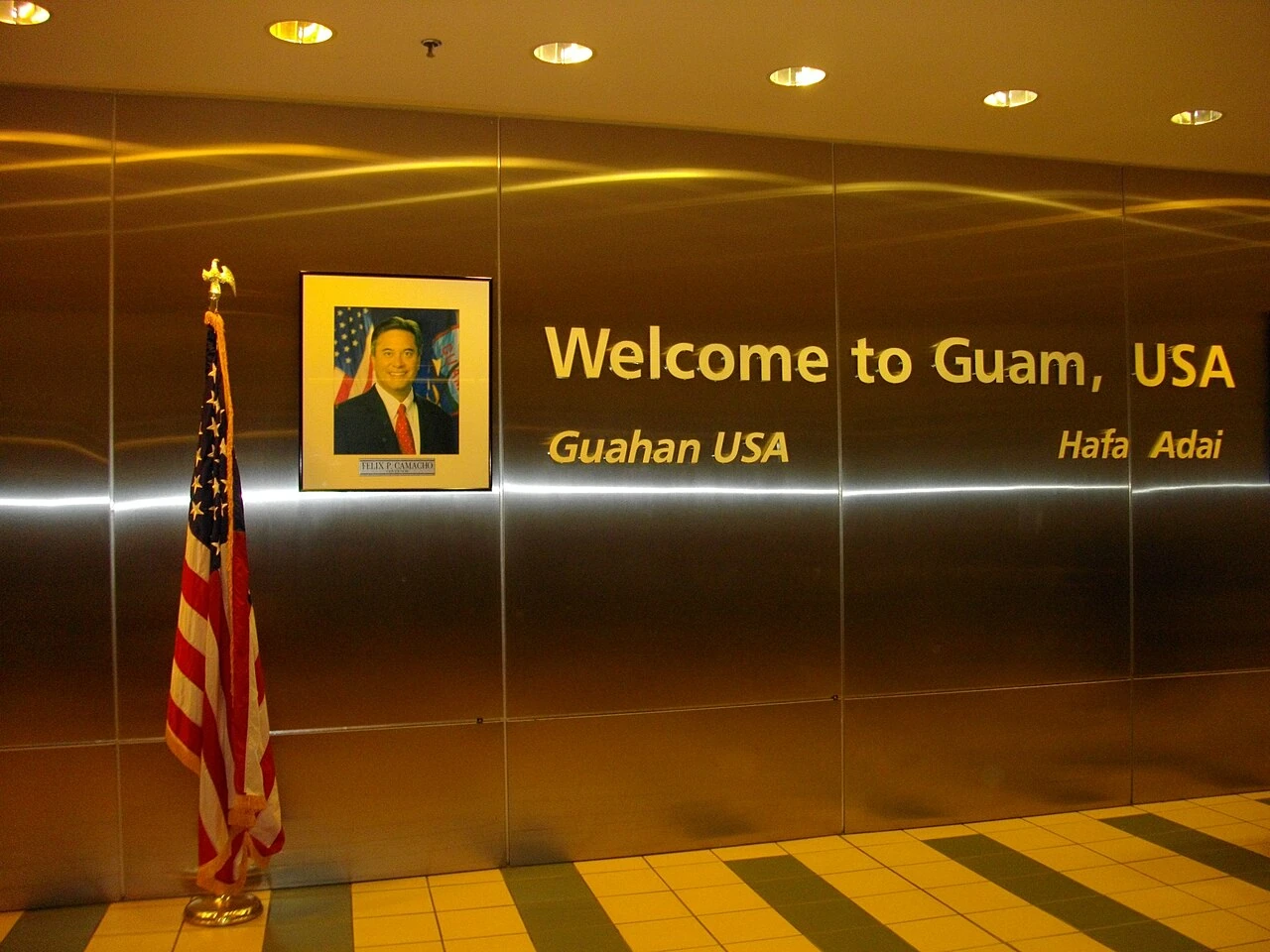
An airport welcome message catalogued as Chamorro–English signage.
Saved in Babelbook · resized display copy. Select the image to open it independently of its source.
Abasaa (あばさー) · Source ↗Public domain ↗View the local visual field note
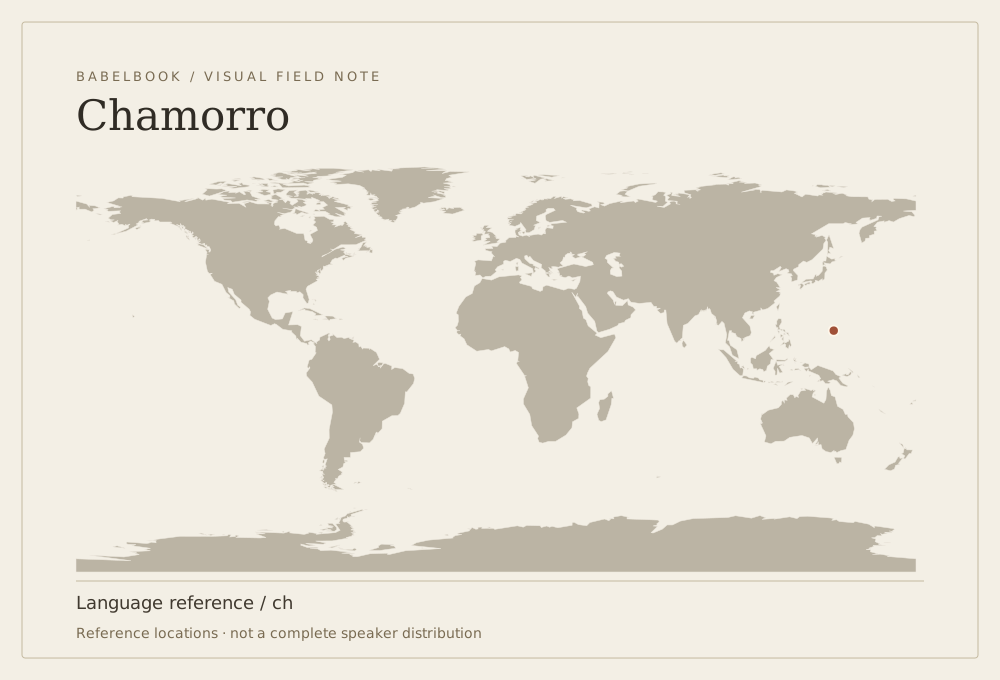
Representative reference points from Glottolog. Historical entries show reference locations, not current speakers. 1 point.
Reference & context ↗Babelbook · original editorial illustration · CC BY 4.0 · Glottolog locations; public-domain Natural Earth land
Source excerpts, selected, shortened and where noted editorially corrected from Chamorro language by Wikipedia contributors. Retrieved 2026-10-05. CC BY-SA 4.0. These excerpts are not an independently verified scholarly history; missing accounts are identified above.
Read further in the source
Speakers
The Chamorro language is threatened, with a precipitous drop in language fluency over the past century. It is estimated that 75% of the population of Guam was literate in the Chamorro language around the time the United States captured the island during the Spanish–American War (there are no similar language fluency estimates for other areas of the Mariana Islands during this time). A century later, the 2000 U.S. Census showed that fewer than 20% of Chamorros living in Guam speak their heritage language fluently, and the vast majority of those were over the age of 55. A number of forces have contributed to the steep, post-World War II decline of Chamorro language fluency. There is a long history of colonization of the Marianas, beginning with the Spanish colonization in 1668 and, eventually, the American acquisition of Guam in 1898 (whose hegemony continues to this day). This imposed power structures privileging the language of the region's colonizers. According to estimates, a large majority, as stated above (75%), maintained active knowledge of the Chamorro language even during the Spanish colonial era, but this was all to change with the advent of American imperialism and enforcement of the English language. In Guam, the language suffered additional suppression when the U.S. government banned the Chamorro language in schools and workplaces in 1922, destroying all Chamorro dictionaries. Similar policies were undertaken by the Japanese government when they controlled the region during World War II. After the war, when Guam was recaptured by the United States, American administrators of the island continued to impose "no Chamorro" restrictions in local schools, teaching only English and disciplining students for speaking their indigenous tongue. While these oppressive language policies were progressively lifted, Chamorro usage had substantially decreased. Subsequent generations were often raised in households where only the oldest family members were fluent. Lack of exposure made it increasingly difficult to pick up Chamorro as a second language. Within a few generations, English replaced Chamorro as the language of daily life. There is a difference in the rate of Chamorro language fluency between Guam and the rest of the Marianas. On Guam the number of native Chamorro speakers has dwindled since the mid-1990s. In the Northern Mariana Islands (NMI), younger Chamorros speak the language fluently but prefer English when speaking to their children. Chamorro is common in Chamorro households in the Northern Marianas, but fluency has greatly decreased among Guamanian Chamorros during the years of American rule in favor of the American English commonplace throughout the Marianas. Today, NMI Chamorros and Guamanian Chamorros disagree strongly on each other's linguistic fluency. An NMI Chamorro would say Guamanian Chamorros speak "broken" Chamorro (i.e., incorrect), whereas a Guamanian Chamorro might consider the form used by NMI Chamorros to be archaic.
Revitalization efforts
Representatives from Guam have unsuccessfully lobbied the United States to take action to promote and protect the language. In 2013, "Guam will be instituting Public Law 31–45, which increases the teaching of the Chamorro language and culture in Guam schools", extending instruction to include grades 7–10. Other efforts have been made in recent times, most notably Chamorro immersion schools. One example is Huråo Guåhan Academy at Chamorro Village in downtown Hagåtña. This program is led by Ann Marie Arceo and her husband, Ray. According to the academy's official YouTube page, "Huråo Academy is one if not the first Chamoru Immersion Schools that focus on the teaching of Chamoru language and Self-identity on Guam. Huråo was founded as a non-profit in June 2005." The academy has been praised by many for the continuity of the Chamoru language. Other creative ways to incorporate and promote the Chamorro language have been found in the use of applications for smartphones, internet videos and television. From Chamorro dictionaries, to the most recent "Speak Chamorro" app, efforts are growing and expanding in ways to preserve and protect the Chamorro language and identity. On YouTube, a popular Chamorro soap opera Siha has received mostly positive feedback from native Chamorro speakers on its ability to weave dramatics, the Chamorro language, and island culture into an entertaining program. On TV, Nihi! Kids is a first-of-its-kind show, because it is targeted "for Guam's nenis that aims to perpetuate Chamoru language and culture while encouraging environmental stewardship, healthy choices and character development." In 2019, local news station KUAM News began a series of videos on their YouTube channel, featuring University of Guam's Dr. Michael Bevacqua.
Orthography
The letters ⟨c⟩, ⟨j⟩, ⟨q⟩, ⟨v⟩, ⟨w⟩, ⟨x⟩, and ⟨z⟩ are only used in proper names. In loanwords, some letter combinations in Chamorro sometimes represent single phonemes. For instance, "ci+[vowel]" and "ti+[vowel]" are both pronounced [ʃ], as in hustisia ('justice') and the surname Concepcion (Spanish influence). The letter ⟨y⟩ is usually (though not always) pronounced more like [dz] (cf. zheísmo in Rioplatense Spanish); it is also sometimes used to represent the same sound as the letter ⟨i⟩ by Guamanian speakers. The phonemes represented by ⟨n⟩ and ⟨ñ⟩ as well as ⟨a⟩ and ⟨å⟩ are not always distinguished in print. Thus the Guamanian place name spelled ⟨Yona⟩ is pronounced ⟨Dzonia⟩ [dzoɲa], not *[jona] as might be expected. ⟨Ch⟩ is usually pronounced like [ts] rather than like English ch. Chamorro ⟨r⟩ is usually a tap /ɾ/, but is rolled /r/ between vowels, and it is a retroflex approximant /ɻ/, like English r, at the beginning of words. Words that begin with r in the Chamorro lexicon are exclusively loanwords. Chamorro has geminate consonants which are written double ⟨gg⟩, ⟨dd⟩, ⟨kk⟩, ⟨mm⟩, ⟨ngng⟩, ⟨pp⟩, ⟨ss⟩, and ⟨tt⟩. Its native diphthongs are ⟨ai⟩ and ⟨ao⟩, and ⟨oi⟩, ⟨oe⟩, ⟨ia⟩, ⟨iu⟩, and ⟨ie⟩ occur in loanwords. When ⟨i⟩ and another vowel are in hiatus, (i.e., /i.e/, /i.o/, /i.a/, and /i.u/), they are spelled ⟨ihe⟩, ⟨iho⟩, ⟨iha⟩, and ⟨ihu⟩. The default stress in Chamorro penultimate stress, except where marked otherwise. If marked at all in writing, it is usually with an acute accent, as in asút 'blue' or dángkulu (NMI) / dǻngkolo (Guam) 'big'. Unstressed vowels are limited to /ə i u/, though they are often spelled ⟨a e o⟩. One main exception is in certain present-continuous conjugations of transitive verbs, as in fagǻgåsi 'washing' or chumóchogui 'doing', in which stress is antepenultimate. Syllables may end in at most one consonant, as in che’lu 'sibling', diskåtga 'unload', mamåhlåo 'shy', oppop 'lie face down', gåtus (Old Chamorro word for 100), or Hagåtña (capital of Guam). Chamorro language orthography differs between NMI Chamorros and Guamanian Chamorros (example: NMI Chamorro vs. Guamanian CHamoru). In 2021, Guam's Kumisión I Fino' CHamoru (CHamoru Language Commission) released the Utgrafihan CHamoru as the latest spelling standard for the local dialect and place names. The Commonwealth of the Northern Mariana Islands revised their official Chamorro orthography in 2010, which included a version translated into English.