Corsican
Corsican (corsu, pronounced [ˈkorsu], or lingua corsa, pronounced [ˈliŋɡwa ˈɡorsa]) is a Romance language of the Italo-Romance group, spoken on the Mediterranean island of Corsica, a territory of France, and in the northern part of the island of Sardinia, an autonomous region of Italy. Its northern varieties result from an intense medieval Tuscanisation and are closely related to, and largely mutually intelligible with, Standard Italian, whereas its southern varieties preserve features of an older stratum shared with Sardinian and show affinities with the Extreme Southern Italian dialects. On the sociolinguistic level, since the 1970s Corsican has increasingly been treated as an autonomous language in its own right rather than an Italian dialect, a status captured by the notion of polynomic language developed by Jean-Baptiste Marcellesi. Under the long-standing influence of Tuscany's Pisa, and the historic Republic of Genoa, over Corsica, the Corsican language once filled the role of a vernacular, with Italian functioning as the island's official language until France acquired the island from the Republic of Genoa (1768); by 1859, French had replaced Italian as Corsica's first language so much so that, by the time of the Liberation of France (1945), nearly every islander had at least a working-knowledge of French. The 20th century saw a vast language shift, with the islanders adapting and changing their communications to the extent that there were no monolingual Corsican-speakers left by the 1960s.
Translate in Corsican ↗The situation of Corsican with regard to French as the country's national language is analogous to that of many other French regions and provinces, which have or used to have a traditional language of their own, even though the islanders' switch from their local idiom to regional French has happened relatively later and the presence of Corsican, albeit declining, is still strongly felt among the population. In 1980, about 70 percent of the island's population "had some command of the Corsican language." In 1990, out of a total population of about 254,000, the percentage had declined to 50 percent, with 10 percent of the island's residents using it as a first language. The language appeared to be in serious decline when the French government reversed its unsupportive stand and initiated some strong measures to save it. The January 2007 estimated population of Corsica was 281,000, whereas the figure for the March 1999 census, when most of the studies—though not the linguistic survey work referenced in this article—were performed, was about 261,000. Only a fraction of the population at either time spoke Corsican with any fluency. According to an official survey run on behalf of the Territorial Collectivity of Corsica which took place in April 2013, in Corsica, the Corsican language had a number of speakers between 86,800 and 130,200, out of a total population amounting to 309,693 inhabitants. 28% of the overall population was able to speak Corsican well, while an additional 14% had a capacity to speak it "quite well." The percentage of those who had a solid oral understanding of the language varies between a minimum of 25 percent in the 25–34 age group and the maximum of 65 percent in the over-65 age group: almost a quarter of the former age group reported that they were not able to understand Corsican, while only a small minority of the older people did not understand it.
Europe
Present-day use
The captured source does not contain a separate current-use account.
Origins
The common relationship between Corsica and central Italy can be traced from as far back as the Etruscans, who asserted their presence on the island in as early as 500 BC. In 40 AD, the natives of Corsica reportedly did not speak Latin. The Roman exile, Seneca the Younger, reported that both coast and interior were occupied by natives whose language he was not able to understand. More specifically, Seneca claimed that the island's population was the result of the stratification of different ethnic groups, such as the Greeks, the Ligures (see the Ligurian hypothesis) and the Iberians, whose language had long since stopped being recognizable among the population due to the intermixing of the other two groups. The occupation of the island by the Vandals around the year 469 marked the end of authoritative influence by Latin speakers. (See Medieval Corsica.) If the natives of that time spoke Latin, they must have acquired it during the late empire. Modern Corsican has been influenced by the languages of the major powers taking an interest in Corsican affairs; earlier by those of the medieval Italian powers, such as the Papal States (828–1077), the Republic of Pisa (1077–1282) and the Republic of Genoa (1282–1768), and finally by France which, since 1859, has promulgated the official Parisian French. The term "gallicised Corsican" refers to the evolution of Corsican starting from about the year 1950, whereas "distanciated Corsican" refers to an idealized variety of Corsican following linguistic purism, by means of removing any French-derived elements.
Development
The captured article does not contain a distinct historical account. No chronology has been invented.
Writing
Latin or customary script (catalog classification; see the source for context).
Beyond the typeface.
Signs, manuscripts, published pages and contextual photographs, with their place, period, source and reuse terms. Captions identify historical spellings, regional examples, community references and character imagery.
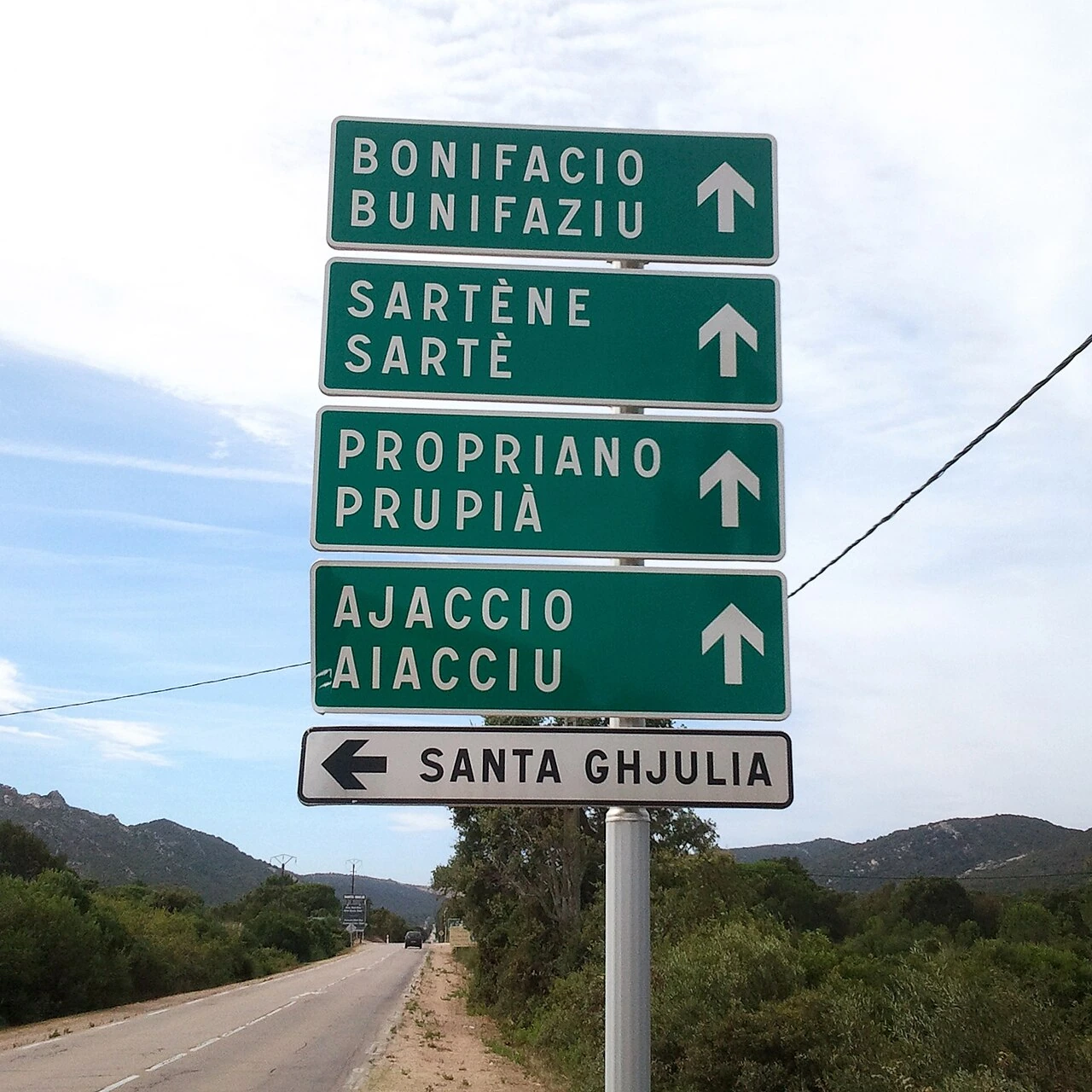
Bilingual direction signage between Porto-Vecchio and Bonifacio, Corsica.
Saved in Babelbook · resized display copy. Select the image to open it independently of its source.
Antofa · Source ↗CC BY-SA 3.0 ↗View the local visual field note
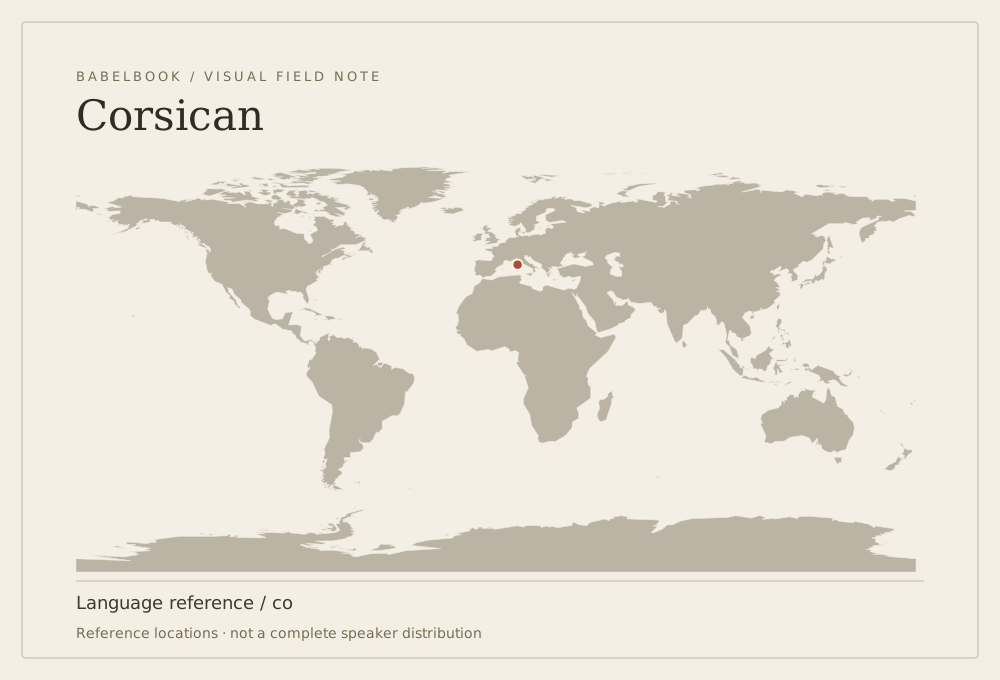
Representative reference points from Glottolog. Historical entries show reference locations, not current speakers. 1 point.
Reference & context ↗Babelbook · original editorial illustration · CC BY 4.0 · Glottolog locations; public-domain Natural Earth land
Source excerpts, selected, shortened and where noted editorially corrected from Corsican language by Wikipedia contributors. Retrieved 2026-10-05. CC BY-SA 4.0. These excerpts are not an independently verified scholarly history; missing accounts are identified above.
Read further in the source
Origins
The common relationship between Corsica and central Italy can be traced from as far back as the Etruscans, who asserted their presence on the island in as early as 500 BC. In 40 AD, the natives of Corsica reportedly did not speak Latin. The Roman exile, Seneca the Younger, reported that both coast and interior were occupied by natives whose language he was not able to understand. More specifically, Seneca claimed that the island's population was the result of the stratification of different ethnic groups, such as the Greeks, the Ligures (see the Ligurian hypothesis) and the Iberians, whose language had long since stopped being recognizable among the population due to the intermixing of the other two groups. The occupation of the island by the Vandals around the year 469 marked the end of authoritative influence by Latin speakers. (See Medieval Corsica.) If the natives of that time spoke Latin, they must have acquired it during the late empire. Modern Corsican has been influenced by the languages of the major powers taking an interest in Corsican affairs; earlier by those of the medieval Italian powers, such as the Papal States (828–1077), the Republic of Pisa (1077–1282) and the Republic of Genoa (1282–1768), and finally by France which, since 1859, has promulgated the official Parisian French. The term "gallicised Corsican" refers to the evolution of Corsican starting from about the year 1950, whereas "distanciated Corsican" refers to an idealized variety of Corsican following linguistic purism, by means of removing any French-derived elements.
Number of speakers
The situation of Corsican with regard to French as the country's national language is analogous to that of many other French regions and provinces, which have or used to have a traditional language of their own, even though the islanders' switch from their local idiom to regional French has happened relatively later and the presence of Corsican, albeit declining, is still strongly felt among the population. In 1980, about 70 percent of the island's population "had some command of the Corsican language." In 1990, out of a total population of about 254,000, the percentage had declined to 50 percent, with 10 percent of the island's residents using it as a first language. The language appeared to be in serious decline when the French government reversed its unsupportive stand and initiated some strong measures to save it. The January 2007 estimated population of Corsica was 281,000, whereas the figure for the March 1999 census, when most of the studies—though not the linguistic survey work referenced in this article—were performed, was about 261,000. Only a fraction of the population at either time spoke Corsican with any fluency. According to an official survey run on behalf of the Territorial Collectivity of Corsica which took place in April 2013, in Corsica, the Corsican language had a number of speakers between 86,800 and 130,200, out of a total population amounting to 309,693 inhabitants. 28% of the overall population was able to speak Corsican well, while an additional 14% had a capacity to speak it "quite well." The percentage of those who had a solid oral understanding of the language varies between a minimum of 25 percent in the 25–34 age group and the maximum of 65 percent in the over-65 age group: almost a quarter of the former age group reported that they were not able to understand Corsican, while only a small minority of the older people did not understand it. While 32 percent of the population of Northern Corsica was reported to speak Corsican quite well, this percentage dropped to 22 percent for Southern Corsica. Moreover, 10 percent of the population of Corsica spoke only French, while 62 percent code-switched between French and at least some Corsican. 8 percent of the Corsicans knew how to write correctly in Corsican, while about 60 percent of the population did not know how to write in Corsican. While 90 percent of the population was in favor of a Corsican-French bilingualism, 3 percent would have liked to have only Corsican as the official language in the island, and 7 percent would have preferred French to have this role. A 2022 estimate by the Collectivity of Corsica put the number of Corsican speakers on the island at about 105,000, with roughly a further 30,000 in mainland France and abroad, for a total of some 125,000; the island's population had by then reached about 350,000. UNESCO classifies Corsican as a "definitely endangered language." The Corsican language is a key vehicle for Corsican culture, which is notably rich in proverbs and in polyphonic song.