Coptic
Coptic (Bohairic Coptic: ϯⲙⲉⲧⲣⲉⲙⲛ̀ⲭⲏⲙⲓ, romanized: Timetremənkʰēmi) is a dormant Afroasiatic language. It is a group of closely related Egyptian dialects, representing the most recent developments of the Egyptian language, and historically spoken by the Egyptians, starting from the third century AD in Roman Egypt. Coptic was supplanted by Arabic as the primary spoken language of Egypt following the Arab conquest of Egypt and was slowly replaced over the centuries. Coptic has no modern-day native speakers, and no fluent speakers apart from a number of priests although it remains in daily use as the liturgical language of the Coptic Orthodox Church and of the Coptic Catholic Church. It is written with the Coptic alphabet, a modified uncial form of the Greek alphabet with seven additional letters borrowed from the Demotic Egyptian script. The major Coptic dialects are Sahidic, Bohairic, Akhmimic, Fayyumic, Lycopolitan (Asyutic), and Oxyrhynchite. Sahidic Coptic was spoken between the cities of Asyut and Oxyrhynchus and flourished as a literary language across Egypt in the period c. 325 – c. 800 AD. The Gnostic texts in the Nag Hammadi library are primarily written in the Sahidic dialect. However, some texts also contain elements of the Subakhmimic (Lycopolitan) dialect, which was also used in Upper Egypt. Bohairic, the dialect of Lower Egypt, gained prominence in the 9th century and is the dialect used by the Coptic Church liturgically.
Translate in Coptic ↗Coptic is spoken liturgically in the Coptic Orthodox and Coptic Catholic Church (along with Modern Standard Arabic). The language is spoken only in Egypt and historically has had little influence outside of the territory, except for monasteries located in Nubia (which straddles modern Egypt and Sudan). Coptic's most noticeable linguistic influence has been on the various dialects of Egyptian Arabic, which is characterised by a Coptic substratum in lexical, morphological, syntactical, and phonological features.
Middle East & North Africa
Present-day use
In the early 20th century, some Copts tried to revive the Coptic language, but they were unsuccessful. In the second half of the 20th century, Pope Cyril VI of Alexandria started a national Church-sponsored movement to revive Coptic. Several works of grammar were published, including a more comprehensive dictionary than had been formerly available. The scholarly findings of the field of Egyptology and the inauguration of the Institute of Coptic Studies further contributed to the renaissance. Efforts at language revitalisation continue to be undertaken, and have attracted the interest of Copts and linguists in and outside of Egypt.
Origins
The captured article does not contain a separate origins section. See the historical account and linked source.
Development
The Egyptian language may have the longest documented history of any language, from Old Egyptian, which appeared just before 3200 BC, to its final phases as Coptic in the Middle Ages. Coptic belongs to the Later Egyptian phase, which started to be written in the New Kingdom of Egypt. Later Egyptian represented colloquial speech of the later periods. It had analytic features like definite and indefinite articles and periphrastic verb conjugation. Coptic, therefore, is a reference to both the most recent stage of Egyptian after Demotic and the new writing system that was adapted from the Greek alphabet.
Writing
Coptic uses a writing system almost wholly derived from the Greek alphabet, with the addition of a number of letters that have their origins in Demotic Egyptian. This is comparable to the Latin-based Icelandic alphabet, which includes the runic letter thorn. There is some variation in the number and forms of these signs depending on the dialect. Some of the letters in the Coptic alphabet that are of Greek origin were normally reserved for Greek words. Old Coptic texts used several graphemes that were not retained in the literary Coptic orthography of later centuries. In Sahidic, syllable boundaries may have been marked by a supralinear stroke ⟨◌̄⟩, or the stroke may have tied letters together in one word, since Coptic texts did not otherwise indicate word divisions. Some scribal traditions use a diaeresis over the letters ⲓ and ⲩ at the beginning of a word or to mark a diphthong. Bohairic uses a superposed point or small stroke known as ϫⲓⲛⲕⲓⲙ (jinkim, "movement"). When jinkim is placed over a vowel it is pronounced independently, and when it is placed over a consonant a short ⲉ precedes it.
Beyond the typeface.
Signs, manuscripts, published pages and contextual photographs, with their place, period, source and reuse terms. Captions identify historical spellings, regional examples, community references and character imagery.
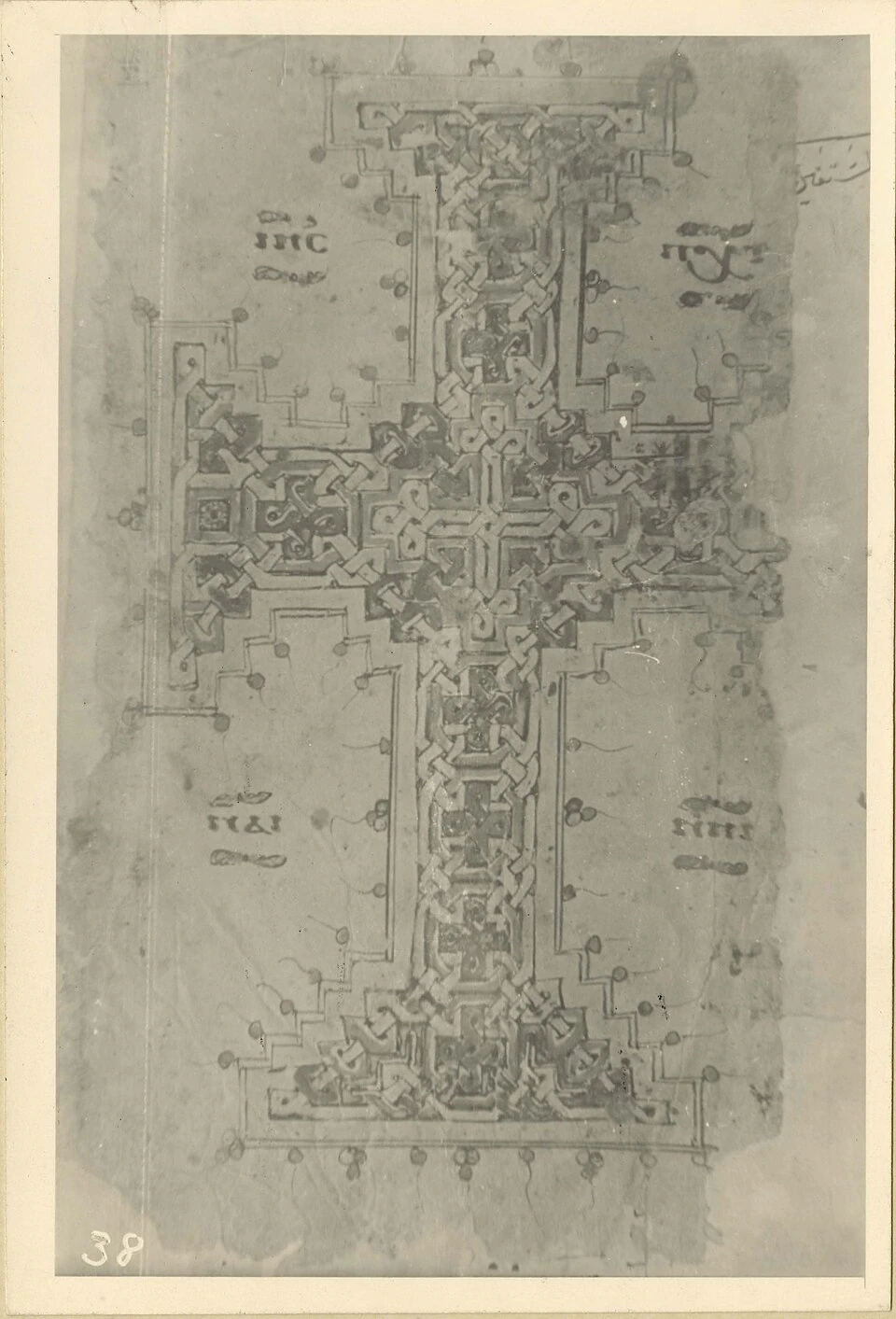
Historical photograph of a manuscript page with a cross illustration from Saint Paul Monastery, Egypt. The Dumbarton Oaks collection title reproduced on Commons identifies the manuscript as Coptic. Not independently transcribed.
Saved in Babelbook · resized display copy. Select the image to open it independently of its source.
Kazazian / Byzantine Institute; Dumbarton Oaks, Trustees for Harvard University · Source ↗CC0 1.0 ↗View the local visual field note
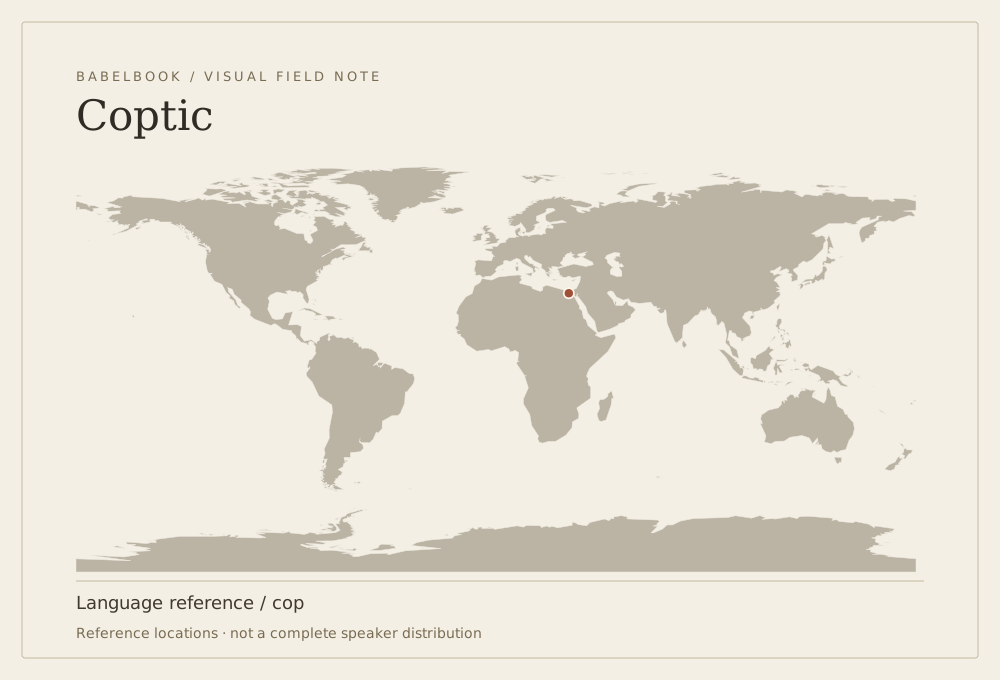
Representative reference points from Glottolog. Historical entries show reference locations, not current speakers. 1 point.
Reference & context ↗Babelbook · original editorial illustration · CC BY 4.0 · Glottolog locations; public-domain Natural Earth land
Source excerpts, selected, shortened and where noted editorially corrected from Coptic language by Wikipedia contributors. Retrieved 2026-10-05. CC BY-SA 4.0. These excerpts are not an independently verified scholarly history; missing accounts are identified above.
Read further in the source
Geographic distribution
Coptic is spoken liturgically in the Coptic Orthodox and Coptic Catholic Church (along with Modern Standard Arabic). The language is spoken only in Egypt and historically has had little influence outside of the territory, except for monasteries located in Nubia (which straddles modern Egypt and Sudan). Coptic's most noticeable linguistic influence has been on the various dialects of Egyptian Arabic, which is characterised by a Coptic substratum in lexical, morphological, syntactical, and phonological features.
History
The Egyptian language may have the longest documented history of any language, from Old Egyptian, which appeared just before 3200 BC, to its final phases as Coptic in the Middle Ages. Coptic belongs to the Later Egyptian phase, which started to be written in the New Kingdom of Egypt. Later Egyptian represented colloquial speech of the later periods. It had analytic features like definite and indefinite articles and periphrastic verb conjugation. Coptic, therefore, is a reference to both the most recent stage of Egyptian after Demotic and the new writing system that was adapted from the Greek alphabet.
Modern revitalisation attempts
In the early 20th century, some Copts tried to revive the Coptic language, but they were unsuccessful. In the second half of the 20th century, Pope Cyril VI of Alexandria started a national Church-sponsored movement to revive Coptic. Several works of grammar were published, including a more comprehensive dictionary than had been formerly available. The scholarly findings of the field of Egyptology and the inauguration of the Institute of Coptic Studies further contributed to the renaissance. Efforts at language revitalisation continue to be undertaken, and have attracted the interest of Copts and linguists in and outside of Egypt.
Dialects
There is little written evidence of dialectal differences in the pre-Coptic phases of the Egyptian language due to the centralised nature of the political and cultural institutions of ancient Egyptian society. However, literary Old and Middle (Classical) Egyptian represent the spoken dialect of Lower Egypt around the city of Memphis, the capital of Egypt in the Old Kingdom. Later Egyptian is more representative of the dialects spoken in Upper Egypt, especially around the area of Thebes as it became the cultural and religious center of the New Kingdom. Coptic more obviously displays a number of regional dialects that were in use from the coast of the Mediterranean Sea in northern Egypt, south into Nubia, and in the western oases. However, while many of these dialects reflect actual regional linguistic (namely phonological and some lexical) variation, they mostly reflect localized orthographic traditions with very little grammatical differences.
Writing system
Coptic uses a writing system almost wholly derived from the Greek alphabet, with the addition of a number of letters that have their origins in Demotic Egyptian. This is comparable to the Latin-based Icelandic alphabet, which includes the runic letter thorn. There is some variation in the number and forms of these signs depending on the dialect. Some of the letters in the Coptic alphabet that are of Greek origin were normally reserved for Greek words. Old Coptic texts used several graphemes that were not retained in the literary Coptic orthography of later centuries. In Sahidic, syllable boundaries may have been marked by a supralinear stroke ⟨◌̄⟩, or the stroke may have tied letters together in one word, since Coptic texts did not otherwise indicate word divisions. Some scribal traditions use a diaeresis over the letters ⲓ and ⲩ at the beginning of a word or to mark a diphthong. Bohairic uses a superposed point or small stroke known as ϫⲓⲛⲕⲓⲙ (jinkim, "movement"). When jinkim is placed over a vowel it is pronounced independently, and when it is placed over a consonant a short ⲉ precedes it.