Cree
Cree ( KREE; also known as Cree–Montagnais–Naskapi) is a dialect continuum of Algonquian languages spoken by approximately 86,475 people across Canada in 2021, from the Northwest Territories to Alberta to Labrador. If considered one language, it is the aboriginal language with the highest number of speakers in Canada. The only region where Cree has any official status is in the Northwest Territories, alongside eight other aboriginal languages. There, Cree is spoken mainly in Fort Smith and Hay River.
Translate in Cree ↗The social and legal status of Cree varies across Canada. Cree is one of the eleven official languages of the Northwest Territories, but is only spoken by a small number of people there in the area around the town of Fort Smith. It is also one of two principal languages of the regional government of Eeyou Istchee James Bay in Northern Quebec, the other being French. Robert Falcon Ouellette, a Cree Member of Parliament, played a pivotal role in promoting Indigenous languages especially Cree within the Canadian Parliament and Canadian House of Commons. He was instrumental in obtaining unanimous consent from all political parties to change the standing orders to allow Indigenous languages to be spoken in the House of Commons, with full translation services provided. This historic change enabled Ouellette to deliver a speech in Cree with interpretation supported by language educator Kevin Lewis, marking the first use of an Indigenous language in the House of Commons on Jan 28, 2019. Furthermore, Bill C-91, the Indigenous Languages Act passed in 2019, was enacted to support and revitalize Indigenous languages across Canada. This legislation, aims to reclaim, revitalize, and maintain Indigenous languages through sustainable funding and the establishment of the Office of the Commissioner of Indigenous Languages. Ouellette was the chair of the Indigenous caucus in the House of Commons and helped ensure it passage before the election of 2019.
North America
Present-day use
The social and legal status of Cree varies across Canada. Cree is one of the eleven official languages of the Northwest Territories, but is only spoken by a small number of people there in the area around the town of Fort Smith. It is also one of two principal languages of the regional government of Eeyou Istchee James Bay in Northern Quebec, the other being French. Robert Falcon Ouellette, a Cree Member of Parliament, played a pivotal role in promoting Indigenous languages especially Cree within the Canadian Parliament and Canadian House of Commons. He was instrumental in obtaining unanimous consent from all political parties to change the standing orders to allow Indigenous languages to be spoken in the House of Commons, with full translation services provided. This historic change enabled Ouellette to deliver a speech in Cree with interpretation supported by language educator Kevin Lewis, marking the first use of an Indigenous language in the House of Commons on Jan 28, 2019. Furthermore, Bill C-91, the Indigenous Languages Act passed in 2019, was enacted to support and revitalize Indigenous languages across Canada. This legislation, aims to reclaim, revitalize, and maintain Indigenous languages through sustainable funding and the establishment of the Office of the Commissioner of Indigenous Languages. Ouellette was the chair of the Indigenous caucus in the House of Commons and helped ensure it passage before the election of 2019. As of 2017, Cree had about 117,000 documented speakers. They are still a minority language given the dominance of English and French in Canada. There are programs in place to maintain and revitalize the language, though.
Origins
Cree is believed to have begun as a dialect of the Proto-Algonquian language spoken between 2,500 and 3,000 years ago in its linguistic homeland, an undetermined area thought to be near the Great Lakes. Speakers of the proto-Cree language are thought to have moved north and quickly diverged into two groups on either side of James Bay. The eastern group then began to diverge into separate dialects, whereas the western grouping probably broke into distinct dialects much later. After this point it is very difficult to make definite statements about how different groups emerged and moved around, because there are no written works in the languages to compare, and descriptions by Europeans are not systematic; as well, Algonquian people have a tradition of bilingualism and even of outright adopting a new language from neighbours. A traditional view among 20th-century anthropologists and historians of the fur trade posits that the Woodland Cree and the Plains Cree (and therefore their dialects) did not diverge from other Cree peoples before 1670, when the Cree expanded out of their homeland near James Bay because of access to European firearms. By contrast, James Smith of the George Gustav Heye Center stated in 1987 that the weight of archeological and linguistic evidence puts the Cree as far west as the Peace River Country of Alberta before European contact.
Development
The captured article does not contain a distinct historical account. No chronology has been invented.
Writing
Cree dialects, except for those spoken in eastern Quebec and Labrador, are traditionally written using Cree syllabics, a variant of Canadian Aboriginal syllabics, but can be written with the Latin script as well. Both writing systems represent the language phonetically. Cree is always written from left to right horizontally. The easternmost dialects are written using the Latin script exclusively. The dialects of Plains Cree, Woods Cree, and western Swampy Cree use Western Cree syllabics and the dialects of eastern Swampy Cree, East Cree, Moose Cree, and Naskapi use Eastern Cree syllabics.
Beyond the typeface.
Signs, manuscripts, published pages and contextual photographs, with their place, period, source and reuse terms. Captions identify historical spellings, regional examples, community references and character imagery.
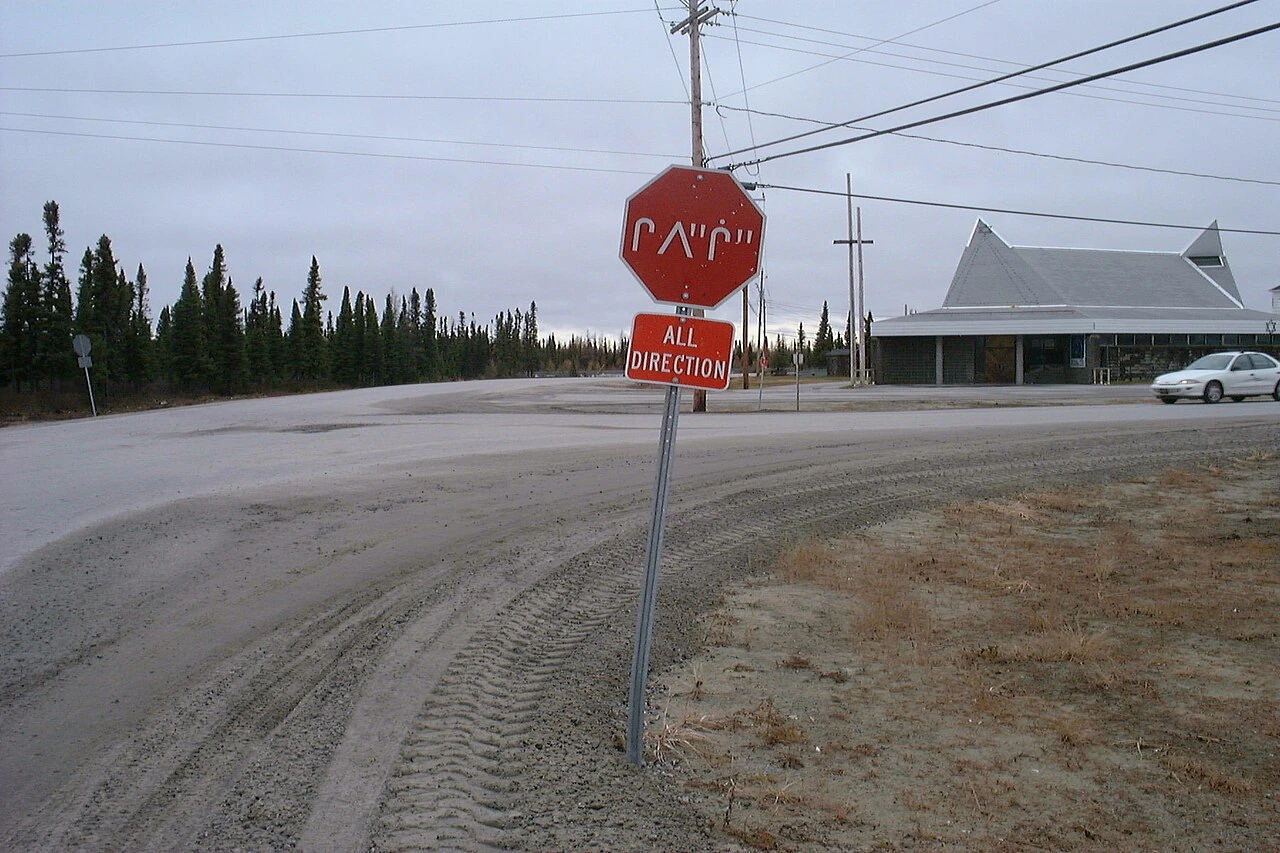
A photographed stop sign with Cree syllabic text, explicitly identified as Cree in the source.
Saved in Babelbook · resized display copy. Select the image to open it independently of its source.
Peter Van den Bossche · Source ↗CC BY-SA 2.0 ↗View the local visual field note
Representative reference points from Glottolog. Historical entries show reference locations, not current speakers. 1 point.
Reference & context ↗Babelbook · original editorial illustration · CC BY 4.0 · Glottolog locations; public-domain Natural Earth land
Source excerpts, selected, shortened and where noted editorially corrected from Cree language by Wikipedia contributors. Retrieved 2026-10-05. CC BY-SA 4.0. These excerpts are not an independently verified scholarly history; missing accounts are identified above.
Read further in the source
Origin and diffusion
Cree is believed to have begun as a dialect of the Proto-Algonquian language spoken between 2,500 and 3,000 years ago in its linguistic homeland, an undetermined area thought to be near the Great Lakes. Speakers of the proto-Cree language are thought to have moved north and quickly diverged into two groups on either side of James Bay. The eastern group then began to diverge into separate dialects, whereas the western grouping probably broke into distinct dialects much later. After this point it is very difficult to make definite statements about how different groups emerged and moved around, because there are no written works in the languages to compare, and descriptions by Europeans are not systematic; as well, Algonquian people have a tradition of bilingualism and even of outright adopting a new language from neighbours. A traditional view among 20th-century anthropologists and historians of the fur trade posits that the Woodland Cree and the Plains Cree (and therefore their dialects) did not diverge from other Cree peoples before 1670, when the Cree expanded out of their homeland near James Bay because of access to European firearms. By contrast, James Smith of the George Gustav Heye Center stated in 1987 that the weight of archeological and linguistic evidence puts the Cree as far west as the Peace River Country of Alberta before European contact.
Dialect criteria
The Cree dialect continuum can be divided by many criteria. Dialects spoken in northern Ontario and the southern James Bay, Lanaudière, and Mauricie regions of Quebec differentiate /ʃ/ (sh as in she) and /s/, while those to the west have merged the two phonemes as /s/ and in the east the phonemes are merged as either /ʃ/ or /h/. In several dialects, including northern Plains Cree and Woods Cree, the long vowels /eː/ and /iː/ have merged into a single vowel, /iː/. In the Quebec communities of Chisasibi, Whapmagoostui, and Kawawachikamach, the long vowel /eː/ has merged with /aː/. However, the most transparent phonological variations between different Cree dialects are reflexes of Proto-Algonquian *l in the modern varieties, as shown below:
The Plains Cree, speakers of the y dialect, refer to their language as nēhiyawēwin, whereas Woods Cree speakers say nīhithawīwin, and Swampy Cree speakers say nēhinawēwin. Another important phonological variation among the Cree dialects involves the palatalisation of Proto-Algonquian *k: East of the Ontario–Quebec border (except for Atikamekw), Proto-Algonquian *k has changed into /tʃ/ or /ts/ before front vowels. See the table above for examples in the *kīla column. Very often, the Cree dialect continuum is divided into two languages: Cree and Innu/Montagnais. Cree includes all dialects which have not undergone the *k > /tʃ/ sound change (BC–QC) while Innu encompasses the territory where this sound change has occurred (QC–NL). These labels are very useful from a linguistic perspective, but are confusing as East Cree then qualifies as Montagnais. For practical purposes, 'Cree' usually covers the dialects that use the Cree syllabics as their orthography (including Atikamekw, but excluding Kawawachikamach Naskapi); the term Innu or Montagnais then applies to those dialects that use the Latin script (excluding Atikamekw, and including Kawawachikamach Naskapi). The term 'Naskapi' typically refers to Kawawachikamach (y-dialect) and Natuashish (n-dialect).
Dialect groups
The Cree dialects can be broadly classified into nine groups. Roughly from west to east:
Writing
Cree dialects, except for those spoken in eastern Quebec and Labrador, are traditionally written using Cree syllabics, a variant of Canadian Aboriginal syllabics, but can be written with the Latin script as well. Both writing systems represent the language phonetically. Cree is always written from left to right horizontally. The easternmost dialects are written using the Latin script exclusively. The dialects of Plains Cree, Woods Cree, and western Swampy Cree use Western Cree syllabics and the dialects of eastern Swampy Cree, East Cree, Moose Cree, and Naskapi use Eastern Cree syllabics.
Legal status
The social and legal status of Cree varies across Canada. Cree is one of the eleven official languages of the Northwest Territories, but is only spoken by a small number of people there in the area around the town of Fort Smith. It is also one of two principal languages of the regional government of Eeyou Istchee James Bay in Northern Quebec, the other being French. Robert Falcon Ouellette, a Cree Member of Parliament, played a pivotal role in promoting Indigenous languages especially Cree within the Canadian Parliament and Canadian House of Commons. He was instrumental in obtaining unanimous consent from all political parties to change the standing orders to allow Indigenous languages to be spoken in the House of Commons, with full translation services provided. This historic change enabled Ouellette to deliver a speech in Cree with interpretation supported by language educator Kevin Lewis, marking the first use of an Indigenous language in the House of Commons on Jan 28, 2019. Furthermore, Bill C-91, the Indigenous Languages Act passed in 2019, was enacted to support and revitalize Indigenous languages across Canada. This legislation, aims to reclaim, revitalize, and maintain Indigenous languages through sustainable funding and the establishment of the Office of the Commissioner of Indigenous Languages. Ouellette was the chair of the Indigenous caucus in the House of Commons and helped ensure it passage before the election of 2019.
Support and revitalization
As of 2017, Cree had about 117,000 documented speakers. They are still a minority language given the dominance of English and French in Canada. There are programs in place to maintain and revitalize the language, though. In the Quebec James Bay Cree community, a resolution was put into action in 1988 that made Cree the language of education in primary schools and eventually elementary schools. The Mistissini council decided to require their employees to learn Cree syllabics in 1991. The Cree School Board now has its annual report available in both English and Cree. There is a push to increase the availability of Cree stations on the radio. In 2013, free Cree language electronic books for beginners became available for Alberta language teachers. The Government of the Northwest Territories releases an annual report on First Nations languages. The 2016–2017 report features successes they have had in revitalizing and supporting and projects they are working on. For example, they released a Medicinal Plant Guide that had information in both Cree and English. An important part of making the guide was input from the elders. Another accomplishment was the dubbing of a movie in Cree. They are working on broadcasting a radio station that "will give listeners music and a voice for our languages". Joshua Whitehead is one writer who has used the Cree language as part of his poetry.