Czech
Czech ( CHEK; endonym: čeština [ˈtʃɛʃcɪna] ), historically known as Bohemian ( boh-HEE-mee-ən, bə-; Latin: lingua Bohemica), is a West Slavic language of the Czech–Slovak group, written in Latin script. Spoken by over 12 million people including second-language speakers, it serves as the official language of the Czech Republic. Czech is closely related to Slovak, to the point of high mutual intelligibility, as well as to Polish to a lesser degree. Czech is a fusional language with a rich system of morphology and relatively flexible word order. Its vocabulary has been extensively influenced by Latin and German. The Czech–Slovak group developed within West Slavic in the high medieval period, and the standardization of Czech and Slovak within the Czech–Slovak dialect continuum emerged in the early modern period. In the later 18th to mid-19th century, the modern written standard became codified in the context of the Czech National Revival. The most widely spoken non-standard variety, known as Common Czech, is based on the vernacular of Prague, but is now spoken as an interdialect throughout most of Bohemia. The Moravian dialects spoken in Moravia and Czech Silesia are considerably more varied than the dialects of Bohemia. Czech has a moderately-sized phoneme inventory, comprising ten monophthongs, three diphthongs and 25 consonants (divided into "hard", "neutral" and "soft" categories). Words may contain complicated consonant clusters or lack vowels altogether.
Translate in Czech ↗Czech is spoken by about 10 million residents of the Czech Republic. A Eurobarometer survey conducted from January to March 2012 found that the first language of 98 percent of Czech citizens was Czech, the third-highest proportion of a population in the European Union (behind Greece and Hungary). As the official language of the Czech Republic (a member of the European Union since 2004), Czech is one of the EU's official languages and the 2012 Eurobarometer survey found that Czech was the foreign language most often used in Slovakia. Economist Jonathan van Parys collected data on language knowledge in Europe for the 2012 European Day of Languages. The five countries with the greatest use of Czech were the Czech Republic (98.77 percent), Slovakia (24.86 percent), Portugal (1.93 percent), Poland (0.98 percent) and Germany (0.47 percent). Czech speakers in Slovakia primarily live in cities. Since it is a recognized minority language in Slovakia, Slovak citizens who speak only Czech may communicate with the government in their language in the same way that Slovak speakers in the Czech Republic also do.
Europe
Present-day use
There was no standardization distinguishing between Czech and Slovak prior to the 15th century. In the 16th century, the division between Czech and Slovak becomes apparent, marking the confessional division between Lutheran Protestants in Slovakia using Czech orthography and Catholics, especially Slovak Jesuits, beginning to use a separate Slovak orthography based on Western Slovak dialects. The publication of the Kralice Bible between 1579 and 1593 (the first complete Czech translation of the Bible from the original languages) became very important for standardization of the Czech language in the following centuries as it was used as a model for the standard language. In 1615, the Bohemian diet tried to declare Czech to be the only official language of the kingdom. After the Bohemian Revolt (of predominantly Protestant aristocracy) which was defeated by the Habsburgs in 1620, the Protestant intellectuals had to leave the country. This emigration together with other consequences of the Thirty Years' War had a negative impact on the further use of the Czech language. In 1627, Czech and German became official languages of the Kingdom of Bohemia and in the 18th century German became dominant in Bohemia and Moravia, especially among the upper classes. Modern standard Czech originates in standardization efforts of the 18th century. By then the language had developed a literary tradition, and since then it has changed little; journals from that period contain no substantial differences from modern standard Czech, and contemporary Czechs can understand them with little difficulty.
Origins
The captured article does not contain a separate origins section. See the historical account and linked source.
Development
The captured article does not contain a distinct historical account. No chronology has been invented.
Writing
Czech has one of the most phonemic orthographies of all European languages. Its alphabet contains 42 graphemes, most of which correspond to individual phonemes, and only contains one digraph: ch, which follows h in the alphabet. The characters q, w and x appear only in foreign words. The háček (ˇ) is used with certain letters to form new characters: š, ž, and č, as well as ň, ě, ř, ť, and ď (the latter five uncommon outside Czech). The last two letters are sometimes written with a comma above (ʼ, an abbreviated háček) because of their height. Czech orthography has influenced the orthographies of other Balto-Slavic languages and some of its characters have been adopted for transliteration of Cyrillic. Czech orthography reflects vowel length; long vowels are indicated by an acute accent or, in the case of the character ů, a ring. Long u is usually written ú at the beginning of a word or morpheme (úroda, neúrodný) and ů in the middle, except for loanwords (skútr) or onomatopoeia (bú). Long vowels and ě are not considered separate letters in the alphabetical order. The character ó exists only in loanwords and onomatopoeia. Czech typographical features not associated with phonetics generally resemble those of most European languages that use the Latin script, including English. Proper nouns, honorifics, and the first letters of quotations are capitalized, and punctuation is typical of other Latin European languages. Ordinal numbers (1st) use a point, as in German (1.). The Czech language uses a decimal comma instead of a decimal point. When writing a long number, spaces between every three digits, including those in decimal places, may be used for better orientation in handwritten texts. The number 1,234,567.89101 may be written as 1234567,89101 or 1 234 567,891 01. In proper noun phrases (except personal and settlement names), only the first word and proper nouns inside such phrases are capitalized (Pražský hrad, Prague Castle).
Beyond the typeface.
Signs, manuscripts, published pages and contextual photographs, with their place, period, source and reuse terms. Captions identify historical spellings, regional examples, community references and character imagery.
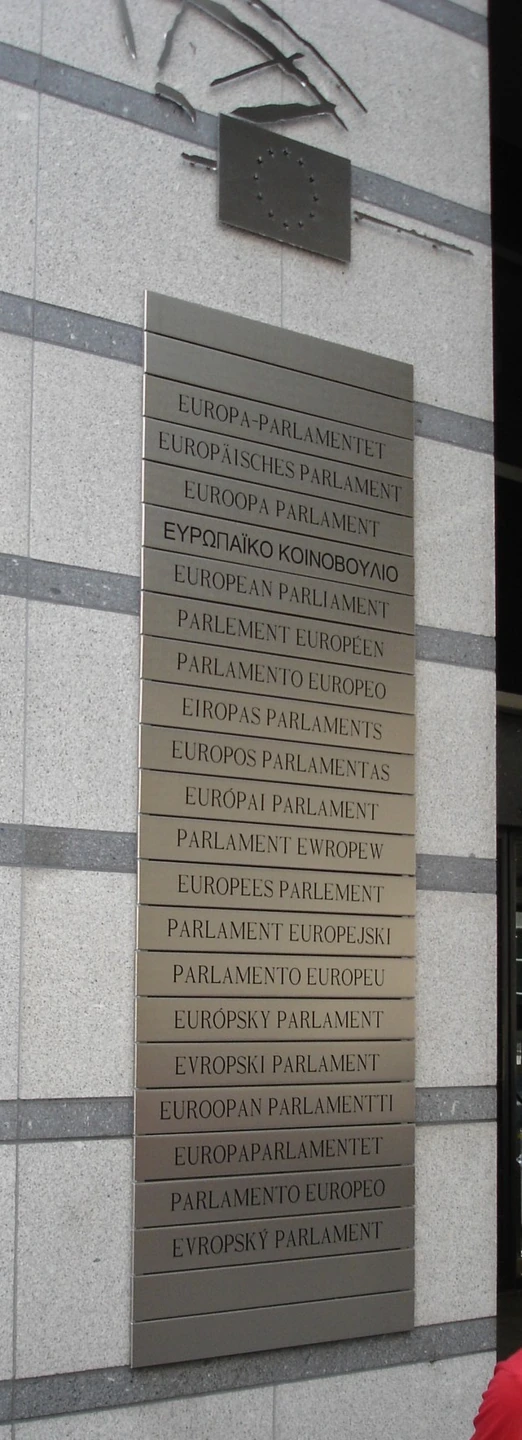
Czech on a multilingual European Parliament sign, photographed in 2006. Language identification follows the source description; not independently transcribed.
Saved in Babelbook · resized display copy. Select the image to open it independently of its source.
Nuno Nogueira · Source ↗Public domain (author dedication) ↗View the local visual field note
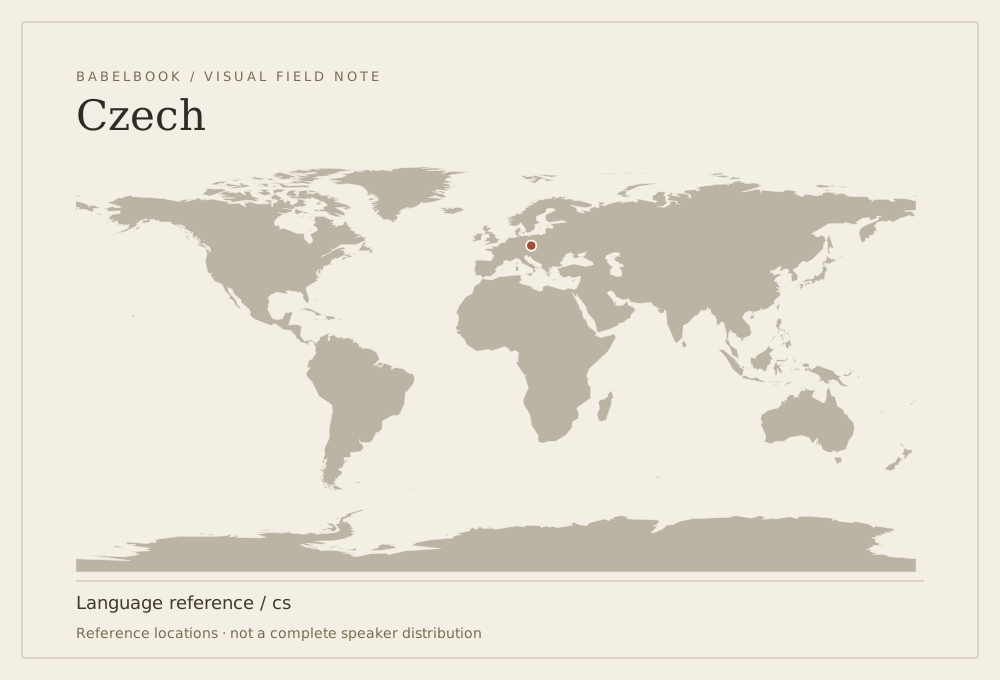
Representative reference points from Glottolog. Historical entries show reference locations, not current speakers. 1 point.
Reference & context ↗Babelbook · original editorial illustration · CC BY 4.0 · Glottolog locations; public-domain Natural Earth land
Source excerpts, selected, shortened and where noted editorially corrected from Czech language by Wikipedia contributors. Retrieved 2026-10-05. CC BY-SA 4.0. These excerpts are not an independently verified scholarly history; missing accounts are identified above.
Read further in the source
Geographic distribution
Czech is spoken by about 10 million residents of the Czech Republic. A Eurobarometer survey conducted from January to March 2012 found that the first language of 98 percent of Czech citizens was Czech, the third-highest proportion of a population in the European Union (behind Greece and Hungary). As the official language of the Czech Republic (a member of the European Union since 2004), Czech is one of the EU's official languages and the 2012 Eurobarometer survey found that Czech was the foreign language most often used in Slovakia. Economist Jonathan van Parys collected data on language knowledge in Europe for the 2012 European Day of Languages. The five countries with the greatest use of Czech were the Czech Republic (98.77 percent), Slovakia (24.86 percent), Portugal (1.93 percent), Poland (0.98 percent) and Germany (0.47 percent). Czech speakers in Slovakia primarily live in cities. Since it is a recognized minority language in Slovakia, Slovak citizens who speak only Czech may communicate with the government in their language in the same way that Slovak speakers in the Czech Republic also do.
Orthography
Czech has one of the most phonemic orthographies of all European languages. Its alphabet contains 42 graphemes, most of which correspond to individual phonemes, and only contains one digraph: ch, which follows h in the alphabet. The characters q, w and x appear only in foreign words. The háček (ˇ) is used with certain letters to form new characters: š, ž, and č, as well as ň, ě, ř, ť, and ď (the latter five uncommon outside Czech). The last two letters are sometimes written with a comma above (ʼ, an abbreviated háček) because of their height. Czech orthography has influenced the orthographies of other Balto-Slavic languages and some of its characters have been adopted for transliteration of Cyrillic. Czech orthography reflects vowel length; long vowels are indicated by an acute accent or, in the case of the character ů, a ring. Long u is usually written ú at the beginning of a word or morpheme (úroda, neúrodný) and ů in the middle, except for loanwords (skútr) or onomatopoeia (bú). Long vowels and ě are not considered separate letters in the alphabetical order. The character ó exists only in loanwords and onomatopoeia. Czech typographical features not associated with phonetics generally resemble those of most European languages that use the Latin script, including English. Proper nouns, honorifics, and the first letters of quotations are capitalized, and punctuation is typical of other Latin European languages. Ordinal numbers (1st) use a point, as in German (1.). The Czech language uses a decimal comma instead of a decimal point. When writing a long number, spaces between every three digits, including those in decimal places, may be used for better orientation in handwritten texts. The number 1,234,567.89101 may be written as 1234567,89101 or 1 234 567,891 01. In proper noun phrases (except personal and settlement names), only the first word and proper nouns inside such phrases are capitalized (Pražský hrad, Prague Castle).
Bohemian dialects
Apart from the Common Czech vernacular, there remain a variety of other Bohemian dialects, mostly in marginal rural areas. Dialect use began to weaken in the second half of the 20th century, and by the early 1990s regional dialect use was stigmatized, associated with the shrinking lower class and used in literature or other media for comedic effect. Increased travel and media availability to dialect-speaking populations has encouraged them to shift to (or add to their own dialect) Standard Czech. The Czech Statistical Office in 2003 recognized the following Bohemian dialects:
Nářečí středočeská (Central Bohemian dialects) Nářečí jihozápadočeská (Southwestern Bohemian dialects) Podskupina chodská (Chod subgroup) Podskupina doudlebská (Doudleby subgroup) Nářečí severovýchodočeská (Northeastern Bohemian dialects) Podskupina podkrknošská (Krkonoše subgroup)
Moravian dialects
The Czech dialects spoken in Moravia and Silesia are known as Moravian (moravština). In the Austro-Hungarian Empire, "Bohemian-Moravian-Slovak" was a language citizens could register as speaking (with German, Polish and several others). In the 2011 census, where respondents could optionally specify up to two first languages, 62,908 Czech citizens specified Moravian as their first language and 45,561 specified both Moravian and Czech. Beginning in the sixteenth century, some varieties of Czech resembled Slovak; the southeastern Moravian dialects form a continuum between the Czech and Slovak languages, using the same declension patterns for nouns and pronouns and the same verb conjugations as Slovak. A popular misconception holds that eastern Moravian dialects are closer to Slovak than Czech, but this is incorrect; in fact, the opposite is true, and certain dialects in far western Slovakia exhibit features more akin to standard Czech than to standard Slovak. The Czech Statistical Office in 2003 recognized the following Moravian dialects:
Nářečí českomoravská (Bohemian–Moravian dialects) Nářečí středomoravská (Central Moravian dialects) Podskupina tišnovská (Tišnov subgroup) Nářečí východomoravská (Eastern Moravian dialects) Podskupina slovácká (Moravian Slovak subgroup) Podskupina valašská (Moravian Wallachian subgroup) Nářečí slezská (Silesian dialects)