Church Slavonic
Church Slavonic is a Slavic language belonging to the South-Slavic linguistic sub-branch of Balto-Slavic languages, in the Indo-European family. It is used, both historically and in the modern era, as a liturgical language by various Eastern Christian denominations. During medieval and early modern periods, it was also used as a literary language among Slavs. It stemmed from the Old Church Slavonic (9th-10th centuries), and later developed by adopting various regional and dialectal influences from local Slavic vernaculars, thus branching into several varieties, also called recensions, or redactions. In its conservative form, that was standardized in the 18th century, it is used today by Eastern Orthodox churches in Belarus, Bosnia and Herzegovina, Bulgaria, Czechia and Slovakia, Croatia, North Macedonia, Montenegro, Poland, Russia, Serbia, Slovenia, and Ukraine. The language also appears in the services of the Russian Orthodox Church Outside of Russia, the American Carpatho-Russian Orthodox Diocese, and occasionally in the services of the Orthodox Church in America. In addition, Church Slavonic is used by some churches which consider themselves Orthodox but are not in communion with the Orthodox Church, such as the Montenegrin Orthodox Church and the Russian True Orthodox Church. The Russian Old Believers and the Co-Believers also use Church Slavonic.
Translate in Church Slavonic ↗Church Slavonic is a Slavic language belonging to the South-Slavic linguistic sub-branch of Balto-Slavic languages, in the Indo-European family. It is used, both historically and in the modern era, as a liturgical language by various Eastern Christian denominations. During medieval and early modern periods, it was also used as a literary language among Slavs. It stemmed from the Old Church Slavonic (9th-10th centuries), and later developed by adopting various regional and dialectal influences from local Slavic vernaculars, thus branching into several varieties, also called recensions, or redactions. In its conservative form, that was standardized in the 18th century, it is used today by Eastern Orthodox churches in Belarus, Bosnia and Herzegovina, Bulgaria, Czechia and Slovakia, Croatia, North Macedonia, Montenegro, Poland, Russia, Serbia, Slovenia, and Ukraine. The language also appears in the services of the Russian Orthodox Church Outside of Russia, the American Carpatho-Russian Orthodox Diocese, and occasionally in the services of the Orthodox Church in America. In addition, Church Slavonic is used by some churches which consider themselves Orthodox but are not in communion with the Orthodox Church, such as the Montenegrin Orthodox Church and the Russian True Orthodox Church. The Russian Old Believers and the Co-Believers also use Church Slavonic.
Europe
Present-day use
The captured source does not contain a separate current-use account.
Origins
The captured article does not contain a separate origins section. See the historical account and linked source.
Development
Church Slavonic represents a later stage of Old Church Slavonic, and is the continuation of the liturgical tradition introduced by two Thessalonian brothers, Saints Cyril and Methodius, in the late 9th century in Nitra, a principal town and religious and scholarly centre of Great Moravia (located in present-day Slovakia). There the first Slavic translations of the Scripture and liturgy from Koine Greek were made. After the Christianization of Bulgaria in 864, Saint Clement of Ohrid and Saint Naum of Preslav were of great importance to the Eastern Orthodox faith and the Old Church Slavonic liturgy in the First Bulgarian Empire. The success of the conversion of the Bulgarians facilitated the conversion of the East Slavs. A major event was the development of the Cyrillic script in Bulgaria at the Preslav Literary School in the 9th century. The Cyrillic script and the liturgy in Old Church Slavonic, also called Old Bulgarian, were declared official in Bulgaria in 893. By the early 12th century, individual Slavic languages started to emerge, and the liturgical language was modified in pronunciation, grammar, vocabulary, and orthography according to the local vernacular usage. These modified varieties or recensions (e.g. Serbian Church Slavonic, Russian Church Slavonic, Ukrainian Church Slavonic in Early Cyrillic script, Croatian Church Slavonic in Croatian angular Glagolitic and later in Latin script, Czech Church Slavonic, Slovak Church Slavonic in Latin script, Bulgarian Church Slavonic in Early Cyrillic and Glagolitic scripts, etc.) eventually stabilized and their regularized forms were used by the scribes to produce new translations of liturgical material from Koine Greek, or Latin in the case of Croatian Church Slavonic. Attestation of Church Slavonic traditions appear in Early Cyrillic and Glagolitic scripts. Glagolitic has nowadays fallen out of use, though both scripts were used from the earliest attested period.
Writing
Latin or customary script (catalog classification; see the source for context).
Beyond the typeface.
Signs, manuscripts, published pages and contextual photographs, with their place, period, source and reuse terms. Captions identify historical spellings, regional examples, community references and character imagery.
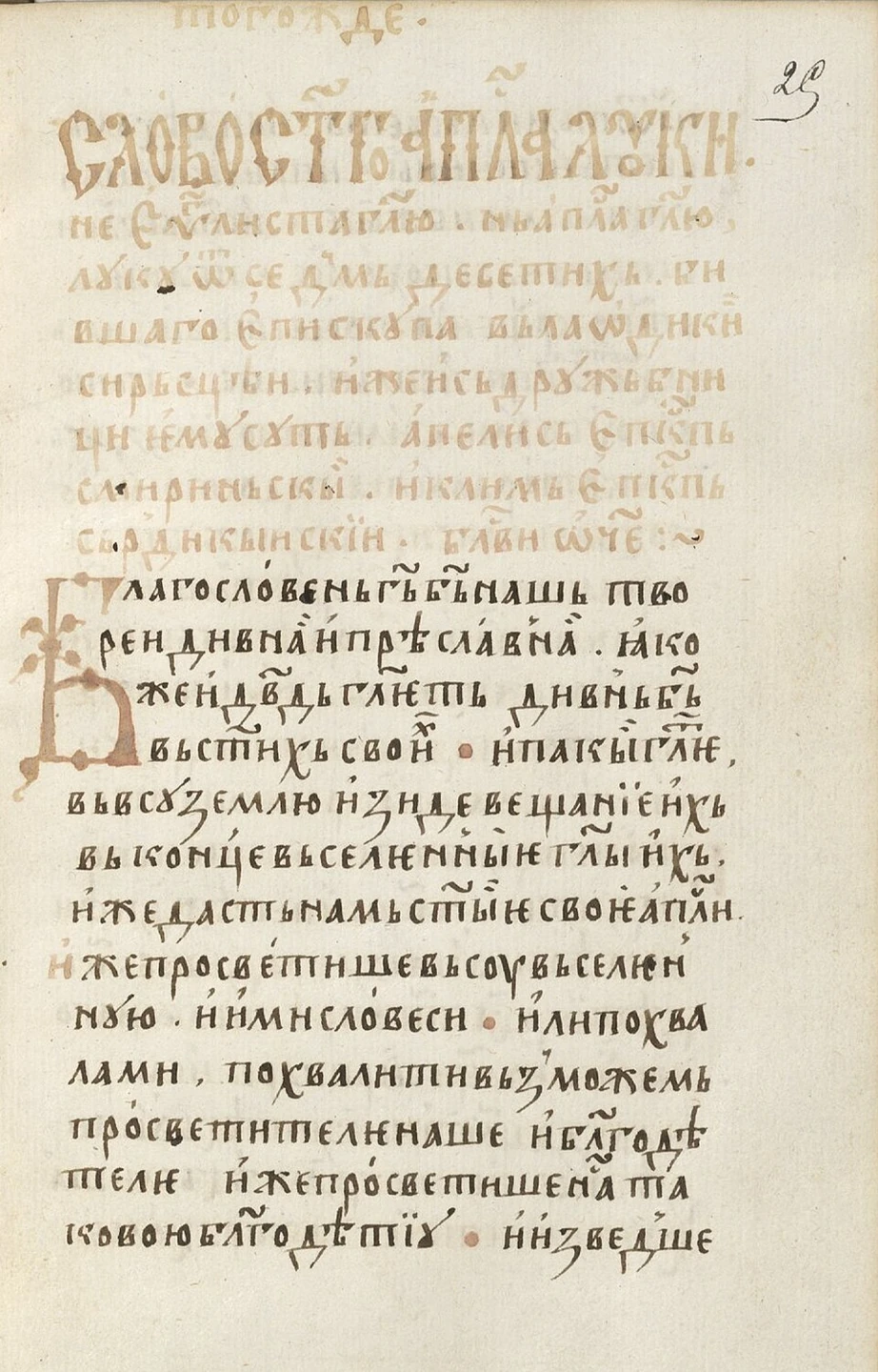
A page from Paris Slave 46, identified as Church Slavonic in its Serbian redaction.
Saved in Babelbook · resized display copy. Select the image to open it independently of its source.
Theodoret of Cyrus (original text); manuscript scribe unidentified · Source ↗Public domain ↗View the local visual field note
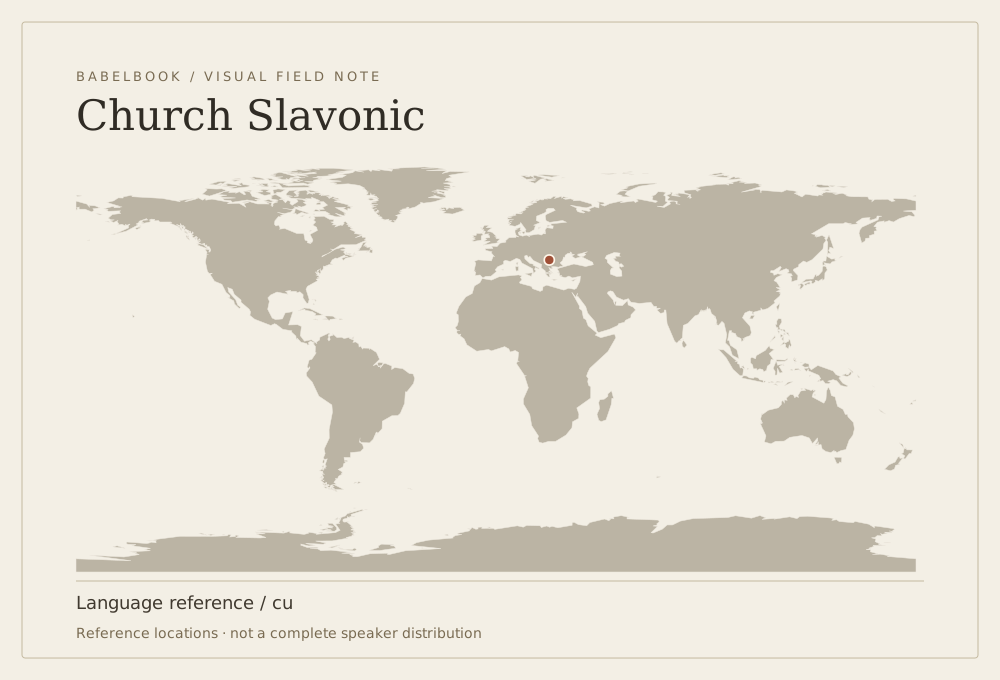
Representative reference points from Glottolog. Historical entries show reference locations, not current speakers. 1 point.
Reference & context ↗Babelbook · original editorial illustration · CC BY 4.0 · Glottolog locations; public-domain Natural Earth land
Source excerpts, selected, shortened and where noted editorially corrected from Church Slavonic by Wikipedia contributors. Retrieved 2026-10-05. CC BY-SA 4.0. These excerpts are not an independently verified scholarly history; missing accounts are identified above.