Chuvash
Chuvash (UK: CHOO-vahsh, US: chuu-VAHSH; Чӑваш чӗлхи, translit. Çăvaş çĕlhi, IPA: [tɕəʋaʃ tɕølɣi], Чӑвашла, translit. Çăvaşla, IPA: [tɕəʋaʃˈla]) is a Turkic language spoken in Volga-Ural region of Russia, primarily in the Chuvash Republic and adjacent areas. It is the only surviving member of the Oghur branch of Turkic languages, one of the two principal branches of the Turkic family. The writing system for the Chuvash language is based on the Cyrillic script, employing all of the letters used in the Russian alphabet and adding four letters of its own: Ӑ, Ӗ, Ҫ and Ӳ.
Translate in Chuvash ↗Chuvash is the native language of the Chuvash people and an official language of Chuvashia. There are contradictory numbers regarding the number of people able to speak Chuvash nowadays; some sources claim it is spoken by 1,640,000 persons in Russia and another 34,000 in other countries and that 86% of ethnic Chuvash and 8% of the people of other ethnicities living in Chuvashia claimed knowledge of Chuvash language during the 2002 census. However, other sources claim that the number of Chuvash speakers is on the decline, with a drop from 1 million speakers in 2010 to 700,000 in 2021; observers suggest this is due to Moscow having a lack of interest in preserving the language diversity in Russia. Although Chuvash is taught at schools and sometimes used in the media, it is considered endangered by the UNESCO, because Russian dominates in most spheres of life and few children learning the language are likely to become active users. A fairly significant production and publication of literature in Chuvash still continues. According to UNESCO's Index Translationum, at least 202 books translated from Chuvash were published in other languages (mostly Russian) since ca. 1979. However, as with most other languages of the former USSR, most of the translation activity took place before the dissolution of the USSR: out of the 202 translations, 170 books were published in the USSR and just 17, in the post-1991 Russia (mostly, in the 1990s). A similar situation takes place with the translation of books from other languages (mostly Russian) into Chuvash (the total of 175 titles published since ca. 1979, but just 18 of them in post-1991 Russia).
Central Asia
Present-day use
The captured source does not contain a separate current-use account.
Origins
The captured article does not contain a separate origins section. See the historical account and linked source.
Development
The captured article does not contain a distinct historical account. No chronology has been invented.
Writing
Cyrillic (catalog classification; see the source for context).
Beyond the typeface.
Signs, manuscripts, published pages and contextual photographs, with their place, period, source and reuse terms. Captions identify historical spellings, regional examples, community references and character imagery.
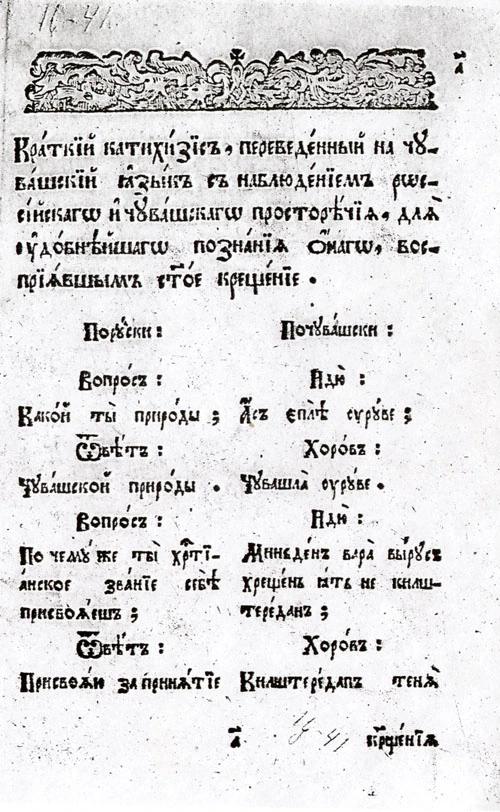
A page identified by Commons as belonging to a Chuvash-language catechism published in 1800.
Saved in Babelbook · resized display copy. Select the image to open it independently of its source.
Unidentified author · Source ↗Public domain ↗View the local visual field note
Representative reference points from Glottolog. Historical entries show reference locations, not current speakers. 1 point.
Reference & context ↗Babelbook · original editorial illustration · CC BY 4.0 · Glottolog locations; public-domain Natural Earth land
Source excerpts, selected, shortened and where noted editorially corrected from Chuvash language by Wikipedia contributors. Retrieved 2026-10-05. CC BY-SA 4.0. These excerpts are not an independently verified scholarly history; missing accounts are identified above.
Read further in the source
Distribution
Chuvash is the native language of the Chuvash people and an official language of Chuvashia. There are contradictory numbers regarding the number of people able to speak Chuvash nowadays; some sources claim it is spoken by 1,640,000 persons in Russia and another 34,000 in other countries and that 86% of ethnic Chuvash and 8% of the people of other ethnicities living in Chuvashia claimed knowledge of Chuvash language during the 2002 census. However, other sources claim that the number of Chuvash speakers is on the decline, with a drop from 1 million speakers in 2010 to 700,000 in 2021; observers suggest this is due to Moscow having a lack of interest in preserving the language diversity in Russia. Although Chuvash is taught at schools and sometimes used in the media, it is considered endangered by the UNESCO, because Russian dominates in most spheres of life and few children learning the language are likely to become active users. A fairly significant production and publication of literature in Chuvash still continues. According to UNESCO's Index Translationum, at least 202 books translated from Chuvash were published in other languages (mostly Russian) since ca. 1979. However, as with most other languages of the former USSR, most of the translation activity took place before the dissolution of the USSR: out of the 202 translations, 170 books were published in the USSR and just 17, in the post-1991 Russia (mostly, in the 1990s). A similar situation takes place with the translation of books from other languages (mostly Russian) into Chuvash (the total of 175 titles published since ca. 1979, but just 18 of them in post-1991 Russia).
Dialects
The linguistic landscape of the Chuvash language is quite homogeneous, and the differences between dialects are insignificant. Currently, the differences between dialects becoming more and more leveled out. Researchers distinguish three main dialect groups, which can be divided further into sub-dialects:
Upper dialect (Turi, Viryal) - upstream of the Sura, preserves the /o/ sound in words like ot "horse" Subdialects: a) Sundyrsky; b) Morgaussko-Yadrinsky; c) Krasnochetaysky; d) Cheboksary; e) Kalininsko-Alikovsky Middle dialect (mixed, transitional); Subdialects: a) Malocivilsky; b) Urmarsky; c) civil-marposadsky Lower dialect (Anatri) - downstream of the Sura, changes the /o/ sound to /u/ in words like ut "horse" Subdialects: a) Buin-Simbirsk; b) Nurlatsky (prichemshanye) The Malokarachinsky dialect is designated as occupying a separate position. The literary language is based on both the Lower and Upper dialects. Both Tatar and the neighbouring Uralic languages such as Mari have influenced the Chuvash language, as have Russian, Arabic and Persian, which have all added many words to the Chuvash lexicon. Phonetic differences: a) All words of the Upper dialect (except exc. Kalinin-Alikov subgroup) in the initial syllable, instead of the "lower" sound -U- is used -O- for example:
Turi: por, olttă, toprăm – Anatri: pur, ulttă, tuprăm (English: 'yes', 'six', 'found') b) In the Upper dialect in the Sundyr sub-dialect, instead of the sound -ü- (used in all other dialects), the sound -ö- is used, which is a correlative soft pair of the posterior -o-, for example:
Turi: pӧrt, tӧrt, šӧrpe — Anatri: pürt, türt, šürpe (English: 'hut', 'back', 'broth') с) In the Upper dialect (in most sub-dialects) the loss of the sound -j- before the sonorant -l-, -n-, -r- and stop -t- is characterized, which in turn entails palatalization of these consonants, for example:
Turi: mar'a, sul'l'a — Anatri: majra, sujla (English: 'Russian woman', 'choose') d) In the Upper dialect (for most sub-dialects), gemination of intervocalic consonants is characteristic, as in the Finnish language, for example:
Turi: tottăr, ĕssĕr, kokkăr – Anatri: tutăr, üsĕr, kukăr (English: 'shawl', 'drunk', 'crooked') In general, gemination itself is the norm for the Chuvash language, since many historically root words in both dialects contain gemination, for example: anne (mather), atte (father), piççe (brother), appa (sister), kukka (uncle), pĕrre (one), ikkĕ (two), vişşĕ (three), tăvattă (four), pillĕk (five), ulttă (six), şiççĕ (seven), sakkăr (eight), tăhhăr (nine), vunnă (ten), etc. Some linguists are inclined to assume that this is the influence of the Volga Finns at the turn of the 7th century when the ancestors of the Chuvash moved to the Volga, there are those who disagree with this statement. In one of the subgroups of the Trans-Kama Chuvash, in the same words there is no gemination at all, for example, the word father is pronounced as Adi, and mother as Ani, their counting looks like this: pĕr, ik, viş, tvat, pül, ulta, şiç, sagăr, tăgăr, vun - but many scientists assume that this is a consequence of the influence of the Tatar language. They also have many words in the Tatar style, the word “hare - kuşana” (tat.kuyan) is “mulkaç” for everyone, “pancakes - kuymak” for the rest is ikerçĕ, “cat - pĕşi” for the rest is “saş”, etc. e) In the Middle and Upper dialects there are rounded vowels -ă°-, -ĕ°- (pronounced with the lips rounded and slightly pulled forward). In the Lower dialect they are absent and correspond to the standard sounds -ă-, -ĕ-. f) Consonantism is distinguished by the pronunciation of the affricate sound -ç-. In the Upper and Middle dialects, the sound -ç- is almost no different from the pronunciation of the Russian affricate; in the Lower dialect it is heard almost like a soft -ç-, as in the Tatar language. Morphological differences: a) In Upper Chuvash there are synharmonic variants of the plural affix -sam/-sem, and in Lower Chuvash only -sem. For example:
Turi and Anatri: ĕnesem, çeçeksem (English: 'cows', 'flowers') but: Turi lašasam, surăhsam, şaramsam – Anatri: lašasem, surăhsem, şeremsem (English: 'horses', 'sheep', 'meadows') b) In the Upper (in most sub-dialects) the affix of the possessive case is -yăn (-yĕn), the dative case is -ya (-ye), while in the Lower, -năn (-nĕn, -n), -na (-ne). For example:
Turi: lašayăn, ĕneyĕn, lašaya, ĕneya, ĕneye – Anatri: lašan(ăn), ĕnen(ĕn), lašana, ĕnene c) in the Upper dialect, affixes of belonging, with the exception of the 3rd person affix -i (-ĕ), have almost fallen out of use or are used extremely rarely. In the latter case, the 2nd person affix -u (-ü) of the Upper dialect usually corresponds to -ă (-ĕ) in the Lower dialect;
Turi: san puşu, san hĕrü — Anatri: san puşă, san hĕrĕ (English: 'your head', 'your daughter') There is also a mixed type d) In the upper dialect, the gemination of the temporal index -t- and -p- is used in the affixes of the 2nd person plural of the verb of the present tense, for example:
Turi: esĕr vulattăr, epĕr pırappăr — Anatri: esir vulatăr, epir pırappăr (English: 'are you reading', 'we are going') The influence of Russian: we are going < epir pıratpăr There is also a mixed type, as already mentioned above. e) In the Upper dialect, the affix of the possibility of verbs -ay (-ey), due to contraction, monophthongized to -i:
Turi: kalimarăm, pĕlimarăm ~ pĕlimerĕm — Anatri: kalaymarăm, pĕleymerĕm (English: 'couldn't tell', 'couldn't find out') f) In the upper dialect, the synharmonic variant of the interrogative particle -i is common, in the dialects of the Lower dialect, variants -a (-e) are used:
Turi: esĕ kayrăn-i? esĕ pĕletĕn-i / es pĕletni? – Anatri: esĕ kayrăn-a? esĕ pĕletĕn-e? es pĕletnĕ? (English: 'Have you left?' 'Do you know?') g) in the upper dialect, individual phrases turn into a complex word by shortening (contraction):
Turi: ulmuşşi (olmaşşi), şatmari – Anatri: ulma yıvăşşi / yıvăşĕ, şatma avri (English: 'apple tree', 'frying pan handle') Turi: hălhanki, upăte, pişĕhe – Anatri: hălha şakki, upa-etem, pilĕk şihhi (English: 'earring' ("ear pendant"), 'monkey' ("bear man"), 'belt' ("lower back tie") Syntactic differences: a) In the Upper dialect (in most dialects), the adverbial participle -sa (-se) performs the function of a simple predicate, which is not allowed in the Middle and Lower dialects:
Turi: Ep şırsa — Anatri: Epĕ şırtăm (English: 'I wrote') b) In the Upper dialect, analytical constructions are used instead of a synthetic one in the Lower dialect:
Turi: Apat şima kilĕr, Kaşiť şinçe şırnă – Anatri: Apata kilĕr, Xaşatra şırnă (English: 'Go to lunch', 'It says in the newspaper') There is also a mixed type. Other lexical differences: Another feature between the upper and lower dialects:
Turi: Epĕr, Esĕr – Anatri: Epir, Esir (English: 'We', 'you') There are also those lower Chuvash (living in Kama) with a biting dialect who use the riding version of Epĕr, Esĕr. It has been established that the correct historical form is the pronunciation of Epĕr, Esĕr, A comparison with the Tatar Turkic languages, which are close to the Chuvash language, determined historical justice. Ep / Epĕ - I, Epĕ+r - We Es / Esĕ - You, Esĕ+r - You Affixes -ĕr/-ăr are converted from singular to plural: Epĕ şitrĕm - Ep+ĕr şitrĕm+ĕr / I got there - We've reached it Epĕ şırtăt - Ep+ĕr şırtăm+ăr / I wrote - we wrote Ham vularăm - Ham+ăr vularăm+ăr / I read it - we read it There is no "+ir" suffix in the Chuvash language so this is a big mistake. No one says "kiltĕm+ir", vularăm+ir", çitrĕm+ir". Don't say "Hamir turăm+ir". There is a dialect with pronunciation "Ep+ĕr+ĕn" - instead of "Pir+ĕn" (our), and "Es+ĕr+ĕn" - instead of "Sir+ĕn" (your) on this we can assume that their pronunciation was historical, because the structure is more correct, but because of what evolution it transformed into "pirĕn/sirĕn". Ep+ĕr pĕr+le - We are one Es+ĕr ik+sĕr - The two of you There are also very different words.