Welsh
Welsh (Cymraeg [kəmˈraːiɡ] or y Gymraeg [ə ɡəmˈraːiɡ]) is a Celtic language of the Brittonic subgroup that is native to the Welsh people. Welsh is spoken natively in Wales by about 18% of the population, by some in England, and in Y Wladfa (the Welsh colony in Chubut Province, Argentina). Historically, it has also been known in English as Cambrian, Cambric and Cymric. The Welsh Language (Wales) Measure 2011 gave the Welsh language official status in Wales. Welsh and English are de jure official languages of the Senedd (the Welsh parliament). According to the 2021 census, 538,300 usual residents in Wales aged three or over (17.8% of the population) were able to speak Welsh, while just over a quarter (25.1%) reported having some Welsh language skills. Other surveys have produced higher figures: a survey in 2022–2023 found that 34% of people aged 16 or over could speak Welsh (of whom 18 per cent said they could speak Welsh, and 16 per cent said they had some Welsh speaking ability). In March 2026, other survey data estimated that 843,700 people (27.3%) aged three or over in Wales could speak Welsh. Almost half of all Welsh speakers consider themselves fluent, while 20% are able to speak a fair amount. 56% of Welsh speakers speak the language daily, and 19% speak the language weekly.
Translate in Welsh ↗Calls for the Welsh language to be granted official status grew with the establishment of the nationalist political party Plaid Cymru in 1925, the establishment of the Welsh Language Society in 1962 and the rise of Welsh nationalism in the later 20th century. Of the six living Celtic languages (including two revived), Welsh has the highest number of native speakers who use the language on a daily basis, and it is the Celtic language which is considered the least endangered by UNESCO. The Welsh Language Act 1993 and the Government of Wales Act 1998 provide that the Welsh and English languages be treated equally in the public sector, as far as is reasonable and practicable. Each public body is required to prepare for approval a Welsh Language Scheme, which indicates its commitment to the equality of treatment principle. This is sent out in draft form for public consultation for a three-month period, whereupon comments on it may be incorporated into a final version. It requires the final approval of the now defunct Welsh Language Board (Bwrdd yr Iaith Gymraeg). Thereafter, the public body is charged with implementing and fulfilling its obligations under the Welsh Language Scheme. The list of other public bodies which have to prepare Schemes could be added to by initially the Secretary of State for Wales, from 1993 to 1997, by way of statutory instrument. Subsequent to the forming of the National Assembly for Wales in 1997, the Government Minister responsible for the Welsh language can and has passed statutory instruments naming public bodies who have to prepare Schemes. Neither the 1993 Act nor secondary legislation made under it covers the private sector, although some organisations, notably banks and some railway companies, provide some of their information in Welsh. On 7 December 2010, the Welsh Assembly unanimously approved a set of measures to develop the use of the Welsh language within Wales.
Europe
Present-day use
The Bible translations into Welsh helped maintain the use of Welsh in daily life, and standardised spelling. The New Testament was translated by William Salesbury in 1567, and the complete Bible by William Morgan in 1588. Modern Welsh is subdivided into Early Modern Welsh and Late Modern Welsh. Early Modern Welsh ran from the 15th century through to the end of the 16th century, and the Late Modern Welsh period roughly dates from the 16th century onwards. Contemporary Welsh differs greatly from the Welsh of the 16th century, but they are similar enough for a fluent Welsh speaker to have little trouble understanding it. During the Modern Welsh period, there has been a decline in the popularity of the Welsh language: the number of Welsh speakers declined to the point at which there was concern that the language would become extinct. During industrialisation in the late 19th century, immigrants from England led to the decline in Welsh speakers particularly in the South Wales Valleys. Welsh government processes and legislation have worked to increase the proliferation of the Welsh language, for example through education. Calls for the Welsh language to be granted official status grew with the establishment of the nationalist political party Plaid Cymru in 1925, the establishment of the Welsh Language Society in 1962 and the rise of Welsh nationalism in the later 20th century. Of the six living Celtic languages (including two revived), Welsh has the highest number of native speakers who use the language on a daily basis, and it is the Celtic language which is considered the least endangered by UNESCO. The Welsh Language Act 1993 and the Government of Wales Act 1998 provide that the Welsh and English languages be treated equally in the public sector, as far as is reasonable and practicable. Each public body is required to prepare for approval a Welsh Language Scheme, which indicates its commitment to the equality of treatment principle.
Origins
Welsh evolved from Common Brittonic, the Celtic language spoken by the ancient Celtic Britons. Classified as Insular Celtic, the British language probably arrived in Britain during the Bronze Age or Iron Age and was probably spoken throughout the island south of the Firth of Forth. During the Early Middle Ages the British language began to fragment due to increased dialect differentiation, thus evolving into Welsh and the other Brittonic languages. It is not clear when Welsh became distinct. Linguist Kenneth H. Jackson has suggested that the evolution in syllabic structure and sound pattern was complete by around 550 AD, and labelled the period between then and about 800 AD "Primitive Welsh". This Primitive Welsh may have been spoken in both Wales and the Hen Ogledd ('Old North') – the Brittonic-speaking areas of what are now northern England and southern Scotland – and therefore may have been the ancestor of Cumbric as well as Welsh. Jackson, however, believed that the two varieties were already distinct by that time. The earliest Welsh poetry – that attributed to the Cynfeirdd or "Early Poets" – is generally considered to date to the Primitive Welsh period. However, much of this poetry was supposedly composed in the Hen Ogledd, raising further questions about the dating of the material and language in which it was originally composed. This discretion stems from the fact that Cumbric was widely believed to have been the language used in Hen Ogledd. An 8th-century inscription in Tywyn shows the language already dropping inflections in the declension of nouns. Janet Davies proposed that the origins of the Welsh language were much less definite; in The Welsh Language: A History, she proposes that Welsh may have been around even earlier than 600 AD. This is evidenced by the dropping of final syllables from Brittonic: *bardos 'poet' became bardd, and *abona 'river' became afon.
Development
The language of the Welsh developed from the language of Britons. The emergence of Welsh was not instantaneous and clearly identifiable. Instead, the shift occurred over a long period, with some historians claiming that it had happened by as late as the 9th century, with a watershed moment being that proposed by linguist Kenneth H. Jackson, the Battle of Dyrham, a military battle between the West Saxons and the Britons in 577 AD, which split the South Western British from direct overland contact with the Welsh. Four periods are identified in the history of Welsh, with rather indistinct boundaries: Primitive Welsh, Old Welsh, Middle Welsh, and Modern Welsh. The period immediately following the language's emergence is sometimes referred to as Primitive Welsh, followed by the Old Welsh period – which is generally considered to stretch from the beginning of the 9th century to sometime during the 12th century. The Middle Welsh period is considered to have lasted from then until the 14th century, when the Modern Welsh period began, which in turn is divided into Early and Late Modern Welsh. Late Modern Welsh, which is still the form spoken today started with William Morgan's 1588 translation of the Bible, and is still readable to most Welsh readers today. This Bible was the first Welsh translation of the whole Bible, and due to the Protestant Reformation in Wales emphasising literacy and vernacular reading of the Bible this standardised the language across Wales. The first Welsh dictionary was the Antiquae linguae Britannicae as a Welsh-Latin dictionary published in 1632 by John Davies, who was an assistant in translating the 1588 Bible.
Writing
Welsh is written in a Latin alphabet of 29 letters, of which eight are digraphs treated as single letters for collation, for example fy comes before ffrwyth in the dictionary: a, b, c, ch, d, dd, e, f, ff, g, ng, h, i, j, l, ll, m, n, o, p, ph, r, rh, s, t, th, u, w, y In contrast to English practice, ⟨w⟩ is considered a vowel letter in Welsh along with ⟨a, e, i, o, u, y⟩. ⟨j⟩ was not used traditionally but is now used in many everyday words borrowed from English such as jam ('jam'), jôc ('joke') and garej ('garage'). ⟨k, q, v, x, z⟩ are used in some technical terms such as kilogram, volt and zero but in all cases can be, and often are, replaced by Welsh letters (same pronunciation): cilogram, folt and sero. ⟨k⟩ was in common use until the 16th century but was dropped at the time of the publication of the New Testament in Welsh, as William Salesbury explained: "⟨c⟩ for ⟨k⟩, because the printers have not so many as the Welsh requireth". This change was not popular at the time. The most common diacritic is the circumflex (called to bach in Welsh, lit. 'little roof'), which usually disambiguates long vowels, most often in the case of homographs, where the vowel is short in one word and long in the other: e.g. man ('place') v. mân ('fine, small').
Beyond the typeface.
Signs, manuscripts, published pages and contextual photographs, with their place, period, source and reuse terms. Captions identify historical spellings, regional examples, community references and character imagery.
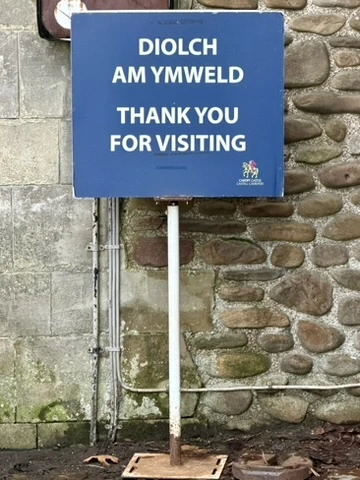
Welsh and English sign thanking visitors to Cardiff Castle. Language identification follows the source description; not independently transcribed.
Saved in Babelbook · resized display copy. Select the image to open it independently of its source.
Sartma · Source ↗CC BY 4.0 ↗View the local visual field note
Representative reference points from Glottolog. Historical entries show reference locations, not current speakers. 1 point.
Reference & context ↗Babelbook · original editorial illustration · CC BY 4.0 · Glottolog locations; public-domain Natural Earth land
Source excerpts, selected, shortened and where noted editorially corrected from Welsh language by Wikipedia contributors. Retrieved 2026-10-05. CC BY-SA 4.0. These excerpts are not an independently verified scholarly history; missing accounts are identified above.
Read further in the source
History
The language of the Welsh developed from the language of Britons. The emergence of Welsh was not instantaneous and clearly identifiable. Instead, the shift occurred over a long period, with some historians claiming that it had happened by as late as the 9th century, with a watershed moment being that proposed by linguist Kenneth H. Jackson, the Battle of Dyrham, a military battle between the West Saxons and the Britons in 577 AD, which split the South Western British from direct overland contact with the Welsh. Four periods are identified in the history of Welsh, with rather indistinct boundaries: Primitive Welsh, Old Welsh, Middle Welsh, and Modern Welsh. The period immediately following the language's emergence is sometimes referred to as Primitive Welsh, followed by the Old Welsh period – which is generally considered to stretch from the beginning of the 9th century to sometime during the 12th century. The Middle Welsh period is considered to have lasted from then until the 14th century, when the Modern Welsh period began, which in turn is divided into Early and Late Modern Welsh. Late Modern Welsh, which is still the form spoken today started with William Morgan's 1588 translation of the Bible, and is still readable to most Welsh readers today. This Bible was the first Welsh translation of the whole Bible, and due to the Protestant Reformation in Wales emphasising literacy and vernacular reading of the Bible this standardised the language across Wales. The first Welsh dictionary was the Antiquae linguae Britannicae as a Welsh-Latin dictionary published in 1632 by John Davies, who was an assistant in translating the 1588 Bible. The first Welsh-English dictionary was published in fifteen parts between 1770 and 1794 by John Walters based on the work of William Gambold. The word Welsh is a descendant, via Old English wealh, wielisc, of the Proto-Germanic word *Walhaz, which was derived from the name of the Celtic people known to the Romans as Volcae and which came to refer to speakers of Celtic languages, and then indiscriminately to the people of the Western Roman Empire. In Old English the term went through semantic narrowing, coming to refer to either Britons in particular or, in some contexts, slaves. The plural form Wēalas evolved into the name for their territory, Wales. The modern names for various Romance-speaking people in Continental Europe (e.g. Walloons, Valaisans, Vlachs/Wallachians, and Włosi, the Polish name for Italians) have a similar etymology. The Welsh term for the language, Cymraeg, descends from the Brythonic word combrogi, meaning 'compatriots' or 'fellow countrymen'.
Origins
Welsh evolved from Common Brittonic, the Celtic language spoken by the ancient Celtic Britons. Classified as Insular Celtic, the British language probably arrived in Britain during the Bronze Age or Iron Age and was probably spoken throughout the island south of the Firth of Forth. During the Early Middle Ages the British language began to fragment due to increased dialect differentiation, thus evolving into Welsh and the other Brittonic languages. It is not clear when Welsh became distinct. Linguist Kenneth H. Jackson has suggested that the evolution in syllabic structure and sound pattern was complete by around 550 AD, and labelled the period between then and about 800 AD "Primitive Welsh". This Primitive Welsh may have been spoken in both Wales and the Hen Ogledd ('Old North') – the Brittonic-speaking areas of what are now northern England and southern Scotland – and therefore may have been the ancestor of Cumbric as well as Welsh. Jackson, however, believed that the two varieties were already distinct by that time. The earliest Welsh poetry – that attributed to the Cynfeirdd or "Early Poets" – is generally considered to date to the Primitive Welsh period. However, much of this poetry was supposedly composed in the Hen Ogledd, raising further questions about the dating of the material and language in which it was originally composed. This discretion stems from the fact that Cumbric was widely believed to have been the language used in Hen Ogledd. An 8th-century inscription in Tywyn shows the language already dropping inflections in the declension of nouns. Janet Davies proposed that the origins of the Welsh language were much less definite; in The Welsh Language: A History, she proposes that Welsh may have been around even earlier than 600 AD. This is evidenced by the dropping of final syllables from Brittonic: *bardos 'poet' became bardd, and *abona 'river' became afon. Though both Davies and Jackson cite minor changes in syllable structure and sounds as evidence for the creation of Old Welsh, Davies suggests it may be more appropriate to refer to this derivative language as Lingua Britannica rather than characterising it as a new language altogether.
Dialects
There is a great deal of variation among Welsh dialects in terms of vocabulary, grammar, and pronunciation. For example: consider the question "Do you want a cuppa [a cup of tea]?" In Gwynedd, this would typically be Dach chi isio paned? while in the south of Dyfed one would be more likely to hear Ych chi'n moyn dishgled? (though, in other parts of the South, one could hear Ych chi isie paned? as well, among other possibilities). An example of a pronunciation difference is the tendency in some southern dialects to palatalise the letter "s", e.g. mis (Welsh for 'month'), usually pronounced IPA: [miːs], but as IPA: [miːʃ] in parts of the south. This normally occurs next to a high front vowel like /i/, although exceptions include the pronunciation of sut "how" as IPA: [ʃʊd] in the southern dialects (compared with northern IPA: [sɨt]).
The four traditional dialects
Although modern understanding often splits Welsh into northern (Gogledd) and southern (De) 'dialects', the traditional classification of four Welsh dialects remains the most academically useful:
Gwyndodeg, the Gwynedd dialect Powyseg, the Powys dialect Dyfedeg, the Dyfed dialect Gwenhwyseg, the dialect of Gwent and Morgannwg A fifth dialect is Patagonian Welsh, which has developed since the start of Y Wladfa (the Welsh settlement in Argentina) in 1865; it includes Spanish loanwords and terms for local features, with a survey in the 1970s showing that the language in Patagonia is consistent throughout the lower Chubut Valley and in the Andes. Subdialects exist within the main dialects (such as the Cofi dialect). The 1989 book Cymraeg, Cymrâg, Cymrêg: Cyflwyno'r Tafodieithoedd (Welsh for 'Welsh, Welsh, Welsh: Introducing the Dialects') was accompanied by a cassette containing recordings of 14 different speakers demonstrating aspects of different regional dialects. The book also refers to the earlier Linguistic Geography of Wales (1973) as describing six different regions which could be identified as having words specific to those regions. In the 1970s, there was an attempt to standardise the Welsh language by teaching Cymraeg Byw ('Living Welsh') – a colloquially based generic form of Welsh, but the attempt largely failed because it did not encompass the regional differences used by Welsh speakers.
Legal status
Calls for the Welsh language to be granted official status grew with the establishment of the nationalist political party Plaid Cymru in 1925, the establishment of the Welsh Language Society in 1962 and the rise of Welsh nationalism in the later 20th century. Of the six living Celtic languages (including two revived), Welsh has the highest number of native speakers who use the language on a daily basis, and it is the Celtic language which is considered the least endangered by UNESCO. The Welsh Language Act 1993 and the Government of Wales Act 1998 provide that the Welsh and English languages be treated equally in the public sector, as far as is reasonable and practicable. Each public body is required to prepare for approval a Welsh Language Scheme, which indicates its commitment to the equality of treatment principle. This is sent out in draft form for public consultation for a three-month period, whereupon comments on it may be incorporated into a final version. It requires the final approval of the now defunct Welsh Language Board (Bwrdd yr Iaith Gymraeg). Thereafter, the public body is charged with implementing and fulfilling its obligations under the Welsh Language Scheme. The list of other public bodies which have to prepare Schemes could be added to by initially the Secretary of State for Wales, from 1993 to 1997, by way of statutory instrument. Subsequent to the forming of the National Assembly for Wales in 1997, the Government Minister responsible for the Welsh language can and has passed statutory instruments naming public bodies who have to prepare Schemes. Neither the 1993 Act nor secondary legislation made under it covers the private sector, although some organisations, notably banks and some railway companies, provide some of their information in Welsh. On 7 December 2010, the Welsh Assembly unanimously approved a set of measures to develop the use of the Welsh language within Wales. On 9 February 2011 this measure, the Welsh Language (Wales) Measure 2011, was passed and received Royal Assent, thus making the Welsh language an officially recognised language within Wales. The measure:
confirmed the official status of the Welsh language created a new system of placing duties on bodies to provide services through the medium of Welsh created a Welsh Language Commissioner with strong enforcement powers to protect the rights of Welsh-speaking people to access services through the medium of Welsh established a Welsh Language Tribunal gave individuals and bodies the right to appeal decisions made in relation to the provision of services through the medium of Welsh created a Welsh Language Partnership Council to advise Government on its strategy in relation to the Welsh language allowed for an official investigation by the Welsh Language Commissioner of instances where there is an attempt to interfere with the freedom of Welsh-speaking people to use the language with one another The measure required public bodies and some private companies to provide services in Welsh. The Welsh government's Minister for Heritage at the time, Alun Ffred Jones, said, "The Welsh language is a source of great pride for the people of Wales, whether they speak it or not, and I am delighted that this measure has now become law. I am very proud to have steered legislation through the Assembly which confirms the official status of the Welsh language; which creates a strong advocate for Welsh speakers and will improve the quality and quantity of services available through the medium of Welsh. I believe that everyone who wants to access services in the Welsh language should be able to do so, and that is what this government has worked towards. This legislation is an important and historic step forward for the language, its speakers and for the nation." The measure was not welcomed warmly by all supporters: Bethan Williams, chairman of the Welsh Language Society, gave a mixed response to the move, saying,Through this measure we have won official status for the language and that has been warmly welcomed. But there was a core principle missing in the law passed by the Assembly before Christmas. It doesn't give language rights to the people of Wales in every aspect of their lives. Despite that, an amendment to that effect was supported by 18 Assembly Members from three different parties, and that was a significant step forward.On 5 October 2011, Meri Huws, Chair of the Welsh Language Board, was appointed the new Welsh Language Commissioner. She released a statement that she was "delighted" to have been appointed to the "hugely important role", adding, "I look forward to working with the Welsh Government and organisations in Wales in developing the new system of standards. I will look to build on the good work that has been done by the Welsh Language Board and others to strengthen the Welsh language and ensure that it continues to thrive." First Minister Carwyn Jones said that Huws would act as a champion for the Welsh language, though some had concerns over her appointment: Plaid Cymru spokeswoman Bethan Jenkins said, "I have concerns about the transition from Meri Huws's role from the Welsh Language Board to the language commissioner, and I will be asking the Welsh government how this will be successfully managed. We must be sure that there is no conflict of interest, and that the Welsh Language Commissioner can demonstrate how she will offer the required fresh approach to this new role." Huws started her role as the Welsh Language Commissioner on 1 April 2012. Local councils and the Senedd use Welsh, issuing Welsh versions of their literature, to varying degrees.
Road signs in Wales are in Welsh and English. Prior to 2016, the choice of which language to display first was the responsibility of the local council. Since then, as part of the Welsh Language (Wales) Measure 2011, all new signs have Welsh displayed first. There have been incidents of one of the languages being vandalised, which may be considered a hate crime. Since 2000, the teaching of Welsh has been compulsory in all schools in Wales up to age 16; this has had an effect in stabilising and reversing the decline in the language. Text on UK coins tends to be in English and Latin. However, a Welsh-language edge inscription was used on pound coins dated 1985, 1990 and 1995, which circulated in all parts of the UK prior to their 2017 withdrawal. The wording is Pleidiol wyf i'm gwlad (Welsh for 'True am I to my country'), and derives from the national anthem of Wales, "Hen Wlad Fy Nhadau". Banknotes used in Wales are in English only, as these are issued by the Bank of England for both England and Wales. Some shops employ bilingual signage. Welsh sometimes appears on product packaging or instructions. The UK government has ratified the European Charter for Regional or Minority Languages in respect of Welsh.
The language has greatly increased its prominence since the creation of the television channel S4C in November 1982, which until digital switchover in 2010 broadcast 70 per cent of Channel 4's programming along with a majority of Welsh language shows during peak viewing hours. The all-Welsh-language digital station S4C Digidol is available throughout Europe on satellite and online throughout the UK. Since the digital switchover was completed in South Wales on 31 March 2010, S4C Digidol became the main broadcasting channel and fully in Welsh. The main evening television news provided by the BBC in Welsh is available for download. There is also a Welsh-language radio station, BBC Radio Cymru, which was launched in 1977. The only Welsh-language national newspaper Y Cymro (The Welshman) was published weekly until 2017, and monthly thereafter, following a change in ownership. There is no daily newspaper in Welsh. A daily newspaper called Y Byd (The World) was scheduled to be launched on 3 March 2008, but was scrapped, owing to insufficient sales of subscriptions and the Welsh Government offering only one third of the £600,000 public funding it needed. There is a Welsh-language online news service which publishes news stories in Welsh called Golwg360 ('360 [degree] view'). As of March 2021, there were 58 local Welsh language community newspapers, known as Papurau Bro, in circulation.
Orthography
Welsh is written in a Latin alphabet of 29 letters, of which eight are digraphs treated as single letters for collation, for example fy comes before ffrwyth in the dictionary:
a, b, c, ch, d, dd, e, f, ff, g, ng, h, i, j, l, ll, m, n, o, p, ph, r, rh, s, t, th, u, w, y In contrast to English practice, ⟨w⟩ is considered a vowel letter in Welsh along with ⟨a, e, i, o, u, y⟩. ⟨j⟩ was not used traditionally but is now used in many everyday words borrowed from English such as jam ('jam'), jôc ('joke') and garej ('garage'). ⟨k, q, v, x, z⟩ are used in some technical terms such as kilogram, volt and zero but in all cases can be, and often are, replaced by Welsh letters (same pronunciation): cilogram, folt and sero. ⟨k⟩ was in common use until the 16th century but was dropped at the time of the publication of the New Testament in Welsh, as William Salesbury explained: "⟨c⟩ for ⟨k⟩, because the printers have not so many as the Welsh requireth". This change was not popular at the time. The most common diacritic is the circumflex (called to bach in Welsh, lit. 'little roof'), which usually disambiguates long vowels, most often in the case of homographs, where the vowel is short in one word and long in the other: e.g. man ('place') v. mân ('fine, small').