Danish
Danish (endonym: dansk pronounced [ˈtænˀsk] , dansk sprog [ˈtænˀsk ˈspʁɔwˀ]) is a North Germanic language from the Indo-European language family spoken by about 5.5 million people, principally in and around Denmark. Communities of Danish speakers are also found in Greenland, the Faroe Islands, Iceland and the northern German region of Southern Schleswig, where it has minority language status. Minor Danish-speaking communities are also found in Norway, Sweden, the United States, Canada, Brazil, and Argentina. Along with the other North Germanic languages, Danish is a descendant of Old Norse, the common language of the Germanic peoples who lived in Scandinavia during the Viking Era. Danish, together with Swedish, derives from the East Norse dialect group, while the Middle Norwegian language (before the influence of Danish) and Norwegian Nynorsk are classified as West Norse along with Faroese and Icelandic (Norwegian Bokmål may be thought of as mixed Danish-Norwegian, therefore mixed East-West Norse). However, the "mainland (or continental) Scandinavian" languages — modern spoken Danish, Norwegian, and Swedish — are largely mutually intelligible with each other, but not with "insular Scandinavian", i.e. Icelandic and Faroese.
Translate in Danish ↗Danish (endonym: dansk pronounced [ˈtænˀsk] , dansk sprog [ˈtænˀsk ˈspʁɔwˀ]) is a North Germanic language from the Indo-European language family spoken by about 5.5 million people, principally in and around Denmark. Communities of Danish speakers are also found in Greenland, the Faroe Islands, Iceland and the northern German region of Southern Schleswig, where it has minority language status. Minor Danish-speaking communities are also found in Norway, Sweden, the United States, Canada, Brazil, and Argentina. Along with the other North Germanic languages, Danish is a descendant of Old Norse, the common language of the Germanic peoples who lived in Scandinavia during the Viking Era. Danish, together with Swedish, derives from the East Norse dialect group, while the Middle Norwegian language (before the influence of Danish) and Norwegian Nynorsk are classified as West Norse along with Faroese and Icelandic (Norwegian Bokmål may be thought of as mixed Danish-Norwegian, therefore mixed East-West Norse). However, the "mainland (or continental) Scandinavian" languages — modern spoken Danish, Norwegian, and Swedish — are largely mutually intelligible with each other, but not with "insular Scandinavian", i.e. Icelandic and Faroese. Although the written languages are compatible, spoken Danish is distinctly different from Norwegian and Swedish and thus the degree of mutual intelligibility with either varies between regions and speakers. Until the 16th century, Danish was a continuum of dialects spoken from Southern Jutland and Schleswig to Scania with no standard variety or spelling conventions. With the Protestant Reformation and the introduction of the printing press, a standard language was developed which was based on the dialect of Copenhagen.
Europe
Present-day use
Following the first Bible translation, the development of Danish as a written language, as a language of religion, administration, and public discourse accelerated. In the second half of the 17th century, grammarians elaborated grammars of Danish, first among them Rasmus Bartholin's 1657 Latin grammar De studio lingvæ danicæ; then Laurids Olufsen Kock's 1660 grammar of the Zealand dialect Introductio ad lingvam Danicam puta selandicam; and in 1685 the first Danish grammar written in Danish, Den Danske Sprog-Kunst ('The Art of the Danish Language') by Peder Syv. Major authors from this period are Thomas Kingo, poet and psalmist, and Leonora Christina Ulfeldt, whose novel Jammersminde (Remembered Woes) is considered a literary masterpiece by scholars. Orthography was still not standardized and the principles for doing so were vigorously discussed among Danish philologists. The grammar of Jens Pedersen Høysgaard was the first to give a detailed analysis of Danish phonology and prosody, including a description of the stød. In this period, scholars were also discussing whether it was best to "write as one speaks" or to "speak as one writes", including whether archaic grammatical forms that had fallen out of use in the vernacular, such as the plural form of verbs, should be conserved in writing, i.e. han er 'he is' vs. de ere 'they are'. The East Danish provinces were lost to Sweden after the Second Treaty of Brömsebro (1645) after which they were gradually Swedified; just as Norway was politically severed from Denmark, beginning also a gradual end of Danish influence on Norwegian (influence through the shared written standard language remained). With the introduction of absolutism in 1660, the Danish state was further integrated, and the language of the Danish chancellery, a Zealandic variety with German and French influence, became the de facto official standard language, especially in writing — this was the original so-called rigsdansk 'Danish of the Realm'.
Origins
The captured article does not contain a separate origins section. See the historical account and linked source.
Development
The Danish philologist Johannes Brøndum-Nielsen divided the history of Danish into a period from 800 AD to 1525 of Old Danish, which he subdivided into Runic Danish (800–1100), Early Middle Danish (1100–1350) and Late Middle Danish (1350–1525).
Writing
The oldest preserved examples of written Danish (from the Iron and Viking Ages) are in the Runic alphabet. The introduction of Christianity also brought the Latin script to Denmark. After the 13th century, runes had essentially been replaced by Latin letters. Danish orthography is conservative, using most of the conventions established in the 16th century. The spoken language however has changed a lot since then, creating a gap between the spoken and written languages. Since 1955, Dansk Sprognævn has been the official language council in Denmark. The modern Danish alphabet is similar to the English one, with three additional letters: ⟨æ⟩, ⟨ø⟩, and ⟨å⟩, which come at the end of the alphabet, in that order. The letters ⟨c⟩, ⟨q⟩, ⟨w⟩, ⟨x⟩ and ⟨z⟩ are only used in loan words. A spelling reform in 1948 introduced the letter ⟨å⟩, already in use in Norwegian and Swedish, into the Danish alphabet to replace the digraph ⟨aa⟩. ⟨Aa⟩ is still used in some person and place names; for example, the name of the cities of Aalborg and Aabenraa are spelled with ⟨Aa⟩ following decision by the local municipalities. Aarhus decided to go back to ⟨Aa⟩ in 2011. When representing the same sound as ⟨å⟩, ⟨aa⟩ is treated like ⟨å⟩ in alphabetical sorting, though it appears to be two letters. The 1948 spelling reform also changed the spelling of a few common words, such as the past tense verbs vilde 'would', kunde 'could' and skulde 'should', to their current forms of ville, kunne and skulle (making them identical to the infinitives in writing, as they are in speech). Modern Danish and Norwegian use the same alphabet, though spelling differs slightly, particularly with the phonetic spelling of loanwords.
Beyond the typeface.
Signs, manuscripts, published pages and contextual photographs, with their place, period, source and reuse terms. Captions identify historical spellings, regional examples, community references and character imagery.
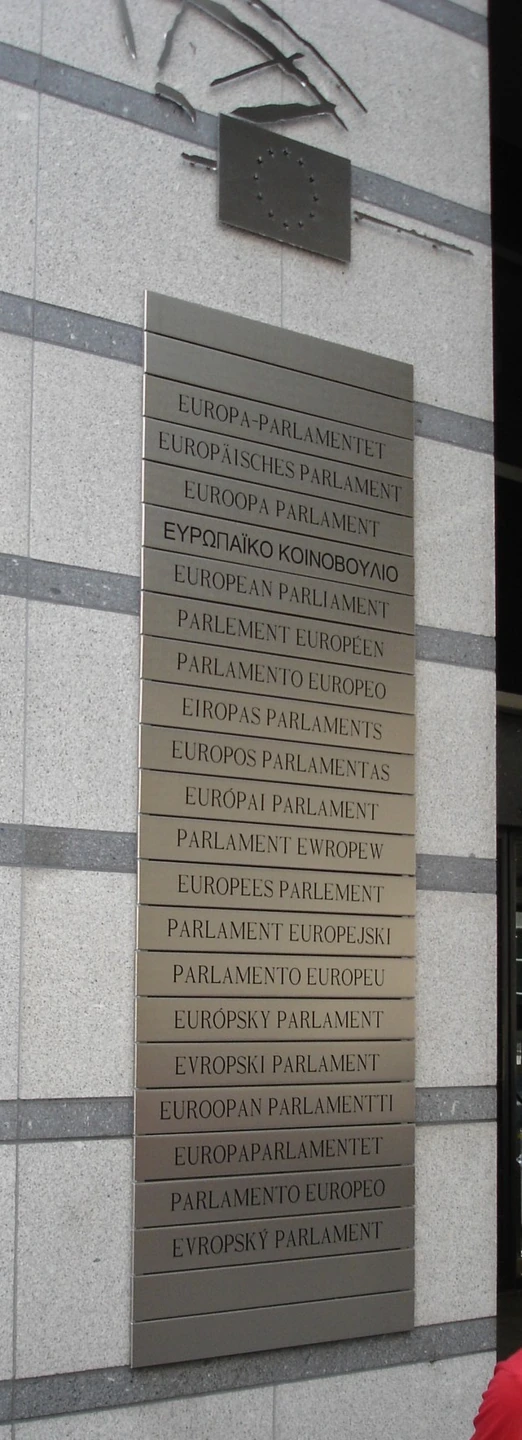
Danish on a multilingual European Parliament sign, photographed in 2006. Language identification follows the source description; not independently transcribed.
Saved in Babelbook · resized display copy. Select the image to open it independently of its source.
Nuno Nogueira · Source ↗Public domain (author dedication) ↗View the local visual field note
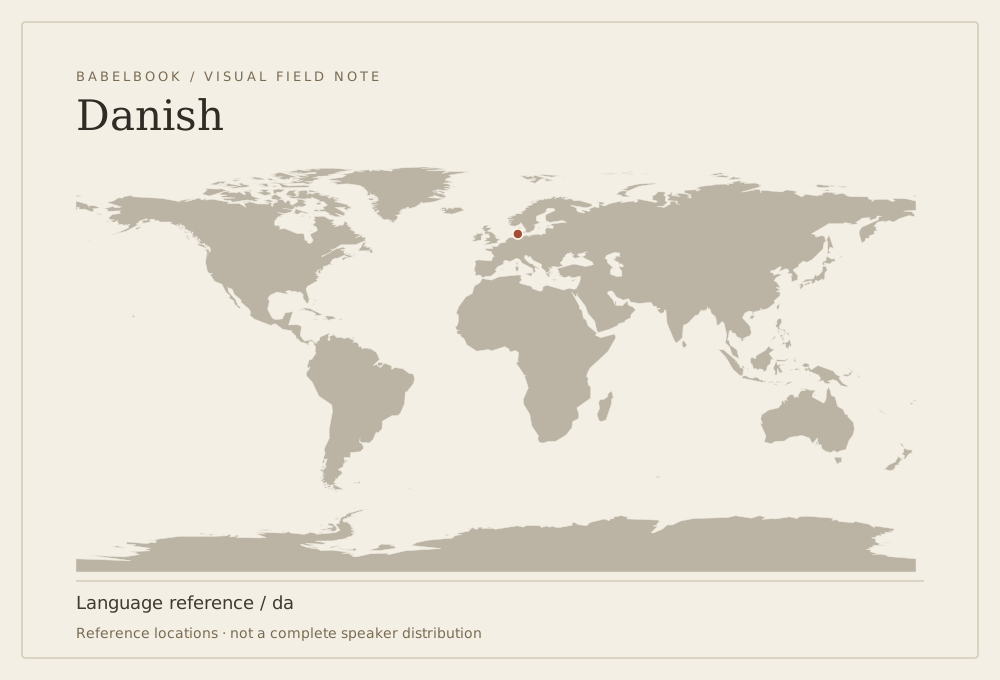
Representative reference points from Glottolog. Historical entries show reference locations, not current speakers. 1 point.
Reference & context ↗Babelbook · original editorial illustration · CC BY 4.0 · Glottolog locations; public-domain Natural Earth land
Source excerpts, selected, shortened and where noted editorially corrected from Danish language by Wikipedia contributors. Retrieved 2026-10-05. CC BY-SA 4.0. These excerpts are not an independently verified scholarly history; missing accounts are identified above.
Read further in the source
History
The Danish philologist Johannes Brøndum-Nielsen divided the history of Danish into a period from 800 AD to 1525 of Old Danish, which he subdivided into Runic Danish (800–1100), Early Middle Danish (1100–1350) and Late Middle Danish (1350–1525).
Old and Middle dialects
In the medieval period, Danish emerged as a separate language from Swedish. The main written language was Latin, and the few Danish-language texts preserved from this period are written in the Latin alphabet, although the runic alphabet seems to have lingered in popular usage in some areas. The main text types written in this period are laws, which were formulated in the vernacular language to be accessible also to those who were not Latinate. The Jutlandic Law and Scanian Law were written in vernacular Danish in the early 13th century. Beginning in 1350, Danish began to be used as a language of administration, and new types of literature began to be written in the language, such as royal letters and testaments. The orthography in this period was not standardized nor was the spoken language, and the regional laws demonstrate the dialectal differences between the regions in which they were written. Throughout this period, Danish was in contact with Low German, and many Low German loan words were introduced in this period. With the Protestant Reformation in 1536, Danish also became the language of religion, which sparked a new interest in using Danish as a literary language. Also in this period, Danish began to take on the linguistic traits that differentiate it from Swedish and Norwegian, such as the stød, the voicing of many stop consonants, and the weakening of many final vowels to /e/. The first printed book in Danish dates from 1495, the Rimkrøniken (Rhyming Chronicle), a history book told in rhymed verses. The first complete translation of the Bible in Danish, the Bible of Christian II translated by Christiern Pedersen, was published in 1550. Pedersen's orthographic choices set the de facto standard for subsequent writing in Danish. From around 1500, several printing presses were in operation in Denmark publishing in Danish and other languages. In the period after 1550, presses in Copenhagen dominated the publication of material in the Danish language.
Standardized national language
The so-called "Golden Age" was an important period in the development of Danish literary culture. Authors such as N.F.S. Grundtvig emphasized the role of language in creating national belonging. Some of the most cherished Danish-language authors of this period are existential philosopher Søren Kierkegaard and prolific fairy tale author Hans Christian Andersen. Throughout the 19th century, Danes emigrated, establishing small expatriate communities in the Americas, particularly in the United States, Canada, and Argentina, where memory and some use of Danish remains today.
Following the loss of Schleswig to Germany, the Danish language in the region lost status. After the Schleswig referendum in 1920, a number of Danes remained as a minority within German territories. After the occupation of Denmark by Germany in World War II, the 1948 orthography reform dropped the German-influenced rule of capitalizing nouns, and introduced the letter ⟨å⟩. With the exclusive use of rigsdansk, the High Copenhagen Standard, in national broadcasting, the traditional dialects came under increased pressure. In the 20th century, they have all but disappeared, and the standard language has extended throughout the country. Minor regional pronunciation variation of the standard language, sometimes called regionssprog 'regional languages' remain, and are in some cases vital. Today, the major varieties of Standard Danish are High Copenhagen Standard, associated with elderly, well to-do, and well educated people of the capital, and low Copenhagen speech traditionally associated with the working class, but today adopted as the prestige variety of the younger generations. Also, in the 21st century, the influence of immigration has had linguistic consequences, such as the emergence of a so-called multiethnolect in the urban areas, an immigrant Danish variety (also known as Perkerdansk), combining elements of different immigrant languages such as Arabic, Turkish, and Kurdish, as well as English and Danish.
Dialects
Standard Danish (rigsdansk) is the language based on dialects spoken in and around the capital, Copenhagen. Unlike Swedish and Norwegian, Danish does not have more than one regional speech norm. More than 25% of all Danish speakers live in the metropolitan area of the capital, and most government agencies, institutions, and major businesses keep their main offices in Copenhagen, which has resulted in a very homogeneous national speech norm. Danish dialects can be divided into the traditional dialects, which differ from modern Standard Danish in both phonology and grammar, and the Danish accents or regional languages, which are local varieties of the Standard language distinguished mostly by pronunciation and local vocabulary colored by traditional dialects. Traditional dialects are now mostly extinct in Denmark, with only the oldest generations still speaking them. Danish traditional dialects are divided into three main dialect areas:
Insular Danish (ømål), including dialects of the Danish islands of Zealand, Funen, Lolland, Falster, and Møn Jutlandic (jysk), further divided in North, East, West, and South Jutlandic East Danish (østdansk), including dialects of Bornholm (bornholmsk), Scania, Halland and Blekinge Jutlandic is further divided into Southern Jutlandic and Northern Jutlandic, with Northern Jutlandic subdivided into North Jutlandic and West Jutlandic. Insular Danish is divided into Zealand, Funen, Møn, and Lolland-Falster dialect areas―each with additional internal variation. Bornholmian is the only Eastern Danish dialect spoken in Denmark. Since the Swedish conquest of the Eastern Danish provinces Skåne, Halland and Blekinge in 1645/1658, the Eastern Danish dialects there have come under heavy Swedish influence. Many residents now speak regional variants of Standard Swedish. However, many researchers still consider the dialects in Scania, Halland (hallandsk) and Blekinge (blekingsk) as part of the East Danish dialect group. The Swedish National Encyclopedia from 1995 classifies Scanian as an Eastern Danish dialect with South Swedish elements. Traditional dialects differ in phonology, grammar, and vocabulary from standard Danish. Phonologically, one of the most diagnostic differences is the presence or absence of stød. Four main regional variants for the realization of stød are known: In Southeastern Jutlandic, Southernmost Funen, Southern Langeland, and Ærø, no stød is used, but instead a pitch accent (like in Norwegian, Swedish and Gutnish). South of a line (stødgrænsen, 'the stød border') going through central South Jutland, crossing Southern Funen and central Langeland and north of Lolland-Falster, Møn, Southern Zealand and Bornholm neither stød nor pitch accent exists. Most of Jutland and on Zealand use stød, and in Zealandic traditional dialects and regional language, stød occurs more often than in the standard language. In Zealand, the stød line divides Southern Zealand (without stød), an area which used to be directly under the Crown, from the rest of the Island that used to be the property of various noble estates. Grammatically, a dialectally significant feature is the number of grammatical genders. Standard Danish has two genders and the definite form of nouns is formed by the use of suffixes, while Western Jutlandic has only one gender and the definite form of nouns uses an article before the noun itself, in the same fashion as West Germanic languages. The Bornholmian dialect has maintained to this day many archaic features, such as a distinction between three grammatical genders. Insular Danish traditional dialects also conserved three grammatical genders. By 1900, Zealand insular dialects had been reduced to two genders under influence from the standard language, but other Insular varieties, such as Funen dialect had not. Besides using three genders, the old Insular or Funen dialect, could also use personal pronouns (like he and she) in certain cases, particularly referring to animals. A classic example in traditional Funen dialect is the sentence: Katti, han får unger, literally The cat, he is having kittens, because cat is a masculine noun, thus is referred to as han 'he', even if it is a female cat.
Writing system and alphabet
The oldest preserved examples of written Danish (from the Iron and Viking Ages) are in the Runic alphabet. The introduction of Christianity also brought the Latin script to Denmark. After the 13th century, runes had essentially been replaced by Latin letters. Danish orthography is conservative, using most of the conventions established in the 16th century. The spoken language however has changed a lot since then, creating a gap between the spoken and written languages. Since 1955, Dansk Sprognævn has been the official language council in Denmark. The modern Danish alphabet is similar to the English one, with three additional letters: ⟨æ⟩, ⟨ø⟩, and ⟨å⟩, which come at the end of the alphabet, in that order. The letters ⟨c⟩, ⟨q⟩, ⟨w⟩, ⟨x⟩ and ⟨z⟩ are only used in loan words. A spelling reform in 1948 introduced the letter ⟨å⟩, already in use in Norwegian and Swedish, into the Danish alphabet to replace the digraph ⟨aa⟩. ⟨Aa⟩ is still used in some person and place names; for example, the name of the cities of Aalborg and Aabenraa are spelled with ⟨Aa⟩ following decision by the local municipalities. Aarhus decided to go back to ⟨Aa⟩ in 2011. When representing the same sound as ⟨å⟩, ⟨aa⟩ is treated like ⟨å⟩ in alphabetical sorting, though it appears to be two letters. The 1948 spelling reform also changed the spelling of a few common words, such as the past tense verbs vilde 'would', kunde 'could' and skulde 'should', to their current forms of ville, kunne and skulle (making them identical to the infinitives in writing, as they are in speech). Modern Danish and Norwegian use the same alphabet, though spelling differs slightly, particularly with the phonetic spelling of loanwords.