German
German (Deutsch, pronounced [dɔɪ̯tʃ] ) is a West Germanic language in the Indo-European language family, mainly spoken in Western and Central Europe. It is the majority and official (or co-official) language in Germany, Austria, Switzerland, and Liechtenstein. It is also an official language of Luxembourg, Belgium and the Italian autonomous province of South Tyrol, as well as a recognised national language in Namibia. There are also notable German-speaking communities in other parts of Europe, including: Poland (Upper Silesia), the Czech Republic (North Bohemia), Denmark (North Schleswig), Slovakia (Krahule), Romania, Hungary (Sopron), and France (Alsace). Overseas, sizeable communities of German-speakers are found in the Americas. German is one of the major languages of the world, with nearly 100 million native speakers and over 130 million total speakers as of 2024. It is the most spoken native language within the European Union. German is the second-most widely spoken Germanic language, after English, both as a first and as a second language. German is also widely taught as a foreign language, especially in continental Europe (where it is the third most taught foreign language after English and French) and in the United States (where it is the third most commonly learned second language in K-12 education and among the most studied foreign languages in higher education after Spanish and French). Overall, German is the fourth most commonly learned second language globally. The language has been influential in the fields of philosophy, theology, science, and technology.
Translate in German ↗As a result of the German diaspora, as well as the popularity of German taught as a foreign language, the geographical distribution of German speakers (or "Germanophones") spans all inhabited continents. However, establishing an exact, global number of native German speakers is complicated by the existence of several varieties whose status as separate "languages" or "dialects" is disputed for political and linguistic reasons, including quantitatively strong varieties like certain forms of Alemannic and Low German. With the inclusion or exclusion of certain varieties, it is estimated that approximately 90–95 million people speak German as a first language, 10–25 million speak it as a second language, and 75–100 million as a foreign language. This would imply the existence of approximately 175–220 million German speakers worldwide. German sociolinguist Ulrich Ammon estimated a number of 289 million German foreign language speakers without clarifying the criteria by which he classified a speaker.
Europe
Present-day use
The captured source does not contain a separate current-use account.
Origins
The captured article does not contain a separate origins section. See the historical account and linked source.
Development
The captured article does not contain a distinct historical account. No chronology has been invented.
Writing
Written texts in German are easily recognisable as such by distinguishing features such as umlauts and certain orthographical features, such as the capitalisation of all nouns, and the frequent occurrence of long compounds. Because legibility and convenience set certain boundaries, compounds consisting of more than three or four nouns are almost exclusively found in humorous contexts. (English also can string nouns together, though it usually separates the nouns with spaces: as, for example, "toilet bowl cleaner".) In German orthography, nouns are capitalised, which makes it easier for readers to determine the function of a word within a sentence. This convention is almost unique to German today (shared perhaps only by the closely related Luxembourgish language and several insular dialects of the North Frisian language), but it was historically common in Northern Europe in the early modern era, including in languages such as Danish which abolished the capitalisation of nouns in 1948, and English for a while, into the 1700s.
Beyond the typeface.
Signs, manuscripts, published pages and contextual photographs, with their place, period, source and reuse terms. Captions identify historical spellings, regional examples, community references and character imagery.
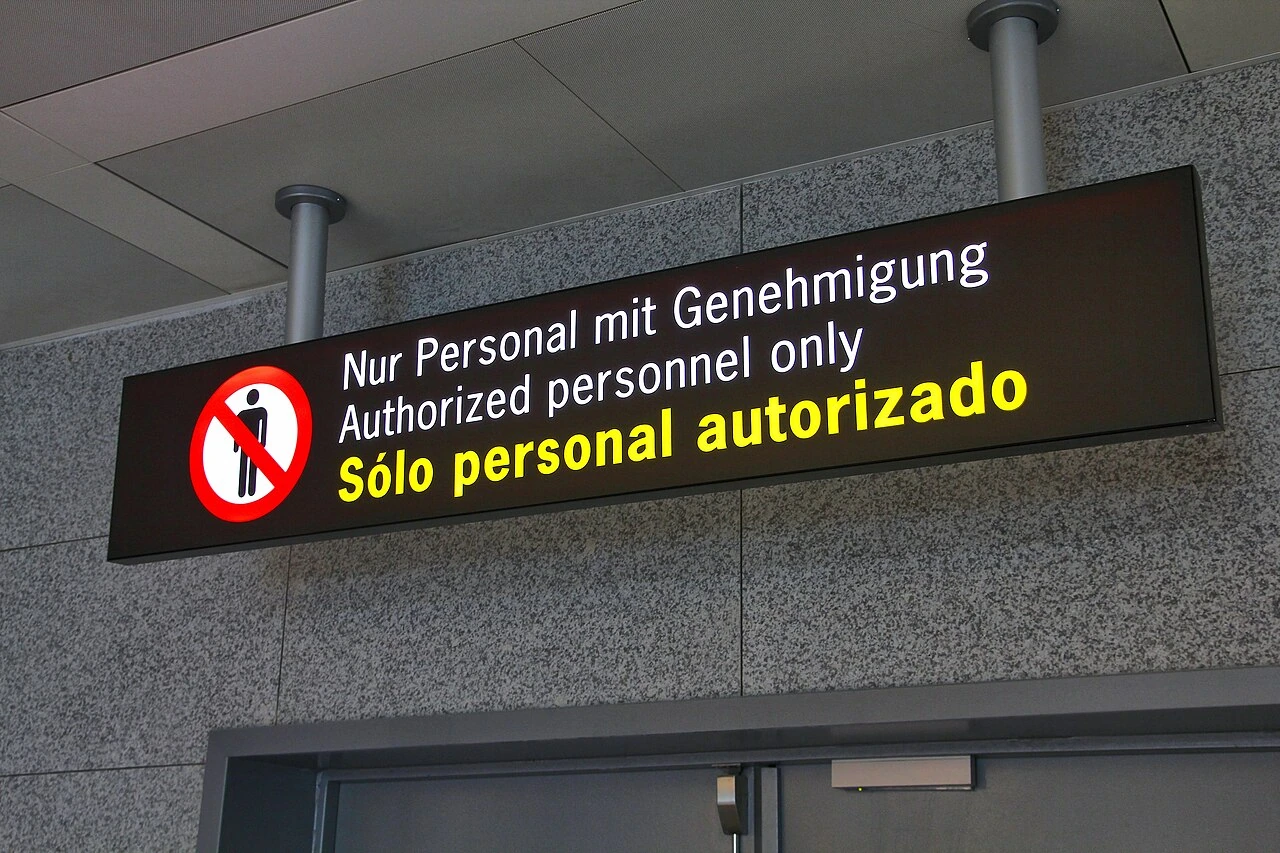
Contemporary German alongside English and Spanish at Málaga Airport, photographed in 2010. Displayed at reduced size; no additional crop.
Saved in Babelbook · resized display copy. Select the image to open it independently of its source.
Marek Ślusarczyk · Source ↗CC BY 3.0 ↗View the local visual field note
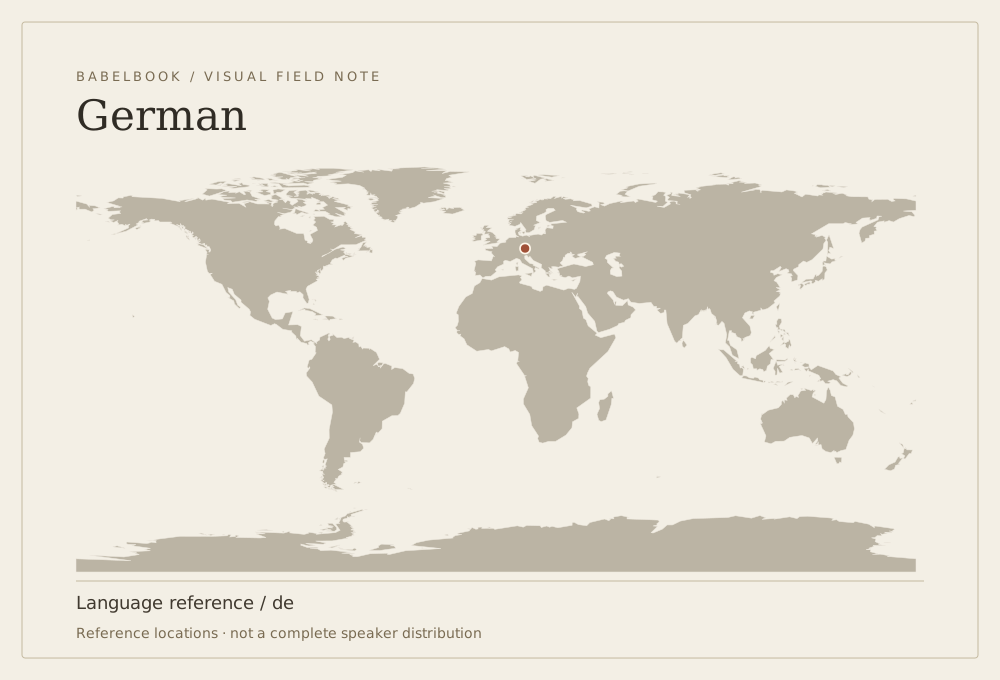
Representative reference points from Glottolog. Historical entries show reference locations, not current speakers. 1 point.
Reference & context ↗Babelbook · original editorial illustration · CC BY 4.0 · Glottolog locations; public-domain Natural Earth land
Source excerpts, selected, shortened and where noted editorially corrected from German language by Wikipedia contributors. Retrieved 2026-10-05. CC BY-SA 4.0. These excerpts are not an independently verified scholarly history; missing accounts are identified above.
Read further in the source
Standardisation
In 1901, the Second Orthographic Conference ended with a (nearly) complete standardisation of the Standard German language in its written form, and the Duden Handbook was declared its standard definition. Punctuation and compound spelling (joined or isolated compounds) were not standardised in the process.
The Deutsche Bühnensprache (lit. 'German stage language') by Theodor Siebs had established conventions for German pronunciation in theatres, three years earlier; however, this was an artificial standard that did not correspond to any traditional spoken dialect. Rather, it was based on the pronunciation of German in Northern Germany, although it was subsequently regarded often as a general prescriptive norm, despite differing pronunciation traditions especially in the Upper-German-speaking regions that still characterise the dialect of the area today – especially the pronunciation of the ending -ig as [ɪk] instead of [ɪç]. In Northern Germany, High German was a foreign language to most inhabitants, whose native dialects were subsets of Low German. It was usually encountered only in writing or formal speech; in fact, most of High German was a written language, not identical to any spoken dialect, throughout the German-speaking area until well into the 19th century. However, wider standardisation of pronunciation was established on the basis of public speaking in theatres and the media during the 20th century and documented in pronouncing dictionaries. Official revisions of some of the rules from 1901 were not issued until the controversial German orthography reform of 1996 was made the official standard by governments of all German-speaking countries. Media and written works are now almost all produced in Standard German which is understood in all areas where German is spoken.
Geographical distribution
As a result of the German diaspora, as well as the popularity of German taught as a foreign language, the geographical distribution of German speakers (or "Germanophones") spans all inhabited continents. However, establishing an exact, global number of native German speakers is complicated by the existence of several varieties whose status as separate "languages" or "dialects" is disputed for political and linguistic reasons, including quantitatively strong varieties like certain forms of Alemannic and Low German. With the inclusion or exclusion of certain varieties, it is estimated that approximately 90–95 million people speak German as a first language, 10–25 million speak it as a second language, and 75–100 million as a foreign language. This would imply the existence of approximately 175–220 million German speakers worldwide. German sociolinguist Ulrich Ammon estimated a number of 289 million German foreign language speakers without clarifying the criteria by which he classified a speaker.
Standard German
The basis of Standard German developed with the Luther Bible and the chancery language spoken by the Saxon court, part of the regional High German group. However, there are places where the traditional regional dialects have been replaced by new vernaculars based on Standard German, which is the case in large stretches of Northern Germany but also in major cities in other parts of the country. However, the remains that the colloquial Standard German differs from the formal written language, especially in grammar and syntax, in which it has been influenced by dialectal speech. Standard German differs regionally among German-speaking countries in vocabulary and some instances of pronunciation and even grammar and orthography. This variation must not be confused with the variation of local dialects. Even though the national varieties of Standard German are only somewhat influenced by the local dialects, they are very distinct. German is thus considered a pluricentric language, with currently three national standard varieties of German: German Standard German, Austrian Standard German and Swiss Standard German. In comparison to other European languages (e.g., Portuguese, English), the multi-standard character of German is still not widely acknowledged. However, 90% of Austrian secondary school teachers of German consider German as having "more than one" standard variety. In this context, some scholars speak of a One Standard German Axiom that has been maintained as a core assumption of German dialectology. In most regions, the speakers use a continuum, e.g., "Umgangssprache" (colloquial standards) from more dialectal varieties to more standard varieties depending on the circumstances.
Dialects
The German dialects are the traditional local varieties of the language; many of them are not mutually intelligible with standard German, and they have great differences in lexicon, phonology, and syntax. If a narrow definition of language based on mutual intelligibility is used, many German dialects are considered to be separate languages (for instance by ISO 639-3). However, such a point of view is unusual in German linguistics. The German dialect continuum is traditionally divided most broadly into High German and Low German (also called "Low Saxon"). However, historically, High German dialects and Low Saxon/Low German dialects do not belong to the same language. Nevertheless, in today's Germany, Low Saxon/Low German is often perceived as a dialectal variation of Standard German on a functional level even by many native speakers. The variation among the German dialects is considerable, with often only neighbouring dialects being mutually intelligible. Some dialects are not intelligible to people who know only Standard German. However, all German dialects belong to the dialect continuum of High German and Low Saxon.
Orthography
Written texts in German are easily recognisable as such by distinguishing features such as umlauts and certain orthographical features, such as the capitalisation of all nouns, and the frequent occurrence of long compounds. Because legibility and convenience set certain boundaries, compounds consisting of more than three or four nouns are almost exclusively found in humorous contexts. (English also can string nouns together, though it usually separates the nouns with spaces: as, for example, "toilet bowl cleaner".) In German orthography, nouns are capitalised, which makes it easier for readers to determine the function of a word within a sentence. This convention is almost unique to German today (shared perhaps only by the closely related Luxembourgish language and several insular dialects of the North Frisian language), but it was historically common in Northern Europe in the early modern era, including in languages such as Danish which abolished the capitalisation of nouns in 1948, and English for a while, into the 1700s.