Dzongkha
Dzongkha (རྫོང་ཁ་ [d͡zòŋkʰɑ́]), also known by its exonym Bhutanese, is a Tibeto-Burman language in the Tibetic language family that is primarily spoken by the Bhutanese people. It is the official and national language of Bhutan, and is written using the Tibetan script in formal contexts, with informal correspondence in the Joyig script. The word dzongkha means "the language of the fortress", from dzong "fortress" and kha "language". As of 2013, Dzongkha had 171,080 native speakers and about 640,000 total speakers. Dzongkha is a South Tibetic language. It is closely related to Laya and Lunana and partially intelligible with Sikkimese, and to some other Bhutanese languages such as Chochangachakha, Brokpa, Brokkat and Lakha. It has a more distant relationship to Standard Tibetan.
Translate in Dzongkha ↗Dzongkha (རྫོང་ཁ་ [d͡zòŋkʰɑ́]), also known by its exonym Bhutanese, is a Tibeto-Burman language in the Tibetic language family that is primarily spoken by the Bhutanese people. It is the official and national language of Bhutan, and is written using the Tibetan script in formal contexts, with informal correspondence in the Joyig script. The word dzongkha means "the language of the fortress", from dzong "fortress" and kha "language". As of 2013, Dzongkha had 171,080 native speakers and about 640,000 total speakers. Dzongkha is a South Tibetic language. It is closely related to Laya and Lunana and partially intelligible with Sikkimese, and to some other Bhutanese languages such as Chochangachakha, Brokpa, Brokkat and Lakha. It has a more distant relationship to Standard Tibetan.
Global / other
Present-day use
The captured source does not contain a separate current-use account.
Origins
The captured article does not contain a separate origins section. See the historical account and linked source.
Development
The captured article does not contain a distinct historical account. No chronology has been invented.
Writing
The Tibetan script used to write Dzongkha has thirty basic letters, sometimes known as "radicals", for consonants. Dzongkha is usually written in Bhutanese forms of the Uchen script, forms of the Tibetan script known as Jôyi "cursive longhand" and Jôtshum "formal longhand". The print form is known simply as Tshûm.
Beyond the typeface.
Signs, manuscripts, published pages and contextual photographs, with their place, period, source and reuse terms. Captions identify historical spellings, regional examples, community references and character imagery.
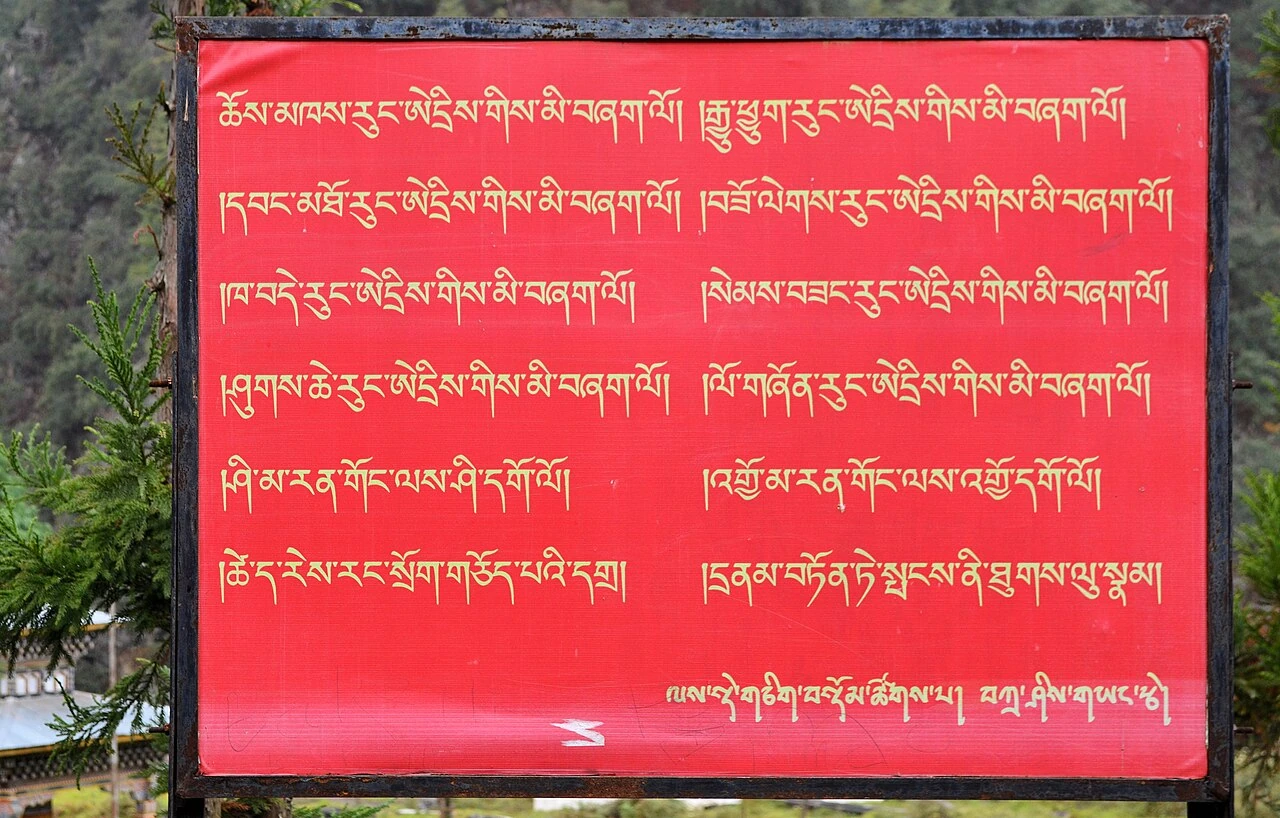
A sign at Chorten Kora, catalogued by Commons among Dzongkha-language signs.
Saved in Babelbook · resized display copy. Select the image to open it independently of its source.
Christopher J. Fynn · Source ↗CC BY-SA 4.0 ↗View the local visual field note
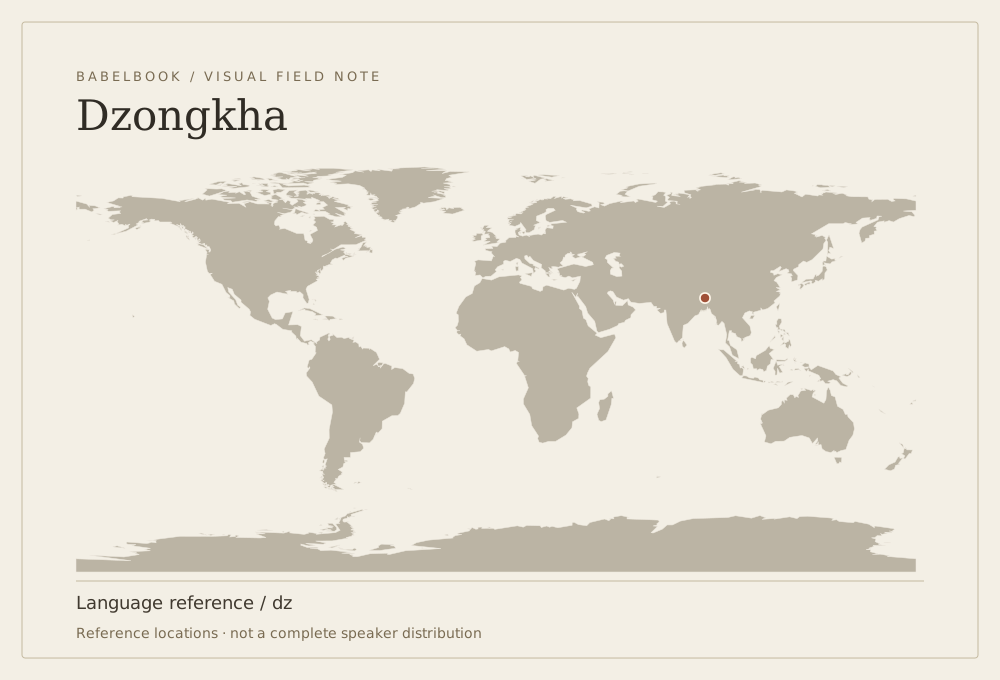
Representative reference points from Glottolog. Historical entries show reference locations, not current speakers. 1 point.
Reference & context ↗Babelbook · original editorial illustration · CC BY 4.0 · Glottolog locations; public-domain Natural Earth land
Source excerpts, selected, shortened and where noted editorially corrected from Dzongkha by Wikipedia contributors. Retrieved 2026-10-05. CC BY-SA 4.0. These excerpts are not an independently verified scholarly history; missing accounts are identified above.
Read further in the source
Writing system
The Tibetan script used to write Dzongkha has thirty basic letters, sometimes known as "radicals", for consonants. Dzongkha is usually written in Bhutanese forms of the Uchen script, forms of the Tibetan script known as Jôyi "cursive longhand" and Jôtshum "formal longhand". The print form is known simply as Tshûm.