Ewe
Ewe (endonym: Eʋe or Eʋegbe [ɛβɛɡ͡bɛ]) or Togolese is a language spoken by approximately 5 million people in West Africa, mainly in Ghana and Togo. Ewe is part of a group of related languages commonly called the Gbe languages. The other major Gbe language is Fon, which is mainly spoken in Benin. Like many African languages, Ewe is tonal as well as a possible member of the Niger-Congo family. The German Africanist Diedrich Hermann Westermann published many dictionaries and grammars of Ewe and several other Gbe languages. Other linguists who have worked on Ewe and closely related languages include Gilbert Ansre (tone, syntax), Herbert Stahlke (morphology, tone), Nick Clements (tone, syntax), Roberto Pazzi (anthropology, lexicography), Felix K. Ameka (semantics, cognitive linguistics), Alan Stewart Duthie (semantics, phonetics), Hounkpati B. Capo (phonology, phonetics), Enoch Aboh (syntax), and Chris Collins (syntax).
Translate in Ewe ↗Ewe is a national language in Togo. It is also a government-backed regional language in Ghana.
Sub-Saharan Africa
Present-day use
Ewe is a national language in Togo. It is also a government-backed regional language in Ghana.
Origins
The captured article does not contain a separate origins section. See the historical account and linked source.
Development
The captured article does not contain a distinct historical account. No chronology has been invented.
Writing
The African Reference Alphabet is used when Ewe is represented orthographically, so the written version is somewhat like a combination of the Latin alphabet and the International Phonetic Alphabet. An "n" is placed after vowels to mark nasalization. Tone is generally unmarked, except in some common cases, which require disambiguation: the first person plural pronoun mí 'we' is marked high to distinguish it from the second person plural mi 'you', and the second person singular pronoun wò 'you' is marked low to distinguish it from the third person plural pronoun wó 'they/them' ekpɔ wò [ɛ́k͡pɔ wò] — 'he saw you' ekpɔ wo [ɛ́k͡pɔ wó] — 'he saw them'
Beyond the typeface.
Signs, manuscripts, published pages and contextual photographs, with their place, period, source and reuse terms. Captions identify historical spellings, regional examples, community references and character imagery.
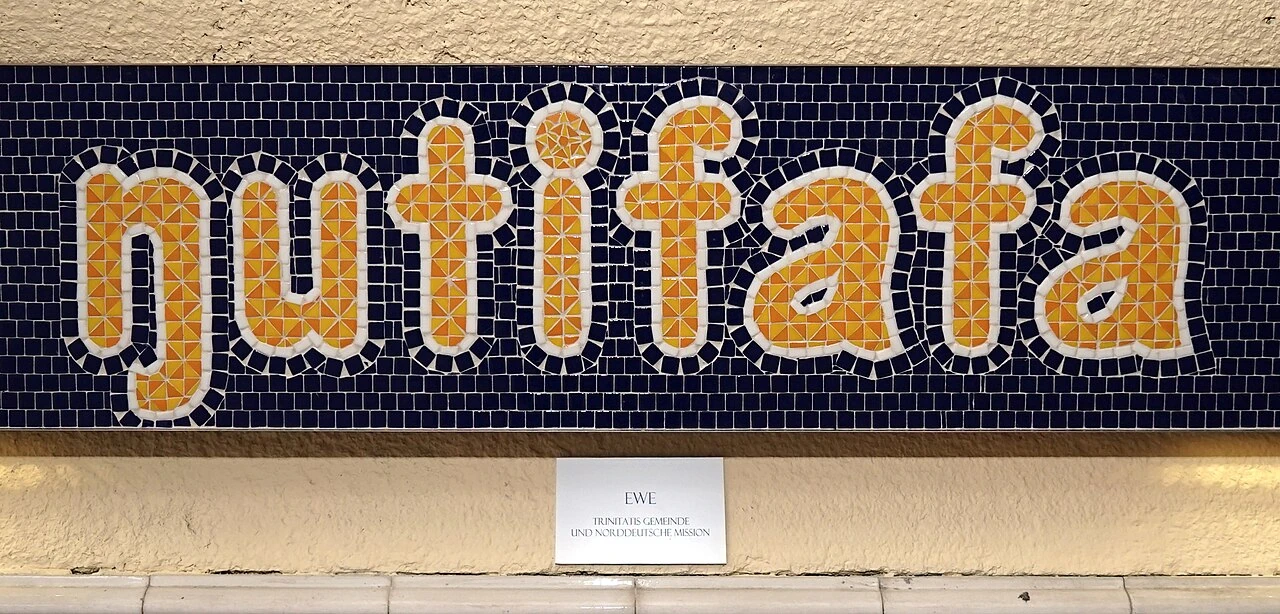
Ewe peace mosaic at the Friedenstunnel in Bremen, Germany, photographed in September 2015. Commons explicitly identifies the Ewe word on the mosaic. This is an installation in Germany, not a local African street sign.
Saved in Babelbook · resized display copy. Select the image to open it independently of its source.
Jürgen Howaldt · Source ↗CC BY-SA 4.0 ↗View the local visual field note
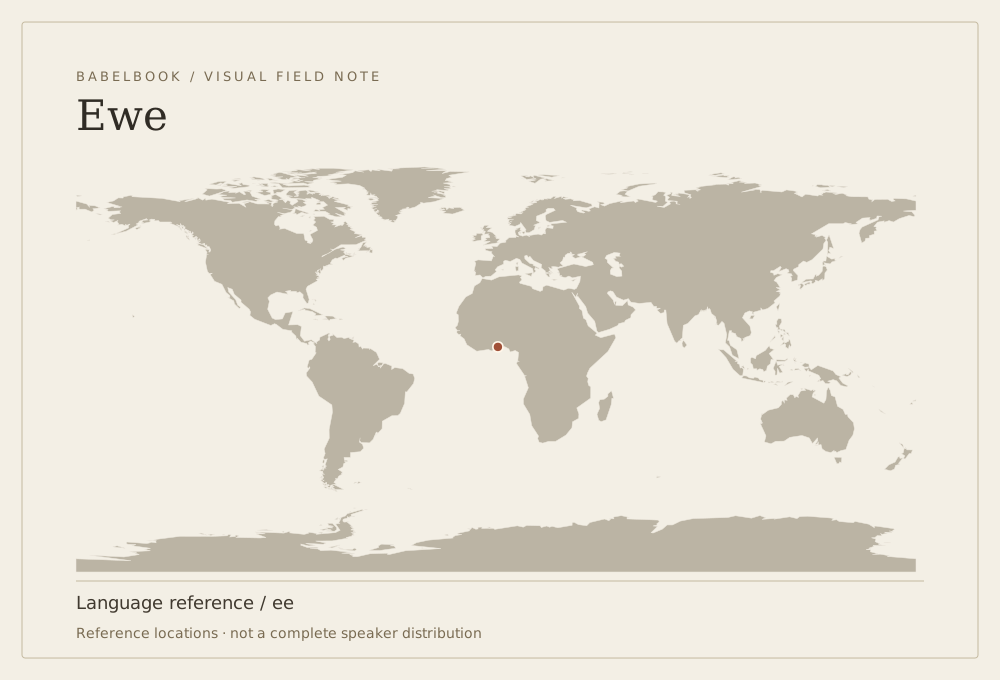
Representative reference points from Glottolog. Historical entries show reference locations, not current speakers. 1 point.
Reference & context ↗Babelbook · original editorial illustration · CC BY 4.0 · Glottolog locations; public-domain Natural Earth land
Source excerpts, selected, shortened and where noted editorially corrected from Ewe language by Wikipedia contributors. Retrieved 2026-10-05. CC BY-SA 4.0. These excerpts are not an independently verified scholarly history; missing accounts are identified above.
Read further in the source
Dialects
Some of the commonly named Ewe ('Vhe') dialects are Aŋlɔ, Tɔŋu (Tɔŋgu), Avenor, Agave people, Evedome, Awlan, Gbín, Pekí, Kpándo, Vhlin, Hó, Avɛ́no, Vo, Kpelen, Vɛ́, Danyi, Agu, Fodome, Wancé, Wací, Adángbe (Capo). Ethnologue 16 considers Waci and Kpesi (Kpessi) to be distinct enough to be considered separate languages. They form a dialect continuum with Ewe and Gen (Mina), which share a mutual intelligibility level of 85%; the Ewe varieties Gbin, Ho, Kpelen, Kpesi, and Vhlin might be considered a third cluster of Western Gbe dialects between Ewe and Gen, but Kpesi is as close or closer to the Waci and Vo dialects, which remain in Ewe in that scenario. Waci intervenes geographically between Ewe proper and Gen; Kpesi forms a Gbe island in the Kabye area. Ewe is itself a dialect cluster of the Gbe languages, which include Gen, Aja, Kotafon, Mina and Xwla and are spoken from the southern part of Ghana to Togo, Benin and Western Nigeria. All Gbe languages share at least some intelligibility with one another. Some coastal and southern dialects of Ewe include Aŋlɔ, Tongu (Tɔŋu), Avenor, Dzodze, and Watsyi. Some inland dialects indigenously characterized as Ewedomegbe include: Ho, Kpedze, Hohoe, Peki, Kpando, Aveme, Liati, Fódome, Danyi, and Kpele. Though there are many classifications, distinct variations exist between towns that are just miles away from one another.
Orthography
The African Reference Alphabet is used when Ewe is represented orthographically, so the written version is somewhat like a combination of the Latin alphabet and the International Phonetic Alphabet.
An "n" is placed after vowels to mark nasalization. Tone is generally unmarked, except in some common cases, which require disambiguation: the first person plural pronoun mí 'we' is marked high to distinguish it from the second person plural mi 'you', and the second person singular pronoun wò 'you' is marked low to distinguish it from the third person plural pronoun wó 'they/them'
ekpɔ wò [ɛ́k͡pɔ wò] — 'he saw you' ekpɔ wo [ɛ́k͡pɔ wó] — 'he saw them'
Status
Ewe is a national language in Togo. It is also a government-backed regional language in Ghana.