Ancient Egyptian
The Egyptian language, or ancient Egyptian (r n kmt; 'speech of Egypt'), is an extinct branch of the Afro-Asiatic language family that was spoken in Egypt. It is one of the earliest known written languages, first recorded in the hieroglyphic script in the late 4th millennium BC, and the longest-attested human language with a written record spanning over 5,000 years. Its classical form, known as "Middle Egyptian," was the vernacular language of the Middle Kingdom of ancient Egypt, and remained the literary language of Egypt until its Christianisation during the Roman period. It is known today from a large corpus of surviving texts, which were deciphered in the early 19th century. By the time of classical antiquity, the spoken language had evolved into Demotic. By the Roman and Byzantine eras, the language later further diversified into various Coptic dialects written in the Greek alphabet. These were eventually supplanted by Arabic after the Arab conquest of Egypt, although Bohairic Coptic remains in use as the liturgical language of the Coptic Orthodox and Coptic Catholic churches.
Translate in Ancient Egyptian ↗The Egyptian language, or ancient Egyptian (r n kmt; 'speech of Egypt'), is an extinct branch of the Afro-Asiatic language family that was spoken in Egypt. It is one of the earliest known written languages, first recorded in the hieroglyphic script in the late 4th millennium BC, and the longest-attested human language with a written record spanning over 5,000 years. Its classical form, known as "Middle Egyptian," was the vernacular language of the Middle Kingdom of ancient Egypt, and remained the literary language of Egypt until its Christianisation during the Roman period. It is known today from a large corpus of surviving texts, which were deciphered in the early 19th century. By the time of classical antiquity, the spoken language had evolved into Demotic. By the Roman and Byzantine eras, the language later further diversified into various Coptic dialects written in the Greek alphabet. These were eventually supplanted by Arabic after the Arab conquest of Egypt, although Bohairic Coptic remains in use as the liturgical language of the Coptic Orthodox and Coptic Catholic churches.
Middle East & North Africa
Present-day use
The captured source does not contain a separate current-use account.
Origins
The captured article does not contain a separate origins section. See the historical account and linked source.
Development
The Egyptian language can be grouped thus: The Egyptian language is conventionally grouped into six major chronological divisions: Archaic Egyptian (before c. 2600 BC), the reconstructed language of the Early Dynastic Period, Old Egyptian (c. 2600 – c. 2000 BC), the language of the Old Kingdom, Middle Egyptian (c. 2000 – c. 1350 BC), the language of the Middle Kingdom to early New Kingdom and continuing on as a literary language into the 4th century AD, Late Egyptian (c. 1350 – c. 700 BC), Amarna period to Third Intermediate Period, Demotic Egyptian (c. 700 BC – c. 400 AD), the vernacular of the Late Period, Ptolemaic and early Roman Egypt, Coptic (after c. 200 AD), the vernacular at the time of Christianisation, and the liturgical language of Egyptian Christianity. Old, Middle, and Late Egyptian were all written using both the hieroglyphic and hieratic scripts. Demotic is the name of the script derived from the hieratic beginning in the 7th century BC. The Coptic alphabet was derived from the Greek alphabet, with adaptations for Egyptian phonology. It was first developed in the Ptolemaic period, and gradually replaced the Demotic script in about the 4th to 5th centuries of the Christian era.
Writing
Most surviving texts in the Egyptian language are written on stone in hieroglyphs. The native name for Egyptian hieroglyphic writing is zẖꜣ n mdw-nṯr ("writing of the gods' words"). In antiquity, most texts were written on the quite perishable medium of papyrus though a few have survived that were written in hieratic and (later) demotic. There was also a form of cursive hieroglyphs, used for religious documents on papyrus, such as the Book of the Dead of the Twentieth Dynasty; it was simpler to write than the hieroglyphs in stone inscriptions, but it was not as cursive as hieratic and lacked the wide use of ligatures. Additionally, there was a variety of stone-cut hieratic, known as "lapidary hieratic". In the language's final stage of development, the Coptic alphabet replaced the older writing system. Hieroglyphs are employed in two ways in Egyptian texts: as ideograms to represent the idea depicted by the pictures and, more commonly, as phonograms to represent their phonetic value. As the phonetic realization of Egyptian currently is not known with certainty, Egyptologists use a system of transliteration to denote each sound that could be represented by a uniliteral hieroglyph. Egyptian scholar Gamal Mokhtar noted that the inventory of hieroglyphic symbols derived from "fauna and flora used in the signs [which] are essentially African", reflecting the local wildlife of North Africa, the Levant and southern Mediterranean. In "regards to writing, we have seen that a purely Nilotic, hence [North] African origin not only is not excluded, but probably reflects the reality" that the geographical location of Egypt is, of course, in Africa.
Beyond the typeface.
Signs, manuscripts, published pages and contextual photographs, with their place, period, source and reuse terms. Captions identify historical spellings, regional examples, community references and character imagery.
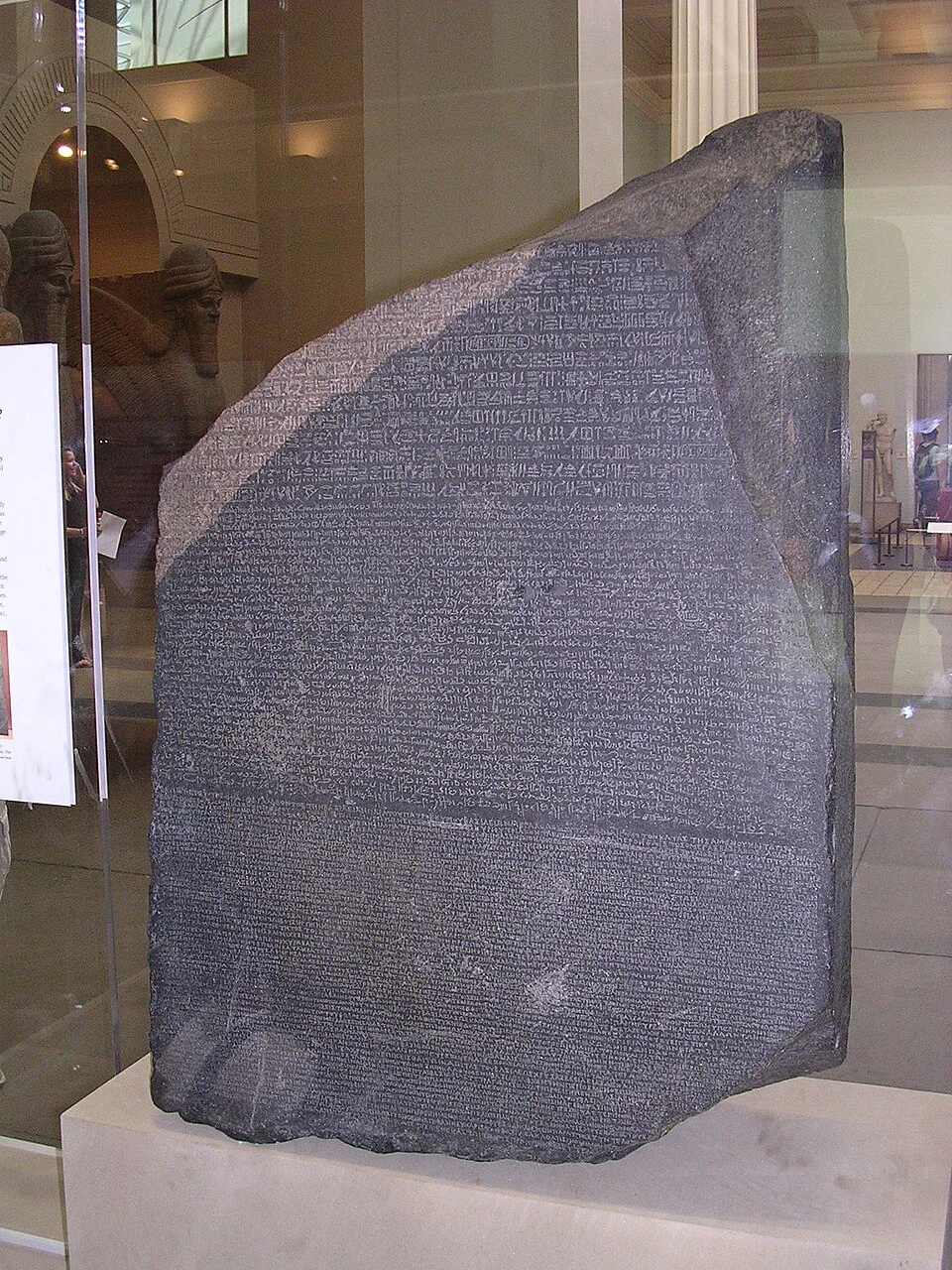
The Rosetta Stone with Egyptian writing in hieroglyphic and Demotic scripts alongside Ancient Greek. Commons identifies the languages and scripts; this is a multilingual artifact. Not independently transcribed.
Saved in Babelbook · resized display copy. Select the image to open it independently of its source.
Tulumnes · Source ↗CC BY-SA 4.0 ↗View the local visual field note
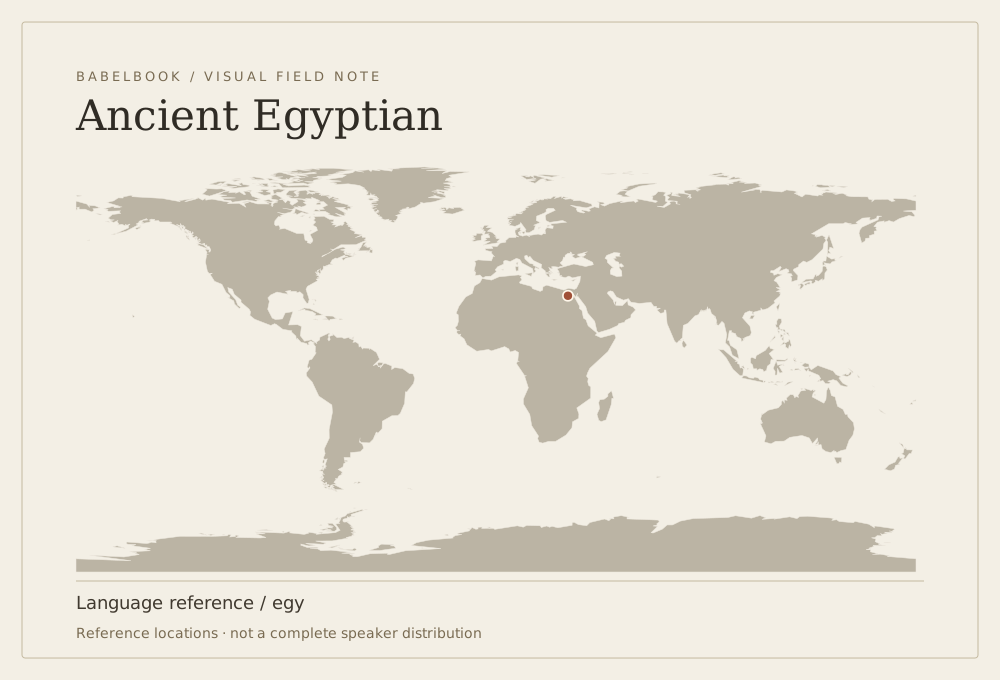
Representative reference points from Glottolog. Historical entries show reference locations, not current speakers. 1 point.
Reference & context ↗Babelbook · original editorial illustration · CC BY 4.0 · Glottolog locations; public-domain Natural Earth land
Source excerpts, selected, shortened and where noted editorially corrected from Egyptian language by Wikipedia contributors. Retrieved 2026-10-05. CC BY-SA 4.0. These excerpts are not an independently verified scholarly history; missing accounts are identified above.
Read further in the source
History
The Egyptian language can be grouped thus:
The Egyptian language is conventionally grouped into six major chronological divisions:
Archaic Egyptian (before c. 2600 BC), the reconstructed language of the Early Dynastic Period, Old Egyptian (c. 2600 – c. 2000 BC), the language of the Old Kingdom, Middle Egyptian (c. 2000 – c. 1350 BC), the language of the Middle Kingdom to early New Kingdom and continuing on as a literary language into the 4th century AD, Late Egyptian (c. 1350 – c. 700 BC), Amarna period to Third Intermediate Period, Demotic Egyptian (c. 700 BC – c. 400 AD), the vernacular of the Late Period, Ptolemaic and early Roman Egypt, Coptic (after c. 200 AD), the vernacular at the time of Christianisation, and the liturgical language of Egyptian Christianity. Old, Middle, and Late Egyptian were all written using both the hieroglyphic and hieratic scripts. Demotic is the name of the script derived from the hieratic beginning in the 7th century BC. The Coptic alphabet was derived from the Greek alphabet, with adaptations for Egyptian phonology. It was first developed in the Ptolemaic period, and gradually replaced the Demotic script in about the 4th to 5th centuries of the Christian era.
Dialects
Some evidence of dialectal variation in Egyptian is found in as early as the 3rd millennium BC. However, because the hieroglyphic script is inherently conservative and most hieroglyphic Egyptian texts are written in a literary prestige register rather than the vernacular speech variety of their author, the dialectical differences are not apparent in written Egyptian until the adoption of the Coptic alphabet. Nevertheless, it is clear that these differences existed before the Coptic period. In one Late Egyptian letter (dated c. 1200 BC), a scribe jokes that his colleague's writing is incoherent like "the speech of a Delta man with a man of Elephantine." Recently, some evidence of internal dialects has been found in pairs of similar words in Egyptian that, based on similarities with later dialects of Coptic, may be derived from northern and southern dialects of Egyptian. Written Coptic has five major dialects, which differ mainly in graphic conventions, most notably the southern Saidic dialect, the main classical dialect, and the northern Bohairic dialect, currently used in Coptic Church services.
Writing systems
Most surviving texts in the Egyptian language are written on stone in hieroglyphs. The native name for Egyptian hieroglyphic writing is zẖꜣ n mdw-nṯr ("writing of the gods' words"). In antiquity, most texts were written on the quite perishable medium of papyrus though a few have survived that were written in hieratic and (later) demotic. There was also a form of cursive hieroglyphs, used for religious documents on papyrus, such as the Book of the Dead of the Twentieth Dynasty; it was simpler to write than the hieroglyphs in stone inscriptions, but it was not as cursive as hieratic and lacked the wide use of ligatures. Additionally, there was a variety of stone-cut hieratic, known as "lapidary hieratic". In the language's final stage of development, the Coptic alphabet replaced the older writing system. Hieroglyphs are employed in two ways in Egyptian texts: as ideograms to represent the idea depicted by the pictures and, more commonly, as phonograms to represent their phonetic value. As the phonetic realization of Egyptian currently is not known with certainty, Egyptologists use a system of transliteration to denote each sound that could be represented by a uniliteral hieroglyph. Egyptian scholar Gamal Mokhtar noted that the inventory of hieroglyphic symbols derived from "fauna and flora used in the signs [which] are essentially African", reflecting the local wildlife of North Africa, the Levant and southern Mediterranean. In "regards to writing, we have seen that a purely Nilotic, hence [North] African origin not only is not excluded, but probably reflects the reality" that the geographical location of Egypt is, of course, in Africa.