Greek
Greek (Modern Greek: ελληνικά, romanized: elliniká [eliniˈka] ; Ancient Greek: ἑλληνική, romanized: hellēnikḗ [helːɛːnikɛ́ː]) is an Indo-European language, constituting an independent Hellenic branch within the Indo-European language family. It is native to the territories that have had populations of Greeks since antiquity: Greece, Cyprus, Egypt, Turkey, Italy (in Calabria and Salento), southern Albania, and other regions of the Balkans, Caucasus, the Black Sea coast, and the Eastern Mediterranean. It has the longest documented history of any Indo-European language, spanning at least 3,400 years of written records. Its writing system is the Greek alphabet, which has been used for approximately 2,800 years; previously, Greek was recorded in writing systems such as Linear B and the Cypriot syllabary. The Greek language holds a very important place in the history of the Western world. Beginning with the epic poetry of Homer, ancient Greek literature includes many works of lasting importance in the European canon. Greek is also the language in which many of the foundational texts in science and philosophy were originally composed. The New Testament of the Christian Bible was also originally written in Greek. Together with the Latin texts and traditions of the Roman world, the Greek texts and Greek societies of antiquity constitute the objects of study of the discipline of Classics. During antiquity, Greek was by far the most widely spoken lingua franca in the Mediterranean world.
Translate in Greek ↗Greek is spoken today by at least 13 million people, principally in Greece and Cyprus along with a sizable Greek-speaking minority in Albania near the Greek-Albanian border. A significant percentage of Albania's population has knowledge of the Greek language due in part to the Albanian wave of immigration to Greece in the 1980s and '90s and the Greek community in the country. Prior to the Greco-Turkish War and the resulting population exchange in 1923 a very large population of Greek-speakers also existed in Turkey, though very few remain today. A small Greek-speaking community is also found in Bulgaria near the Greek-Bulgarian border. Greek is also spoken worldwide by the sizeable Greek diaspora which has notable communities in the United States, Australia, Canada, South Africa, Chile, Brazil, Argentina, Russia, Ukraine, the United Kingdom, and throughout the European Union, especially in Germany. Historically, significant Greek-speaking communities and regions were found throughout the Eastern Mediterranean, in what are today Southern Italy, Turkey, Cyprus, Syria, Lebanon, Israel, Palestine, Egypt, and Libya; in the area of the Black Sea, in what are today Turkey, Bulgaria, Romania, Ukraine, Russia, Georgia, Armenia, and Azerbaijan; and, to a lesser extent, in the Western Mediterranean in and around colonies such as Massalia, Monoikos, and Mainake. It was also used as the official language of government and religion in the Christian Nubian kingdoms, for most of their history. Greek, in its modern form, is the official language of Greece, where it is spoken by almost the entire population. It is also the official language of Cyprus (alongside Turkish) and the British Overseas Territory of Akrotiri and Dhekelia (alongside English). Because of the membership of Greece and Cyprus in the European Union, Greek is one of the organization's 24 official languages.
Europe
Present-day use
Greek, in its modern form, is the official language of Greece, where it is spoken by almost the entire population. It is also the official language of Cyprus (alongside Turkish) and the British Overseas Territory of Akrotiri and Dhekelia (alongside English). Because of the membership of Greece and Cyprus in the European Union, Greek is one of the organization's 24 official languages. Greek is recognized as a minority language in Albania, and used co-officially in some of its municipalities, in the districts of Gjirokastër and Sarandë. It is also an official minority language in the regions of Apulia and Calabria in Italy. In the framework of the European Charter for Regional or Minority Languages, Greek is protected and promoted officially as a regional and minority language in Armenia, Hungary, Romania, and Ukraine. It is recognized as a minority language and protected in Turkey by the 1923 Treaty of Lausanne.
Origins
The captured article does not contain a separate origins section. See the historical account and linked source.
Development
Greek has been spoken in the Balkan peninsula since around the 3rd millennium BC, or possibly earlier. The earliest written evidence is a Linear B clay tablet found in Messenia that dates to between 1450 and 1350 BC, making Greek the world's oldest recorded living language. Among the Indo-European languages, its date of earliest written attestation is matched only by the now-extinct Anatolian languages.
Writing
Greek (catalog classification; see the source for context).
Beyond the typeface.
Signs, manuscripts, published pages and contextual photographs, with their place, period, source and reuse terms. Captions identify historical spellings, regional examples, community references and character imagery.
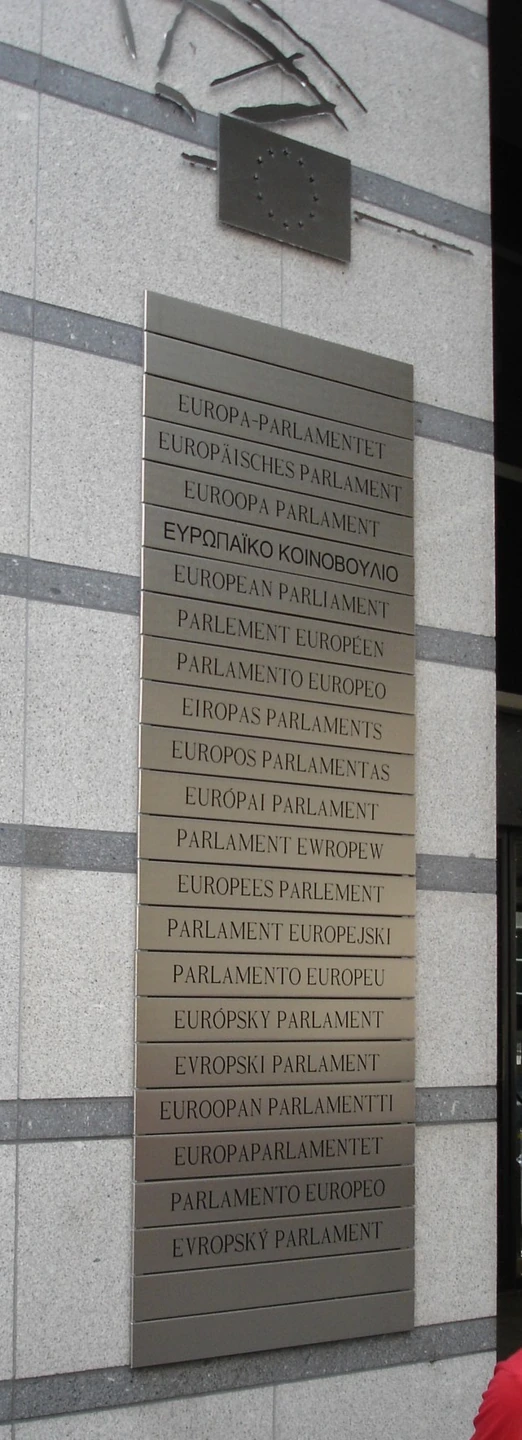
Greek on a multilingual European Parliament sign, photographed in 2006. Language identification follows the source description; not independently transcribed.
Saved in Babelbook · resized display copy. Select the image to open it independently of its source.
Nuno Nogueira · Source ↗Public domain (author dedication) ↗View the local visual field note
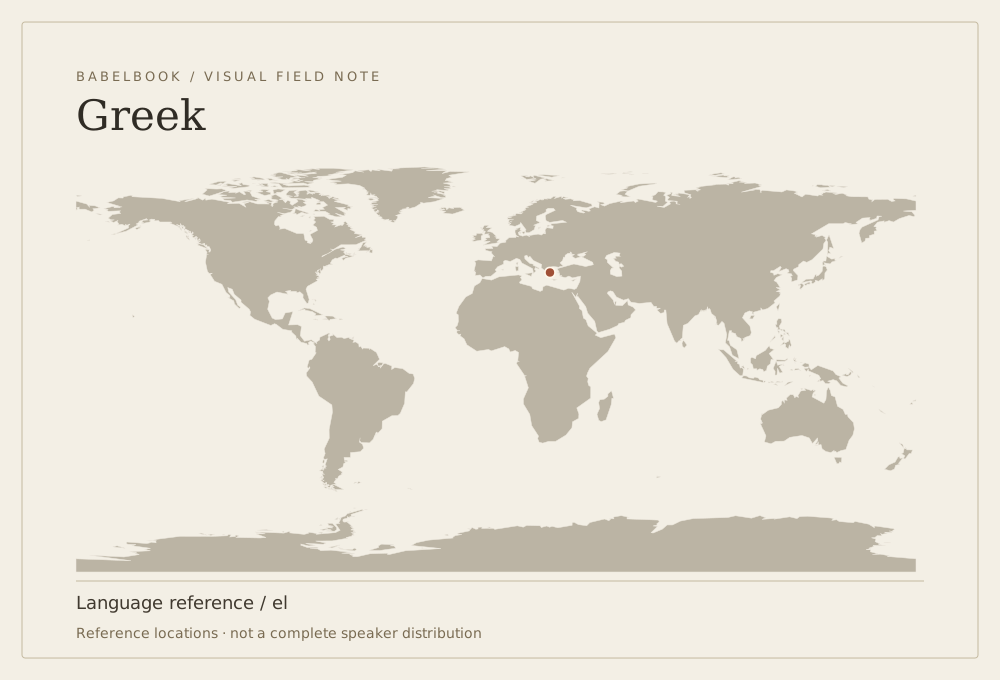
Representative reference points from Glottolog. Historical entries show reference locations, not current speakers. 1 point.
Reference & context ↗Babelbook · original editorial illustration · CC BY 4.0 · Glottolog locations; public-domain Natural Earth land
Source excerpts, selected, shortened and where noted editorially corrected from Greek language by Wikipedia contributors. Retrieved 2026-10-05. CC BY-SA 4.0. These excerpts are not an independently verified scholarly history; missing accounts are identified above.
Read further in the source
History
Greek has been spoken in the Balkan peninsula since around the 3rd millennium BC, or possibly earlier. The earliest written evidence is a Linear B clay tablet found in Messenia that dates to between 1450 and 1350 BC, making Greek the world's oldest recorded living language. Among the Indo-European languages, its date of earliest written attestation is matched only by the now-extinct Anatolian languages.
Geographic distribution
Greek is spoken today by at least 13 million people, principally in Greece and Cyprus along with a sizable Greek-speaking minority in Albania near the Greek-Albanian border. A significant percentage of Albania's population has knowledge of the Greek language due in part to the Albanian wave of immigration to Greece in the 1980s and '90s and the Greek community in the country. Prior to the Greco-Turkish War and the resulting population exchange in 1923 a very large population of Greek-speakers also existed in Turkey, though very few remain today. A small Greek-speaking community is also found in Bulgaria near the Greek-Bulgarian border. Greek is also spoken worldwide by the sizeable Greek diaspora which has notable communities in the United States, Australia, Canada, South Africa, Chile, Brazil, Argentina, Russia, Ukraine, the United Kingdom, and throughout the European Union, especially in Germany. Historically, significant Greek-speaking communities and regions were found throughout the Eastern Mediterranean, in what are today Southern Italy, Turkey, Cyprus, Syria, Lebanon, Israel, Palestine, Egypt, and Libya; in the area of the Black Sea, in what are today Turkey, Bulgaria, Romania, Ukraine, Russia, Georgia, Armenia, and Azerbaijan; and, to a lesser extent, in the Western Mediterranean in and around colonies such as Massalia, Monoikos, and Mainake. It was also used as the official language of government and religion in the Christian Nubian kingdoms, for most of their history.
Official status
Greek, in its modern form, is the official language of Greece, where it is spoken by almost the entire population. It is also the official language of Cyprus (alongside Turkish) and the British Overseas Territory of Akrotiri and Dhekelia (alongside English). Because of the membership of Greece and Cyprus in the European Union, Greek is one of the organization's 24 official languages. Greek is recognized as a minority language in Albania, and used co-officially in some of its municipalities, in the districts of Gjirokastër and Sarandë. It is also an official minority language in the regions of Apulia and Calabria in Italy. In the framework of the European Charter for Regional or Minority Languages, Greek is protected and promoted officially as a regional and minority language in Armenia, Hungary, Romania, and Ukraine. It is recognized as a minority language and protected in Turkey by the 1923 Treaty of Lausanne.