English
English is a West Germanic language of the Indo-European language family that emerged in early medieval England and has since become a global lingua franca. The language is named after the Angles, one of the Germanic peoples who migrated to Britain after the end of Roman rule. English is the most spoken language in the world, primarily due to the global influence of the British Empire (succeeded by the Commonwealth of Nations) and the rise of the United States. It is the most widely learned second language in the world, with more second‑language speakers than native speakers. However, English is only the third‑most spoken native language, after Mandarin Chinese and Spanish. English is either the official language, or one of the official languages, of 57 sovereign states and 30 dependent territories, making it the most geographically widespread language in the world. In the United Kingdom, the United States and Australia, it is the dominant language for historical reasons without being explicitly defined by law. It is a co‑official language of the United Nations, the European Union, and many other international and regional organisations. It has also become the de facto lingua franca of diplomacy, science, technology, international trade, logistics, tourism, aviation, entertainment, and the Internet. Ethnologue estimated that there were over 1.4 billion speakers worldwide as of 2021. Old English emerged from a group of West Germanic dialects spoken by the Anglo-Saxons. Early inscriptions were written with runes before a Latin‑based alphabet was adopted for longer texts.
Translate in English ↗As of 2016, 400 million people spoke English as their first language, and 1.1 billion spoke it as a second language. English is the largest language by number of speakers, spoken by communities on every continent. Estimates of second‑language and foreign‑language speakers vary greatly depending on how proficiency is defined, ranging from 470 million to more than 1 billion. In 2003, David Crystal estimated that non‑native speakers outnumbered native speakers by a ratio of three to one.
Europe
Present-day use
The period of Early Modern English, lasting from 1500 to 1700, was characterised by the Great Vowel Shift (1350–1700), inflectional simplification, and linguistic standardisation. The Great Vowel Shift affected the stressed long vowels of Middle English. It was a chain shift, meaning that each shift triggered a subsequent shift in the vowel system. Mid and open vowels were raised, and close vowels were broken into diphthongs. For example, the word bite was originally pronounced as the word beet is today, and the second vowel in the word about was pronounced as the word boot is today. The Great Vowel Shift explains many irregularities in spelling, since English retains many spellings from Middle English, and it also explains why English vowel letters have very different pronunciations from the same letters in other languages. English began to rise in prestige relative to Norman French during the reign of Henry V. Around 1430, the Court of Chancery in Westminster began using English in its official documents, and a new standard form of Middle English, known as Chancery Standard, developed from the dialects of London and the East Midlands. In 1476, William Caxton introduced the printing press to England and began publishing the first printed books in London, thereby expanding the influence of this form of English. Literature in Early Modern English includes the works of William Shakespeare and the 1611 King James Version (KJV) of the Bible. Even after the vowel shift, the language still sounded different from Modern English: for example, the consonant clusters /kn ɡn sw/ in knight, gnat, and sword were still pronounced. Many of the grammatical features that a modern reader of Shakespeare might find quaint or archaic represent the distinct characteristics of Early Modern English.
Origins
Throughout its history, English has been a particularly frequent borrower of loanwords from other languages. West Germanic words in use since the Anglo-Saxon period still comprise most of the language's core vocabulary, as well as most of its most frequently used words. Many sentences can be constructed without loanwords, but not without core Anglo-Saxon vocabulary. English has formal and informal speech registers; informal registers, including child-directed speech, tend to be made up predominantly of Anglo-Saxon vocabulary, while Latinate vocabulary appears more frequently in legal, scientific, and academic writing. Prolonged and intense contact with French has resulted in English having a very high proportion of Latinate words – with French loanwords borrowed during different stages of the language's history comprising 28 per cent of the English lexicon. In all periods of its history, English has also borrowed words from Latin directly, representing another 28 per cent of the lexicon. In turn, many of these words had originally entered Latin from Greek. Greek and Latin stems remain highly productive sources for new literary, technical, and scientific vocabulary in English. Loanwords from Old Norse primarily entered English between the 8th and 11th centuries, during the Norse colonisation of eastern and northern England, and typically displaced an Anglo-Saxon equivalent. Many represent core vocabulary – including give, get, sky, skirt, egg, and cake.
Development
The captured article does not contain a distinct historical account. No chronology has been invented.
Writing
Since the 9th century, English has been written using the English alphabet, which uses the Latin script. Anglo-Saxon runes were previously used to write Old English, but only in short inscriptions; the overwhelming majority of attested writings in Old English are in the Old English Latin alphabet. English orthography is multi-layered and complex, with elements of French, Latin, and Greek spelling on top of the native Germanic system. Further complications have arisen through sound changes with which the orthography has not kept pace. Compared to European languages for which official organisations have promoted spelling reforms, English has spelling that is a less consistent indicator of pronunciation, and standard spellings of words that are more difficult to guess from knowing how a word is pronounced. There are also systematic spelling differences between British and American English. These situations have prompted proposals for spelling reform in English. Although letters and speech sounds do not have a one-to-one correspondence in standard English spelling, spelling rules that take into account syllable structure, phonetic changes in derived words, and word accent are reliable for most English words. Moreover, standard English spelling shows etymological relationships between related words that would be obscured by a closer correspondence between pronunciation and spelling – for example, the words photograph, photography, and photographic, or the words electricity and electrical. While few scholars agree with Chomsky and Halle (1968) that conventional English orthography is "near-optimal", there is a rationale for current English spelling patterns. The standard orthography of English is the most widely used writing system in the world.
Beyond the typeface.
Signs, manuscripts, published pages and contextual photographs, with their place, period, source and reuse terms. Captions identify historical spellings, regional examples, community references and character imagery.

Contemporary English platform lettering photographed in 2010. Displayed at reduced size; no additional crop.
Saved in Babelbook · resized display copy. Select the image to open it independently of its source.
Ha17 · Source ↗Public domain — author release ↗View the local visual field note
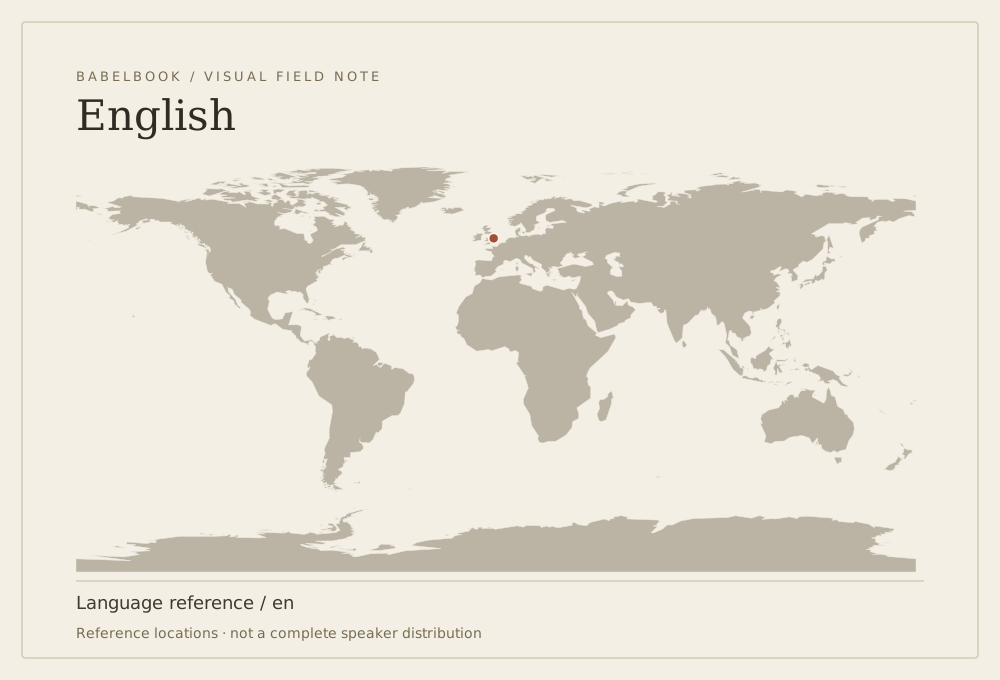
Representative reference points from Glottolog. Historical entries show reference locations, not current speakers. 1 point.
Reference & context ↗Babelbook · original editorial illustration · CC BY 4.0 · Glottolog locations; public-domain Natural Earth land
Source excerpts, selected, shortened and where noted editorially corrected from English language by Wikipedia contributors. Retrieved 2026-10-05. CC BY-SA 4.0. These excerpts are not an independently verified scholarly history; missing accounts are identified above.
Read further in the source
Geographical distribution
As of 2016, 400 million people spoke English as their first language, and 1.1 billion spoke it as a second language. English is the largest language by number of speakers, spoken by communities on every continent. Estimates of second‑language and foreign‑language speakers vary greatly depending on how proficiency is defined, ranging from 470 million to more than 1 billion. In 2003, David Crystal estimated that non‑native speakers outnumbered native speakers by a ratio of three to one.
Dialects, accents, and varieties
Dialectologists identify many English dialects, which usually refer to regional varieties that differ from each other in terms of patterns of grammar, vocabulary, and pronunciation. The pronunciation of particular areas distinguishes dialects as separate regional accents. The major native dialects of English are often divided by linguists into two extremely general categories: British English (BrE) and North American English (NAE).
Orthography
Since the 9th century, English has been written using the English alphabet, which uses the Latin script. Anglo-Saxon runes were previously used to write Old English, but only in short inscriptions; the overwhelming majority of attested writings in Old English are in the Old English Latin alphabet. English orthography is multi-layered and complex, with elements of French, Latin, and Greek spelling on top of the native Germanic system. Further complications have arisen through sound changes with which the orthography has not kept pace. Compared to European languages for which official organisations have promoted spelling reforms, English has spelling that is a less consistent indicator of pronunciation, and standard spellings of words that are more difficult to guess from knowing how a word is pronounced. There are also systematic spelling differences between British and American English. These situations have prompted proposals for spelling reform in English. Although letters and speech sounds do not have a one-to-one correspondence in standard English spelling, spelling rules that take into account syllable structure, phonetic changes in derived words, and word accent are reliable for most English words. Moreover, standard English spelling shows etymological relationships between related words that would be obscured by a closer correspondence between pronunciation and spelling – for example, the words photograph, photography, and photographic, or the words electricity and electrical. While few scholars agree with Chomsky and Halle (1968) that conventional English orthography is "near-optimal", there is a rationale for current English spelling patterns. The standard orthography of English is the most widely used writing system in the world. Standard English spelling is based on a graphomorphemic segmentation of words into written clues of what meaningful units make up each word. Readers of English can generally rely on the correspondence between spelling and pronunciation to be fairly regular for letters or digraphs used to spell consonant sounds. The letters b, d, f, h, j, k, l, m, n, p, r, s, t, v, w, y, z represent, respectively, the phonemes /b, d, f, h, dʒ, k, l, m, n, p, r, s, t, v, w, j, z/. The letters c and g normally represent /k/ and /ɡ/, but there is also a soft c pronounced /s/, and a soft g pronounced /dʒ/. The differences in the pronunciations of the letters c and g are often signalled by the following letters in standard English spelling. Digraphs used to represent phonemes and phoneme sequences include ch for /tʃ/, sh for /ʃ/, th for /θ/ or /ð/, ng for /ŋ/, qu for /kw/, and ph for /f/ in Greek-derived words. The single letter x is generally pronounced as /z/ in word-initial position and as /ks/ otherwise. There are exceptions to these generalisations, often the result of loanwords being spelled according to the spelling patterns of their languages of origin or residues of proposals by scholars in the early period of Modern English to follow the spelling patterns of Latin for English words of Germanic origin. For the vowel sounds of the English language, however, correspondences between spelling and pronunciation are more irregular. There are many more vowel phonemes in English than there are single vowel letters (a, e, i, o, u, y, and very rarely w). As a result, some "long vowels" are often indicated by combinations of letters (like the oa in boat, the ow in how, and the ay in stay), or the historically based silent e (as in note and cake). The consequence of this complex orthographic history is that learning to read and write can be challenging in English. It can take longer for school pupils to become independently fluent readers of English than of many other languages, including Italian, Spanish, and German. Nonetheless, there is an advantage for learners of English reading in learning the specific sound-symbol regularities that occur in the standard English spellings of commonly used words. Such instruction greatly reduces the risk of children experiencing reading difficulties in English. Making primary school teachers more aware of the primacy of morpheme representation in English may help learners learn more efficiently to read and write English. English writing also includes a system of punctuation marks that is similar to those used in most alphabetic languages around the world. The purpose of punctuation is to mark meaningful grammatical relationships in sentences to aid readers in understanding a text and to indicate features important for reading a text aloud.
Word origins
Throughout its history, English has been a particularly frequent borrower of loanwords from other languages. West Germanic words in use since the Anglo-Saxon period still comprise most of the language's core vocabulary, as well as most of its most frequently used words. Many sentences can be constructed without loanwords, but not without core Anglo-Saxon vocabulary. English has formal and informal speech registers; informal registers, including child-directed speech, tend to be made up predominantly of Anglo-Saxon vocabulary, while Latinate vocabulary appears more frequently in legal, scientific, and academic writing. Prolonged and intense contact with French has resulted in English having a very high proportion of Latinate words – with French loanwords borrowed during different stages of the language's history comprising 28 per cent of the English lexicon. In all periods of its history, English has also borrowed words from Latin directly, representing another 28 per cent of the lexicon. In turn, many of these words had originally entered Latin from Greek. Greek and Latin stems remain highly productive sources for new literary, technical, and scientific vocabulary in English. Loanwords from Old Norse primarily entered English between the 8th and 11th centuries, during the Norse colonisation of eastern and northern England, and typically displaced an Anglo-Saxon equivalent. Many represent core vocabulary – including give, get, sky, skirt, egg, and cake.