Middle English
Middle English (abbreviated to ME) refers to the variations of the English language that were spoken in England after the Norman Conquest of 1066, until the late 15th century, roughly coinciding with the High and Late Middle Ages. The Middle English dialects evolved from Old English under the influence of Anglo-Norman French and Old Norse. They were eventually replaced in England by Early Modern English, in Scotland by Early Scots, and in Ireland by the Fingallian language and the Yola language. The four main dialects in England were Northern, East Midland, West Midland, and Southern. Overall, Middle English exhibited significant regional variation in its vocabulary, grammar, pronunciation, and orthography. During the Middle English period, many Old English grammatical features either became simplified or disappeared altogether. Noun, adjective, and verb inflections were simplified by the reduction (and eventual elimination) of most grammatical case distinctions. Middle English also saw considerable adoption of Anglo-Norman vocabulary, especially in the areas of politics, law, the arts, and religion, as well as poetic and emotive diction. Conventional English vocabulary remained primarily Germanic in its sources, with Old Norse influences becoming more apparent.
Translate in Middle English ↗Middle English (abbreviated to ME) refers to the variations of the English language that were spoken in England after the Norman Conquest of 1066, until the late 15th century, roughly coinciding with the High and Late Middle Ages. The Middle English dialects evolved from Old English under the influence of Anglo-Norman French and Old Norse. They were eventually replaced in England by Early Modern English, in Scotland by Early Scots, and in Ireland by the Fingallian language and the Yola language. The four main dialects in England were Northern, East Midland, West Midland, and Southern. Overall, Middle English exhibited significant regional variation in its vocabulary, grammar, pronunciation, and orthography. During the Middle English period, many Old English grammatical features either became simplified or disappeared altogether. Noun, adjective, and verb inflections were simplified by the reduction (and eventual elimination) of most grammatical case distinctions. Middle English also saw considerable adoption of Anglo-Norman vocabulary, especially in the areas of politics, law, the arts, and religion, as well as poetic and emotive diction. Conventional English vocabulary remained primarily Germanic in its sources, with Old Norse influences becoming more apparent. Significant changes in pronunciation took place, particularly involving long vowels and diphthongs, which in the later Middle English period began to undergo the Great Vowel Shift. Little survives of early Middle English literature, due in part to Norman domination and the prestige that came with writing in French rather than English.
Europe
Present-day use
Emerging around 1430, the Chancery Standard was an official written English dialect firmly rooted in the East Midlands-influenced speech of London. This administrative script was pioneered in August 1417 when King Henry V began issuing his Signet letters to government officials in English, establishing a uniform style that directly influenced modern spelling. Multilingual clerks, proficient in French and Latin, shaped this blueprint by blending local London speech with Central East Midland Lollard texts. Although the Church and courts initially resisted by maintaining Latin and Law French, this national standard was slowly adopted by royal bureaucrats for most official purposes. The Chancery Standard's influence on later forms of written English is disputed, but it did undoubtedly provide the core around which Early Modern English formed. Early Modern English emerged with the help of William Caxton's printing press, developed during the 1470s. The press stabilized English through a push towards standardization, led by Chancery Standard enthusiast and writer Richard Pynson. Early Modern English began in the 1540s after the printing and wide distribution of the English Bible and Prayer Book, which made the new standard of English publicly recognisable and lasted until about 1650.
Origins
The captured article does not contain a separate origins section. See the historical account and linked source.
Development
The captured article does not contain a distinct historical account. No chronology has been invented.
Writing
With the discontinuation of the Late West Saxon standard used for the writing of Old English in the period prior to the Norman Conquest, Middle English came to be written in a wide variety of scribal forms, reflecting different regional dialects and orthographic conventions. Later in the Middle English period, however, and particularly with the development of the Chancery Standard in the 15th century, orthography became relatively standardised in a form based on the East Midlands-influenced speech of London. Spelling at the time was mostly quite regular. (There was a fairly consistent correspondence between letters and sounds.) The irregularity of present-day English orthography is largely due to pronunciation changes that have taken place over the Early Modern English and Modern English eras. Middle English generally did not have silent letters. For example, knight was pronounced [ˈkniçt] (with both the ⟨k⟩ and the ⟨gh⟩ pronounced, the latter sounding as the ⟨ch⟩ in German Ich). The major exception was the silent ⟨e⟩ – originally pronounced but lost in normal speech by Chaucer's time. This letter, however, came to indicate a lengthened – and later also modified – pronunciation of a preceding vowel. For example, in name, originally pronounced as two syllables, the /a/ in the first syllable (originally an open syllable) lengthened, the final weak vowel was later dropped, and the remaining long vowel was modified in the Great Vowel Shift (for these sound changes, see Phonology, above). The final ⟨e⟩, now silent, thus became the indicator of the longer and changed pronunciation of ⟨a⟩. In fact, vowels could have this lengthened and modified pronunciation in various positions, particularly before a single consonant letter and another vowel or before certain pairs of consonants. A related convention involved the doubling of consonant letters to show that the preceding vowel was not to be lengthened.
Beyond the typeface.
Signs, manuscripts, published pages and contextual photographs, with their place, period, source and reuse terms. Captions identify historical spellings, regional examples, community references and character imagery.
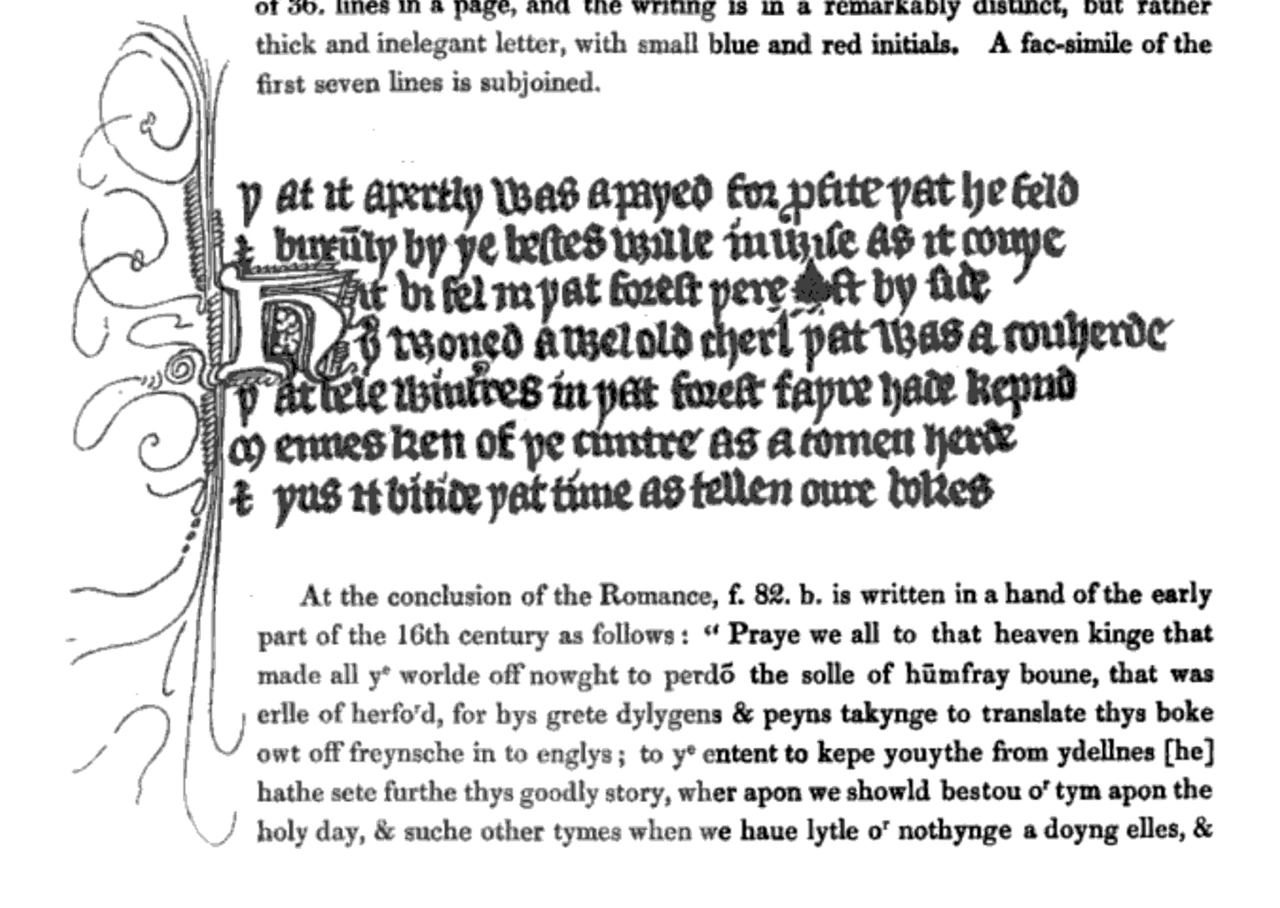
An 1832 printed facsimile of the opening seven lines of the Middle English romance in Cambridge, King's College, manuscript 13.
Saved in Babelbook · resized display copy. Select the image to open it independently of its source.
Frederick Madden · Source ↗Public domain ↗View the local visual field note
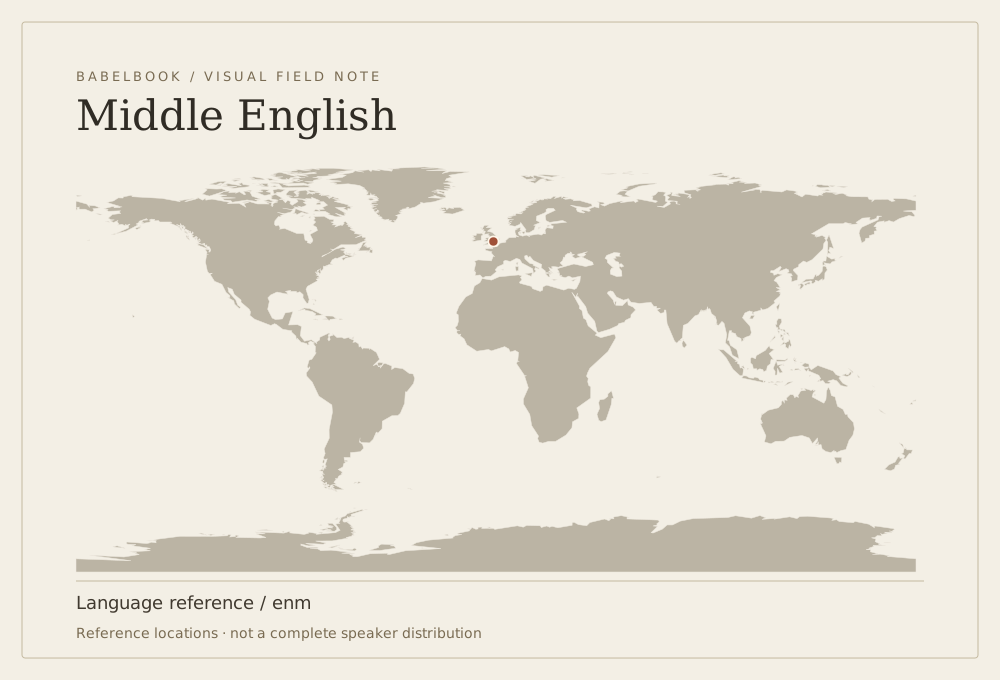
Representative reference points from Glottolog. Historical entries show reference locations, not current speakers. 1 point.
Reference & context ↗Babelbook · original editorial illustration · CC BY 4.0 · Glottolog locations; public-domain Natural Earth land
Source excerpts, selected, shortened and where noted editorially corrected from Middle English by Wikipedia contributors. Retrieved 2026-10-05. CC BY-SA 4.0. These excerpts are not an independently verified scholarly history; missing accounts are identified above.
Read further in the source
Orthography
With the discontinuation of the Late West Saxon standard used for the writing of Old English in the period prior to the Norman Conquest, Middle English came to be written in a wide variety of scribal forms, reflecting different regional dialects and orthographic conventions. Later in the Middle English period, however, and particularly with the development of the Chancery Standard in the 15th century, orthography became relatively standardised in a form based on the East Midlands-influenced speech of London. Spelling at the time was mostly quite regular. (There was a fairly consistent correspondence between letters and sounds.) The irregularity of present-day English orthography is largely due to pronunciation changes that have taken place over the Early Modern English and Modern English eras. Middle English generally did not have silent letters. For example, knight was pronounced [ˈkniçt] (with both the ⟨k⟩ and the ⟨gh⟩ pronounced, the latter sounding as the ⟨ch⟩ in German Ich). The major exception was the silent ⟨e⟩ – originally pronounced but lost in normal speech by Chaucer's time. This letter, however, came to indicate a lengthened – and later also modified – pronunciation of a preceding vowel. For example, in name, originally pronounced as two syllables, the /a/ in the first syllable (originally an open syllable) lengthened, the final weak vowel was later dropped, and the remaining long vowel was modified in the Great Vowel Shift (for these sound changes, see Phonology, above). The final ⟨e⟩, now silent, thus became the indicator of the longer and changed pronunciation of ⟨a⟩. In fact, vowels could have this lengthened and modified pronunciation in various positions, particularly before a single consonant letter and another vowel or before certain pairs of consonants. A related convention involved the doubling of consonant letters to show that the preceding vowel was not to be lengthened. In some cases, the double consonant represented a sound that was (or had previously been) geminated (i.e., had genuinely been "doubled" and would thus have regularly blocked the lengthening of the preceding vowel). In other cases, by analogy, the consonant was written double merely to indicate the lack of lengthening.