Esperanto
Esperanto (; Esperanto: [espeˈranto]) is the world's most widely spoken constructed auxiliary language. Created by L. L. Zamenhof in 1887 as 'the International Language' (la Lingvo Internacia), it is intended to be a universal second language for international communication. Esperanto culture is grounded in the idea that people can interact on an equal footing across language barriers, without linguistic hierarchies, and with respect for linguistic and cultural diversity. He described the language in Dr. Esperanto's International Language (known as Unua Libro, the 'first book'), which he published under the pseudonym Doktoro Esperanto. Early adopters of the language liked the name Esperanto ('one who hopes') so much, they soon used it to describe the language itself. Within the range of constructed languages, Esperanto occupies a middle ground between "naturalistic" (imitating existing natural languages) and a priori (where features are not based on existing languages). Esperanto's vocabulary, syntax, and semantics derive predominantly from languages of the Indo-European group. A substantial majority of its vocabulary (approximately 80%) derives from Romance languages, but it also contains elements derived from Germanic, Greek, and Slavic languages.
Translate in Esperanto ↗Esperanto is by far the most widely spoken constructed language in the world. Speakers are most numerous in Europe and East Asia, especially in urban areas, where they often form Esperanto clubs. Esperanto is particularly prevalent in the northern and central countries of Europe; in China, South Korea, Japan, and Iran within Asia; in Brazil, and the United States in the Americas; and in Togo in Africa. Countering a common criticism against Esperanto, the statistician Svend Nielsen has found no significant correlation between the number of Esperanto speakers and the similarity of a given national native language to Esperanto. He concludes that Esperanto tends to be more popular in rich countries with widespread Internet access and a tendency to contribute more to science and culture. Linguistic diversity within a country was found to have no, or perhaps a slightly reductive, correlation with Esperanto popularity. An estimate of the number of Esperanto speakers was made by Sidney S. Culbert, a retired psychology professor at the University of Washington and a longtime Esperantist, who tracked down and tested Esperanto speakers in sample areas in dozens of countries over a period of twenty years. Culbert concluded that between one and two million people speak Esperanto at Foreign Service Level 3, "professionally proficient" (able to communicate moderately complex ideas without hesitation, and to follow speeches, radio broadcasts, etc.). Culbert's estimate was not made for Esperanto alone, but formed part of his listing of estimates for all languages of more than one million speakers, published annually in the World Almanac and Book of Facts. Culbert's most detailed account of his methodology is found in a 1989 letter to David Wolff.
Global / other
Present-day use
In 1954, the United Nations — through UNESCO — granted official support to Esperanto as an international auxiliary language in the Montevideo Resolution. However, Esperanto is not one of the six official languages of the UN. The development of Esperanto has continued unabated into the 21st century. The advent of the Internet has had a significant impact on the language, as learning it has become increasingly accessible on platforms such as Duolingo, and as speakers have increasingly networked on platforms such as Amikumu. With up to two million speakers, it is the most widely spoken constructed language in the world. Although no country has adopted Esperanto officially, Esperantujo ("Esperanto-land") is the name given to the collection of places where it is spoken. On 22 February 2012, Google Translate added Esperanto as its 64th language. On 25 July 2016, Yandex Translate added Esperanto as a language. As of August 2026, Esperanto Wikipedia (Vikipedio) contains about 390,000 articles, making it the 37th-largest Wikipedia, as measured by the number of articles, and is the largest Wikipedia in a constructed language. About 150,000 users consult the Vikipedio regularly, as attested by Wikipedia's automatically aggregated log-in data, which showed that in October 2019 the website has 117,366 unique individual visitors per month, plus 33,572 who view the site on a mobile device instead.
Origins
The captured article does not contain a separate origins section. See the historical account and linked source.
Development
In 1954, the United Nations — through UNESCO — granted official support to Esperanto as an international auxiliary language in the Montevideo Resolution. However, Esperanto is not one of the six official languages of the UN. The development of Esperanto has continued unabated into the 21st century. The advent of the Internet has had a significant impact on the language, as learning it has become increasingly accessible on platforms such as Duolingo, and as speakers have increasingly networked on platforms such as Amikumu. With up to two million speakers, it is the most widely spoken constructed language in the world. Although no country has adopted Esperanto officially, Esperantujo ("Esperanto-land") is the name given to the collection of places where it is spoken. On 22 February 2012, Google Translate added Esperanto as its 64th language. On 25 July 2016, Yandex Translate added Esperanto as a language. As of August 2026, Esperanto Wikipedia (Vikipedio) contains about 390,000 articles, making it the 37th-largest Wikipedia, as measured by the number of articles, and is the largest Wikipedia in a constructed language. About 150,000 users consult the Vikipedio regularly, as attested by Wikipedia's automatically aggregated log-in data, which showed that in October 2019 the website has 117,366 unique individual visitors per month, plus 33,572 who view the site on a mobile device instead.
Writing
Latin or customary script (catalog classification; see the source for context).
Beyond the typeface.
Signs, manuscripts, published pages and contextual photographs, with their place, period, source and reuse terms. Captions identify historical spellings, regional examples, community references and character imagery.
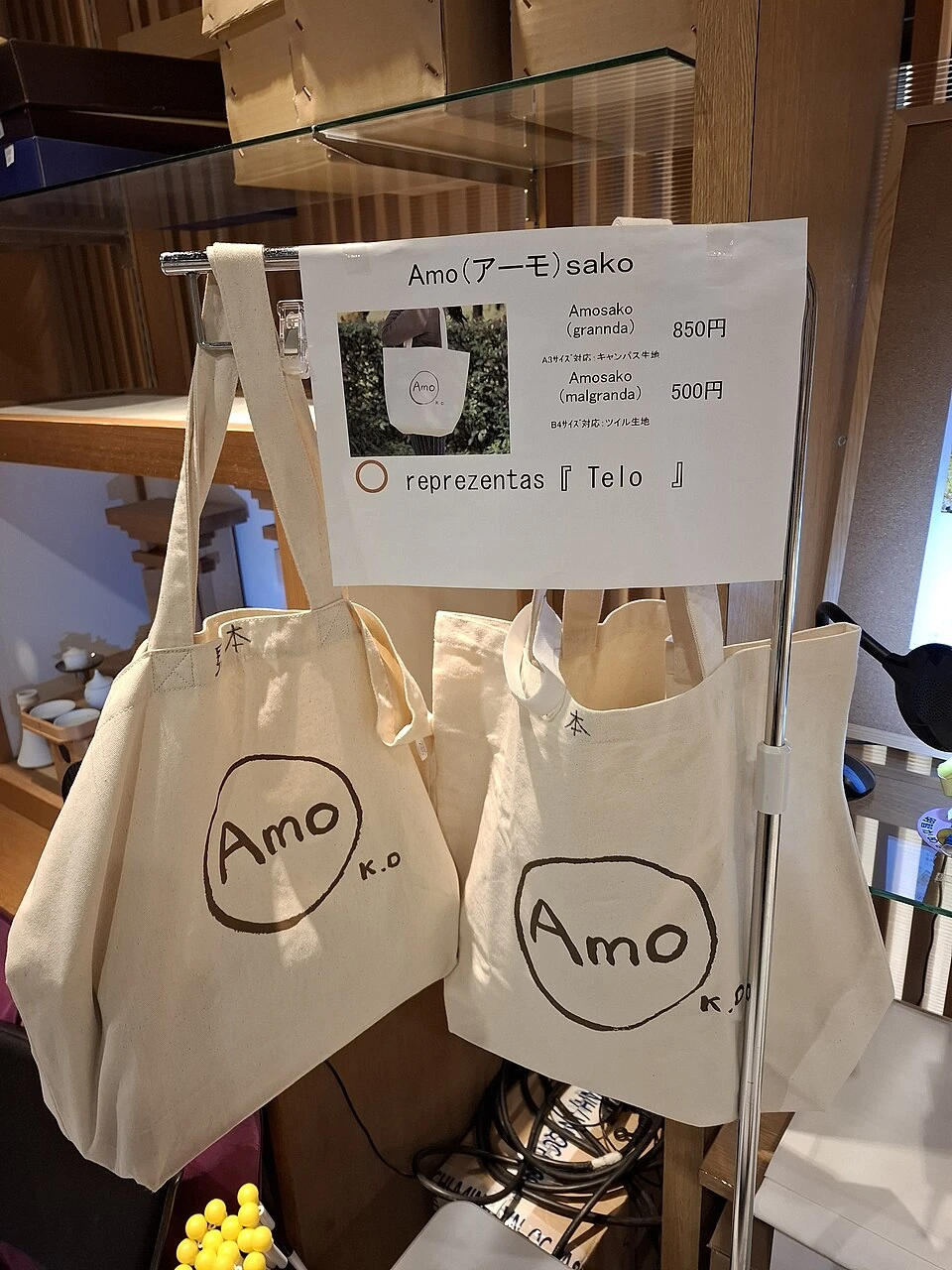
Esperanto and Japanese shop sign for bags at the Oomoto headquarters store, Kameoka. Language identification follows Commons metadata; not independently transcribed.
Saved in Babelbook · resized display copy. Select the image to open it independently of its source.
Kuroshiononeko · Source ↗CC0 1.0 ↗View the local visual field note
This constructed-language or category entry has no geographic reference points in the collection.
Reference & context ↗Babelbook · original editorial illustration · Babelbook original illustration
Source excerpts, selected, shortened and where noted editorially corrected from Esperanto by Wikipedia contributors. Retrieved 2026-10-05. CC BY-SA 4.0. These excerpts are not an independently verified scholarly history; missing accounts are identified above.
Read further in the source
Modern history
In 1954, the United Nations — through UNESCO — granted official support to Esperanto as an international auxiliary language in the Montevideo Resolution. However, Esperanto is not one of the six official languages of the UN.
The development of Esperanto has continued unabated into the 21st century. The advent of the Internet has had a significant impact on the language, as learning it has become increasingly accessible on platforms such as Duolingo, and as speakers have increasingly networked on platforms such as Amikumu. With up to two million speakers, it is the most widely spoken constructed language in the world. Although no country has adopted Esperanto officially, Esperantujo ("Esperanto-land") is the name given to the collection of places where it is spoken. On 22 February 2012, Google Translate added Esperanto as its 64th language. On 25 July 2016, Yandex Translate added Esperanto as a language. As of August 2026, Esperanto Wikipedia (Vikipedio) contains about 390,000 articles, making it the 37th-largest Wikipedia, as measured by the number of articles, and is the largest Wikipedia in a constructed language. About 150,000 users consult the Vikipedio regularly, as attested by Wikipedia's automatically aggregated log-in data, which showed that in October 2019 the website has 117,366 unique individual visitors per month, plus 33,572 who view the site on a mobile device instead.
Geography and demography
Esperanto is by far the most widely spoken constructed language in the world. Speakers are most numerous in Europe and East Asia, especially in urban areas, where they often form Esperanto clubs. Esperanto is particularly prevalent in the northern and central countries of Europe; in China, South Korea, Japan, and Iran within Asia; in Brazil, and the United States in the Americas; and in Togo in Africa. Countering a common criticism against Esperanto, the statistician Svend Nielsen has found no significant correlation between the number of Esperanto speakers and the similarity of a given national native language to Esperanto. He concludes that Esperanto tends to be more popular in rich countries with widespread Internet access and a tendency to contribute more to science and culture. Linguistic diversity within a country was found to have no, or perhaps a slightly reductive, correlation with Esperanto popularity.
Number of speakers
An estimate of the number of Esperanto speakers was made by Sidney S. Culbert, a retired psychology professor at the University of Washington and a longtime Esperantist, who tracked down and tested Esperanto speakers in sample areas in dozens of countries over a period of twenty years. Culbert concluded that between one and two million people speak Esperanto at Foreign Service Level 3, "professionally proficient" (able to communicate moderately complex ideas without hesitation, and to follow speeches, radio broadcasts, etc.). Culbert's estimate was not made for Esperanto alone, but formed part of his listing of estimates for all languages of more than one million speakers, published annually in the World Almanac and Book of Facts. Culbert's most detailed account of his methodology is found in a 1989 letter to David Wolff. Since Culbert never published detailed intermediate results for particular countries and regions, it is difficult to independently gauge the accuracy of his results. In the Almanac, his estimates for numbers of language speakers were rounded to the nearest million, thus the number of Esperanto speakers is shown as two million. This latter figure appears in Ethnologue. Assuming that this figure is accurate, that means that about 0.03% of the world's population speaks the language. Although it does not meet Zamenhof's goal of a universal language, it still represents a level of popularity unmatched by any other constructed language. Marcus Sikosek (now Ziko van Dijk) has challenged this figure of 1.6 million as exaggerated. He estimated that even if Esperanto speakers were evenly distributed, assuming one million Esperanto speakers worldwide would lead one to expect about 180 in the city of Cologne. Van Dijk finds only 30 fluent speakers in that city, and similarly smaller-than-expected figures in several other places thought to have a larger-than-average concentration of Esperanto speakers. He also notes that there are a total of about 20,000 members of the various Esperanto organizations (other estimates are higher). Though there are undoubtedly many Esperanto speakers who are not members of any Esperanto organization, he thinks it unlikely that there are fifty times more speakers than organization members. In 1996, Finnish linguist Jouko Lindstedt, an expert on native-born Esperanto speakers, presented the following scheme to show the overall proportions of language capabilities within the Esperanto community:
1,000 have Esperanto as their native family language. 10,000 speak it fluently. 100,000 can use it actively. One million understand a large amount passively. Ten million have studied it to some extent at some time. In 2017, doctoral student Svend Nielsen estimated around 63,000 Esperanto speakers worldwide, taking into account association memberships, user-generated data from Esperanto websites and census statistics. This number, however, was disputed by statistician Sten Johansson, who questioned the reliability of the source data and highlighted a wide margin of error, the latter point with which Nielsen agrees. Both have stated, however, that this new number is likely more realistic than some earlier projections. In the absence of Culbert's detailed sampling data, or any other census data, it is impossible to state the number of speakers with certainty. According to the website of the Universal Esperanto Association:
Numbers of textbooks sold and membership of local societies put "the number of people with some knowledge of the language in the hundreds of thousands and possibly millions".
Native speakers
Native Esperanto speakers (eo: denaskuloj, lit. 'person from/since birth') have learned the language from birth from Esperanto-speaking parents. This usually happens when Esperanto is the chief or only common language in an international family, but sometimes occurs in a family of Esperanto speakers who often use the language. In 2004, an estimated 2,000 children in about a thousand families use Esperanto as one of their languages. Citing this research, the 2022 edition of Ethnologue gives 1,000 first language users. However, native speakers do not occupy an authoritative position in the Esperanto community, as they would in other language communities. This presents a challenge to linguists, whose usual source of grammaticality and meanings are native speakers.