Spanish
Spanish (español) or Castilian (castellano) is a Romance language of the Indo-European language family that evolved from the Vulgar Latin spoken on the Iberian Peninsula of Europe. It originated in the Kingdom of Castile, a kingdom in north-central Iberia. Today, it is a global language with 519 million native speakers, mainly in the Americas and Spain, and about 636 million speakers total, including second-language speakers. Spanish is the official language of 21 countries, as well as one of the six official languages of the United Nations. Spanish is the world's second-most spoken native language after Mandarin Chinese; the world's fourth-most spoken language overall after English, Mandarin Chinese, and Hindustani (Hindi-Urdu); and the world's most widely spoken Romance language. The country with the largest population of native speakers is Mexico, with 130M speakers, almost triple that of the United States of America. Spanish is part of the Ibero-Romance language group, which evolved from several dialects of Vulgar Latin in Iberia after the collapse of the Western Roman Empire in the 5th century. The oldest Latin texts with traces of Spanish come from mid-northern Iberia in the 9th century, and the first systematic written use of the language happened in Toledo, a prominent city of the Kingdom of Castile, in the 13th century. Spanish colonialism in the early modern period spurred the introduction of the language to overseas locations, most notably to the Americas. As a Romance language, Spanish is a descendant of Latin.
Translate in Spanish ↗Spanish is the primary language in 20 countries worldwide. As of 2025, it is estimated that about 519 million people speak Spanish as a native language, making it the second most spoken language by number of native speakers. An additional 117 million speak Spanish as a second or foreign language, making it the fourth most spoken language in the world overall after English, Mandarin Chinese, and Hindi with a total number of 636 million speakers. Spanish is also the third most used language on the Internet, after English and Chinese. 20 countries and one United States territory speak Spanish officially, and the language has a significant unofficial presence in the rest of the United States along with Andorra, Belize and the territory of Gibraltar. Spanish is the official, or national language in 18 countries and one "Unincorporated" territory in the Americas, Spain, Equatorial Guinea and co-official in the non-self-governing territory with limited recognition of Western Sahara (RASD) With a population of over 410 million, Hispanophone America accounts for the vast majority of Spanish speakers, of which Mexico is the most populous Spanish-speaking country. In the European Union, Spanish is the mother tongue of 8% of the population, with an additional 7% speaking it as a second language. Additionally, Spanish is the second most spoken language in the United States and is by far the most popular foreign language among students. In 2015, it was estimated that over 50 million U.S.citizens, about 41 million of whom were native speakers. With continued immigration and increased use of the language domestically in public spheres and media, the number of Spanish speakers in the United States is expected to continue growing over the forthcoming decades. Although vos is not used in Spain, it occurs in many Spanish-speaking regions of the Americas as the primary spoken form of the second-person singular familiar pronoun, with wide differences in social consideration.
Europe
Present-day use
The captured source does not contain a separate current-use account.
Origins
The term castellano is related to Castile (Castilla or archaically Castiella), the kingdom where the language was originally spoken. The name Castile, in turn, is usually assumed to be derived from castillo ('castle'). In the Middle Ages, the language spoken in Castile was generically referred to as Romance and later also as Lengua vulgar. Later in the period, it gained geographical specification as Romance castellano (romanz castellano, romanz de Castiella), lenguaje de Castiella, and ultimately simply as castellano (noun). Different etymologies have been suggested for the term español (Spanish). According to the Royal Spanish Academy, español derives from the Occitan word espaignol and that, in turn, derives from the Vulgar Latin *hispaniolus ('of Hispania'). Hispania was the Roman name for the entire Iberian Peninsula. There are other hypotheses apart from the one suggested by the Royal Spanish Academy. Spanish philologist Ramón Menéndez Pidal suggested that the classic hispanus or hispanicus took the suffix -one from Vulgar Latin, as happened with other words such as bretón (Breton) or sajón (Saxon).
Development
Like the other Romance languages, the Spanish language evolved from Vulgar Latin, which was brought to the Iberian Peninsula by the Romans during the Second Punic War, beginning in 210 BC. Several pre-Roman languages (also called Paleohispanic languages)—some distantly related to Latin as Indo-European languages, and some that are not related at all—were previously spoken in the Iberian Peninsula. These languages included Proto-Basque, Iberian, Lusitanian, Celtiberian and Gallaecian. The first documents to show traces of what is today regarded as the precursor of modern Spanish are from the 9th century. Throughout the Middle Ages and into the modern era, the most important influences on the Spanish lexicon came from neighboring Romance languages—Mozarabic (Andalusi Romance), Navarro-Aragonese, Leonese, Catalan/Valencian, Portuguese, Galician, Occitan, and later, French and Italian. Spanish also borrowed a considerable number of words from Andalusi Arabic, and a few from Basque. In addition, many more words were borrowed from Latin through the influence of written language and the liturgical language of the Church. The loanwords were taken from both Classical Latin and Renaissance Latin, the form of Latin in use at that time. According to the theories of Ramón Menéndez Pidal, local sociolects of Vulgar Latin evolved into Spanish, in the north of Iberia, in an area centered in the city of Burgos, and this dialect was later brought to the city of Toledo, where the written standard of Spanish was first developed, in the 13th century. In this formative stage, Spanish developed a strongly differing variant from its close cousin, Leonese, and, according to some authors, was distinguished by a heavy Basque influence (see Iberian Romance languages).
Writing
Spanish is written in the Latin script, with the addition of the character ⟨ñ⟩ (eñe, representing the phoneme /ɲ/, a letter distinct from ⟨n⟩, although typographically composed of an ⟨n⟩ with a tilde). Formerly the digraphs ⟨ch⟩ (che, representing the phoneme /t͡ʃ/) and ⟨ll⟩ (elle, representing the phoneme /ʎ/ or /ʝ/), were also considered single letters. However, the digraph ⟨rr⟩ (erre fuerte, 'strong r', erre doble, 'double r', or simply erre), which also represents a distinct phoneme /r/, was not similarly regarded as a single letter. Since 1994 ⟨ch⟩ and ⟨ll⟩ have been treated as letter pairs for collation purposes, though they remained a part of the alphabet until 2010. Words with ⟨ch⟩ are now alphabetically sorted between those with ⟨cg⟩ and ⟨ci⟩, instead of following ⟨cz⟩ as they used to. The situation is similar for ⟨ll⟩. Thus, the Spanish alphabet has the following 27 letters: A, B, C, D, E, F, G, H, I, J, K, L, M, N, Ñ, O, P, Q, R, S, T, U, V, W, X, Y, Z. Since 2010, none of the digraphs (ch, ll, rr, gu, qu) are considered letters by the Royal Spanish Academy. The letters k and w are used only in words and names coming from foreign languages (kilo, folklore, whisky, kiwi, etc.). With the exclusion of a very small number of regional terms such as México (see Toponymy of Mexico), pronunciation can be entirely determined from spelling. Under the orthographic conventions, a typical Spanish word is stressed on the syllable before the last if it ends with a vowel (not including ⟨y⟩) or with a vowel followed by ⟨n⟩ or an ⟨s⟩; it is stressed on the last syllable otherwise.
Beyond the typeface.
Signs, manuscripts, published pages and contextual photographs, with their place, period, source and reuse terms. Captions identify historical spellings, regional examples, community references and character imagery.
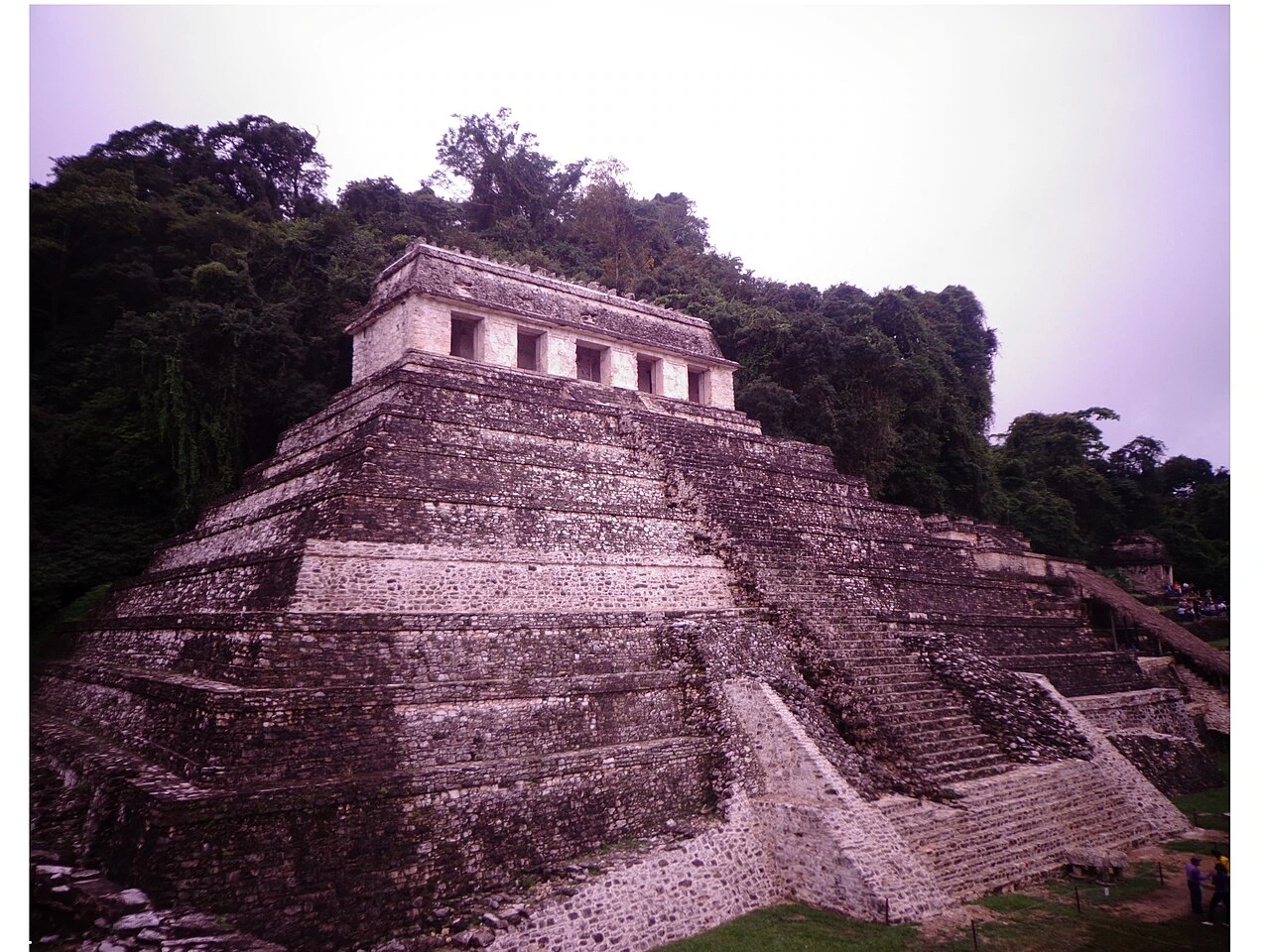
“¡Prohibido el paso!” sign at Palenque, photographed in 2012. Modern Spanish. Displayed at reduced size; no additional crop.
Saved in Babelbook · resized display copy. Select the image to open it independently of its source.
Le Chule · Source ↗CC BY-SA 3.0 ↗View the local visual field note
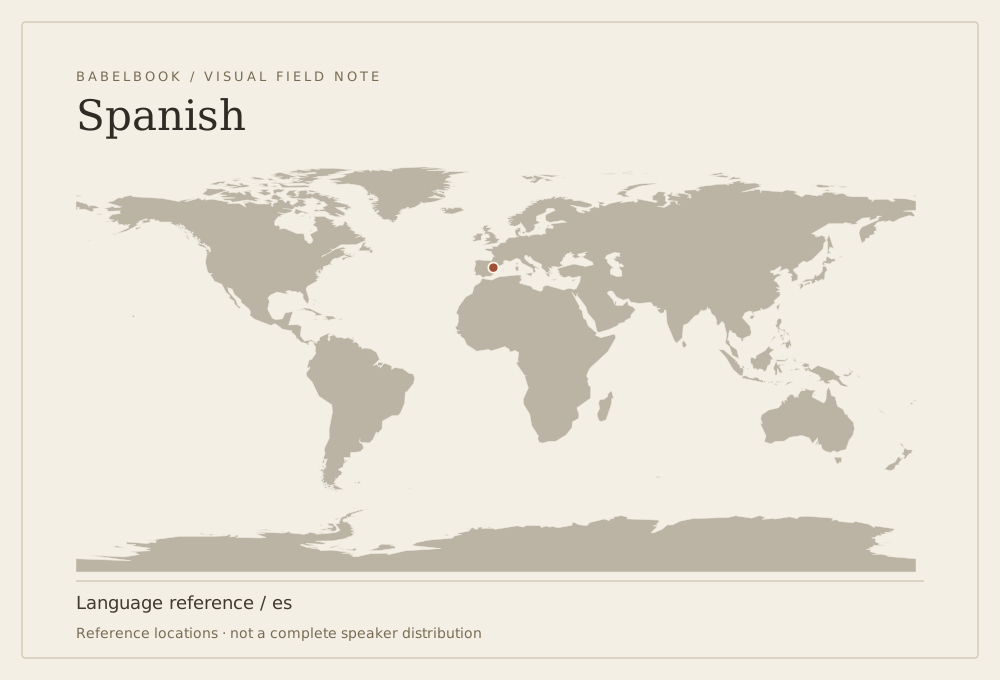
Representative reference points from Glottolog. Historical entries show reference locations, not current speakers. 1 point.
Reference & context ↗Babelbook · original editorial illustration · CC BY 4.0 · Glottolog locations; public-domain Natural Earth land
Source excerpts, selected, shortened and where noted editorially corrected from Spanish language by Wikipedia contributors. Retrieved 2026-10-05. CC BY-SA 4.0. These excerpts are not an independently verified scholarly history; missing accounts are identified above.
Read further in the source
History
Like the other Romance languages, the Spanish language evolved from Vulgar Latin, which was brought to the Iberian Peninsula by the Romans during the Second Punic War, beginning in 210 BC. Several pre-Roman languages (also called Paleohispanic languages)—some distantly related to Latin as Indo-European languages, and some that are not related at all—were previously spoken in the Iberian Peninsula. These languages included Proto-Basque, Iberian, Lusitanian, Celtiberian and Gallaecian. The first documents to show traces of what is today regarded as the precursor of modern Spanish are from the 9th century. Throughout the Middle Ages and into the modern era, the most important influences on the Spanish lexicon came from neighboring Romance languages—Mozarabic (Andalusi Romance), Navarro-Aragonese, Leonese, Catalan/Valencian, Portuguese, Galician, Occitan, and later, French and Italian. Spanish also borrowed a considerable number of words from Andalusi Arabic, and a few from Basque. In addition, many more words were borrowed from Latin through the influence of written language and the liturgical language of the Church. The loanwords were taken from both Classical Latin and Renaissance Latin, the form of Latin in use at that time. According to the theories of Ramón Menéndez Pidal, local sociolects of Vulgar Latin evolved into Spanish, in the north of Iberia, in an area centered in the city of Burgos, and this dialect was later brought to the city of Toledo, where the written standard of Spanish was first developed, in the 13th century. In this formative stage, Spanish developed a strongly differing variant from its close cousin, Leonese, and, according to some authors, was distinguished by a heavy Basque influence (see Iberian Romance languages). This distinctive dialect spread to southern Spain with the advance of the Reconquista, and meanwhile gathered a sizable lexical influence from the Arabic of Al-Andalus, much of it indirectly, through the Romance Mozarabic dialects (some 4,000 Arabic-derived words, make up about 8% of the language today). The written standard for this new language was developed in the cities of Toledo, in the 13th to 16th centuries, and Madrid, from the 1570s. The development of the Spanish sound system from that of Vulgar Latin exhibits most of the changes that are typical of Western Romance languages, including lenition of intervocalic consonants (thus Latin vīta > Spanish vida). The diphthongization of Latin stressed short e and o—which occurred in open syllables in French and Italian, but not at all in Catalan or Portuguese—is found in both open and closed syllables in Spanish, as shown in the following table:
Spanish is marked by palatalization of the Latin double consonants (geminates) nn and ll (thus Latin annum > Spanish año, and Latin anellum > Spanish anillo). The consonant written u or v in Latin and pronounced [w] in Classical Latin had probably "fortified" to a bilabial fricative /β/ in Vulgar Latin. In early Spanish (but not in Catalan or Portuguese) it merged with the consonant written b (a bilabial with plosive and fricative allophones). In modern Spanish, there is no difference between the pronunciation of orthographic b and v. Typical of Spanish (as also of neighboring Gascon extending as far north as the Gironde estuary, and found in a small area of Calabria), attributed by some scholars to a Basque substratum was the mutation of Latin initial f into h- whenever it was followed by a vowel that did not diphthongize. The h-, still preserved in spelling, is now silent in most varieties of the language, although in some Andalusian and Caribbean dialects, it is still aspirated in some words. Because of borrowings from Latin and neighboring Romance languages, there are many f-/h- doublets in modern Spanish: Fernando and Hernando (both Spanish for "Ferdinand"), ferrero and herrero (both Spanish for "smith"), fierro and hierro (both Spanish for "iron"), and fondo and hondo (both words pertaining to depth in Spanish, though fondo means "bottom", while hondo means "deep"); additionally, hacer ("to make") is cognate to the root word of satisfacer ("to satisfy"), and hecho ("made") is similarly cognate to the root word of satisfecho ("satisfied"). Compare the examples in the following table:
Some consonant clusters of Latin also produced characteristically different results in these languages, as shown in the examples in the following table:
In the 15th and 16th centuries, Spanish underwent a dramatic change in the pronunciation of its sibilant consonants, known in Spanish as the reajuste de las sibilantes, which resulted in the distinctive velar [x] pronunciation of the letter ⟨j⟩ and—in a large part of Spain—the characteristic interdental [θ] ("th-sound") for the letter ⟨z⟩ (and for ⟨c⟩ before ⟨e⟩ or ⟨i⟩). See History of Spanish (Modern development of the Old Spanish sibilants) for details. The Gramática de la lengua castellana, written in Salamanca in 1492 by Elio Antonio de Nebrija, was the first grammar written for a modern European language. According to a popular anecdote, when Nebrija presented it to Queen Isabella I, she asked him what was the use of such a work, and he answered that language is the instrument of empire. In his introduction to the grammar, dated 18 August 1492, Nebrija wrote that "... language was always the companion of empire." From the 16th century onwards, the language was taken to the Spanish-discovered America and the Spanish East Indies via Spanish colonization of America. Miguel de Cervantes, author of Don Quixote, is such a well-known reference in the world that Spanish is often called la lengua de Cervantes ("the language of Cervantes"). In the 20th century, Spanish was introduced to Equatorial Guinea and the Western Sahara, and to areas of the United States that had not been part of the Spanish Empire, such as Spanish Harlem in New York City. For details on borrowed words and other external influences upon Spanish, see Influences on the Spanish language.
Geographical distribution
Spanish is the primary language in 20 countries worldwide. As of 2025, it is estimated that about 519 million people speak Spanish as a native language, making it the second most spoken language by number of native speakers. An additional 117 million speak Spanish as a second or foreign language, making it the fourth most spoken language in the world overall after English, Mandarin Chinese, and Hindi with a total number of 636 million speakers. Spanish is also the third most used language on the Internet, after English and Chinese.
Spanish speakers by country
20 countries and one United States territory speak Spanish officially, and the language has a significant unofficial presence in the rest of the United States along with Andorra, Belize and the territory of Gibraltar.
Speaker population
Spanish is the official, or national language in 18 countries and one "Unincorporated" territory in the Americas, Spain, Equatorial Guinea and co-official in the non-self-governing territory with limited recognition of Western Sahara (RASD) With a population of over 410 million, Hispanophone America accounts for the vast majority of Spanish speakers, of which Mexico is the most populous Spanish-speaking country. In the European Union, Spanish is the mother tongue of 8% of the population, with an additional 7% speaking it as a second language. Additionally, Spanish is the second most spoken language in the United States and is by far the most popular foreign language among students. In 2015, it was estimated that over 50 million U.S.citizens, about 41 million of whom were native speakers. With continued immigration and increased use of the language domestically in public spheres and media, the number of Spanish speakers in the United States is expected to continue growing over the forthcoming decades.
Dialectal variation
While being mutually intelligible, there are important variations (phonological, grammatical, and lexical) in the spoken Spanish of the various regions of Spain and throughout the Spanish-speaking areas of the Americas. The national variety with the most speakers is Mexican Spanish. It is spoken by more than twenty percent of the world's Spanish speakers (more than 112 million of the total of more than 500 million, according to the table above). One of its main features is the reduction or loss of unstressed vowels, mainly when they are in contact with the sound /s/. In Spain, northern dialects are popularly thought of as closer to the standard, although positive attitudes toward southern dialects have increased significantly in the last 50 years. The speech from the educated classes of Madrid is the standard variety for use on radio and television in Spain and it is indicated by many as the one that has most influenced the written standard for Spanish. Central (European) Spanish speech patterns have been noted to be in the process of merging with more innovative southern varieties (including Eastern Andalusian and Murcian), as an emerging interdialectal levelled koine buffered between the Madrid's traditional national standard and the Seville speech trends.
Distribution in Spanish-speaking regions of the Americas
Although vos is not used in Spain, it occurs in many Spanish-speaking regions of the Americas as the primary spoken form of the second-person singular familiar pronoun, with wide differences in social consideration. Generally, it can be said that there are zones of exclusive use of tuteo (the use of tú) in the following areas: almost all of Mexico, the West Indies, Panama, most of Colombia, Peru, Venezuela and coastal Ecuador. Tuteo as a cultured form alternates with voseo as a popular or rural form in Bolivia, in the north and south of Peru, in Andean Ecuador, in small zones of the Venezuelan Andes (and most notably in the Venezuelan state of Zulia), and in a large part of Colombia. Some researchers maintain that voseo can be heard in some parts of eastern Cuba, and others assert that it is absent from the island. Tuteo exists as the second-person usage with an intermediate degree of formality alongside the more familiar voseo in Chile, in the Venezuelan state of Zulia, on the Caribbean coast of Colombia, in the Azuero Peninsula in Panama, in the Mexican state of Chiapas, and in parts of Guatemala. Areas of generalized voseo include Argentina, Nicaragua, eastern Bolivia, El Salvador, Guatemala, Honduras, Costa Rica, Paraguay, Uruguay and the Colombian departments of Antioquia, Caldas, Risaralda, Quindio and Valle del Cauca.
Writing system
Spanish is written in the Latin script, with the addition of the character ⟨ñ⟩ (eñe, representing the phoneme /ɲ/, a letter distinct from ⟨n⟩, although typographically composed of an ⟨n⟩ with a tilde). Formerly the digraphs ⟨ch⟩ (che, representing the phoneme /t͡ʃ/) and ⟨ll⟩ (elle, representing the phoneme /ʎ/ or /ʝ/), were also considered single letters. However, the digraph ⟨rr⟩ (erre fuerte, 'strong r', erre doble, 'double r', or simply erre), which also represents a distinct phoneme /r/, was not similarly regarded as a single letter. Since 1994 ⟨ch⟩ and ⟨ll⟩ have been treated as letter pairs for collation purposes, though they remained a part of the alphabet until 2010. Words with ⟨ch⟩ are now alphabetically sorted between those with ⟨cg⟩ and ⟨ci⟩, instead of following ⟨cz⟩ as they used to. The situation is similar for ⟨ll⟩. Thus, the Spanish alphabet has the following 27 letters:
A, B, C, D, E, F, G, H, I, J, K, L, M, N, Ñ, O, P, Q, R, S, T, U, V, W, X, Y, Z. Since 2010, none of the digraphs (ch, ll, rr, gu, qu) are considered letters by the Royal Spanish Academy. The letters k and w are used only in words and names coming from foreign languages (kilo, folklore, whisky, kiwi, etc.). With the exclusion of a very small number of regional terms such as México (see Toponymy of Mexico), pronunciation can be entirely determined from spelling. Under the orthographic conventions, a typical Spanish word is stressed on the syllable before the last if it ends with a vowel (not including ⟨y⟩) or with a vowel followed by ⟨n⟩ or an ⟨s⟩; it is stressed on the last syllable otherwise. Exceptions to this rule are indicated by placing an acute accent on the stressed vowel. The acute accent is used, in addition, to distinguish between certain homophones, especially when one of them is a stressed word and the other one is a clitic: compare el ('the', masculine singular definite article) with él ('he' or 'it'), or te ('you', object pronoun) with té ('tea'), de (preposition 'of') versus dé ('give' [formal imperative/third-person present subjunctive]), and se (reflexive pronoun) versus sé ('I know' or imperative 'be'). The interrogative pronouns (qué, cuál, dónde, quién, etc.) also receive accents in direct or indirect questions, and some demonstratives (ése, éste, aquél, etc.) can be accented when used as pronouns. Accent marks used to be omitted on capital letters (a widespread practice in the days of typewriters and the early days of computers when only lowercase vowels were available with accents), although the Real Academia Española advises against this and the orthographic conventions taught at schools enforce the use of the accent. When u is written between g and a front vowel e or i, it indicates a "hard g" pronunciation. A diaeresis ü indicates that it is not silent as it normally would be (e.g., cigüeña, 'stork', is pronounced [θiˈɣweɲa]; if it were written *cigueña, it would be pronounced *[θiˈɣeɲa]). Interrogative and exclamatory clauses are introduced with inverted question and exclamation marks (¿ and ¡, respectively) and closed by the usual question and exclamation marks.