Estonian
Estonian (eesti keel [ˈeːsʲti ˈkeːl] ) is a Uralic language, and is the official language of Estonia. Estonian is written using the Latin alphabet and is the first language of the majority of the country's population; it is also an official language of the European Union. Estonian is spoken natively by about 1.1 million people: 922,000 people in Estonia and 160,000 elsewhere.
Translate in Estonian ↗Estonian (eesti keel [ˈeːsʲti ˈkeːl] ) is a Uralic language, and is the official language of Estonia. Estonian is written using the Latin alphabet and is the first language of the majority of the country's population; it is also an official language of the European Union. Estonian is spoken natively by about 1.1 million people: 922,000 people in Estonia and 160,000 elsewhere.
Europe
Present-day use
The captured source does not contain a separate current-use account.
Origins
The captured article does not contain a separate origins section. See the historical account and linked source.
Development
The speakers of the two major historical languages spoken in Estonia, North and South Estonian, are thought by some linguists to have arrived in Estonia in at least two different migration waves over two millennia ago, both groups having spoken considerably different vernacular. Some linguists have classified South Estonian as another, separate Finnic language, rather than a variety of Estonian. Modern standard Estonian evolved in the 18th and 19th centuries based on the dialects of northern Estonia. During the Medieval and Early Modern periods, Estonian accepted many loanwords from Germanic languages, mainly from Middle Low German (Middle Saxon) and, after the 16th-century Protestant Reformation, from the Standard German language. The oldest written records of the Estonian language date from the 13th century. The "Originates Livoniae" in the Livonian Chronicle of Henry contains Estonian place names, words and fragments of sentences.
Writing
Although Estonian orthography is generally guided by phonemic principles, with each grapheme corresponding to one phoneme, there are some historical and morphological deviations from this: for example preservation of the morpheme in declension of the word (writing b, g, d in places where p, k, t is pronounced) and in the use of 'i' and 'j'. Where it is very impractical or impossible to type š and ž, they are replaced by sh and zh in some written texts, although this is considered incorrect. Otherwise, the h in sh represents a voiceless glottal fricative, as in Pasha (pas-ha); this also applies to some foreign names. Modern Estonian orthography is based on the "Newer Orthography" created by Eduard Ahrens in the second half of the 19th century, which was based on Finnish orthography. The "Older Orthography" it replaced was created in the 17th century by Bengt Gottfried Forselius and Johann Hornung, and based on standard German orthography. Earlier writing in Estonian had, by and large, used an ad hoc orthography based on Latin and Middle Low German orthography. Some influences of the standard German orthography – for example, writing 'W'/'w' instead of 'V'/'v' – persisted well into the 1930s.
Beyond the typeface.
Signs, manuscripts, published pages and contextual photographs, with their place, period, source and reuse terms. Captions identify historical spellings, regional examples, community references and character imagery.
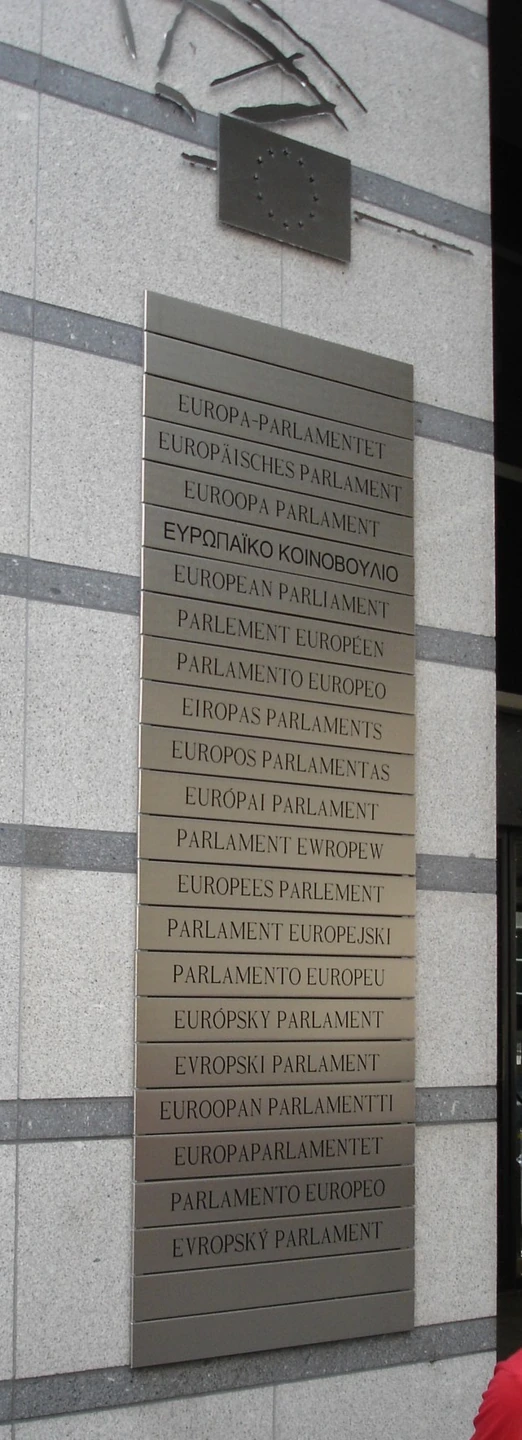
Estonian on a multilingual European Parliament sign, photographed in 2006. Language identification follows the source description; not independently transcribed.
Saved in Babelbook · resized display copy. Select the image to open it independently of its source.
Nuno Nogueira · Source ↗Public domain (author dedication) ↗View the local visual field note
Representative reference points from Glottolog. Historical entries show reference locations, not current speakers. 2 points.
Reference & context ↗Babelbook · original editorial illustration · CC BY 4.0 · Glottolog locations; public-domain Natural Earth land
Source excerpts, selected, shortened and where noted editorially corrected from Estonian language by Wikipedia contributors. Retrieved 2026-10-05. CC BY-SA 4.0. These excerpts are not an independently verified scholarly history; missing accounts are identified above.
Read further in the source
History
The speakers of the two major historical languages spoken in Estonia, North and South Estonian, are thought by some linguists to have arrived in Estonia in at least two different migration waves over two millennia ago, both groups having spoken considerably different vernacular. Some linguists have classified South Estonian as another, separate Finnic language, rather than a variety of Estonian. Modern standard Estonian evolved in the 18th and 19th centuries based on the dialects of northern Estonia. During the Medieval and Early Modern periods, Estonian accepted many loanwords from Germanic languages, mainly from Middle Low German (Middle Saxon) and, after the 16th-century Protestant Reformation, from the Standard German language.
The oldest written records of the Estonian language date from the 13th century. The "Originates Livoniae" in the Livonian Chronicle of Henry contains Estonian place names, words and fragments of sentences.
Dialects
The Estonian dialects are divided into two groups – the northern and southern dialects, historically associated with the cities of Tallinn in the north and Tartu in the south, in addition to a distinct kirderanniku dialect, Northeastern coastal Estonian. The northern group consists of the keskmurre or central dialect that is also the basis for the standard language, the läänemurre or western dialect, roughly corresponding to Lääne County and Pärnu County, the saarte murre (islands' dialect) of Saaremaa, Hiiumaa, Muhu and Kihnu, and the idamurre or eastern dialect on the northwestern shore of Lake Peipus. One of the pronunciation features of the Saaremaa dialect is the lack of the 'õ' vowel. A five-metre monument erected in 2020, marking the "border" between the vowels 'õ' and 'ö', humorously makes reference to this fact. South Estonian consists of the Tartu, Mulgi, Võro and Seto varieties. These are sometimes considered either variants of South Estonian or separate languages altogether. Also, Seto and Võro distinguish themselves from each other less by language and more by their culture and their respective Christian confession.
Orthography
Although Estonian orthography is generally guided by phonemic principles, with each grapheme corresponding to one phoneme, there are some historical and morphological deviations from this: for example preservation of the morpheme in declension of the word (writing b, g, d in places where p, k, t is pronounced) and in the use of 'i' and 'j'. Where it is very impractical or impossible to type š and ž, they are replaced by sh and zh in some written texts, although this is considered incorrect. Otherwise, the h in sh represents a voiceless glottal fricative, as in Pasha (pas-ha); this also applies to some foreign names. Modern Estonian orthography is based on the "Newer Orthography" created by Eduard Ahrens in the second half of the 19th century, which was based on Finnish orthography. The "Older Orthography" it replaced was created in the 17th century by Bengt Gottfried Forselius and Johann Hornung, and based on standard German orthography. Earlier writing in Estonian had, by and large, used an ad hoc orthography based on Latin and Middle Low German orthography. Some influences of the standard German orthography – for example, writing 'W'/'w' instead of 'V'/'v' – persisted well into the 1930s.