Basque
Basque ( BASK, BAHSK; endonym euskara [eus̺ˈkaɾa]) is a language spoken by Basques and other residents of the Basque Country, a region that straddles the westernmost Pyrenees in adjacent parts of southwestern France and northern Spain. Basque is Europe's only known language isolate (with no relation to any other known languages) and the only surviving language of Paleo-European origin. The Basques are indigenous to and primarily inhabit the Basque Country. Basque has 806,000 speakers: 93.7% (756,000) are in the Spanish area of the Basque Country and the remaining 6.3% (51,000) are in the French portion. Native speakers live in a contiguous area that includes parts of four Spanish provinces and the three "ancient provinces" in France. Gipuzkoa, most of Biscay, a few municipalities on the northern border of Álava and the northern area of Navarre formed the core of the remaining Basque-speaking area before measures were introduced in the 1980s to strengthen Basque fluency. By contrast, most of Álava, the westernmost part of Biscay, and central and southern Navarre are predominantly populated by native speakers of Spanish, either because Basque was replaced by either Navarro-Aragonese or Spanish over the centuries (as in most of Álava and central Navarre), or because it may never have been spoken there (as in parts of Enkarterri and south-eastern Navarre). In Francoist Spain, Basque language use was suppressed by the government's repressive policies.
Translate in Basque ↗The region where Basque is spoken has become smaller over centuries, especially at the northern, southern, and eastern borders. Nothing is known about the limits of the region in ancient times but on the basis of toponyms and epigraphs, it seems that in the beginning of the Common Era it stretched to the river Garonne in the north (including the south-western part of present-day France); at least to the Val d'Aran in the east (now a Gascon-speaking part of Catalonia), including lands on both sides of the Pyrenees; the southern and western boundaries are not clear at all. The Reconquista temporarily counteracted that contracting tendency when the Christian lords called on northern Iberian peoples (Basques, Asturians, and "Franks") to colonise the new conquests. By the 16th century, the Basque-speaking area was reduced basically to the present-day seven provinces of the Basque Country, excluding the southern part of Navarre, the south-western part of Álava, and the western part of Biscay, and including some parts of Aragon and Béarn. In 1807, Basque was still spoken in the northern half of Álava—including its capital city Vitoria-Gasteiz—and a vast area in central Navarre, but in those two provinces, Basque experienced a rapid decline that pushed its border northwards. In the French Basque Country, Basque was still spoken in all the territory except in Bayonne and some villages around, and including some bordering towns in Béarn. In the 20th century, however, the rise of Basque nationalism spurred increased interest in the language as a sign of ethnic identity, and with the establishment of autonomous governments in the Southern Basque Country, it has recently made a modest comeback.
Europe
Present-day use
Historically, Latin or Romance languages have been the official languages in the region. However, Basque was explicitly recognised in some areas. For instance, the fuero or charter of the Basque-colonised Ojacastro (now in La Rioja) allowed the inhabitants to use Basque in legal processes in the 13th and 14th centuries. Basque was allowed in telegraph messages in Spain thanks to the royal decree of 1904. The Spanish Constitution of 1978 states in Article 3 that the Spanish language is the official language of the nation, but allows autonomous communities to provide a co-official language status for the other languages of Spain. Consequently, the Statute of Autonomy of the Basque Autonomous Community establishes Basque as the co-official language of the autonomous community. The Statute of Navarre establishes Spanish as the official language of Navarre, but grants co-official status to the Basque language in the Basque-speaking areas of northern Navarre. Basque has no official status in the French Basque Country and French citizens are barred from officially using Basque in a French court of law. However, the use of Basque by Spanish nationals in French courts is permitted (with translation), as Basque is officially recognised on the other side of the border. The positions of the various existing governments differ with regard to the promotion of Basque in areas where Basque is commonly spoken. The language has official status in those territories that are within the Basque Autonomous Community, where it is spoken and promoted heavily but only partially in Navarre. The Ley del Vascuence ('Law of Basque'), seen as contentious by many Basques, but considered fitting Navarra's linguistic and cultural diversity by some of the main political parties of Navarre, divides Navarre into three language areas: Basque-speaking, non-Basque-speaking, and mixed. Support for the language and the linguistic rights of citizens vary, depending on the area.
Origins
The captured article does not contain a separate origins section. See the historical account and linked source.
Development
Despite the Basque language being geographically surrounded by Romance languages, it is a language isolate that is unrelated to them or to any other living language. Most scholars believe Basque to be the last remaining descendant of one of the pre-Indo-European languages of prehistoric Europe. Consequently, it may be impossible to reconstruct the prehistory of the Basque language by the traditional comparative method except by applying it to differences between Basque dialects. Little is known of its origins, but it is likely that an early form of the Basque language was present in and around the area of modern Basque Country before the arrival of the Indo-European languages in western Europe during the 3rd millennium BC. Authors such as Miguel de Unamuno and Louis Lucien Bonaparte have noted that the words for "knife" (aizto), "axe" (aizkora), and "hoe" (aitzur) appear to derive from the word for "stone" (haitz), and have therefore concluded that the language dates to prehistoric Europe when those tools were made of stone. Others find this theory unlikely. Latin inscriptions in Gallia Aquitania preserve a number of words with cognates in the reconstructed proto-Basque language, for instance, the personal names Nescato and Cison (neskato and gizon mean 'young girl' and 'man', respectively in modern Basque). This language is generally referred to as Aquitanian and is assumed to have been spoken in the area before the Roman Republic's conquests in the western Pyrenees. Some authors even argue for late Basquisation, that the language moved westward during Late antiquity after the fall of the Western Roman Empire into the northern part of Hispania into what is now the Basque Country. Roman neglect of this area allowed Aquitanian to survive while the Iberian and Tartessian languages became extinct. Through the long contact with Romance languages, Basque adopted a sizeable number of Romance words.
Writing
Basque is written using the Latin script including ⟨ñ⟩ and sometimes ⟨ç⟩ and ⟨ü⟩. Basque does not use ⟨c, q, v, w, y⟩ for native words, but the Basque alphabet (established by Euskaltzaindia) does include them for loanwords: ⟨Aa, Bb, Cc, Dd, Ee, Ff, Gg, Hh, Ii, Jj, Kk, Ll, Mm, Nn, Ññ, Oo, Pp, Qq, Rr, Ss, Tt, Uu, Vv, Ww, Xx, Yy, Zz⟩ The phonetically meaningful digraphs ⟨dd, ll, rr, ts, tt, tx, tz⟩ are treated as pairs of letters. All letters and digraphs represent unique phonemes. The main exception is ⟨i⟩ if it precedes ⟨l⟩ and ⟨n⟩, which, in most dialects, palatalises their sounds into /ʎ/ and /ɲ/, even if they are not written. Hence, Ikurriña can also be written Ikurrina without changing the sound, and the proper name Ainhoa requires the mute ⟨h⟩ to break the palatalisation of the ⟨n⟩. ⟨h⟩ is mute in most regions but is pronounced in many places in the north-east, the main reason for its existence in the Basque alphabet. Its acceptance was a matter of contention during the standardisation process because the speakers of the most widespread dialects had to learn where to place ⟨h⟩, which was silent for them. In Sabino Arana's (1865–1903) alphabet, digraphs ⟨ll⟩ and ⟨rr⟩ were replaced with ⟨ĺ⟩ and ⟨ŕ⟩, respectively. A typically Basque style of lettering is sometimes used for inscriptions. It derives from the work of stone and wood carvers and is characterised by thick serifs. Allières, Jacques (1979). Manuel pratique de basque. Connaissance des langues (in French). Vol. 13. Paris: A. & J. Picard. ISBN 2-7084-0038-X. "Aurkezpena". Sareko Euskal Gramatika (in Basque). Euskal Herriko Unibertsitatea. de Azkue Aberasturi, Resurrección María (1969). "Morfología vasca". La Gran enciclopedia vasca (in Spanish). Bilbao.{{cite encyclopedia}}: CS1 maint: location missing publisher (link) Campion, Arturo (1884). Gramática de los cuatro dialectos literarios de la lengua euskara (in Spanish).
Beyond the typeface.
Signs, manuscripts, published pages and contextual photographs, with their place, period, source and reuse terms. Captions identify historical spellings, regional examples, community references and character imagery.
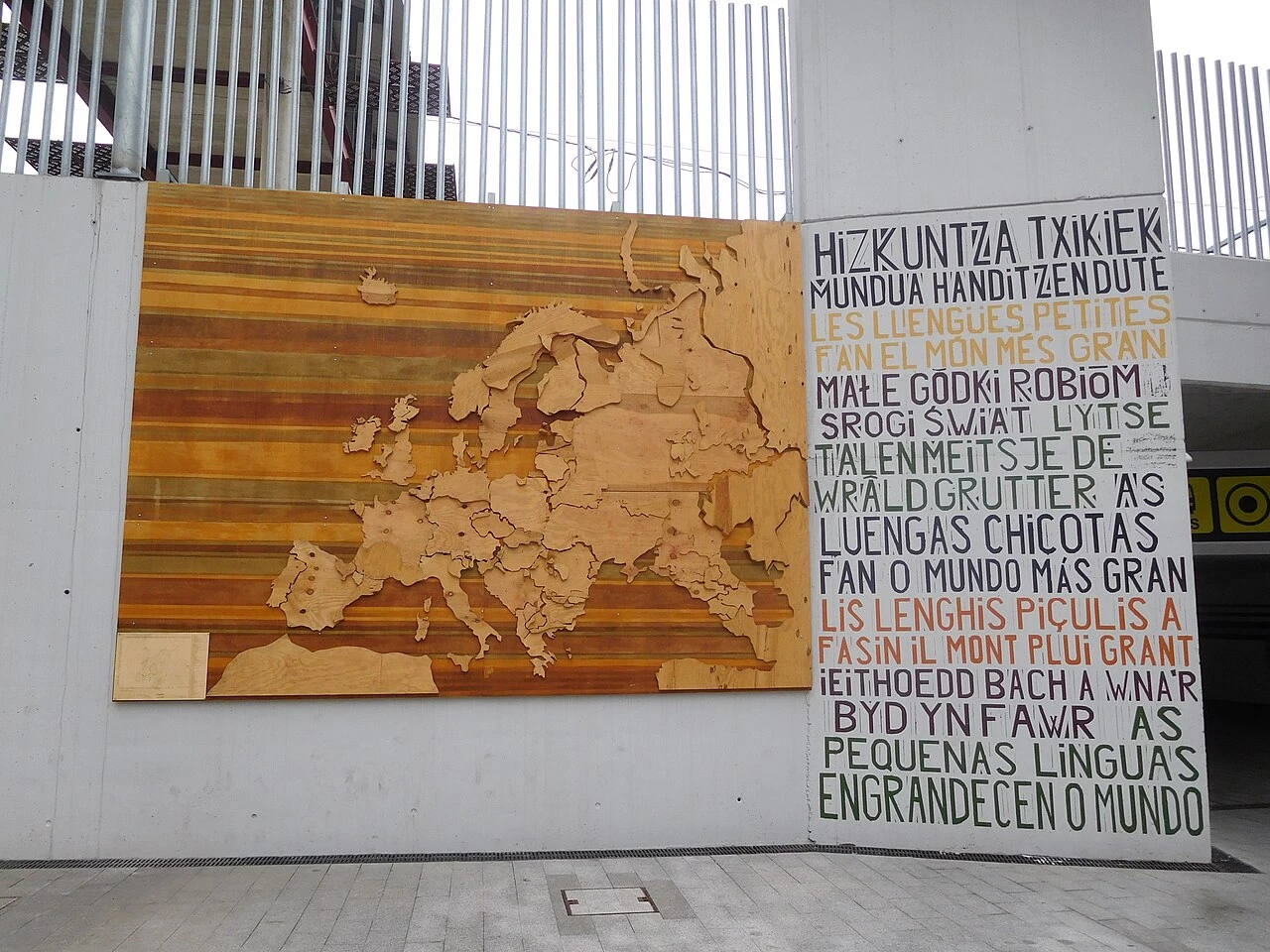
Multilingual street artwork celebrating smaller languages in San Sebastián, photographed in 2016. Includes Basque, Catalan and Galician among eight languages. Language identification follows Commons descriptions or categories; not independently transcribed.
Saved in Babelbook · resized display copy. Select the image to open it independently of its source.
Vasconium · Source ↗CC BY-SA 4.0 ↗View the local visual field note
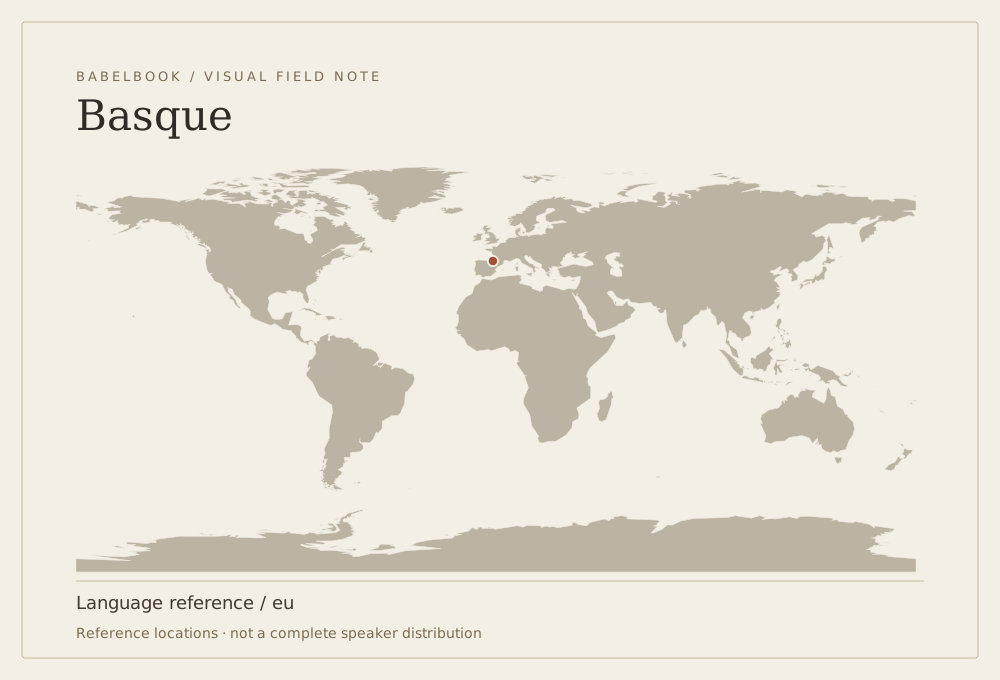
Representative reference points from Glottolog. Historical entries show reference locations, not current speakers. 1 point.
Reference & context ↗Babelbook · original editorial illustration · CC BY 4.0 · Glottolog locations; public-domain Natural Earth land
Source excerpts, selected, shortened and where noted editorially corrected from Basque language by Wikipedia contributors. Retrieved 2026-10-05. CC BY-SA 4.0. These excerpts are not an independently verified scholarly history; missing accounts are identified above.
Read further in the source
History and classification
Despite the Basque language being geographically surrounded by Romance languages, it is a language isolate that is unrelated to them or to any other living language. Most scholars believe Basque to be the last remaining descendant of one of the pre-Indo-European languages of prehistoric Europe. Consequently, it may be impossible to reconstruct the prehistory of the Basque language by the traditional comparative method except by applying it to differences between Basque dialects. Little is known of its origins, but it is likely that an early form of the Basque language was present in and around the area of modern Basque Country before the arrival of the Indo-European languages in western Europe during the 3rd millennium BC. Authors such as Miguel de Unamuno and Louis Lucien Bonaparte have noted that the words for "knife" (aizto), "axe" (aizkora), and "hoe" (aitzur) appear to derive from the word for "stone" (haitz), and have therefore concluded that the language dates to prehistoric Europe when those tools were made of stone. Others find this theory unlikely. Latin inscriptions in Gallia Aquitania preserve a number of words with cognates in the reconstructed proto-Basque language, for instance, the personal names Nescato and Cison (neskato and gizon mean 'young girl' and 'man', respectively in modern Basque). This language is generally referred to as Aquitanian and is assumed to have been spoken in the area before the Roman Republic's conquests in the western Pyrenees. Some authors even argue for late Basquisation, that the language moved westward during Late antiquity after the fall of the Western Roman Empire into the northern part of Hispania into what is now the Basque Country. Roman neglect of this area allowed Aquitanian to survive while the Iberian and Tartessian languages became extinct. Through the long contact with Romance languages, Basque adopted a sizeable number of Romance words. Initially the source was Latin, later Gascon (a branch of Occitan) in the north-east, Navarro-Aragonese in the south-east and Spanish in the south-west. The process of literary unification began in 1918 with the founding of the Royal Academy of the Basque Language (Euskaltzaindia). Since 1968, Basque has been immersed in a revitalisation process, facing formidable obstacles. However, significant progress has been made in numerous areas. Six main factors have been identified to explain its relative success:
implementation and acceptance of Unified Basque (Batua), integration of Basque in the education system creation of media in Basque (radio, newspapers, and television) the established new legal framework collaboration between public institutions and people's organisations, and campaigns for Basque language literacy. While those six factors influenced the revitalisation process, the extensive development and use of language technologies is also considered a significant additional factor.
Geographic distribution
The region where Basque is spoken has become smaller over centuries, especially at the northern, southern, and eastern borders. Nothing is known about the limits of the region in ancient times but on the basis of toponyms and epigraphs, it seems that in the beginning of the Common Era it stretched to the river Garonne in the north (including the south-western part of present-day France); at least to the Val d'Aran in the east (now a Gascon-speaking part of Catalonia), including lands on both sides of the Pyrenees; the southern and western boundaries are not clear at all. The Reconquista temporarily counteracted that contracting tendency when the Christian lords called on northern Iberian peoples (Basques, Asturians, and "Franks") to colonise the new conquests. By the 16th century, the Basque-speaking area was reduced basically to the present-day seven provinces of the Basque Country, excluding the southern part of Navarre, the south-western part of Álava, and the western part of Biscay, and including some parts of Aragon and Béarn. In 1807, Basque was still spoken in the northern half of Álava—including its capital city Vitoria-Gasteiz—and a vast area in central Navarre, but in those two provinces, Basque experienced a rapid decline that pushed its border northwards. In the French Basque Country, Basque was still spoken in all the territory except in Bayonne and some villages around, and including some bordering towns in Béarn. In the 20th century, however, the rise of Basque nationalism spurred increased interest in the language as a sign of ethnic identity, and with the establishment of autonomous governments in the Southern Basque Country, it has recently made a modest comeback. In the Spanish part, Basque-language schools for children and Basque-teaching centres for adults have brought the language to areas such as western Enkarterri and the Ribera del Ebro in southern Navarre, where it is not known to ever have been widely spoken; and in the French Basque Country, those schools and centres have almost stopped the decline of the language.
Official status
Historically, Latin or Romance languages have been the official languages in the region. However, Basque was explicitly recognised in some areas. For instance, the fuero or charter of the Basque-colonised Ojacastro (now in La Rioja) allowed the inhabitants to use Basque in legal processes in the 13th and 14th centuries. Basque was allowed in telegraph messages in Spain thanks to the royal decree of 1904. The Spanish Constitution of 1978 states in Article 3 that the Spanish language is the official language of the nation, but allows autonomous communities to provide a co-official language status for the other languages of Spain. Consequently, the Statute of Autonomy of the Basque Autonomous Community establishes Basque as the co-official language of the autonomous community. The Statute of Navarre establishes Spanish as the official language of Navarre, but grants co-official status to the Basque language in the Basque-speaking areas of northern Navarre. Basque has no official status in the French Basque Country and French citizens are barred from officially using Basque in a French court of law. However, the use of Basque by Spanish nationals in French courts is permitted (with translation), as Basque is officially recognised on the other side of the border. The positions of the various existing governments differ with regard to the promotion of Basque in areas where Basque is commonly spoken. The language has official status in those territories that are within the Basque Autonomous Community, where it is spoken and promoted heavily but only partially in Navarre. The Ley del Vascuence ('Law of Basque'), seen as contentious by many Basques, but considered fitting Navarra's linguistic and cultural diversity by some of the main political parties of Navarre, divides Navarre into three language areas: Basque-speaking, non-Basque-speaking, and mixed. Support for the language and the linguistic rights of citizens vary, depending on the area. Others consider it unfair, since the rights of Basque speakers differ greatly depending on the place they live.
Dialects
The modern Basque dialects show a high degree of dialectal divergence, sometimes making cross-dialect communication difficult. That is especially true in the case of Biscayan and Souletin, which are regarded as the most divergent Basque dialects. In 1729, the Jesuit Manuel de Larramendi published a grammar of Basque, titled El Imposible Vencido. El arte de la lengua bascongada in which he spoke about diverse dialects. Specifically, he mentions Gipuzkoan, Biscayan and Navarrese or Labourdian, which he says are often the same. Later, the Basque philologist Louis-Lucien Bonaparte created a map to classify the dialects, which was later reviewed by the priest and first president of the Academia de la Lengua Vasca, Resurrección María de Azkue (1864-1951). However, in 1998, the linguist Koldo Zuazo, revised the classification of Basque dialects, which divides Basque into six dialects (euskalkiak in Basque): Biscayan dialect, Gipuzkoan dialect, Upper Navarrese dialect, Eastern Navarrese dialect (Roncalese, extinct), Navarro-Lapurdian dialect, and Souletin dialect. Those dialects are divided in 11 subdialects, and 24 minor varieties among them. According to Koldo Zuazo, the Biscayan dialect or "Western" is the most widespread dialect, with around 300,000 speakers out of a total of around 660,000 speakers. The dialect is divided in two minor subdialects (Western Biscayan and Eastern Biscayan), as well as transitional dialects. There is some debate over whether the Roncalese dialect can be considered a subdialect of Souletin, or its own dialect. Formerly spoken in the seven villages of the Roncal Valley, this dialect disappeared in 1991 when its last speaker, Fidela Bernat, died. A lesser-known dialect is the Alavese dialect, which became extinct in the 19th century. However, toponymy tells us that it was very similar to the Western dialect. The primary source of information on the Basque spoken in Álava today is the manuscript of Joan Perez de Lazarraga (16th century), as it provides the most comprehensive written source. The phonological, morphosyntactic, and lexical differences between two geographically distant dialects can be as abundant as those between Catalan and Castilian Spanish. Biscayan (westernmost region) and Souletin (easternmost region) are prime examples of this; they are typified by their distance from other dialects and are spoken at two extreme points of the Basque linguistic region. All the same, for most Basque speakers, speaking different dialects does not get in the way of their understanding one another. For example, a Basque speaker from Navarre can understand someone speaking a western variety fairly easily, due to the familiar words used, which they will have come across in formal contexts. Furthermore, although standard Basque is the official form of the language, the presence of the dialects in methods of communication, such as local radio and publications, shows efforts to integrate them into daily life.
Writing system
Basque is written using the Latin script including ⟨ñ⟩ and sometimes ⟨ç⟩ and ⟨ü⟩. Basque does not use ⟨c, q, v, w, y⟩ for native words, but the Basque alphabet (established by Euskaltzaindia) does include them for loanwords:
⟨Aa, Bb, Cc, Dd, Ee, Ff, Gg, Hh, Ii, Jj, Kk, Ll, Mm, Nn, Ññ, Oo, Pp, Qq, Rr, Ss, Tt, Uu, Vv, Ww, Xx, Yy, Zz⟩ The phonetically meaningful digraphs ⟨dd, ll, rr, ts, tt, tx, tz⟩ are treated as pairs of letters. All letters and digraphs represent unique phonemes. The main exception is ⟨i⟩ if it precedes ⟨l⟩ and ⟨n⟩, which, in most dialects, palatalises their sounds into /ʎ/ and /ɲ/, even if they are not written. Hence, Ikurriña can also be written Ikurrina without changing the sound, and the proper name Ainhoa requires the mute ⟨h⟩ to break the palatalisation of the ⟨n⟩.
⟨h⟩ is mute in most regions but is pronounced in many places in the north-east, the main reason for its existence in the Basque alphabet. Its acceptance was a matter of contention during the standardisation process because the speakers of the most widespread dialects had to learn where to place ⟨h⟩, which was silent for them. In Sabino Arana's (1865–1903) alphabet, digraphs ⟨ll⟩ and ⟨rr⟩ were replaced with ⟨ĺ⟩ and ⟨ŕ⟩, respectively. A typically Basque style of lettering is sometimes used for inscriptions. It derives from the work of stone and wood carvers and is characterised by thick serifs.
History of the language and etymologies
Azurmendi, Joxe: "Die Bedeutung der Sprache in Renaissance und Reformation und die Entstehung der baskischen Literatur im religiösen und politischen Konfliktgebiet zwischen Spanien und Frankreich" In: Wolfgang W. Moelleken (Herausgeber), Peter J. Weber (Herausgeber): Neue Forschungsarbeiten zur Kontaktlinguistik, Bonn: Dümmler, 1997. ISBN 978-3537864192 Hualde, José Ignacio; Lakarra, Joseba A. & R.L. Trask (eds) (1996): Towards a History of the Basque Language, "Current Issues in Linguistic Theory" 131, John Benjamin Publishing Company, Amsterdam, ISBN 978-1-55619-585-3. Michelena, Luis, 1990. Fonética histórica vasca. Bilbao. ISBN 84-7907-016-1 Lafon, René (1944): Le système du verbe basque au XVIe siècle, Delmas, Bordeaux. Löpelmann, Martin (1968): Etymologisches Wörterbuch der baskischen Sprache. Dialekte von Labourd, Nieder-Navarra und La Soule. 2 Bde. de Gruyter, Berlin (non-standard etymologies; idiosyncratic). Orpustan, J. B. (1999): La langue basque au Moyen-Age. Baïgorri, ISBN 2-909262-22-7. Pagola, Rosa Miren. 1984. Euskalkiz Euskalki. Vitoria-Gasteiz: Eusko Jaurlaritzaren Argitalpe. Rohlfs, Gerhard. 1980. Le Gascon: études de philologie pyrénéenne. Zeitschrift für Romanische Philologie 85. Trask, R.L.: History of Basque. New York/London: Routledge, 1996. ISBN 0-415-13116-2. Trask, R.L. † (edited by Max W. Wheeler) (2008): Etymological Dictionary of Basque, University of Sussex (unfinished). Also "Some Important Basque Words (And a Bit of Culture)" Buber's Basque Page: The Larry Trask Archive: Some Important Basque Words (And a Bit of Culture)