Persian
Persian, also known as Farsi, is a Western Iranian language belonging to the Iranian branch of the Indo-Iranian subdivision of the Indo-European languages. Persian is a pluricentric language predominantly spoken and used officially within Iran, Afghanistan, and Tajikistan in three mutually intelligible standard varieties, namely Iranian Persian (officially known as Farsi), Afghan Persian (officially known as Dari since 1964), and Tajiki Persian (officially known as Tajik since 1999). It is also spoken natively in the Tajik variety by a significant population in Uzbekistan, as well as within other regions with a Persianate history in the cultural sphere of Greater Iran. It is written officially within Iran and Afghanistan in the Persian alphabet, a derivative of the Arabic script, and within Tajikistan in the Tajik alphabet, a derivative of the Cyrillic script. Modern Persian is a continuation of Middle Persian, an official language of the Sasanian Empire (224–651 CE), itself a continuation of Old Persian, which was used in the Achaemenid Empire (550–330 BCE). It originated in the region of Fars (Persia) in southwestern Iran. Throughout history, Persian was considered prestigious by various empires centered in West Asia, Central Asia, and South Asia. Old Persian is attested in Old Persian cuneiform on inscriptions from between the 6th and 4th century BCE. Middle Persian is attested in Aramaic-derived scripts (Pahlavi and Manichaean) on inscriptions and in Zoroastrian and Manichaean scriptures from between the third to the tenth centuries (see Middle Persian literature).
Translate in Persian ↗Persian, also known as Farsi, is a Western Iranian language belonging to the Iranian branch of the Indo-Iranian subdivision of the Indo-European languages. Persian is a pluricentric language predominantly spoken and used officially within Iran, Afghanistan, and Tajikistan in three mutually intelligible standard varieties, namely Iranian Persian (officially known as Farsi), Afghan Persian (officially known as Dari since 1964), and Tajiki Persian (officially known as Tajik since 1999). It is also spoken natively in the Tajik variety by a significant population in Uzbekistan, as well as within other regions with a Persianate history in the cultural sphere of Greater Iran. It is written officially within Iran and Afghanistan in the Persian alphabet, a derivative of the Arabic script, and within Tajikistan in the Tajik alphabet, a derivative of the Cyrillic script. Modern Persian is a continuation of Middle Persian, an official language of the Sasanian Empire (224–651 CE), itself a continuation of Old Persian, which was used in the Achaemenid Empire (550–330 BCE). It originated in the region of Fars (Persia) in southwestern Iran. Throughout history, Persian was considered prestigious by various empires centered in West Asia, Central Asia, and South Asia. Old Persian is attested in Old Persian cuneiform on inscriptions from between the 6th and 4th century BCE. Middle Persian is attested in Aramaic-derived scripts (Pahlavi and Manichaean) on inscriptions and in Zoroastrian and Manichaean scriptures from between the third to the tenth centuries (see Middle Persian literature).
Middle East & North Africa
Present-day use
The captured source does not contain a separate current-use account.
Origins
The captured article does not contain a separate origins section. See the historical account and linked source.
Development
In general, the Iranian languages are known from three periods: namely Old, Middle, and New (Modern). These correspond to three historical eras of Iranian history; Old era being sometime around the Achaemenid Empire (i.e., 400–300 BCE), Middle era being the next period most officially around the Sasanian Empire, and New era being the period afterward down to present day. According to available documents, the Persian language is "the only Iranian language" for which close philological relationships between all of its three stages are established and so that Old, Middle, and New Persian represent one and the same language of Persian; that is, New Persian is a direct descendant of Middle and Old Persian. Gernot Windfuhr considers new Persian as an evolution of the Old Persian language and the Middle Persian language but also states that none of the known Middle Persian dialects is the direct predecessor of Modern Persian. Ludwig Paul states: "The language of the Shahnameh should be seen as one instance of continuous historical development from Middle to New Persian." The known history of the Persian language can be divided into the following three distinct periods:
Writing
The vast majority of modern Iranian Persian and Dari text is written with the Arabic script. Tajiki, which is considered by some linguists to be a Persian dialect influenced by Russian and the Turkic languages of Central Asia, is written with the Cyrillic script in Tajikistan (see Tajik alphabet). There also exist several romanization systems for Persian.
Beyond the typeface.
Signs, manuscripts, published pages and contextual photographs, with their place, period, source and reuse terms. Captions identify historical spellings, regional examples, community references and character imagery.

Detail of a Persian dedicatory inscription naming Jahan Shah, Darb-e Imam, Isfahan, dated 1453. Historical Persian in thuluth script; not Arabic or Old Persian cuneiform. Displayed at reduced size; no additional crop.
Saved in Babelbook · resized display copy. Select the image to open it independently of its source.
payam.shaterpour@gmail.com; detail extracted by Pataliputra! · Source ↗CC BY-SA 4.0 ↗View the local visual field note
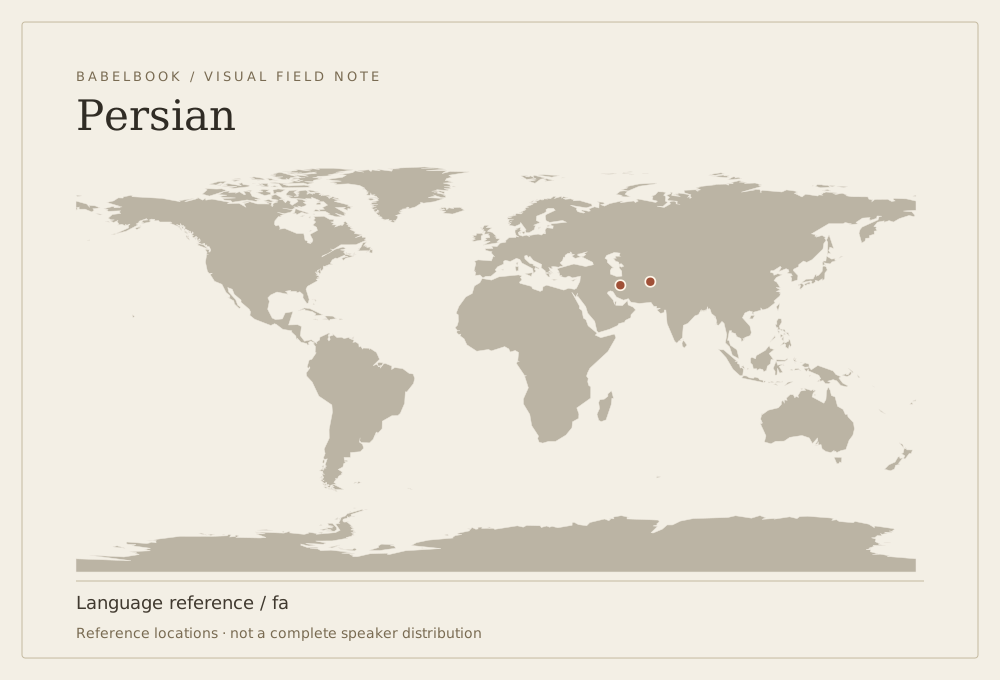
Representative reference points from Glottolog. Historical entries show reference locations, not current speakers. 2 points.
Reference & context ↗Babelbook · original editorial illustration · CC BY 4.0 · Glottolog locations; public-domain Natural Earth land
Source excerpts, selected, shortened and where noted editorially corrected from Persian language by Wikipedia contributors. Retrieved 2026-10-05. CC BY-SA 4.0. These excerpts are not an independently verified scholarly history; missing accounts are identified above.
Read further in the source
Standard varieties' names
The standard Persian of Iran has been called, apart from Persian and Farsi, by names such as Iranian Persian and Western Persian, exclusively. The official language of Iran is designated simply as Persian (فارسی, Fārsī). The standard Persian of Afghanistan has been officially named Dari (دری, Darī) since 1958. Also referred to as Afghan Persian in English, it is one of Afghanistan's two official languages, together with Pashto. The term Dari, meaning "of the court", originally referred to the variety of Persian used in the court of the Sasanian Empire in capital Ctesiphon, which spread to the northeast of the empire and gradually replaced the former Iranian dialects of Parthia (Parthian). Tajik Persian (форси́и тоҷикӣ́, forsi-i tojikī), the standard Persian of Tajikistan, has been officially designated as Tajik (тоҷикӣ, tojikī) since the time of the Soviet Union. It is the name given to the varieties of Persian spoken in Central Asia in general.
History
In general, the Iranian languages are known from three periods: namely Old, Middle, and New (Modern). These correspond to three historical eras of Iranian history; Old era being sometime around the Achaemenid Empire (i.e., 400–300 BCE), Middle era being the next period most officially around the Sasanian Empire, and New era being the period afterward down to present day. According to available documents, the Persian language is "the only Iranian language" for which close philological relationships between all of its three stages are established and so that Old, Middle, and New Persian represent one and the same language of Persian; that is, New Persian is a direct descendant of Middle and Old Persian. Gernot Windfuhr considers new Persian as an evolution of the Old Persian language and the Middle Persian language but also states that none of the known Middle Persian dialects is the direct predecessor of Modern Persian. Ludwig Paul states: "The language of the Shahnameh should be seen as one instance of continuous historical development from Middle to New Persian." The known history of the Persian language can be divided into the following three distinct periods:
Orthography
The vast majority of modern Iranian Persian and Dari text is written with the Arabic script. Tajiki, which is considered by some linguists to be a Persian dialect influenced by Russian and the Turkic languages of Central Asia, is written with the Cyrillic script in Tajikistan (see Tajik alphabet). There also exist several romanization systems for Persian.