Fulah
Fula (; FOO-lə), natively known as Fulfulde and also known as Fulani (; fuu-LAH-nee) or Fulah (Fulfulde, Pulaar, Pular; Adlam: 𞤊𞤵𞤤𞤬𞤵𞤤𞤣𞤫, 𞤆𞤵𞤤𞤢𞥄𞤪, 𞤆𞤵𞤤𞤢𞤪; Ajami: ࢻُلْࢻُلْدٜ, ݒُلَارْ, بُۛلَر), is a Senegambian language spoken by around 36.8 million people as a set of various dialects in a continuum that stretches across some 18 countries in West and Central Africa. Along with other related languages such as Serer and Wolof, it belongs to the Atlantic geographic group within Niger–Congo, more specifically to the Senegambian branch. Unlike most other Niger-Congo languages, Fula does not have tones. It is spoken as a first language by the Fula people ("Fulani", Fula: Fulɓe) from the Senegambia region and Guinea to Cameroon, Nigeria, and Sudan and by related groups such as the Toucouleur people in the Senegal River Valley. It is also spoken as a second language by various peoples in the region, such as the Kirdi of northern Cameroon and northeastern Nigeria.
Translate in Fulah ↗Fula is a lingua franca in Guinea, Guinea-Bissau, Senegal, Gambia, northeastern Nigeria, Cameroon, Mali, Burkina Faso, northern Ghana, southern Niger, and northern Benin (in Borgou Region, where many speakers are bilingual), and a local language in many African countries, such as Mauritania, Sierra Leone, Togo, CAR, Chad, and Sudan. It has more than 95 million speakers in total.
Sub-Saharan Africa
Present-day use
Fula is a lingua franca in Guinea, Guinea-Bissau, Senegal, Gambia, northeastern Nigeria, Cameroon, Mali, Burkina Faso, northern Ghana, southern Niger, and northern Benin (in Borgou Region, where many speakers are bilingual), and a local language in many African countries, such as Mauritania, Sierra Leone, Togo, CAR, Chad, and Sudan. It has more than 95 million speakers in total.
Origins
The captured article does not contain a separate origins section. See the historical account and linked source.
Development
The captured article does not contain a distinct historical account. No chronology has been invented.
Writing
Five different scripts have been or are used to write Fula. It was historically written in a form of the Arabic script known as Ajami, and although not standardized, it is still used by some today. During the colonial period and after independence, the Latin script began to be used to write Fula, leading to efforts facilitated by UNESCO to standardize transcription. This process also addressed other African languages, incorporating use of modified letters to represent sounds particular to these languages, and it has been the basis for Latin-based Fula orthographies since the mid-1960s. There were two unsuccessful efforts in the 1950s and 1960s to create a unique script to write Fulfulde, namely Fula Dita and Fula Ba. In 1989, the Adlam script was created specifically for Fula. In the late 1980s and early 1990s, two teenage brothers, Ibrahima and Abdoulaye Barry from the Nzérékoré Region of Guinea, created the Adlam script, which accurately represents all the sounds of Fulani. The script is written from right to left and includes 28 letters with 5 vowels and 23 consonants. Fula has also been written in the Arabic script or the Ajami script since before European colonization by many scholars and learned people including Usman dan Fodio and the early emirs of the northern Nigeria emirates. This continues to a certain degree and notably in some areas like Guinea and Cameroon. Fula also has Arabic loanwords.
Beyond the typeface.
Signs, manuscripts, published pages and contextual photographs, with their place, period, source and reuse terms. Captions identify historical spellings, regional examples, community references and character imagery.
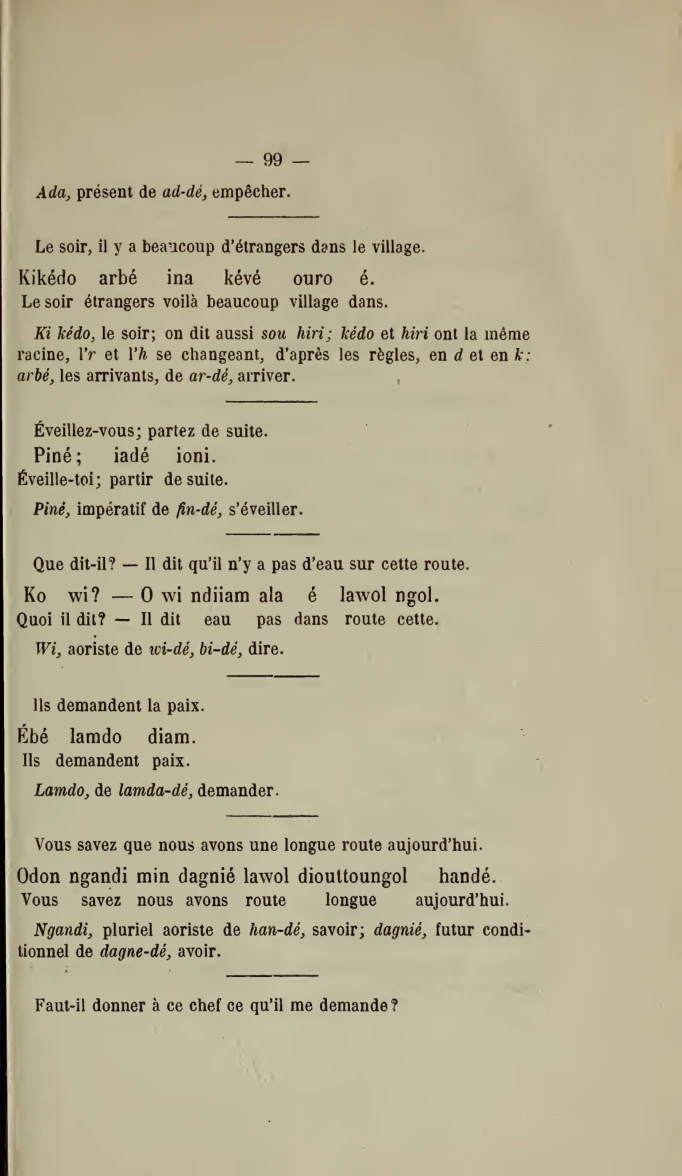
Fula/Pulaar phrases with French translations on printed page 99 of an 1875 grammar based on Senegalese materials. This is a regional historical transcription within the broader Fulah grouping, not a modern universal Fulah spelling standard.
Saved in Babelbook · resized display copy. Select the image to open it independently of its source.
Louis Léon César Faidherbe (1818–1889); source materials gathered with interpreter Ousman and Descemet · Source ↗Public domain ↗View the local visual field note
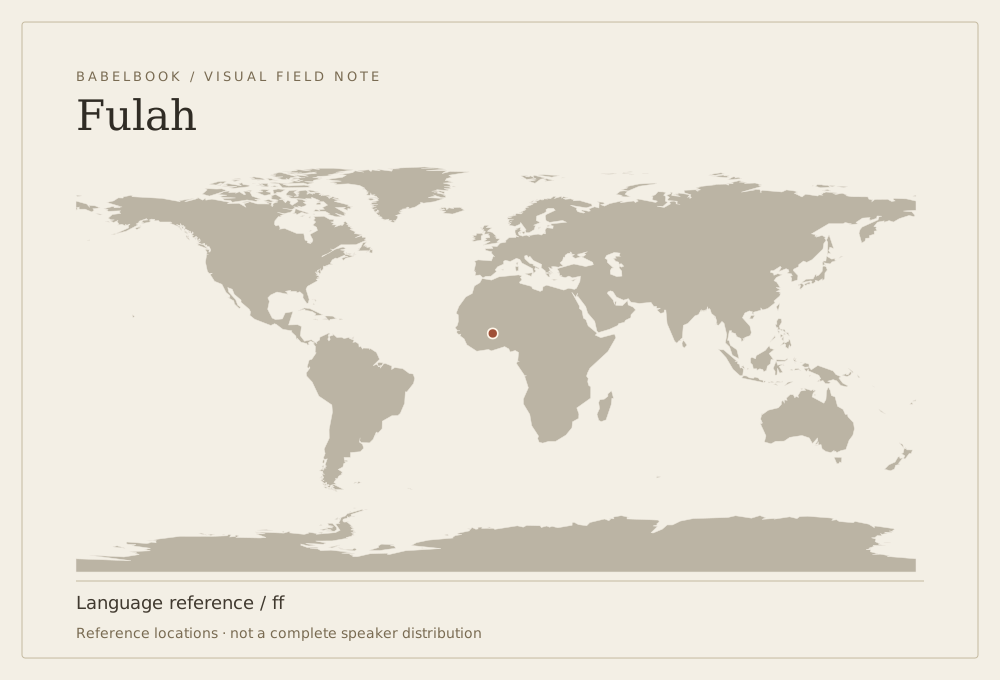
Representative reference points from Glottolog. Historical entries show reference locations, not current speakers. 1 point.
Reference & context ↗Babelbook · original editorial illustration · CC BY 4.0 · Glottolog locations; public-domain Natural Earth land
Source excerpts, selected, shortened and where noted editorially corrected from Fula language by Wikipedia contributors. Retrieved 2026-10-05. CC BY-SA 4.0. These excerpts are not an independently verified scholarly history; missing accounts are identified above.
Read further in the source
Status
Fula is a lingua franca in Guinea, Guinea-Bissau, Senegal, Gambia, northeastern Nigeria, Cameroon, Mali, Burkina Faso, northern Ghana, southern Niger, and northern Benin (in Borgou Region, where many speakers are bilingual), and a local language in many African countries, such as Mauritania, Sierra Leone, Togo, CAR, Chad, and Sudan. It has more than 95 million speakers in total.
Writing systems
Five different scripts have been or are used to write Fula. It was historically written in a form of the Arabic script known as Ajami, and although not standardized, it is still used by some today. During the colonial period and after independence, the Latin script began to be used to write Fula, leading to efforts facilitated by UNESCO to standardize transcription. This process also addressed other African languages, incorporating use of modified letters to represent sounds particular to these languages, and it has been the basis for Latin-based Fula orthographies since the mid-1960s. There were two unsuccessful efforts in the 1950s and 1960s to create a unique script to write Fulfulde, namely Fula Dita and Fula Ba. In 1989, the Adlam script was created specifically for Fula.