Finnish
Finnish (endonym: suomi [ˈsuo̯mi] or suomen kieli [ˈsuo̯meŋ ˈkie̯li]) is a Finnic language of the Uralic language family, spoken by the majority of the population in Finland and by ethnic Finns outside of Finland. Finnish is one of the two official languages of Finland, alongside Swedish. In Sweden, both Finnish and Meänkieli (which has significant mutual intelligibility with Finnish) are official minority languages. Kven, which like Meänkieli is mutually intelligible with Finnish, is spoken in the Norwegian counties of Troms and Finnmark by a minority of Finnish descent. However, these are recognized as independent languages in their relative countries for sociohistorical reasons. Finnish is typologically agglutinative and uses almost exclusively suffixal affixation. Nouns, adjectives, pronouns, numerals and verbs are inflected depending on their role in the sentence. Sentences are normally formed with subject–verb–object word order, although the extensive use of inflection allows them to be ordered differently. Word order variations are often reserved for differences in information structure. Finnish orthography uses a Latin-script alphabet derived from the Swedish alphabet, and is phonemic to a great extent. Vowel length and consonant length are distinguished, and there are a range of diphthongs, although vowel harmony limits which diphthongs are possible.
Translate in Finnish ↗Finnish is spoken by about five million people, most of whom reside in Finland. There are also notable Finnish-speaking minorities in Sweden, Norway, Russia, Estonia, Brazil, Canada, and the United States. The majority of the population of Finland (90.37% as of 2010) speak Finnish as their first language. The remainder speak Swedish (5.42%), one of the Sámi languages (for example Northern, Inari, or Skolt), or another language as their first language. Finnish is spoken as a second language in Estonia by about 167,000 people. The Finnic varieties found in Norway's Finnmark (namely Kven) and in northern Sweden (namely Meänkieli) have the status of official minority languages, and thus can be considered distinct languages from Finnish. However, since these languages are mutually intelligible, one may alternatively view them as dialects of the same language. No language census exists for Norway, neither for Kven, standard Finnish, or combined. As of 2023, 7,454 first- or second-generation immigrants from Finland were registered as having Norwegian residency, while as of 2021, 235 Finns were registered as foreigners studying at Norwegian higher education. Great Norwegian Encyclopedia estimates Kven speakers at 2,000-8,000. Altogether, this results in a total amount of Finnish-speakers roughly between 7,200 and 15,600. In the latest census, around 1000 people in Russia claimed to speak Finnish natively; however, a larger amount of 14,000 claimed to be able to speak Finnish in total. There are also forms of Finnish spoken by diasporas outside Europe, such as American Finnish, spoken by Finnish Americans, and Siberian Finnish, spoken by Siberian Finns. Today, Finnish is one of two official languages of Finland (the other being Swedish), and has been an official language of the European Union since 1995. Finnish also enjoys the status of an official minority language in Sweden.
Europe
Present-day use
Today, Finnish is one of two official languages of Finland (the other being Swedish), and has been an official language of the European Union since 1995. Finnish also enjoys the status of an official minority language in Sweden. Under the Nordic Language Convention, citizens of the Nordic countries speaking Finnish have the opportunity to use their native language when interacting with official bodies in other Nordic countries without being liable to any interpretation or translation costs. However, concerns have been expressed about the future status of Finnish in Sweden, for example, where reports produced for the Swedish government during 2017 show that minority language policies are not being respected, particularly for the 7% of Finns settled in the country. In the 19th century Johan Vilhelm Snellman and others began to stress the need to improve the status of Finnish. Ever since the days of Mikael Agricola, written Finnish had been used almost exclusively in religious contexts, but now Snellman's Hegelian nationalistic ideas of Finnish as a fully-fledged national language gained considerable support. Concerted efforts were made to improve the status of the language and to modernize it, and by the end of the century Finnish had become a language of administration, journalism, literature, and science in Finland, along with Swedish. The Finnish language did not have an official status in the country during the period of Swedish rule, which ended in 1809. After the establishment of the Grand Duchy of Finland, and against the backdrop of the Fennoman movement, the language gained official standing through the Language Rescript of 1863, an imperial decree issued in the same year as the first Diet since 1809. In 1853 Daniel Europaeus published the first Swedish-Finnish dictionary, and between 1866 and 1880 Elias Lönnrot compiled the first Finnish-Swedish dictionary.
Origins
The captured article does not contain a separate origins section. See the historical account and linked source.
Development
The Uralic family of languages, of which Finnish is a member, are hypothesized to derive from a single ancestor language termed Proto-Uralic, spoken sometime between 8,000 and 2,000 BCE (estimates vary) in the vicinity of the Ural Mountains. Over time, Proto-Uralic split into various daughter languages, which themselves continued to change and diverge, yielding yet more descendants. One of these descendants is the reconstructed Proto-Finnic, from which the Finnic languages developed. Current models assume that three or more Proto-Finnic dialects evolved during the first millennium BCE. These dialects were defined geographically, and were distinguished from one another along a north–south split as well as an east–west split. The northern dialects of Proto-Finnic, from which Finnish developed, lacked the mid vowel [ɤ]. This vowel was found only in the southern dialects, which developed into Estonian, Livonian, and Votian. The northern variants used third person singular pronoun hän instead of southern tämä (Est. tema). While the eastern dialects of Proto-Finnic (which developed in the modern-day eastern Finnish dialects, Veps, Karelian, and Ingrian) formed genitive plural nouns via plural stems (e.g., eastern Finnish kalojen < *kaloi-ten), the western dialects of Proto-Finnic (today's Estonian, Livonian and western Finnish varieties) used the non-plural stems (e.g., Est. kalade < *kala-ten). Another defining characteristic of the east–west split was the use of the reflexive suffix -(t)te, used only in the eastern dialects.
Writing
The first comprehensive writing system for Finnish was created by Mikael Agricola, a Finnish bishop, in the 16th century. He based his writing system on the western dialects. Agricola's ultimate plan was to translate the Bible, but first he had to develop an orthography for the language, which he based on Swedish, German, and Latin. The Finnish standard language still relies on his innovations with regard to spelling, though Agricola used less systematic spelling than is used today. Though Agricola's intention was that each phoneme (and allophone under qualitative consonant gradation) should correspond to one letter, he failed to achieve this goal in various respects. For example, k, c, and q were all used for the phoneme /k/. Likewise, he alternated between dh and d to represent the allophonic [ð] (like th in English this), between dh and z to represent /θː/ (like th in thin, but longer in duration), and between gh and g to represent the allophonic [ɣ]. Agricola did not consistently represent vowel length in his orthography. Others revised Agricola's work later, striving for a more systematic writing system. Along the way, Finnish lost several fricative consonants in a process of sound change. The sounds [ð] and [θ(ː)] disappeared from the language, surviving only in a small rural region in Western Finland. In the standard language, however, the effect of the lost sounds is thus: [ð] became [d]. The sound [ð] was written ⟨d⟩ or ⟨dh⟩ by Agricola. This sound was lost from most varieties of Finnish, either losing all phonetic realization or being pronounced as [r], [ɾ], [l], or [h] instead (depending on dialect and the position in the word). However, Agricola's spelling ⟨d⟩ prevailed, and the pronunciation in Standard Finnish became [d] through spelling pronunciation. [θː, θ] became [ts]. These interdental fricatives were written as ⟨tz⟩ (for both grades: geminate and short) in some of the earliest written records.
Beyond the typeface.
Signs, manuscripts, published pages and contextual photographs, with their place, period, source and reuse terms. Captions identify historical spellings, regional examples, community references and character imagery.
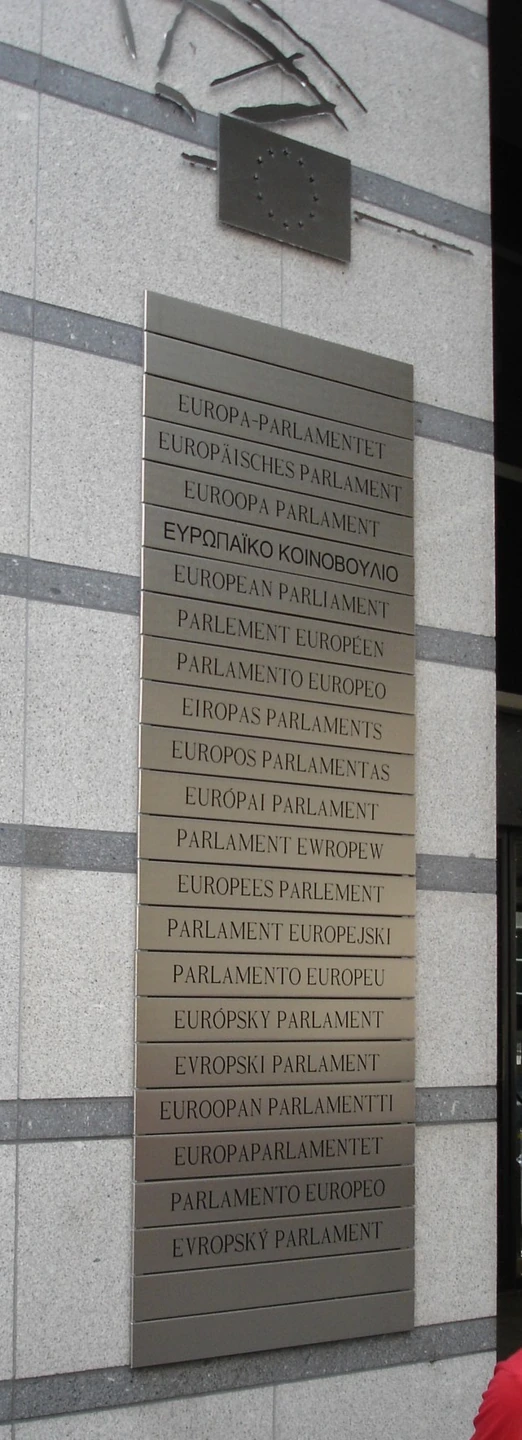
Finnish on a multilingual European Parliament sign, photographed in 2006. Language identification follows the source description; not independently transcribed.
Saved in Babelbook · resized display copy. Select the image to open it independently of its source.
Nuno Nogueira · Source ↗Public domain (author dedication) ↗View the local visual field note
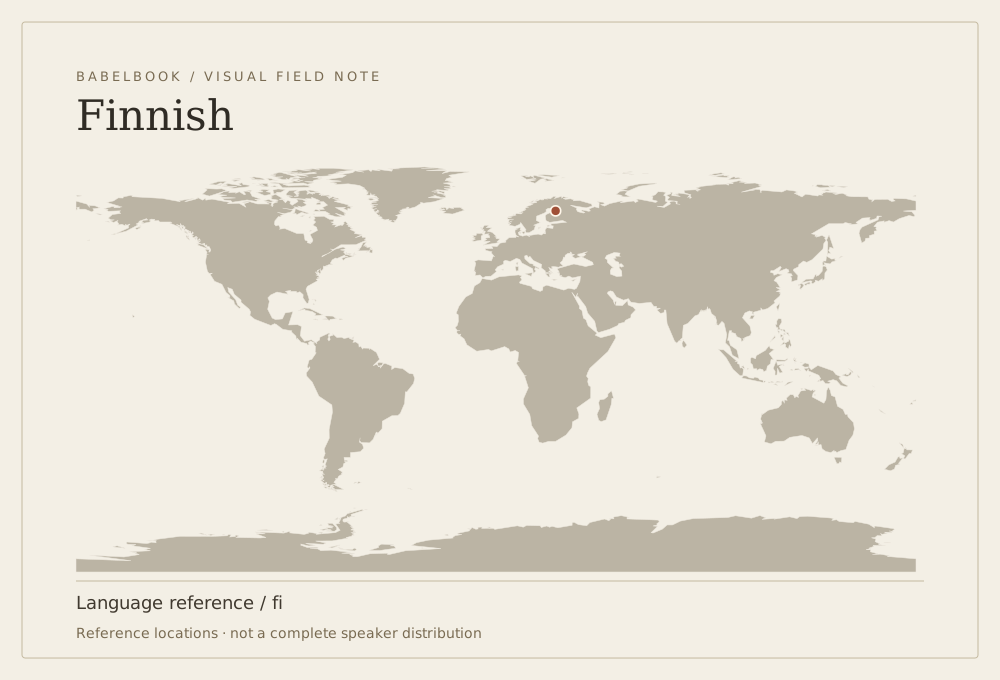
Representative reference points from Glottolog. Historical entries show reference locations, not current speakers. 1 point.
Reference & context ↗Babelbook · original editorial illustration · CC BY 4.0 · Glottolog locations; public-domain Natural Earth land
Source excerpts, selected, shortened and where noted editorially corrected from Finnish language by Wikipedia contributors. Retrieved 2026-10-05. CC BY-SA 4.0. These excerpts are not an independently verified scholarly history; missing accounts are identified above.
Read further in the source
Geographic distribution
Finnish is spoken by about five million people, most of whom reside in Finland. There are also notable Finnish-speaking minorities in Sweden, Norway, Russia, Estonia, Brazil, Canada, and the United States. The majority of the population of Finland (90.37% as of 2010) speak Finnish as their first language. The remainder speak Swedish (5.42%), one of the Sámi languages (for example Northern, Inari, or Skolt), or another language as their first language. Finnish is spoken as a second language in Estonia by about 167,000 people. The Finnic varieties found in Norway's Finnmark (namely Kven) and in northern Sweden (namely Meänkieli) have the status of official minority languages, and thus can be considered distinct languages from Finnish. However, since these languages are mutually intelligible, one may alternatively view them as dialects of the same language. No language census exists for Norway, neither for Kven, standard Finnish, or combined. As of 2023, 7,454 first- or second-generation immigrants from Finland were registered as having Norwegian residency, while as of 2021, 235 Finns were registered as foreigners studying at Norwegian higher education. Great Norwegian Encyclopedia estimates Kven speakers at 2,000-8,000. Altogether, this results in a total amount of Finnish-speakers roughly between 7,200 and 15,600. In the latest census, around 1000 people in Russia claimed to speak Finnish natively; however, a larger amount of 14,000 claimed to be able to speak Finnish in total. There are also forms of Finnish spoken by diasporas outside Europe, such as American Finnish, spoken by Finnish Americans, and Siberian Finnish, spoken by Siberian Finns.
Official status
Today, Finnish is one of two official languages of Finland (the other being Swedish), and has been an official language of the European Union since 1995. Finnish also enjoys the status of an official minority language in Sweden. Under the Nordic Language Convention, citizens of the Nordic countries speaking Finnish have the opportunity to use their native language when interacting with official bodies in other Nordic countries without being liable to any interpretation or translation costs. However, concerns have been expressed about the future status of Finnish in Sweden, for example, where reports produced for the Swedish government during 2017 show that minority language policies are not being respected, particularly for the 7% of Finns settled in the country.
Prehistory
The Uralic family of languages, of which Finnish is a member, are hypothesized to derive from a single ancestor language termed Proto-Uralic, spoken sometime between 8,000 and 2,000 BCE (estimates vary) in the vicinity of the Ural Mountains. Over time, Proto-Uralic split into various daughter languages, which themselves continued to change and diverge, yielding yet more descendants. One of these descendants is the reconstructed Proto-Finnic, from which the Finnic languages developed. Current models assume that three or more Proto-Finnic dialects evolved during the first millennium BCE. These dialects were defined geographically, and were distinguished from one another along a north–south split as well as an east–west split. The northern dialects of Proto-Finnic, from which Finnish developed, lacked the mid vowel [ɤ]. This vowel was found only in the southern dialects, which developed into Estonian, Livonian, and Votian. The northern variants used third person singular pronoun hän instead of southern tämä (Est. tema). While the eastern dialects of Proto-Finnic (which developed in the modern-day eastern Finnish dialects, Veps, Karelian, and Ingrian) formed genitive plural nouns via plural stems (e.g., eastern Finnish kalojen < *kaloi-ten), the western dialects of Proto-Finnic (today's Estonian, Livonian and western Finnish varieties) used the non-plural stems (e.g., Est. kalade < *kala-ten). Another defining characteristic of the east–west split was the use of the reflexive suffix -(t)te, used only in the eastern dialects.
Writing system
The first comprehensive writing system for Finnish was created by Mikael Agricola, a Finnish bishop, in the 16th century. He based his writing system on the western dialects. Agricola's ultimate plan was to translate the Bible, but first he had to develop an orthography for the language, which he based on Swedish, German, and Latin. The Finnish standard language still relies on his innovations with regard to spelling, though Agricola used less systematic spelling than is used today. Though Agricola's intention was that each phoneme (and allophone under qualitative consonant gradation) should correspond to one letter, he failed to achieve this goal in various respects. For example, k, c, and q were all used for the phoneme /k/. Likewise, he alternated between dh and d to represent the allophonic [ð] (like th in English this), between dh and z to represent /θː/ (like th in thin, but longer in duration), and between gh and g to represent the allophonic [ɣ]. Agricola did not consistently represent vowel length in his orthography. Others revised Agricola's work later, striving for a more systematic writing system. Along the way, Finnish lost several fricative consonants in a process of sound change. The sounds [ð] and [θ(ː)] disappeared from the language, surviving only in a small rural region in Western Finland. In the standard language, however, the effect of the lost sounds is thus:
[ð] became [d]. The sound [ð] was written ⟨d⟩ or ⟨dh⟩ by Agricola. This sound was lost from most varieties of Finnish, either losing all phonetic realization or being pronounced as [r], [ɾ], [l], or [h] instead (depending on dialect and the position in the word). However, Agricola's spelling ⟨d⟩ prevailed, and the pronunciation in Standard Finnish became [d] through spelling pronunciation. [θː, θ] became [ts]. These interdental fricatives were written as ⟨tz⟩ (for both grades: geminate and short) in some of the earliest written records. Though these developed into a variety of other sounds depending on dialect ([tː, t], [ht, h], [ht, t], [sː, s], [tː, tː], or [ht, ht]), the standard language has arrived at spelling pronunciation [ts] (which is treated as a consonant cluster and hence not subject to consonant gradation). [ɣ] became: [ʋ] if it appeared originally between high round vowels [u] and [y] (cf. suku 'kin, family' : suvun [genitive form] from earlier *suku : *suɣun, and kyky : kyvyn 'ability, skill' [nominative and genitive, respectively] from *kükü : *küɣün, contrasting with sika : sian 'pig, pork' [nominative and genitive] from *sika : *siɣan. A similar process explains the /f/ pronunciation for some English words with "gh", such as "tough"), [j] between a liquid consonant [l] or [r] and a vowel [e] (like in kuljen 'I go', a form of the verb kulkea 'to go' that was originally *kulɣen), and otherwise it was lost entirely. Modern Finnish punctuation, along with that of Swedish, uses the colon (:) to separate the stem of a word and its grammatical ending in some cases, for example after acronyms, as in EU:ssa 'in the EU'. (This contrasts with some other alphabetic writing systems, which would use other symbols, such as e.g. apostrophe, hyphen.) Since suffixes play a prominent role in the language, this use of the colon is quite common.
Dialects
The dialects of Finnish are divided into two distinct groups, Western and Eastern. The dialects are largely mutually intelligible and are distinguished from each other by changes in vowels, diphthongs and rhythm, as well as in preferred grammatical constructions. For the most part, the dialects operate on the same phonology and grammar. There are only marginal examples of sounds or grammatical constructions specific to some dialect and not found in standard Finnish. Two examples are the voiced dental fricative found in the Rauma dialect, and the Eastern exessive case.
Western dialects
The Southwest Finnish dialects (lounaissuomalaismurteet) are spoken in Southwest Finland and Satakunta. Their typical feature is abbreviation of word-final vowels, and in many respects they resemble Estonian. The Tavastian dialects (hämäläismurteet) are spoken in Tavastia. They are closest to the standard language, but feature some slight vowel changes, such as the opening of diphthong-final vowels (tie → tiä, miekka → miakka, kuolisi → kualis), the change of d to l (mostly obsolete) or trilled r (widespread, nowadays disappearance of d is popular) and the personal pronouns (me: meitin ('we: our'), te: teitin ('you: your') and he: heitin ('they: their')). The South Ostrobothnian dialects (eteläpohjalaismurteet) are spoken in Southern Ostrobothnia. Their most notable feature is the pronunciation of "d" as a tapped or even fully trilled /r/. The Central and North Ostrobothnian dialects (keski- ja pohjoispohjalaismurteet) are spoken in Central and Northern Ostrobothnia. The Lapland dialects (lappilaismurteet) are spoken in Lapland. The dialects spoken in the western parts of Lapland are recognizable by retention of old "h" sounds in positions where they have disappeared from other dialects. One form of speech related to Northern dialects, Meänkieli, which is spoken on the Swedish side of the border is recognized in Sweden as its own distinct language, having its own standardized language separate from Finnish. This form of speech developed from the border created between Sweden and Finland in 1809 when the Russian Empire annexed Finland. This caused the speakers of Meänkieli to be isolated from the developments of standard Finnish and instead be influenced by the Swedish language. However, it is still mutually intelligible with Finnish, and is thus sometimes considered a dialect of the Finnish language. The Kven language is spoken in Finnmark and Troms, in Norway. Its speakers are descendants of Finnish emigrants to the region in the 18th and 19th centuries. Kven is an official minority language in Norway.
Eastern dialects
The Eastern dialects consist of the widespread Savonian dialects (savolaismurteet) spoken in Savo and nearby areas, and the South-Eastern dialects now spoken only in Finnish South Karelia. The South Karelian dialects (eteläkarjalaismurteet) were previously also spoken on the Karelian Isthmus and in Ingria. The Karelian Isthmus was evacuated during World War II and refugees were resettled all over Finland. Most Ingrian Finns were deported to various interior areas of the Soviet Union. Palatalization, a common feature of Uralic languages, had been lost in the Finnic branch, but it has been reacquired by most of these languages, including Eastern Finnish, but not Western Finnish. In Finnish orthography, this is denoted with a "j", e.g. vesj [vesʲ] "water", cf. standard vesi [vesi].
Standardization
Standard Finnish is prescribed by the Language Office of the Research Institute for the Languages of Finland and is the language used in official communication. The Dictionary of Contemporary Finnish (Nykysuomen sanakirja 1951–61), with 201,000 entries, was a prescriptive dictionary that defined official language. An additional volume for words of foreign origin (Nykysuomen sivistyssanakirja, 30,000 entries) was published in 1991. An updated dictionary, The New Dictionary of Modern Finnish (Kielitoimiston sanakirja) was published in an electronic form in 2004 and in print in 2006. A descriptive grammar (the Large grammar of Finnish, Iso suomen kielioppi, 1,600 pages) was published in 2004. There is also an etymological dictionary, Suomen sanojen alkuperä, published in 1992–2000, and a handbook of contemporary language (Nykysuomen käsikirja). Standard Finnish is used in official texts and is the form of language taught in schools. Its spoken form is used in political speech, newscasts, in courts, and in other formal situations. Nearly all publishing and printed works are in standard Finnish.
Orthography
Finnish is written with the Latin alphabet including the distinct characters ⟨ä⟩ and ⟨ö⟩, and also several characters (⟨b, c, f, q, w, x, z, å, š⟩ and ⟨ž⟩) reserved for words of non-Finnish origin. The Finnish orthography follows the phonemic principle: each phoneme (meaningful sound) of the language corresponds to exactly one grapheme (independent letter), and each grapheme represents almost exactly one phoneme. This enables an easy spelling and facilitates reading and writing acquisition. The rule of thumb for Finnish orthography is write as you read, read as you write. However, morphemes retain their spelling despite sandhi. Some orthographical notes:
Long vowels and consonants are represented by double occurrences of the relevant graphemes. This causes no confusion, and permits these sounds to be written without having to nearly double the size of the alphabet to accommodate separate graphemes for long sounds. If a sequence of two identical vowels in different syllables occurs, it is written with an apostrophe, e.g. rei'itin "hole punch". The grapheme ⟨h⟩ covers all the allophones of /h/. In some positions, it has a fricative quality, which can be voiced glottal or voiceless velar or palatal. This occurs after or between vowels, as in e.g. lahti, which is pronounced [lɑxti] with a voiceless velar fricative. Sandhi is not transcribed; the spelling of morphemes is immutable, such as tulen+pa [tulempa]. Some consonants (⟨v, j, d⟩) do not have distinctive length (and consonant length generally is only contrastive in certain positions), and consequently their allophonic variation is typically not specified in spelling; e.g. rajaan [rajaan] ('I limit') vs. raijaan [raijjaan] ('I haul'). Pre-1900s texts and personal names use ⟨w⟩ for ⟨v⟩. Both correspond to the same phoneme, the labiodental approximant /ʋ/, a ⟨v⟩ without the fricative ("hissing") quality of the English ⟨v⟩. The letters ⟨ä⟩ [æ] and ⟨ö⟩ [ø], although written with two dots, do not represent phonological umlauts (as in German, for example), and they are considered independent graphemes; the letter shapes have been copied from Swedish. An appropriate parallel from the Latin alphabet are the characters ⟨C⟩ and ⟨G⟩ (uppercase), which historically have a closer kinship than many other characters (⟨G⟩ is a derivation of ⟨C⟩) but are considered distinct letters, and changing one for the other will change meanings. Although Finnish orthography is mostly shallow, there are a few differences:
The ⟨n⟩ in the sequence ⟨nk⟩ is pronounced as a velar nasal /ŋ/, as in English. When not followed by ⟨k⟩, /ŋː/ is written ⟨ng⟩. The fact that two spellings correspond to this one sound (putting aside the difference in length) can be seen as an exception to the general one-to-one correspondence between sounds and letters. Sandhi phenomena at word or clitic boundaries involving gemination (e.g., tule tänne is pronounced [tu.let.tæn.ne], not [tu.le.tæn.ne]) or the place assimilation of nasals (sen pupu would usually be pronounced as [sem.pu.pu], and onpa as [om.pɑ]) The /j/ after the letter ⟨i⟩ is very weak or there is no /j/ at all, but in writing it is used; for example: urheilija. Indeed, the ⟨j⟩ is not used in writing words with consonant gradation such as aion and läksiäiset. When the appropriate characters are not available, the graphemes ⟨ä⟩ and ⟨ö⟩ are usually converted to ⟨a⟩ and ⟨o⟩, respectively. This is common in e-mail addresses and other electronic media where there may be no support for characters outside the basic ASCII character set. Writing them as ⟨ae⟩ and ⟨oe⟩, following German usage, is rarer and usually considered incorrect, but formally used in passports and equivalent situations. Both conversion rules have minimal pairs which would no longer be distinguished from each other. The sounds ⟨š⟩ and ⟨ž⟩ are not a part of the Finnish language itself and have been introduced by the Finnish national languages body for more phonologically accurate transcription of loanwords (such as Tšekki, 'Czech Republic') and foreign names. For technical reasons or convenience, the graphemes ⟨sh⟩ and ⟨zh⟩ are often used in quickly or less carefully written texts instead of ⟨š⟩ and ⟨ž⟩. This is a deviation from the phonetic principle, and as such is liable to cause confusion, but the damage is minimal as the transcribed words are foreign in any case. Finnish does not use the sounds ⟨z⟩, ⟨š⟩ or ⟨ž⟩, but for the sake of exactitude, they can be included in spelling. (The recommendation cites the Russian opera Hovanštšina as an example.) Many speakers pronounce all of them ⟨s⟩, or distinguish only between ⟨s⟩ and ⟨š⟩, because Finnish has no voiced sibilants. The language may be identified by its distinctive lack of the letters ⟨b, c, f, q, w, x, z⟩ and ⟨å⟩.